ByteDance's international revenue hit $39B in 2024 (+63% YoY), but here's the kicker: while matching Meta's revenue ($155B vs $164.5B), their profit is half ($33B vs $62.4B).
The price of aggressive expansion in AI and e-commerce? 🤔 #TikTok#ByteDance
Ray Dalio's interview with Tucker Carlson just went viral.
And he's NOT just talking about market predictions.
Instead, he exposed a dark truth most Americans don't want to admit.
Here are his 7 shocking claims about 'America's new Civil War': 🧵
A man spoke and the market bends. "If you kind of said 15 years for very useful quantum computers, that would probably be on the early side. If you said 30, it's probably on the late side." #NVDA#jensenhuang#quantumcomputing
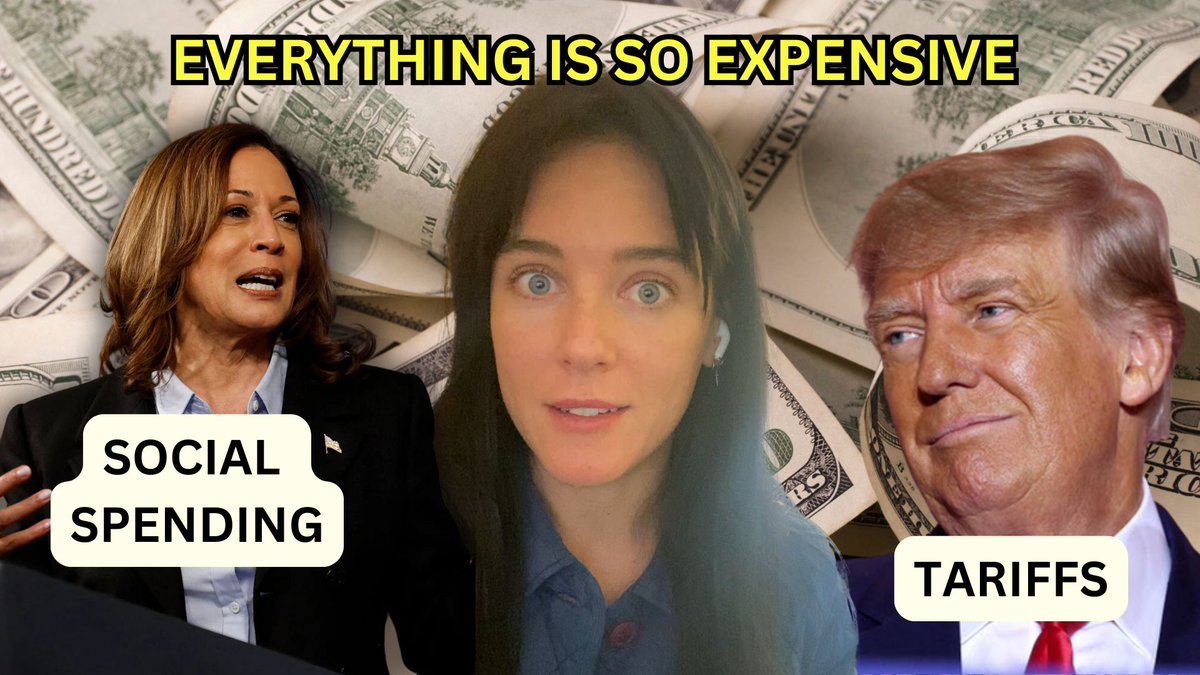
What are the economic policy proposals of each candidate? I have a new video up on who is spending whatm how they plan to pay for it, and what each economic future would look like, depending on who wins.
The CRFB put together a fantastic analysis on this - over ten years, the proposals from Harris will increase the debt by ~$4T. Trump will increase it by ~$7T. Harris is better for the long-term strength of the economy, especially through the lens of spending.
Both candidates have very different spending plans- Harris has a lot of social spending, Trump has tax cuts. They also have very different ways to pay for things - Trump loves tariffs*, Harris likes taxes.
Harris is a lot of social spending - she plans to extend tax cuts for those making < $400k, expand CTC and EITC, expand the ACA, supporting affordable housing, no tax on tips, raise minimum wage, support small businesses, improve border security, expand pre-K and childcare, establish paid family and medical leave, and support education. This will cost ~$7.6T
She will pay for this through increasing the corporate tax rate from 21% to 28%, increasing taxes on capital income, NIIT, and raising the medicare payroll surtax, reforming international tax rules, and lowering prescription drug costs. This will generate ~$4.2T
This will cost about ~$550b in higher interest payments. So in total, her plan costs $7.6T - $4.2T + $550b = $3.9T (Penn Wharton estimates $1.2T)
Trump is a lot of tax cuts. He will extend and modify the TCJA, costing $5.35T, exempt overtime income from taxes, end taxation of social security benefits, lower corp tax rate to 15% for domestic manufacturers, other tax breaks, strengthen the military, secure the border, provide credits to first-time homebuyers, pay for IVF, and improve long term care. This will cost $10.4T.
He will pay for this through 10-20% flat tariffs + 60% tariff on China (which as we know from @Brendan_duke will cost the avg American about ~$4000). This is expected to generate $2.7T. He also wants to reverse current energy/environment policies, reduce fraud, and end the department of education. This will all together will generate $3.7T.
This will cost $1T in higher int payments. So in total, his plan costs $10.4T - $3.7T + $1T = $7.7T (Penn Wharton estimates $5.8T)
So Trump is spending a lot more, but his policies benefit fewer people. According to ITEP, the average tax changes vary widely between the two candidates’ plans. For example:
The middle fifth of Americans would receive an average tax cut of $1,980 under Harris’ plan and an average tax increase of $1,530 under Trump’s plan.
The bottom fifth of Americans would receive an average tax cut of $1,130 under Harris’ plan and an average tax increase of $790 under Trump’s plan.
The top 1 percent of Americans would receive an average tax increase of $121,460 under Harris’ plan and an average tax cut of $36,320 under Trump’s plan
These are all ballpark numbers. In the video I go into more detail about the economic impact of raising the deficit and the breakdown of what this spending could look like for the future. It's a great election day watch because I am sure everyone wants to hear about deficits right now and wants to think in decades instead of days. Great.
The AI chip market is projected to hit $400bn in annual sales within 5 years. But with great power comes great scrutiny (and potential regulation) 🕵️♂️⚖️
Are we witnessing the birth of the next tech monopoly, or the biggest bubble since tulip mania? Only time will tell... 🌷💥 #AIChipWars
https://t.co/ZAyNqwuIGR
Wall Street's $11bn bet on Nvidia's AI chips: A high-stakes game of GPU Monopoly or the dawn of a new tech era? 🎲💻 The neocloud gold rush is on, but will this chip-fueled frenzy lead to innovation or implosion? 🚀💥 #AIBubble
🧵 below
🚨 Red flags are waving:
- DOJ investigating Nvidia for potential monopolistic practices
- Tech giants developing their own chips
- AMD and Intel nipping at Nvidia's heels
Is this the beginning of the end for Nvidia's AI empire, or just a speed bump on the road to techno-utopia? 🛣️🤖
🧠 "While Silicon Valley chases AI, a leaked 36-page memo reveals how Mr. Beast built a $700M empire by mastering something more valuable: your attention span.
A deep dive into the future of digital psychology and why it matters for every business.
https://t.co/WsjeOASjdh
#FutureOfBusiness #Innovation #MrBeast
Accenni di pericolosa talianizzazione dei sogni del governo britannico...
Esportiamo spunti di finanza nazzzzionale di qualità @Phastidio
https://t.co/6N3tSI8NDq
Most dating apps are having a hard time - and so are their users.
Falling revenues, people not wanting to pay, and Gen Z seemingly uninterested in dating have led to collapsing stocks and circling activist investors. Their only path forward is monetization - but what does that mean for the demographic crisis?