On-chain perps moved $X trillion last year
Options are trading about 1% of that, which most of the timeline takes as evidence that options are a small cousin to perps.
The same ratio used to describe perps versus spot back in 2017, and that framing didn't age well.
May was the month the Kyan waitlist closed for good and the rewards system came online, with Krystals accruing on every trade.
The full wrap-up has the rest of what shipped this month and the numbers behind it:
https://t.co/dnG8tsgI1a
Delta on perps = 1.
Delta on an option = how much the price moves per $ of underlying:
A 0.5 delta call moves $0.50 when BTC moves $1, all else equal.
If you've been "long BTC" via perps, you've been at delta 1 the whole time. Options let you pick the delta you actually want.
Vol was meant to be sold.
Marty + Andrew from Block Scholes on this week's Options Talk: BTC ran 30% through war with vol collapsing every week, ETH/BTC vol parity is here, and MicroStrategy might be the silent vol seller nobody can see.
Summary of the last Options Talk:
https://t.co/U2tBHh0IxS
"you cant make money on crypto options"
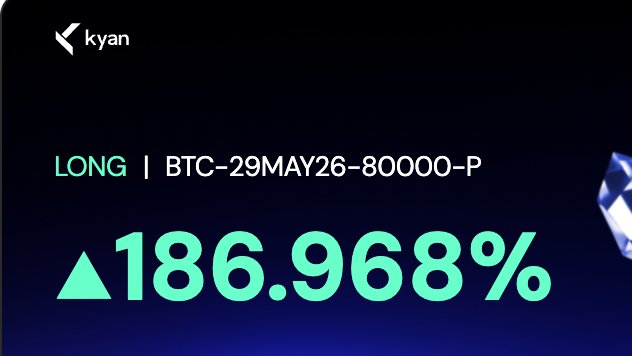
not even a short dated option - bought this when we were trading in the 80s.
if it were a perp i'd have been liquidated on the 2nd pump to 84k or whatever
My take is that options are inherently a sophisticated product.
They are undisputedly the best instrument for hedging, capital management, yield, and speculation, as proven by TradFi volumes.
Until about a year and a half ago, there were no onchain options toolkits sufficient enough for sophisticated traders.
Portfolio margin is an essential piece of the puzzle alongside things like execution and settlement on par with CEXs. That just didn’t exist before.
And while they can be a directional instrument, purely directional crypto-native retail traders lack the incentive to switch from perps to options.
Now that we have the tools that players with actual size need, it’s up to spreads and orderbook depth. We have the latency and risk engines to match CEXs.
It’s also about tenure and building institutional trust over time, but we’re closer to a giant leap in adoption than ever before.
If you’re interested in more stats to contextualize my comment, I wrote a piece on this topic that’s pinned on my profile.
Block Scholes is the sole crypto vol data provider to the Bloomberg Terminal.
That same surface comes out of Kyan's API with self-service keys and no fee, which closes the gap between what a desk and a self-directed trader can quote off of.
https://t.co/hrsnPqfhR1
I've been treating AI work from the beginning as the work of an intern, and that has worked out pretty well.
Sometimes if the feature is complex I first do a pass of light scaffolding where i start to structure the code how I want it, and leave placeholders.
LLMs thrives around structure, as they are designed to recognize patterns. From my experience, if you design a whole new feature and the AI can't really find proper structure around it in your codebase, result quality will be much lower.
I then make Codex do most of the implementation work, and do a very light review myself, to make sure the code is not unnecessarily bloated. If codex doesn't structure the code the way I imagined and I can think of a more efficient way to do it, I'll guide it.
Then in a new session I ask codex to review the changes compared to the base branch, most of the time he will find issues, in which case I make him fix what's worth fixing, always making sure the fix doesn't lead to unnecessary bloat through a very light review
I then trigger a new review in a new session, and keep repeating this until there are no more issue worth fixing.
When codex is done fixing issues, I then usually make Claude do a pass of review. Claude is usually much more nitpicky and often a lot of his findings are not really worth fixing. So I feed the output to Codex, and ask it to review what is valid and worth fixing. In some case, it will highlight a valid problem than Claude found and Codex missed.
Once all those steps are completed and both Codex and Claude don't find any meaningful issue anymore, I'll do a manual very in-depth review myself, in the same manner I would review the PR of an intern.
Then another person from the team will also do another pass of manual review on my PR before it is merged.
Ultimately, I think it also depends on what type of software you are working. I could probably live with few less pass of reviews that I am currently doing if I wasnt working on a financial app like @KyanExchange where there is no room for mistake.