Catch up with VoxTalks Economics, recorded at the PSE–CEPR Policy Forum 2026. In this epsiode, Tim Phillips speaks to three rising economists about work that challenges conventional wisdom.
🔹@GuidoLamarmora (@UoNEconomics) shows that once land is taken into account, low-income countries can actually have relatively high agricultural productivity, rather than low productivity.
🔹@CostanzaTomase1 (@ImperialBiz) uses a natural experiment from Mexico to examine how firms respond to energy shocks.
🔹Mushegh Tovmasyan (@UnivParisSaclay) uses detailed Armenian trade data to study what happened following sanctions on Russia.
And as an added bonus, all three researchers share their views on where AI can help economics students and researchers, and where using it risks becoming a substitute for thinking.
🎧Listen now: https://t.co/8p8Q0nuDzQ
#VoxTalks #FrontiersofEconomicResearch #AI #NextGen
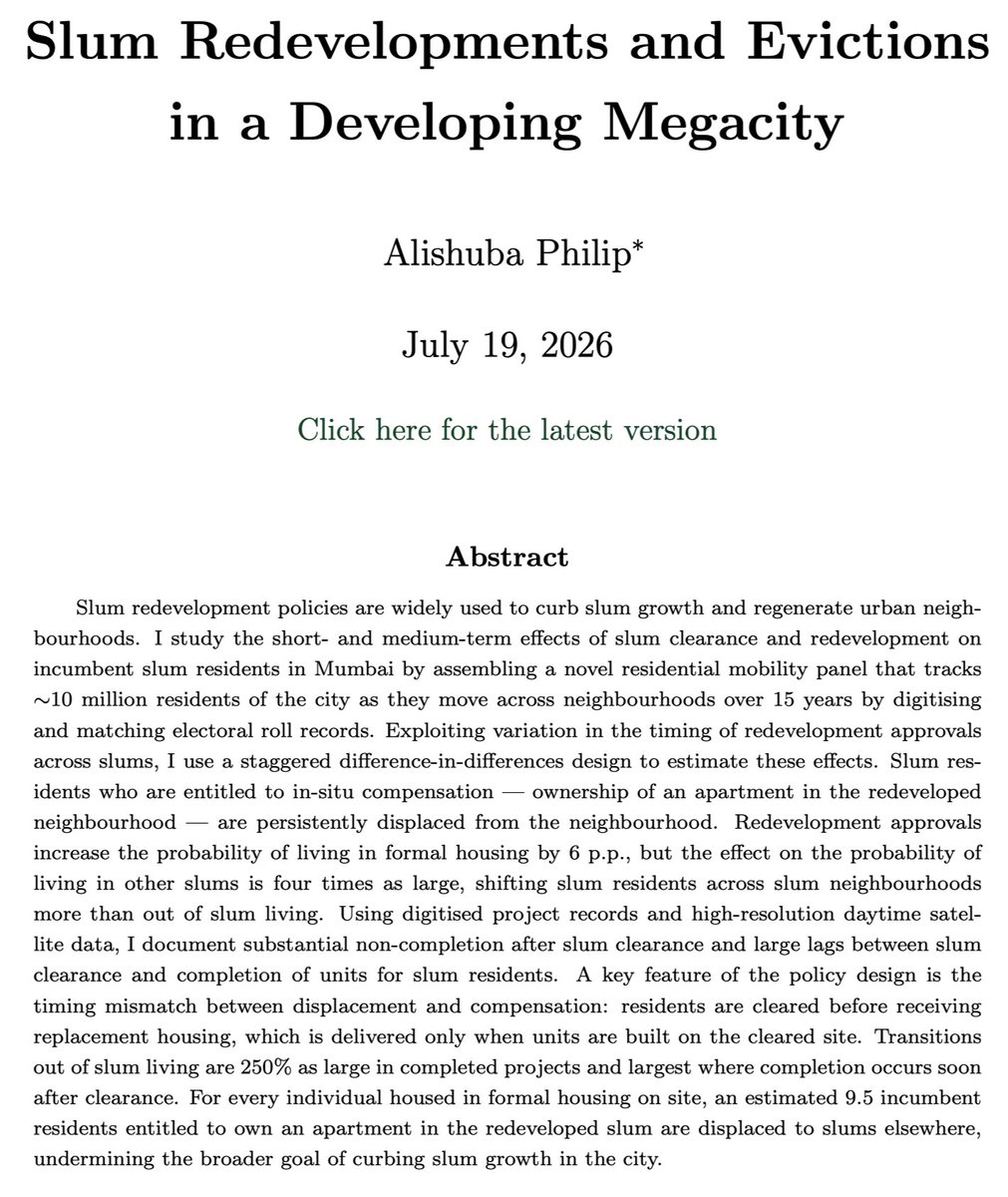
Mumbai has an elegant solution for slums: relocate residents to tall buildings on some of the slum real estate, develop the rest.
This is an elegant solution to the perpetual slum dilemma: cast out the poorest, or accept low value land use in perpetuity. Did it work? 1/
Our partner is hiring!
The Development Innovation Lab (DIL)- India, based at the UChicago Trust in India, is expanding its research team and recruiting for several exciting roles working on cutting-edge development research. 1/3
At the CEPR Annual Symposium, @timsvengali caught up with the exciting research of three talented economists at the start of their careers. In today’s episode, hear from Alishuba Philips @UZH_en on slum redevelopment, Lucie Giorgi @amseaixmars on the end of single sex education in France, and @bakhtawar_a@amseaixmars on lawfare in Pakistan.
Find out more: https://t.co/Sk5XKLzVOE
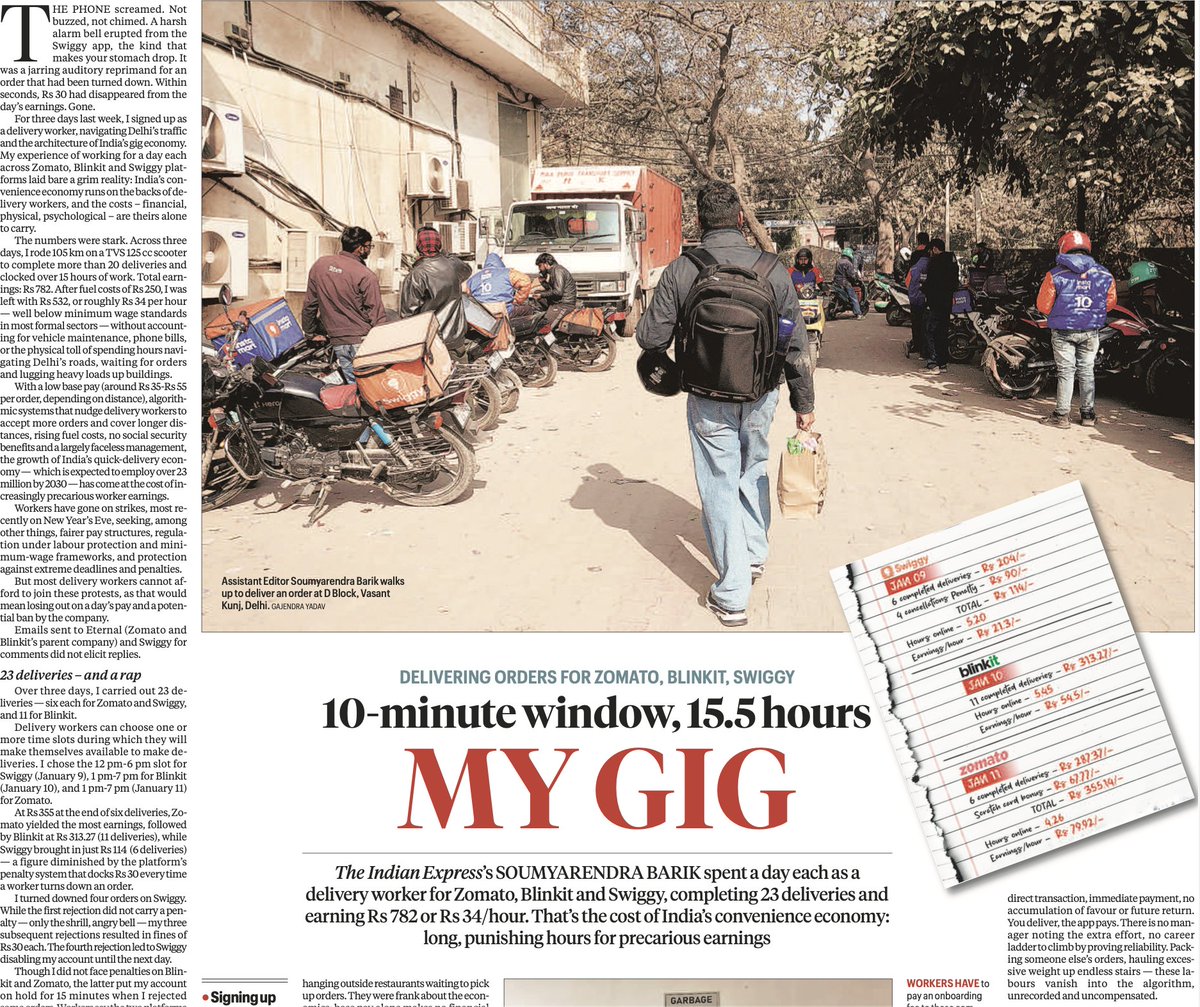
🚨Ground report: I spent 3 days as a gig worker for Zomato, Blinkit & Swiggy in Delhi.
23 deliveries. 15.5 hours. 105 km.
Total earnings: Rs 782 (Rs 34/hour)
After fuel: ₹532
This is India's convenience economy. A thread on what I learned @IndianExpress
I'm excited to announce that I am on the 2025-26 economics job market!
I’m an applied microeconomist working on education, gender, and inequality—with a focus on how teachers and institutions shape student outcomes.
A 🧵on my #JMP and other projects:
#econtwitter
(1/n)
In 1550, naming your son "Matthias" in Germany meant nothing.
By 1650, it marked you as Catholic.
How do arbitrary symbols become identity markers—common knowledge that organizes group boundaries?
My JMP studies this in the Protestant Reformation. 🧵
I am delighted to share that Nobel laureates Esther Duflo and Abhijit Banerjee will join our Department of Economics @econ_uzh at the University of Zurich on July 1, 2026, as Lemann Foundation Professors of Economics.
🧵 1/7
No matter who forms the government, policy professionals should celebrate this moment nonetheless! Hung Parliament = more deliberation = more room for serious discussions on policy and more stakeholders for advocacy.
*And please don't get started with "oh but it will slow down the process". Under a majority govt., Data Protection Law took 5 years of deliberation and the farms laws took 0 but had to be rolled back because no effort in consensus building. I believe India will continue to grow and prosper- we are at that moment in time in our history, but a more deliberative democracy can ensure more equitable growth and better policy design!
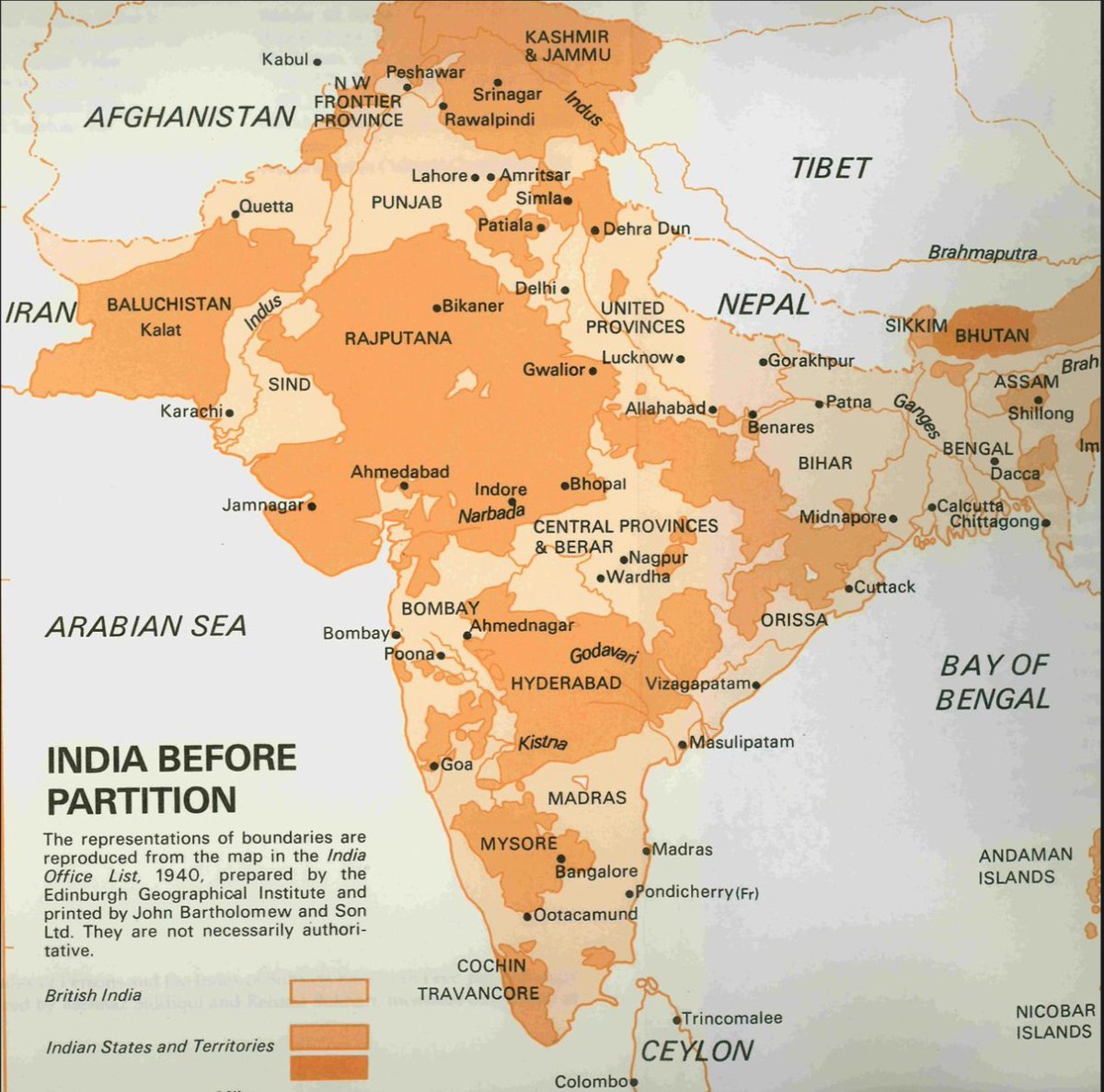
0. On Independence day, I look briefly at how some of the current states came into being. Some of them I had not even heard before.
This is now India looked before partition.
@prerna394 Likely, although a significant fraction would have pursued their PhDs abroad I would think (all unsubstantiated by data). This year at UZH, someone's JMP explored how women tend to drop out from male-majority settings based on an experiment at the department.
@prerna394 But my hunch (based on personal experience, unfortunately) would be that a lot of women have to drop out after masters, maybe get a 'real' job because of the societal pressure to 'settle down' and get married in a couple of years? The 'marriageable' age is much higher for men.
@prerna394 This paper discusses the attrition numbers: https://t.co/d435fuc4mo (just found this on a quick Google search - haven't read the entire paper).