Which one are you actually running your automations on?
⠀
• n8n, self-hosted
• Make or Zapier
• Custom code, no visual builder
• Still doing it by hand
Finding one winning TikTok Shop ad with freelance UGC creators costs about $1,750.
⠀
Industry data puts the win rate at 1 in 10, for every ten creatives tested, one to three become real winners. At the $175 median rate per video, ten tries to land the first one runs $1,750.
⠀
Run it at growth-stage pace, 8 to 15 new creatives a week, and creative alone costs $7,000 to $10,500 a month. $84,000 to $126,000 a year, before usage rights add another 30 to 50% on top.
⠀
→ No more $175 a video before rights are even added
→ No more waiting on a creator's turnaround for the next test
→ No more capping the week at ten creatives because that's what the budget allows
→ No more paying full price again for what's really just a new hook on the same video
⠀
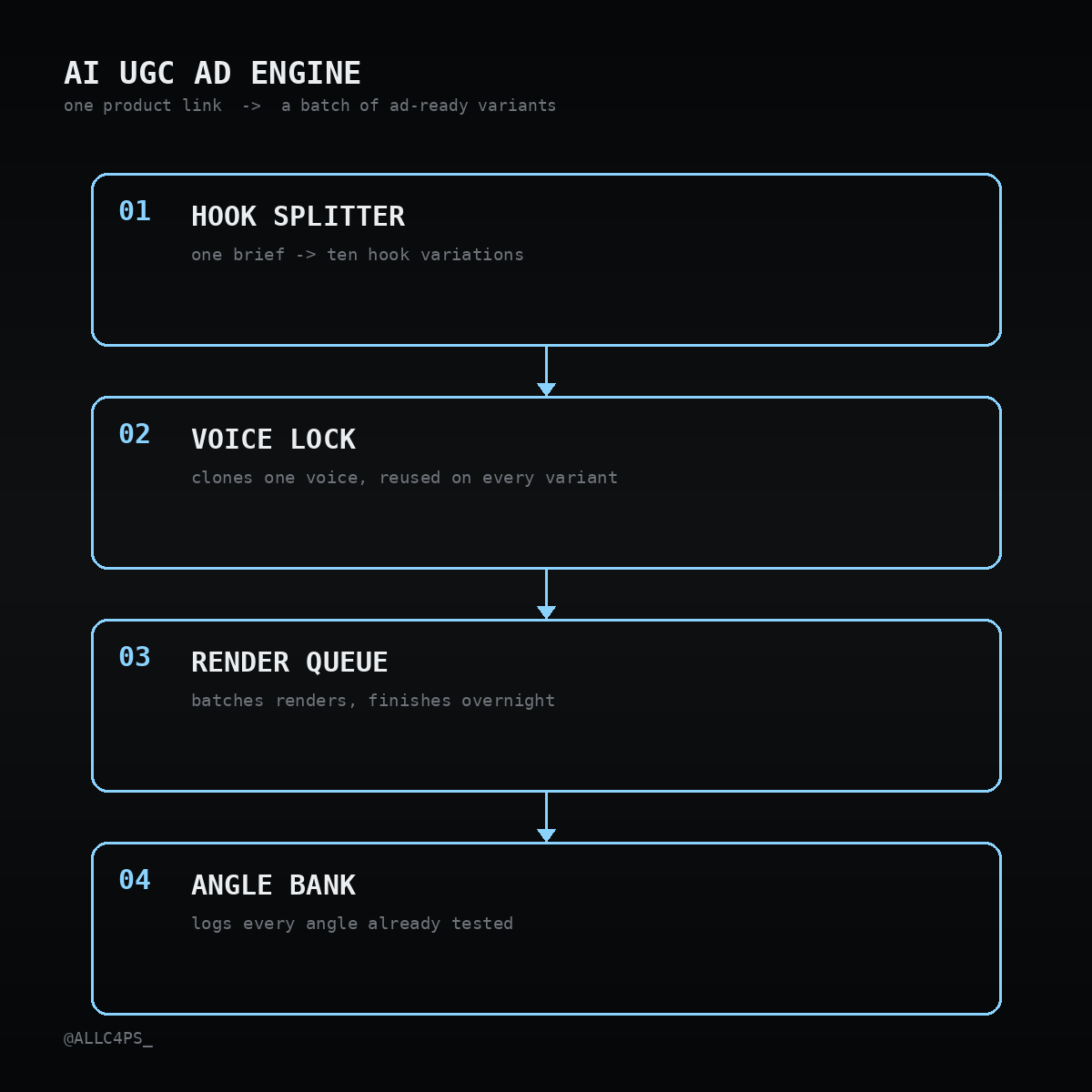
Just a product link → a batch of UGC-style ad variants with a consistent AI avatar and cloned voice.
⠀
Here's how it works:
⠀
→ Hook Splitter (turns one product brief into ten hook variations before a single render starts)
→ Voice Lock (clones one voice once, reused on every variant so the account never sounds different week to week)
→ Render Queue (batches the generations so ten variants finish overnight instead of over ten days of a creator's calendar)
→ Angle Bank (logs every angle already tested, so a "new" test this week never repeats one that failed in August)
⠀
The maths on a ten-video test:
⠀
Freelancer route: $1,750, roughly a week of back and forth waiting on turnaround.
⠀
System route: $2 a video, $20 for the same ten, same day.
⠀
Same test. $1,750 against $20. Most of the cost was never the video. It was the waiting.
⠀
Comment "QUEUE" and I'll DM you the node map. (must be following)
n8n just raised $180 million at a $2.5 billion valuation, up from $350 million less than a year ago.
⠀
Accel led, with Nvidia's venture arm and Sequoia in the round. Over 230,000 active users, $40 million-plus in ARR.
⠀
The tooling underneath a lot of these workflows is getting serious institutional money behind it, fast.
Most AI-voiced UGC ads never clear a 30% hook rate, the bar TikTok itself calls average.
⠀
Hook rate is three-second video views divided by impressions. TikTok's own bands: 30 to 40% is average, 40 to 55% is good, 55% and up is great. Average sits at roughly half of what TikTok calls great, and most AI-voiced ads land under the floor, not near the ceiling.
⠀
The obvious explanation is the avatar. People assume a viewer scrolls past because the face looks synthetic, so they spend the whole budget on a sharper render and better lip sync.
⠀
That's not where the drop happens. Watch the retention curve on a failed AI UGC ad and the fall is in the first two seconds, before a viewer has had time to judge a face. It's the voice.
⠀
TTS reads a script the way it's punctuated, not the way a person would say it. A comma gets a pause whether or not a human would pause there. A long sentence gets read end to end at one flat pace. The result is technically correct audio that carries no urgency, and a viewer's ear clocks "ad" before the hook line finishes.
⠀
What actually works:
⠀
Write the hook as three short sentences, never one long one. Each full stop forces the model to reset pitch and pace, which is the closest a script gets to natural emphasis without manual phoneme editing.
⠀
Open on a question or a flat claim, never a scene-setter. "I spent six weeks testing this" beats "So I've been working on something for the past few weeks" for the same reason a headline beats a preamble.
⠀
Keep the first line under eight words. Long open lines are where TTS drifts furthest from natural stress, because there's more sentence left for the model to plan around.
⠀
Match the burned-in caption timing to the voice, not the other way round. A caption landing half a second ahead of the word reads as sloppy. A caption landing with the word reads as produced.
⠀
The second-order thing nobody mentions: once a hook clears the floor, the rest of the script can be far more TTS-flat than people assume. Viewers judge the first two seconds and relax their ear after. The craft budget belongs almost entirely on line one.
⠀
So the honest fix for a 20% hook rate AI ad usually isn't a better voice model. It's rewriting three sentences.
⠀
Rendering the same script with different sentence structure costs the same render fee either way, so testing five phrasings of one hook is a same-day loop, not a new shoot.
⠀
Comment "HOOKS" and I'll DM you the workflow that runs that loop. (must be following)
A product trends on TikTok Shop two weeks before the next restock lands.
⠀
Orders keep coming in the whole time the supplier's lead time hasn't moved.
⠀
Which is actually worth fixing first: faster restocks, or better demand forecasting before it trends?
Every account that looks established today started at zero followers posting into a timeline that didn't care yet.
⠀
The only difference is who kept posting through the first month when nothing happened.
n8n just raised $180 million at a $2.5 billion valuation, up from $350 million less than a year ago.
⠀
Accel led, with Nvidia's venture arm and Sequoia in the round. Over 230,000 active users, $40 million-plus in ARR.
⠀
The tooling underneath a lot of these workflows is getting serious institutional money behind it, fast.
A product trends on TikTok Shop two weeks before the next restock lands.
⠀
Orders keep coming in the whole time the supplier's lead time hasn't moved.
⠀
Which is actually worth fixing first: faster restocks, or better demand forecasting before it trends?
Finding one winning TikTok Shop ad with freelance UGC creators costs about $1,750.
⠀
Industry data puts the win rate at 1 in 10, for every ten creatives tested, one to three become real winners. At the $175 median rate per video, ten tries to land the first one runs $1,750.
⠀
Run it at growth-stage pace, 8 to 15 new creatives a week, and creative alone costs $7,000 to $10,500 a month. $84,000 to $126,000 a year, before usage rights add another 30 to 50% on top.
⠀
→ No more $175 a video before rights are even added
→ No more waiting on a creator's turnaround for the next test
→ No more capping the week at ten creatives because that's what the budget allows
→ No more paying full price again for what's really just a new hook on the same video
⠀
Just a product link → a batch of UGC-style ad variants with a consistent AI avatar and cloned voice.
⠀
Here's how it works:
⠀
→ Hook Splitter (turns one product brief into ten hook variations before a single render starts)
→ Voice Lock (clones one voice once, reused on every variant so the account never sounds different week to week)
→ Render Queue (batches the generations so ten variants finish overnight instead of over ten days of a creator's calendar)
→ Angle Bank (logs every angle already tested, so a "new" test this week never repeats one that failed in August)
⠀
The maths on a ten-video test:
⠀
Freelancer route: $1,750, roughly a week of back and forth waiting on turnaround.
⠀
System route: $2 a video, $20 for the same ten, same day.
⠀
Same test. $1,750 against $20. Most of the cost was never the video. It was the waiting.
⠀
Comment "QUEUE" and I'll DM you the node map. (must be following)
Every account that looks established today started at zero followers posting into a timeline that didn't care yet.
⠀
The only difference is who kept posting through the first month when nothing happened.
Which one are you actually running your automations on?
⠀
• n8n, self-hosted
• Make or Zapier
• Custom code, no visual builder
• Still doing it by hand
Most AI-voiced UGC ads never clear a 30% hook rate, the bar TikTok itself calls average.
⠀
Hook rate is three-second video views divided by impressions. TikTok's own bands: 30 to 40% is average, 40 to 55% is good, 55% and up is great. Average sits at roughly half of what TikTok calls great, and most AI-voiced ads land under the floor, not near the ceiling.
⠀
The obvious explanation is the avatar. People assume a viewer scrolls past because the face looks synthetic, so they spend the whole budget on a sharper render and better lip sync.
⠀
That's not where the drop happens. Watch the retention curve on a failed AI UGC ad and the fall is in the first two seconds, before a viewer has had time to judge a face. It's the voice.
⠀
TTS reads a script the way it's punctuated, not the way a person would say it. A comma gets a pause whether or not a human would pause there. A long sentence gets read end to end at one flat pace. The result is technically correct audio that carries no urgency, and a viewer's ear clocks "ad" before the hook line finishes.
⠀
What actually works:
⠀
Write the hook as three short sentences, never one long one. Each full stop forces the model to reset pitch and pace, which is the closest a script gets to natural emphasis without manual phoneme editing.
⠀
Open on a question or a flat claim, never a scene-setter. "I spent six weeks testing this" beats "So I've been working on something for the past few weeks" for the same reason a headline beats a preamble.
⠀
Keep the first line under eight words. Long open lines are where TTS drifts furthest from natural stress, because there's more sentence left for the model to plan around.
⠀
Match the burned-in caption timing to the voice, not the other way round. A caption landing half a second ahead of the word reads as sloppy. A caption landing with the word reads as produced.
⠀
The second-order thing nobody mentions: once a hook clears the floor, the rest of the script can be far more TTS-flat than people assume. Viewers judge the first two seconds and relax their ear after. The craft budget belongs almost entirely on line one.
⠀
So the honest fix for a 20% hook rate AI ad usually isn't a better voice model. It's rewriting three sentences.
⠀
Rendering the same script with different sentence structure costs the same render fee either way, so testing five phrasings of one hook is a same-day loop, not a new shoot.
⠀
Comment "HOOKS" and I'll DM you the workflow that runs that loop. (must be following)
@wilczyn worse, honestly. new account so most posts are still sub-100, but the same logic applies, volume's the only thing that gets you a data point to learn from
TikTok allows 10-minute in-app recordings and up to 60 minutes on a web upload.
⠀
Reels caps at 3 minutes, no exception for longer form.
⠀
YouTube Shorts has?
$4,500 a month for 12 UGC videos works out to $54,000 a year.
⠀
That's a real published agency package, not an outlier. Their own rate card breaks it down to $375 a video, and a one-off professional shoot commonly runs close to that anyway.
⠀
The maths that doesn't go in the deck:
⠀
→ $375 buys one edited video, not one winning ad
⠀
→ At a 1-in-20 hit rate on creative testing, that's $7,500 in spend just to find one ad that works
⠀
→ The $54,000 annual retainer covers roughly 144 videos a year, most of which never spend a dollar in the ad account
⠀
→ The same 20-video test round through an AI avatar pipeline: $15-38, on Higgsfield's own published per-video rate
⠀
→ Scale that to monthly testing all year and the agency route sits near $54,000 against under $500 run through the pipeline
⠀
Same 20-video round, other way: an afternoon and a product link instead of a monthly invoice and a call with your account manager.
⠀
The agency was never really selling video count. It was selling the labour of shooting the same beat forty different ways, on somebody else's schedule.
⠀
That's the part the render pipeline replaces, not the creative judgement behind it.
⠀
Comment "STACK" and I'll DM you the workflow. (must be following)
Ordered a restock sample from a new supplier and watched the ship date slide by a week, every week, for six weeks.
⠀
The product was still trending when the order went in. It wasn't by the time the sample landed.
⠀
How do you actually protect a launch window you don't control?