One word changed the selected experts in 25 of Flint’s 47 routed blocks.
We’re alphaBell. We built Model Observatory to explore model behavior: routing, blind Q4 vs Q8 tests, and trace-to-sound.
Try it and inspect the captures:
https://t.co/MIL8Svy2bu
@lvwerra The useful unit here is the ticket: its own session, its own directory, and a clear handoff when review or input is needed.
Animated that as a small coding-agent city.
https://t.co/yjPjkTXb1y
@liquidai Inside d1-2B's text backbone: 13 convolutions, 5 sliding-attention layers and 6 global-attention layers.
24 layers, one forward pass, zero generated tokens. Here's the architecture in motion.
https://t.co/QVIygShYM2
@LoubnaBenAllal1 Teaching Qwen DNA takes more than DNA.
55% sequences, 45% biology text, English and instructions. We animated FineDNA's 302B-token recipe, from the helix to six-base tokens.
https://t.co/fWCTSw4loL
@niklaslenz_ai 16 weight scans → 1 per 2,048-row projection.
Your 64K prompt result makes the payoff concrete: 1,173 → 1,313 tok/s, with the same output tokens.
https://t.co/k9qJd2Cqhc
@hwchase17 Your async point made me picture this race: the user changes direction while a subagent is still running.
Made a visual of one handling pattern: tag the job, queue its result, re-check relevance before applying it.
https://t.co/SyEpIA72VI
Two different ratios:
8/128 = 6.25% of experts selected in one MoE layer.
22/235 ≈ 9.4% of reported total parameters active per token.
Attention and other dense components also count.
Model card:
https://t.co/Sf1VIGZ631
235B parameters stored. 22B active per token.
A schematic of one MoE layer in Qwen3-235B-A22B: 8 experts selected out of 128.
The other experts still need storage.
Illustrative routes. Sources + controls:
https://t.co/7J4UFKHbMl
Think 3 billion parameters is big?
Watch it become one trillion. The original 3B stays orange: just 0.3% of the final grid.
One dot = 10 million parameters. Illustrative scale, not a capability ranking.
Scrub it and download:
https://t.co/zUygiivTW0
NF12's 12-bit format is lossless: it restores the same BF16 weights. The trick is predictable exponent bits, with exceptions stored separately.
We drew the packing idea below. Storage format and numerical precision are different choices.
Lossless weight compression has saved LLMs GPU memory, but not time. Decoding costs more than it saves.
NyoomFloat12 (NF12) is a lossless 12-bit BF16 format with decode cheap enough to speed up inference. Qwen3-32B: 1.23× faster token generation, up to 2.54× rollout throughput🧵
Before celebrating a fine-tune, keep five receipts:
1. Held-out before/after outputs
2. Decoding settings
3. An out-of-domain task
4. An answerable/unanswerable pair
5. A behavior the base model gets right
What is your must-pass test after merging an adapter?
@ollama Flint is fun to look inside. We captured its expert choices as single words change, then put the traces in a browser viewer. Compare the routes and download the evidence. A companion to local runs:
https://t.co/MIL8Svy2bu
@lmstudio@jundotkim@huggingface The underrated win is comparing engines without changing the UI or model files. For regression reports, keep the engine version and chat-template hash with the prompt. Otherwise an engine change can look like a model change.
@wikiwayne Iris found a good park and decided the open world was optional. Respect.
I'd try the bakery next. Does the neighborhood keep running when you switch which character you follow?
@__sylvie_l__ Small packing clarification for readers implementing this: 3 bytes holds two 12-bit weights; an eight-weight group takes 12 bytes before escapes. Is that what the SWAR description intended? The fixed-length decode is the neat part.
Vela returns decisions plus character-offset spans. Useful for routing, redaction and evidence highlighting. The card reports 18 ms for a 200-token span question on MI325X (batch 1). A CPU latency curve would help small deployments choose a model.
Introducing Vela 3.0 📡 Name it. Vela finds it.
Six open models (0.3B–27B): decisions + the spans you name. One call.
⚡ 380M: #1 Decision Index ≤500M
🎯 Beats GPT-5-mini at zero-shot classification
🔍 18 ms per span question
🤗 https://t.co/F1fYdiSNzX
#Jev#Decison
@__tinygrad__ Topology diagrams beat GPU-count flexing. The useful curve now is time to first token versus prompt length, with cold and warm runs separated. That would make the NVMe data path's impact visible alongside the quoted decode rate.
@tri_dao The fun test here: consistently rename local variables to same-length unseen names, keeping the program valid. Compare loss per byte and test pass rate. Does learned tokenization keep its advantage when familiar naming patterns disappear?
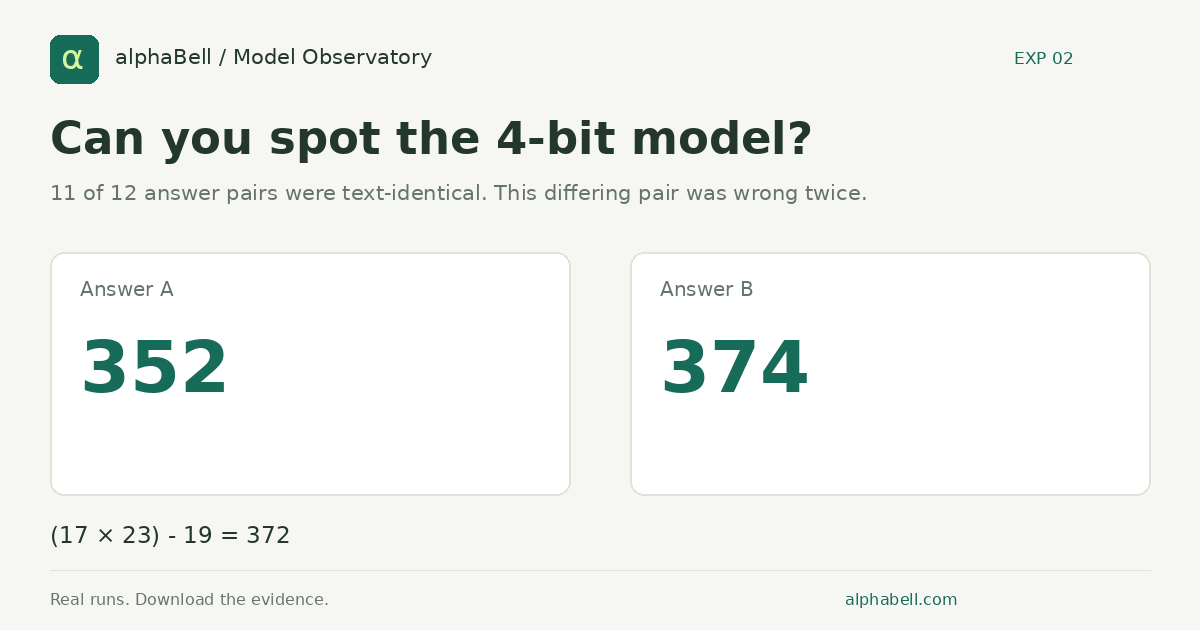
Spot the 4-bit model.
In our 12 Q4/Q8 pairs, 11 answers matched exactly. The odd pair? Both wrong.
Agreement is not accuracy. Try the blind test, then reveal the checks and raw captures:
https://t.co/ofuWeux3I8
@srush_nlp The insertion theorem is the sleeper feature here. Self-distillation can change the teacher context while the sampled suffix must stay fixed. Preserving suffix token IDs makes "same trajectory, different context" an invariant instead of a string comparison.
@GoogleDeepMind World-model escape room: put a key in a drawer, leave, change the weather, return by another route. Can you still unlock the same door? Add a character who moves the key off-screen. Pretty worlds get much more interesting when they can keep secrets.