Alphie is a four-person company. Our fifth employee works 24/7 and never once asked for equity. Now I understand why. 💰📈
Follow me for more HR advice from a four-person startup - and happy Friday everyone!
I’ve done office hours on building inbound traffic with 15 YC founders in the last two weeks.
Insurance, robotics, AI-native ERP, healthcare APIs, AR collections, employee benefits, etc.
Here are some quick wins I found myself recommending again and again, from call to call:
1. Get listed on G2 and every directory in your niche. Get your pilot customers to review you, that’s how you get on G2’s category pages (👉 https://t.co/J3s7agN8J9).
2. Create an MCP and add it to the Claude, OpenAI and Perplexity connector directories.
3. Write the “Top 5 tools for X” article yourself. And add yourself to the list (more on 2 and 3 👉 https://t.co/hVCBlpW8OB).
4. Start at the bottom of the funnel: the comparisons and questions your buyers actually google. Nobody searches for thought leadership.
5. You write the first draft, AI edits, you do the final pass (👉 https://t.co/ihHBFBKG3m).
6. 1 piece = 5 assets: blog, LinkedIn, X, video, newsletter.
7. Swap backlinks with founders in your network with a comparable domain rating. Space out the dates and repeat every few months.
8. 45 minutes a day. Results take about 6 months and then it compounds.
Key thing: inbound takes time - so the best time to start is now.
Driving to SF, I often listen to a podcast nobody else listens to. It’s a podcast about what our competitors did last week. By Claude.
Much of @AlphietheAI runs on Claude loops - recurring automations that keep running while we sleep (or drive). Tools are in my previous post 👉 https://t.co/azCCWE7d5p. These are loops we use week in week out.
1. Keeping Alphie’s knowledge up to date. Every week a loop goes through everything that changed - our website, our messaging, how the product works, how we position it. It writes the updates into a markdown file, and Alphie itself reads that file. It powers our website chat, customer support chat and signal-based outbound so they are always up to date, without anyone needing to edit anything manually.
2. Market monitoring, now in podcast form: every week we look at the market - changes on competitor websites, their announcements and other news in our space. The main loop to post a digest to Slack was created by Olena Vozna. I added a branch that rewrites the digest as a narrated article and sends it to Speechify. That’s the podcast out of my car.
3. Email follow-ups: Attio is our CRM but I’ve opened the UI maybe twice since we signed up. Claude uses it as a database. It picks up all the emails that need a follow up every morning and drafts them all. I read the final versions and it sends them.
Two of our customers have taken this even further and have vibe-coded their own CRMs. A CRM is basically a souped up spreadsheet so maybe that’s less audacious than it sounds 🙂 We’ve also connected Alphie to theirs, so they get the same visibility as teams on Attio, HubSpot or Salesforce.
4. LinkedIn topics: a loop checks what is trending on LinkedIn and what news people are talking about, then suggests what I should write about next.
5. AI search visibility: weekly prompts run through Perplexity, ChatGPT, Claude and others. We look to see if Alphie shows up, what queries bring it up, and what we need to change on our website or write about for AI to find us more easily.
6. Demos that update themselves: When the product changes, a loop updates our video demo and interactive demo on our website, which runs on mock data. They never fall out of date, and that saves us a lot of time.
7. 24/7 customer support: Alphie handles support on our site and we also have a shared Slack channel with each customer. Claude is in all these channels, and it checks them every hour. It is connected to the product and our knowledge base so it normally gives very good answers. Before anything leaves for a customer, it comes to Olena or me in draft form to be looked at and tweaked.
We are constantly building new loops. If any of these are useful to you, comment/ping me and I'll share the skill files behind them 👇🏻
We're a four-person company, and we automate everything we can (more in my post on how we work 👉 https://t.co/4YyZ5ZVPFD). People keep asking what that looks like, so here's the stack behind @AlphietheAI.
The core: Claude is our company brain. Everything connects to Claude. Every conversation is recorded, and Granola, Linear, our CRM and our inbox all feed into it. So we pick tools that are MCP-first, meaning tools Claude can find, connect to and set up by itself. That's how Instantly and Attio got into our stack.
Communication: Gmail for email and Slack for day-to-day work. Alphie is wired in too, so it drops new leads straight into Slack.
Meetings and voice: we record meetings with Granola and dictate with Wispr Flow. Wispr isn't perfect, but it's about the only tool of its kind that handles Ukrainian well. Olena Vozna and I often talk in Ukrainian, so that matters. If anyone at Wispr reads this: keep going. Make it even better and we'll tell the whole Ukrainian community about it 🇺🇦
Scheduling, built in-house: we built our own scheduler, basically an internal copy of Calendly with one difference: enrichment. Whether we book a meeting or someone books with us, the invite description already says who the person is. That data also goes straight into Claude, so we never have to look people up before a call.
Enrichment: Clay, Company Enrich.
Personal assistant: for work, I use Claude for nearly everything. At conferences it's my mini CRM, and with Wispr I can use it by voice from the event floor. For personal stuff, like restaurants, my schedule or my kids' lessons, I use Instinct. I worried one WhatsApp thread for everything would get messy, but it's the opposite: I never think about tokens, so I just ask.
Outreach: Instantly for email. It runs headless and Claude handles all of it through MCP. Dripify for LinkedIn.
Projects and docs: Linear for project management, connected to Claude like everything else. For docs we tried Notion and others and went back to Google Docs.
Creative: Higgsfield for images and video.
Analytics: PostHog for analytics, heatmaps and session recordings. Alphie links to it, so we can match an identified company to its recordings.
Alphie on Alphie: we use our own product for support and sales chat on our site, and for parts of our outbound. It also connects to Instantly, which lets us measure outbound ROI more precisely. Most tools stop at opens, clicks and replies; we also see when the target company visits our site, which helps us plan the next campaign.
Engineering: Next.js for the front end, Vercel for hosting and Supabase for the database. For coding we use both Claude Code and Codex.
Back office: Fondo for taxes and Stable for our office.
Built in-house: a few more tools of our own, like a weekly market-monitoring report - that's my next post 🙂
What's in your stack that we should try? 👇🏻
My day as a 42-year-old father-of-two 4th-time-is-the-charm founder: part 2.
(part 1 👉 https://t.co/W1mrzOwGDR).
Afternoon - Calls and LLM Herding
Late morning into early afternoon: sales calls, onboarding calls, customer conversations. Every call starts with a pre-call brief, and every call gets a prepared follow-up. I have one Claude loop that prepares me for the call and another that drafts the follow-up. Each conversation is recorded by Granola, checked in with Claude, and logged into Attio, which Claude uses through MCP essentially as our database.
Between calls is what I think of as close supervision work: coding tasks, website updates, planning and replanning, product testing. This is also when I'm often in the car, driving my son to his coding class or my 13-year-old to musical theatre. The family schedule shapes the work schedule, and I've stopped fighting that.
The afternoon Pomodoro
Once I start feeling tired, I switch to my own edition of the Pomodoro method: 45 minutes of deep, focused work, then 15 minutes of something completely different. A short walk, or a game. Right now I'm replaying all the StarCraft 2 campaigns.
I eat lunch late, because I only eat twice a day.
3:00 to 3:30 - Head to the city
Every second day there's an event, and events work really well for us. I leave for San Francisco around 3 to outsmart the traffic, find a quiet cafe near the venue, and keep working. On the drive, I dictate first drafts of new posts. This one started as a voice memo on Highway 24.
I always prepare for events. The day before, LinkedIn invites go out to people I want to meet. I'm an introvert who pretends to be an extrovert, so events drain me, and the only way to make them worth it is to arrive knowing exactly who I want to talk to (more in my post on events 👉 https://t.co/fBn6AF3PXk). Full disclosure, and please don't throw tomatoes: during the long talks, I rarely listen. I catch up on work and save my energy for the conversations 🍅
That's the second rule: when your energy dips in the evening, a change of scenery and other people's brains will revive you in a way another hour at the desk never will.
8:00 - Done
My working day ends around 8. Then it's the kids: my son and I are playing Cult of the Lamb at the moment, we're watching Spy x Family as a family, there are board games and chores. Around 11 I go to bed and read myself to sleep.
I do not work harder than I did when I was 25. But I'm getting much more done, because, unlike the 25-year-old me, I know my energy.
Find your cognitive peak, protect it ruthlessly, and put the mechanical work everywhere else.
I'm 42, I have two kids and this is my fourth company.
People sometimes ask how I get everything done without working 996.
Actually, they don't, but I'll answer anyway: I try to understand how my energy works and spend it where it actually produces ROI.
7:10 - Wake up and read
The first thing I do is read for 10 minutes. Not Slack or, god forbid, email. Fiction - to start my brain 'on the right food'. Right now I'm working my way through the Booker Prize winners and finishing Orbital by Samantha Harvey. While I read, I play an EMDR track from YouTube in my headphones. It takes the edge off the morning cortisol and eases me into the day instead of throwing me into it.
Then I brush my teeth, get dressed and go downstairs. Coffee with a small sandwich or a banana, and I drive my 9-year-old to school.
8:30 to 9:30 - The overnight catch-up
Before breakfast, I clear everything that happened overnight. My co-founder Olena Vozna is based in Europe, so there is always something waiting for me, and the hours before she goes to bed are precious. We have one call a week and one all-hands every 4 weeks; everything else is asynchronous (more in my post on how we work 👉 https://t.co/4YyZ5ZVPFD).
Then I do Email follow-ups and the to-do list - a loop in Claude. If there was an event the day before, follow-ups go out the same or next day. If there's an event coming, I check who accepted the invites (more in my post on events 👉 https://t.co/fBn6AF3PXk).
Customer support. We run shared Slack channels with our customers, so I check whether anything new needs picking up.
9:30 - Actual breakfast. I try to get at least 30 grams of protein. Breakfast is also a deliberate unwind, because what comes next is the most demanding part of my day.
10:00 to 12:00 - Focus time
This is the block I protect. I write fiction for an hour: I've published a couple of short stories (https://t.co/DO9ySqq4Xc), and I'm now working with literary agents to publish my first novel. It's about a girl who is actually a goddess but doesn't know it. Every time she falls asleep, she destroys the world; every time she wakes, she creates it anew.
Writing is the most taxing thing you can ask of a brain, so it goes where my brain is sharpest. The rest of the block goes to whatever else genuinely needs creativity: drafting a blog post, updating website content, staring into the void, etc. If it needs original thinking, it happens here, not at 4 p.m.
This is the first rule, and the most important one: know where your cognitive peak is and where it isn't, and schedule accordingly.
The afternoon, the events and the other two rules - in my next post 🙂
@AlphietheAI is a four-person company and we plan to keep it that way until at least $10M ARR.
Here's how we work 👇🏻
1. Everything is connected to Claude. AI is only as good as the context it gets, so ours gets all of it: Slack, every Gmail inbox, every calendar, Granola for meetings, Stripe, our code repo, support and design.
Every week Claude rewrites a markdown file about what Alphie is. That is the knowledge base Alphie itself uses to write emails on our behalf and to chat with visitors on our site.
2. Minimize meetings. Comes with being small. Every additional person adds overhead, which means more meetings and more coordination. Internally we have one all-hands a month and one weekly 1:1 with Olena Vozna. That's all. Also because we're remote, everything happens either in Slack or over calls - so no internal communication leaves unrecorded.
If you want to cut meetings in your own company, look at what Darka Azhnyuk is building at Spry.
3. Prep for every customer meeting and follow up on every one. Claude already has the context, so a loop preps each client call and onboarding, and drafts the follow-up from Granola afterwards.
4. Let customers drive the roadmap. About 90% of our roadmap is pulled by customers. Every customer gets their own Slack channel with us, and we tell them there's roughly a 50% chance any feature request ships overnight. This is how we've built every integration. Building has never been cheaper, so there's no excuse for not listening.
5. Only two things matter: talking to customers and building the product. No PR. No press. No interviews. No fancy videos - AI or otherwise. We only go to events where we know our audience will be (more in my post on events 👉 https://t.co/fBn6AF3PXk).
6. No idle days. Each day we check what moved: a new customer, a shipped feature, a lesson learned.
7. We don't believe in 996. Your productivity over the day is non-linear, the output doesn't scale proportionally to hours. My day runs from 8:30 to 8, but that includes an hour of writing fiction and, sometimes a 20-minute nap. Weekends are for family - non-negotiable.
(More on my day as a 42-year-old founder in my tomorrow post.)
Comment or DM me if you want a copy of the skill that updates the company knowledge base weekly.
I wrote this post while driving to San Francisco.
No, AI didn't write it. I did.
I live in Walnut Creek, but I'm in the city every other day, so I've got a regular half-hour drive over the Bay Bridge. It's a beautiful route, and it's where I write most of my LinkedIn posts. I just talk them out.
When my wife and I moved to the US, we had a private game: spot the Eastern European. They didn't have to say a word. They could be dressed head to toe from Nordstrom. We'd still know, and we were never wrong.
This is how intuition work. We grew up among those faces, those mannerisms, those gaits. So we just know.
It works the same way with AI writing. You don't need to be an editor to spot it. Your readers will feel it, the same way they feel AI slop in an image. If you think they won't notice, they will.
Even Y Combinator agrees. Its latest Request for Startups includes "LLMs That Write Well" (https://t.co/xnruZjJtM4), from Jared Friedman: as models have gotten better at code, they've gotten worse at writing.
So don't let AI write instead of you. Let it write with you.
I use what I call the sandwich principle. I'm the bread. AI is the filling 🥪
Bottom slice: me. The idea, the angle, the raw draft, typed like thos with a ton of typis and no regard for hgarmmar or spelloing. Or dictated on the drive.
The mortadella (my fav sandwich filling): AI. It structures, trims, researches and fact-checks. That's where the hours get saved.
Top slice: me again. I edit by taste, and mostly that means cutting. AI over-explains and repeats itself, because it writes so the average reader will get it. Make of that what you will about what Claude thinks of the average reader's intellect 😅
People trust their readers more. We leave gaps, and our sentences come out uneven.
Anything that doesn't sound like you, rewrite it without mercy. Do a quick grammar pass, and you're done.
If you'd like the prompt I use to turn my first draft into a second one, comment or DM me and I'll send it over 👇🏻
"You Can See Everything" is, among other things, a movie about the wrong side of Silicon Valley culture.
"You Can See Everything" is mesmerizing. I didn't think I could watch a 3-hour documentary in one sitting - I could barely take my eyes off the screen 🍿 Nathan Fielder and Lance Oppenheim created an instant classic.
It's a movie about our perception of reality. It keeps teasing that perception, until we stop trusting our own judgement and realize how hard it is to separate truth from fiction.
The Dropout, Hulu's series with Amanda Seyfried as Holmes is featured prominently in the movie. In one of the series' scenes, Dr. Phyllis Gardner asks Holmes what happens to all the other women who want to start companies: "Who's gonna trust them? Cause it's not just you. It's never just you."
This goes beyond women founders. Every startup that chooses to 'fake it till it makes it', makes it a bit harder for everyone else.
Silicon Valley became so unique because it brought together the nerd culture of curiosity and discovery, people ready to bet their money on it, and California's old tolerance for the weird - inherited from the hippies and beatniks of the '60s and '70s.
There's still a lot of that. I moved to the Bay Area 9 years ago, when my previous company got into YC, and never looked back. It's still the best place to build a tech startup by a huge margin, and I've never been surrounded by so many smart and interesting people.
But it is also impossible to ignore the element of hype - as, despite Theranos, SBF and others, it only keeps growing. I believe the root cause is baked into the math of venture capital: it forces founders to overpromise.
The hype flywheel starts turning the moment a VC asks a founder raising a pre-seed round: "How will you become a billion-dollar company?" There's simply no way a pre-seed founder can answer that honestly, other than "we're going to win the lottery - ten times in a row."
The median startup's odds of success are so low that there's no way to make money other than outweighing a sea of losses with the enormous returns of a few winners.
The moment some of the leading VCs discovered they could build hype around startups and make real money from it, they did what the Swiss watchmakers did in Paul Graham's "The Brand Age": stopped making better watches and started making status symbols.
My hope is that AI will change this. Building smaller, niche products is so much easier and cheaper now that the failure rate could drop - and that would make good venture returns possible without good working horses having to grow a horn on their heads 🦄
Until then, I'm afraid we'll keep seeing the same scene with founders who took "fake it till you make it" just a little too far.
"Where exactly did it go wrong?"
The camera takes a close-up of the founder's face.
"I don't know. I'm still trying to figure it out myself."
Go check it out 👇🏻
https://t.co/Wjtyatpa1C
AEO is just a top-5 list plus an MCP 🤷♂️
AI search is the fastest-growing channel in B2B right now. The share of software companies calling it a core GTM motion jumped 11 points in a single year, to 39% - the biggest jump of any channel (2026 State of B2B GTM Report by Kyle Poyar and Maja Voje). No surprise everyone's rushing to "optimize for AI". Alas: and most of what they're being sold doesn't work.
What doesn't work: the alchemy. Agent-only pages, special sitemaps, llms.txt files. Ahrefs analyzed 137,000 sites and found that 97% of llms.txt files never get read by anyone.
That's because AEO isn't so different from SEO. AI agents still search the web through search infrastructure: Google, Bing, Brave, or their own crawlers built on the same principles. Ask "what are the best inference tools?" and the agent goes looking for articles titled "Top 5 inference platforms". Sometimes it blends several. Oftentimes it retells the top one almost word for word (try Googling your prompt in parallel ;)
So, two low-hanging fruits 👇🏻
1. DIY. Publish "Top 5 X for Y" on your own blog. Use a tool like Ahrefs Brand Radar to see what people actually ask AI. It works even on your own site, especially in niche categories. Put yourself at number two - that's what we do at @AlphietheAI. Number one if you're feeling audacious 😜
2. Ship an MCP server. It's easy to build, and it makes you discoverable to the AI engines themselves. People literally ask "which tools can I connect here?" List it in the Anthropic and OpenAI connector directories, and anywhere else you can.
Start with your own site and an MCP. Then go after the real prize: a mention in an authoritative, frequently cited source. That could be a top publication or a respected industry blogger or an online magazine. Shouldn't be a problem if your product is actually good ;).
Sources:
2026 State of B2B GTM Report: https://t.co/F45on0cfw9
Ahrefs, llms.txt study: https://t.co/n97O8LOCPm
Ahrefs, schema study: https://t.co/WQqPQPyNAw
Ahrefs, 75K brands study: https://t.co/CgAbGcEuHo
First-time founders start with a product. Fourth-time founders start with distribution.
@AlphietheAI is my fourth startup. My previous one, YouTeam (YC W18), was acquired by Toptal. Before that I built software for scientific conferences, launched Hubbub FM, a voice social network, ran a consultancy for small businesses, and even co-created a beekeeping championship - the World Beekeeping Awards 🐝
Most first-time founders fall in love with an idea. You put two things together and something beautiful comes out of that alchemy. The trouble is you didn't start with a problem, so you end up with a solution in search of a problem.
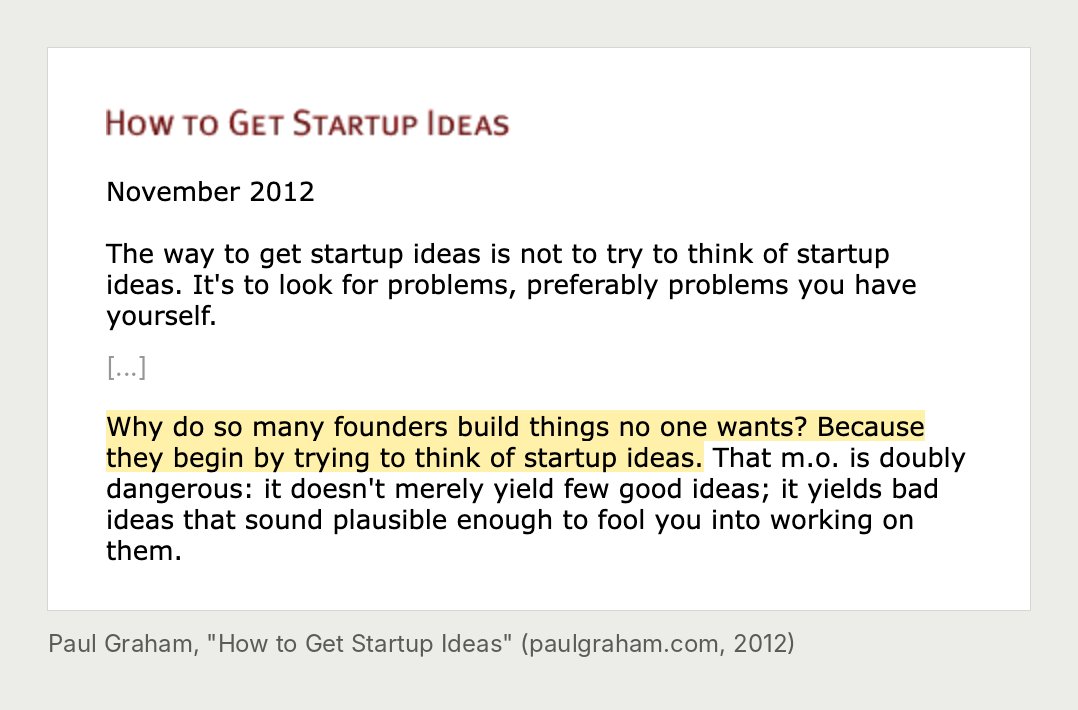
Dalton Caldwell and Michael Seibel cover this in "Should You Follow Your Passion?" (https://t.co/UbOO5yZxbV). Paul Graham put it well in How to Get Startup Ideas (https://t.co/RzC4f1OfK9): "Why do so many founders build things no one wants? Because they begin by trying to think of startup ideas." Education system isn't designed to breed entrepreneurs. At school we were always presented with a problem - nobody ever taught us how to find one.
What I do now is start with an audience: people I know well and can easily reach. Then I look for a problem they have that I can actually solve.
This matters even more now. AI made building easy, and GTM got proportionally harder because there's so much more noise.
For us, the audience was founders. I'm one, I know hundreds of YC founders personally, and YouTeam had lots of YC customers. We started with a personal assistant, but everyone wanted something different from it. If we'd kept going, we'd probably have ended up building another Instinct, Grok Bot or Claude Duet.
The one thing everyone agreed on was needing customers. We'd had great results with inbound at YouTeam, and inbound is back because outbound is so crowded (my Monday post 👉 https://t.co/JCqVMdypZE). But general inbound had too many points of failure, so we narrowed down to the lowest-hanging fruit: the qualified visitors already on your website. Now 9 out of 10 demos end with a customer signing up.
Starting with an audience also hands you your distribution channel. Your first 10 customers come from your network. You get into the meetups, where you see how people react right away and learn which message and language land. And if you've already worked in that space, you have the authority people need before they'll trust you and buy.
Then it's on to PMF, which is just retention (my previous post 👉 https://t.co/TSfRMTaHIW).
The mythical product-market fit is just retention. 🦄
Founders dream about PMF. Startup life gets split into "pre" and "post". But ask anyone to define it and you get Justice Potter Stewart on obscenity: "I know it when I see it."
Marc Andreessen did us a disservice here. In his famous 2007 essay he wrote that "you can always feel product/market fit when it's happening" - customers buy as fast as you can make the product, usage grows as fast as you can add servers.
Great prose, but there are no metrics in it. So you're stuck with a yes or no: if you don't feel it, you don't have it. And you have no idea what to look at next.
The best definition I've found is from Mark Roberge, the founding CRO of HubSpot, in The Science of Scaling: "Customer retention is the best statistical representation of product-market-fit."
If customers keep coming back, your product is part of their routine. Then they'll pay, and when the moment comes, they'll recommend you.
Here's how we do it at @AlphietheAI 👇🏻
1. Find what sells to your chosen audience. Our first idea, a personal assistant for founders, didn't 😅
2. Once it sells, look for retention. Which features do customers actually use? Which customers come back every day, and how are they different from the ones who don't?
3. Double down on those. Then figure out pricing.
Stop waiting to feel it. Measure who comes back.
Sources:
Marc Andreessen, The only thing that matters: https://t.co/C1FUONfanX
Mark Roberge, The Science of Scaling: https://t.co/GCGtj1g7jP
Inbound is the new outbound.
AI turned outbound into a robot battleground 🤖 Companies are spamming more every day. I barely read my own email anymore - Claude reads it for me. It unsubscribes me from the junk, summarizes updates and replies to anything important on my behalf. Still: five new cold emails land every day, and within a week anything that matters is buried in junk.
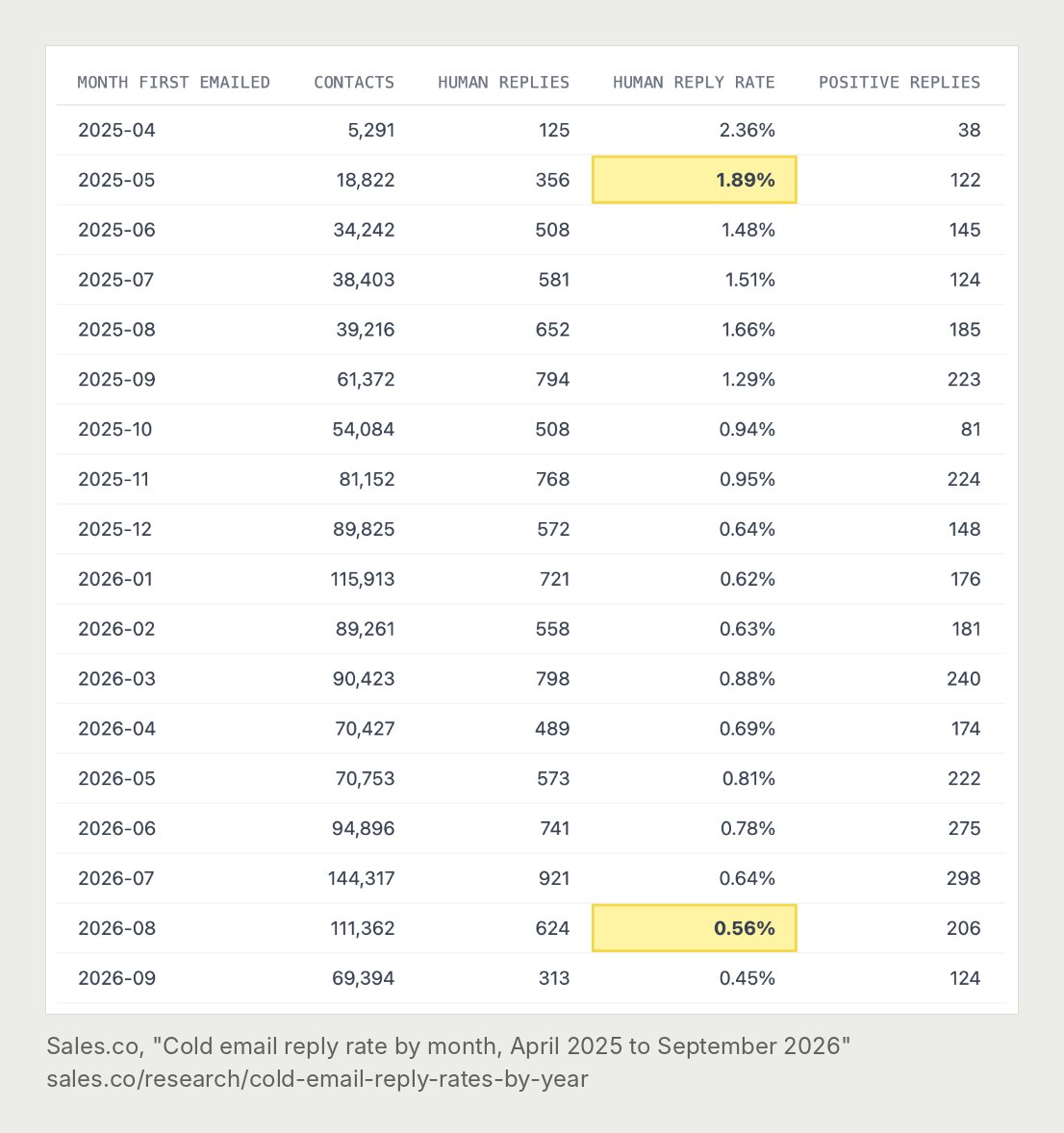
If I'm doing this, so is your prospect. https://t.co/hPSqzVgg2I, a cold email agency, publishes its numbers every month: 1.89% of contacts replied in May 2025, 0.56% in August 2026.
When someone asked me what it takes to build a successful inbound, my answer used to be: faith. At YouTeam (YC W18) - my previous company, acquired by Toptal - we were in a cutthroat industry where everyone was spamming everyone even before AI, so we bet on inbound from the very beginning. We had a whole team doing nothing but content and link building, and it still took years before we saw meaningful traffic.
Most startups put inbound off until after product-market fit (a fancy word for retention), because it takes a team, and before PMF you can't spare one. So the old playbook was: network, then outbound, and inbound last.
Now you can automate the whole play: link building, directory listings, content. In every previous company I had to hire a team for it; now you can run it yourself with Claude. Here's how we did the directory part 👉 https://t.co/J3s7agN8J9
Your industry is probably less crowded than ours was, but traffic still takes time to build up - so why not start on day one?
The new playbook: inbound in parallel with your network sales. Your first customers come from your network. While you close them and look for product-market fit, inbound compounds, and by the time you've exhausted your network, it's already working.
That's what we do at @AlphietheAI. I'll share our full inbound playbook in a series of posts 🚀 DM me and I'll send you the file we use ourselves.
Source: https://t.co/hPSqzVgg2I, cold email reply rates by month: https://t.co/jJtg886MEc
As a kid, I wanted to be an astronaut.
Now I'm working from Spaces, banking with Mercury, and sending cold email written by GPT Astra via https://t.co/s3Ehs0fd74 in Perplexity Comet.
Here's to dreams coming true! 🚀
Have a great weekend, everyone. ✨
Delegate, but don't abdicate. Turns out, this applies to AI too.
I planned a dinner in SF for growth leaders of Series A+ B2B startups. It would have been tonight, in an awesome little French restaurant near Union Square 🍷
Nobody signed up. 🤷♂️
Turns out, most of them never even saw the invite. A nice guy who actually checks his spam folder told me everything from me was landing there.
The culprit was DMARC - a DNS record that tells Gmail and Outlook how to treat email claiming to come from your domain. Ours was misconfigured, so my invites went straight to spam. No bounces, no errors: Apollo showed every invite as delivered 👇🏻 Delivered to spam still counts as delivered.
That part is on me. I set up the whole campaign with Claude, automatically, because I wanted it done fast. I even went to the restaurant myself to check it out. I never checked whether the emails reached anyone.
It's fixed now. And I'm keeping the lesson: when it comes to AI, delegate - but do not abdicate.
If you run growth at a B2B startup in the Bay Area and an evening like this sounds worth your time, let me know in the comments or DM. If we get at least 8 people - I'm booking the table!
I doubled @AlphietheAI's inbound organic traffic in 1 week using a low-hanging fruit most founders ignore.
I'm talking about listings.
The logic of Google's algorithm is simple. Actually, it's not simple at all (and they keep changing it every few months), but here is the gist: get links to your website from websites that have high authority. Software directories are the easiest way to get them: you fill in a form, and a site with far more authority than yours links back.
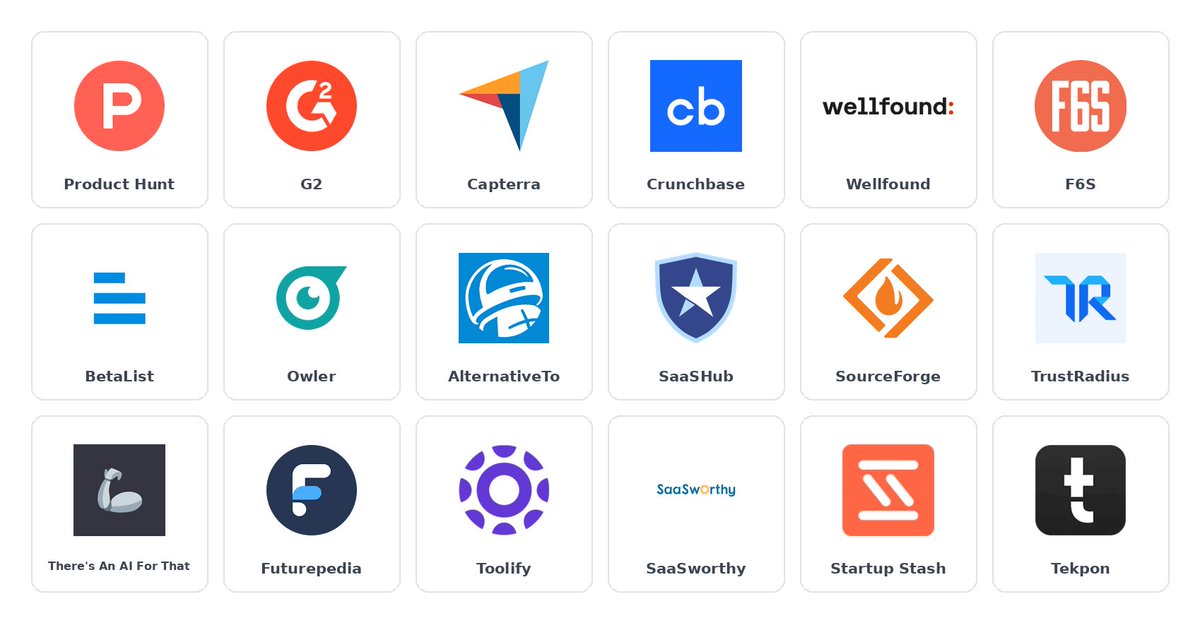
Everybody knows about Product Hunt and G2.
But there are a ton of others. Here are some Alphie is listed on 👇🏻
- Capterra
- Crunchbase
- Wellfound
- F6S
- BetaList
- Owler - A Meltwater Offering
- AlternativeTo
- SaaSHub: https://t.co/OyxENTvMWb
- SourceForge
- TrustRadius
- There's An AI For That
- Futurepedia
- Toolify: https://t.co/11sFh0hW90
- SaaSworthy
- Startup Stash
- Tekpon
Most are free; a few charge $30-250 to list.
Result: our Domain Rating went from 19 to 24 in 4 days, and traffic more than doubled 🚀
Two more things worth doing:
1. Get your customers to review you on G2. A listing with zero reviews is a dead end. G2 pages rank high for "best X software" searches, and AI assistants quote them when someone asks which tool to buy. Ask right after a win, and send the direct review link.
2. Get a business address. Every listing asks for one, and you don't want your home address on a dozen websites. We use Stable (YC W20).
Best part: Claude can do most of this for you 🪄 DM me - and I'll share our skill file.
One note: avoid the backlink farms. At best you'll waste time, at worst - Google can blacklist your domain. Rule of thumb: respectable listings usually don't cold-email you 😅
TechCrunch Disrupt has the worst coffee and food. And it's still the highest-ROI event for founders, by a long margin. Why? Networking!
Most other conferences only show you the list of attendees if you buy a sponsorship - and the cheapest packages I've seen start at, like, $20K. Disrupt has everyone in its app, plus an area with numbered tables and snacks.
In 3 days I had 20+ meetings, and every single one was with a potential customer or partner. Five turned into demos.
I'd booked many of them in the app before the doors even opened. Same rule as with meetups: know who you want to talk to before you walk in.
Who needs those speeches? In the age of YouTube and AI, no wisdom is esoteric.
If I were running a conference - it would be just one huge networking area + an app to actually vet and connect relevant people.
Shoutout to some of the awesome folks I met there: Erkang Zheng, Kristian Boström, Lauri Hollo, Antonio Ajewole, Griffin Kurzius, Chantelle Luicien, Sam Micinilio, Sanguk Ahn, Erin Kim and Junyong Min.
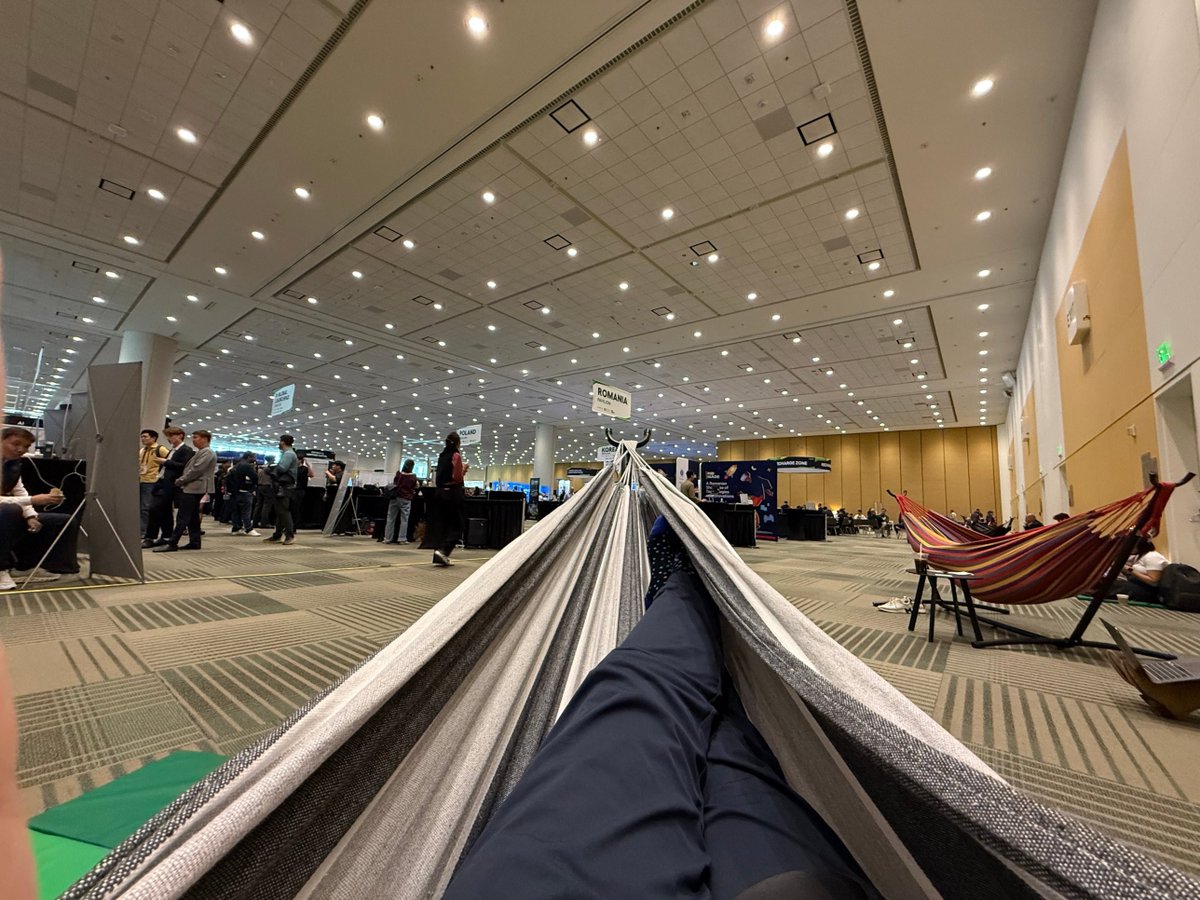
Oh yeah - this is also the only conference that has a nap area with hammocks. Respect!
#TCDisrupt
I walk into every meetup already knowing who I'll talk to - and most of them are expecting me.
Last Thursday, that got me three demos booked on the spot.
Small in-person events have once again proven to be one of the best channels to get early customers. Here is how we use AI at @AlphietheAI to get the most demos from meetups.
1. A weekly Claude loop checks for new events. Events are prioritized by how much of our target audience is likely to attend. After the registration is confirmed, Claude checks on Luma whether the list of participants is public.
No list = no go. Unless the event is super-relevant for another reason, Claude cancels the registration.
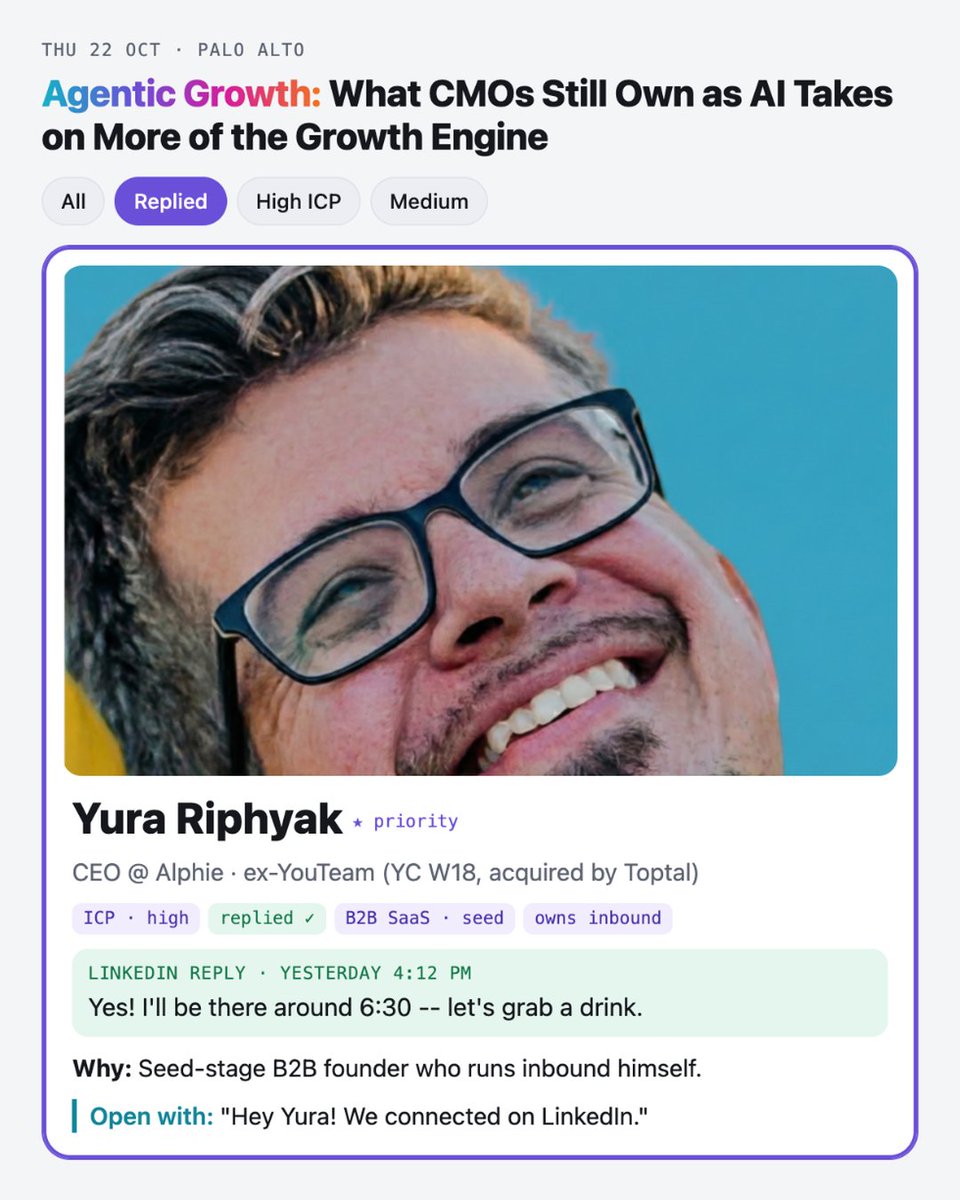
2. Claude scans the list and ranks the participants by their ICP score into three groups: high, medium, and low.
3. A day before the event, I send LinkedIn connection requests to the high- and medium-ICP people (depending on the size of the audience) with a short note, e.g. "Noticed you're also coming to X tomorrow. Let's meet up there?"
You would be surprised how many will respond ;)
4. Claude creates a one-off iPhone app with photos of those who responded and short summaries of what they do and what makes them relevant. At the event, I scan the room for those faces and try to talk only to those who are there, starting from the top of the list.
5. I open with something like "Hey, Jessica! We connected on LinkedIn." They immediately recognize me and engage - after all, unlike most other people in the room, I'm not a complete stranger ;)
6. I always try to set up the demo on the spot. No "I'll follow up with some times." We both pull out our phones and calendars and set the time - I get their email and whisper to Claude to send the invite immediately.
The key is to know exactly who you want to talk to - and have them expecting you. Realistically, you can have between 5 and 10 conversations per evening - so every meeting counts. Random "bouncing" seldom works - unless the organizers did a truly exceptional job of filtering the participants.
Going to a meetup in the Bay Area soon? Tell me which one - maybe we'll meet there.
95% of qualified visitors to your website never convert.
Not bots -- real buyers who match your ICP. They land, look around, and vanish.
Most B2B websites are a brochure pretending to be software. Same homepage, same "Book a Demo," whether the visitor is a 2-person startup or a 500-person enterprise.
Alphie fixes that.
Read the full thesis: https://t.co/y1qBNw4ZuF