@JohanBruyneel@BTPCycling#SpencerMartin@wedusport 🐶
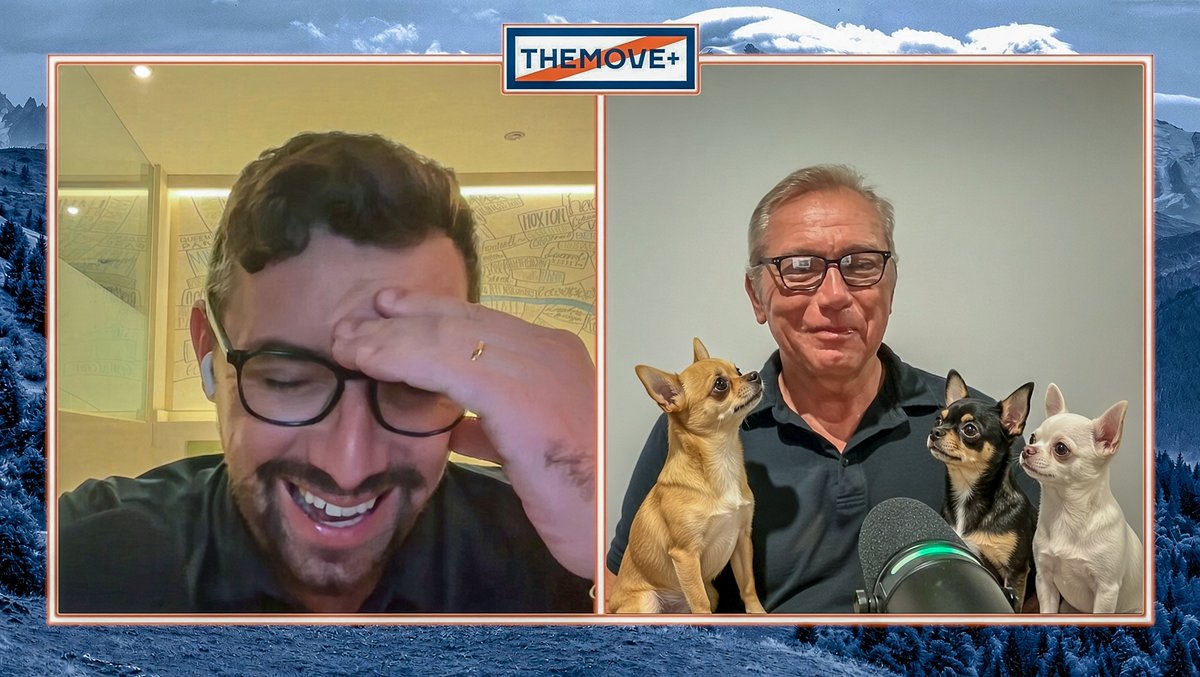
Spencer Martin and Johan Bruyneel on the Move Plus podcast.
Johan Bruyneel is offering free Chihuahua dogs to anyone in the Madrid area.
Portion of the podcast transcript:
Spencer: But Johan, before we get going, before we get going, how are you doing? What is up with you lately?
Johan: I'm good, I'm good, you know. Still in Madrid, still riding my bike. How are you doing, by the way, with, with your bike riding? We haven't talked about that for a while.
Spencer: We'll tease this for next week, and we'll get into the Strava numbers. It's not, it's not pretty, unless, unless I can....
Johan: I've checked a little bit. I mean, you're almost the same as last year.
Spencer: I am fighting for my life to ride the same as I did last year. Yeah. And you, you are ahead of that. The thing is, the news, I mean....
Johan: we can go into detail on another podcast, Spencer. The thing is, I'm doing a lot better than last year, so, that's not good for you. But we'll talk about it in another podcast.
Spencer: Yeah, it's actually kind of interesting. You've set a goal and you're crushing it. I think people, I think people need to hear about it in next week's show.
Johan: Well, I mean, in your favor now, it's really, really bad weather, in Madrid. It's been raining every day. Today was the only day of the week I could get out, go out since, since the weekend. And from tomorrow on, it's raining again. So, it's always good to have a cushion built in, right? If you set yourself a goal. Yes. But hopefully, hopefully the weather will, will get better soon.
Spencer: The thing I can't believe is you're doing this through having three dogs in the house. Is that true?
Johan: Spencer, I don't want to talk about it. It's gotten worse. It's gotten worse. Right now, my daughter is temporary now here with me. And, so, you know, Initially, she brought her three chihuahuas, plus my dog, so that's four.
Spencer: How could it get worse than this?
Johan: Well you know, obviously there's certain parts of her life that I was not aware of. Turns out she had five chihuahuas. So I currently have six little dogs in my house. Spencer you cannot imagine having six little dogs, I mean, my dog Bobby is fine, you know, he's a gentleman he's behaving everything's fine with him. But yeah, I'm not a chihuahua fan.
Spencer: This is like a nightmare you wake up from and you're like, whoa, what a crazy dream that was.
Johan: listen, it's crazy. I have right now six little dogs at my house. I've been telling her she needs to find a solution because this is, this is unsustainable.
Spencer: That's too many chihuahuas.
Johan: Listen, anybody in Spain around Madrid who is interested in receiving a free chihuahua, hit me up. I can make it happen.
Spencer: We'll fly it somewhere. Doesn't matter where you are. We'll send that.
Johan: The Madrid, the Madrid area.
Spencer Martin: First class and free
Johan: Free chihuahuas available.
Spencer: Today I was flying to Rouleur Live show in London. Saw Mathieu van der Poel mere two feet away from me, just minutes ago, Johan. So it's, I'm actually surprised how many, there's like a big celebrities at this thing. It's getting bigger every year. It's great, crazy show. I guess the main thing of Rouleur Live, I've thought about this a lot, it's very easy to get to if you live in Europe.
Word jij de spil in het web van onze wielerploeg? Wij zijn op zoek naar een tijdelijke parttime Team travel & planning coördinator. 💻
Meer weten of direct solliciteren? https://t.co/a9WmzlKYXM
@fiorebike@vismaleaseabike@Bardiani_CSF@trobroleon@giroditalia@ACCPI1946
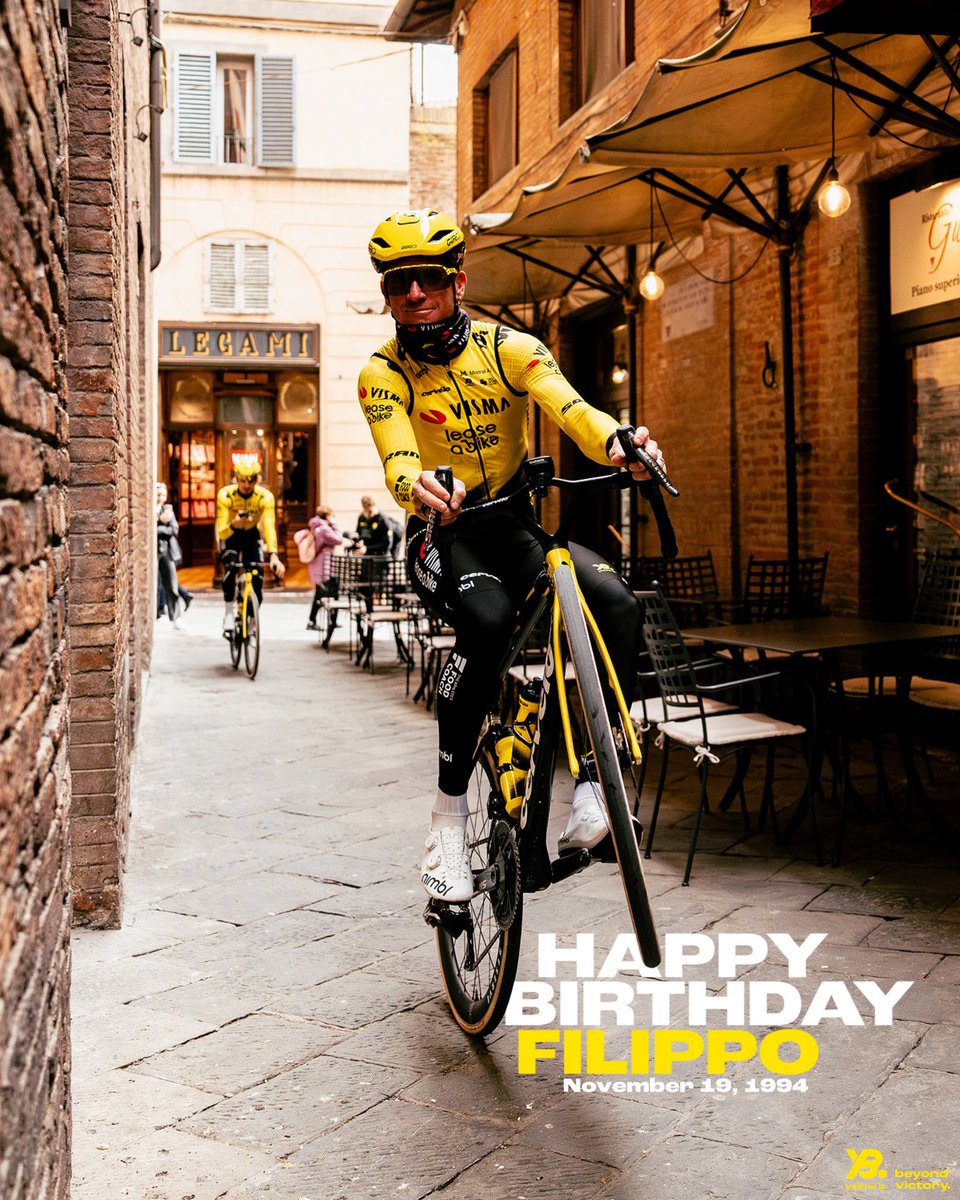
Happy 32nd Birthday, Filippo!
Filippo Fiorelli (born 19 November 1994 in Palermo, Sicily) is an Italian professional road cyclist who currently rides for UCI WorldTeam Visma | Lease a Bike.
He joined the team ahead of the 2026 season (contract through 2027) after six years with Bardiani–CSF–Faizanè and its successors, turning professional in 2020.
A late starter who began racing seriously around age 20, Fiorelli is a versatile all-rounder—described by his team as a fast man with solid climbing skills.
His primary role at Visma is supporting sprinters such as Matthew Brennan on fast finishes, while remaining capable of winning races himself.
Key career highlights include:
Overall winner of the 2019 Tour of Albania (plus points classification and a stage)
Poreč Trophy (2021)
Stage 1 of the Sibiu Cycling Tour (2022)—his first professional victory
Intergiro classification at the 2024 Giro d’Italia
Two stage podiums (3rd) at the Giro d’Italia (2021 and 2023)
5th at the 2022 Bretagne Classic
Tro-Bro Léon (2026), his first win for Visma and the biggest of his career to date, taken with a late attack.
He has started the Giro d’Italia six times. Off the bike, the Sicilian remains closely tied to Palermo (where his family lives) and enjoys time with his horse.
A gritty, late-blooming rider who has steadily built a reputation through consistent results, Fiorelli’s move to Visma marks a major step into the WorldTour elite.
Buon compleanno!
@rogla@NSNCyclingTeam@weare_NSN@andresiniesta8@kjellcarlstrom@RichardCarapazM@SantiagoBS26@GrmayeBiniam@georgenbennett#Vuelta2027@wedusport
Primož Roglič has signed a one-year contract with NSN Cycling Team for the 2027 season, announced on 18 November 2026. The 37-year-old Slovenian leaves Red Bull-Bora-Hansgrohe after three seasons and joins a Swiss WorldTour squad building general classification ambitions around a group of experienced leaders.
NSN framed the move as the “final chapter” of his career (“gremo!”), though neither side has confirmed retirement after 2027. Roglič remains motivated, citing the team’s “Never Say Never” name as a perfect fit.
The Signing and Immediate Context:
NSN Cycling Team (UCI WorldTeam, Swiss license, operations based in Girona with Catalan ties) announced the deal on its website. It is a one-year agreement covering only 2027—shorter than the multi-year deals given to other incoming GC riders. This followed months of speculation after his Red Bull-Bora-Hansgrohe contract expired.Options had included a rejected Lotto-Intermarché offer, a ruled-out return to Visma-Lease a Bike, interest from Tudor, Pinarello-Q36.5, Movistar and others, and even Unibet Rose Rockets (which withdrew for financial reasons).
Retirement was openly discussed; Red Bull boss Ralph Denk reportedly advised him to consider stepping away rather than joining a more modest project.
Roglič’s own words indicate he still has “some work to do—in both racing and with myself.”
He will join Richard Carapaz (signed through 2029), Santiago Buitrago and Lennert Van Eetvelt (also on longer deals). The group gives NSN its strongest GC roster yet.
Primož Roglič Career:
Born 29 October 1989, Roglič transitioned from ski jumping to professional cycling around 2012–13. He rode for Adria Mobil, then spent eight highly successful years at Jumbo-Visma (later Visma-Lease a Bike) before three seasons at Red Bull-Bora-Hansgrohe.
Key palmarès (93 career victories total):
4× Vuelta a España (2019, 2020, 2021, 2024)
Giro d’Italia (2023)
Olympic gold in the individual time trial (Tokyo 2021)
World Championships time-trial silver (2017)
Liège-Bastogne-Liège (2020)
Multiple stage-race wins and Grand Tour stage victories (especially in the Vuelta).
He is known for resilience, time-trial strength, climbing ability in Grand Tours, and a winning mentality that has produced consistent high-level results across more than a decade in the WorldTour.
2026 Season PerformanceRoglič’s 2026 campaign included setbacks and strong finishes. A training incident in late July (hit by a car) forced him to miss San Sebastián and the Vuelta a Burgos.
He still delivered
2nd overall at the Vuelta a España, 2 minutes 15 seconds behind winner Enric Mas (Movistar).
A fifth Vuelta title would have given him the outright record; he described the result positively given the circumstances of preparing for the race.
European Time Trial Champion on home soil in Šenčur, Slovenia (7 October 2026), winning the 22 km course in 28:16.61 ahead of Bruno Armirail.
Slovenian time-trial champion and solid results including 5th at Tirreno-Adriatico.
These late-season performances demonstrated he remains competitive at the highest level at age 37.
Primož Roglič will enter NSN as one of its primary general classification options in 2027, but not as an undisputed sole leader.
The team has assembled a crowded group of riders with Grand Tour ambitions, and Roglič’s experience and one-year “final chapter” framing position him as a high-priority option for at least one of the three Grand Tours—most logically the Vuelta a España, the race he has dominated more than any other.
Roglič brings the most proven three-week management experience on the roster: four Vuelta titles, a Giro win, Olympic time-trial gold, and a long track record of defending or chasing GC across all three Grand Tours.
At 37, his strengths remain time-trialing, resilience, and the ability to perform when it matters in the final week.
He joins three other riders who have also been given leadership language:
Richard Carapaz (signed through 2029): 2019 Giro winner, Olympic road-race gold, two Tour stage wins and the mountains classification in 2026, plus 8th overall at the Tour and 4th at the Vuelta that year.
Santiago Buitrago (longer deal): Giro stage winner, 2026 Vuelta mountains classification winner, and consistent top-10 Grand Tour finishes.
Lennert Van Eetvelt (longer deal): Winner of the 2024 UAE Tour and Tour of Guangxi; younger climber with stage-race GC potential.
With only three Grand Tours, the team will almost certainly split leadership. Roglič’s short contract and specialized Vuelta pedigree make him the natural lead when the calendar aligns with his strengths, while the others can co-lead, attack, or support depending on the race.
The group gives NSN tactical flexibility (multiple threats) but also the classic risk of diluted resources if all four are targeting the same objectives.
Support Riders for GC Ambitions:
True dedicated super-domestiques are limited compared with UAE, Visma, or Red Bull. The most relevant options include:
George Bennett (New Zealand, staying through 2027): Experienced climber and Grand Tour veteran (previous stints at Visma and UAE). Team management has highlighted his road-captaincy value as NSN increases its GC focus. He is the clearest pure support option among the veterans.
Kasper Asgreen: Time-trial and classics specialist who can protect on flatter stages and contribute in individual time trials.
Nick Schultz and other climbers already on the roster: Useful mountain support.
The co-leaders themselves (especially Buitrago and Van Eetvelt on days they are not racing for personal GC) can function as high-level helpers.
Younger or versatile riders (Artem Shmidt and others) add depth but are not yet established Grand Tour domestiques.
The 2027 climbing depth is a clear upgrade from NSN’s 2026 sprint- and breakaway-oriented roster, yet it remains a mid-tier support structure rather than an elite one.
Realistic Assessment of Support Strength:
The support should be enough for opportunistic results—stage wins, solid top-10 GC finishes, and the possibility of a podium if Roglič arrives in peak form and the race develops favorably (especially a Vuelta). It is unlikely to be strong enough to control a three-week race against the top superteams when the competition is at its highest (Pogacar, Vingegaard, or a fully stacked Red Bull/UAE squad).
Multiple leaders can help create attacks from different angles, but they also mean fewer pure workers fully committed to one rider. Success will depend more on Roglič’s personal form, race selection, and tactical opportunism than on overwhelming team strength.
Competitiveness Beyond GC:
Roglič remains highly competitive outside pure Grand Tour GC:
Time trials: Fresh European champion (home soil, 2026) and Olympic gold medalist. He can target individual TTs in stage races, national/European championships, and select one-day TTs.
Week-long stage races: Volta a Catalunya (convenient given the team’s Girona base), Tirreno-Adriatico, Critérium du Dauphiné, Tour de Suisse, and similar events suit his climbing-plus-TT profile.
Hilly or selective one-day races: Possible interest in Ardennes classics (he has a Liège-Bastogne-Liège win) or other events with significant climbing and time-trial elements.
Stage hunting in Grand Tours when not prioritizing overall classification.
His 2026 season (2nd at the Vuelta despite a mid-season training crash, plus the European TT title) showed he can still deliver at the highest level when focused.
NSN is the direct successor to Israel-Premier Tech. In late 2025 the WorldTour license was acquired by Never Say Never (a company co-founded by Andrés Iniesta) in partnership with the Swiss investment firm Stoneweg. The team switched to a Swiss license, established a strong operational base in Girona, and rebranded with the “Never Say Never” identity.
In 2026 it operated primarily as a sprint and breakaway unit (16 professional wins, led by riders such as Biniam Girmay and Ethan Vernon) with limited Grand Tour GC presence and a lower ranking among WorldTour teams.
The 2027 recruitment wave—Carapaz, Buitrago, Van Eetvelt, Roglič, Asgreen, and others—marks a deliberate pivot toward multi-leader general classification ambitions.
The project is still early in building the support structures and race programs that top GC teams take for granted, but the direction is clear: from opportunistic wins toward competing for major overall results.
Roglič gives NSN instant credibility and a realistic shot at strong results in selected races, particularly the Vuelta and stage races with time trials. The support and leadership situation will require careful management, and the team’s broader GC project remains a work in progress rather than a finished superteam.
Happy Birthday to @daniekh20 who turned 24 on 17 November 2026.
She is a Dutch professional road and track cyclist from Nootdorp who currently rides for @visma_lab_women (contract through 2028). #HappyBirthday
She is viewed as a strong all-rounder—solid in time trials, capable on longer climbs, and useful supporting leaders in the classics while developing her own opportunities
Her cycling began casually around 2011 in local “Dikke Banden Races” (fat-tire races on ordinary bikes) near her hometown; she later moved to proper racing bikes without strong initial competitive pressure. On the track as a junior she won the European junior elimination race title in 2019 (and took medals in other events, including with Maike van der Duin in the Madison).
She turned professional in 2021 with the Dutch GT Krush Tunap team.
Early road highlights included her first pro win—the prologue of the 2021 Belgrade GP Woman Tour—followed later that day by a crash that led to a hospital stay in Serbia with an initial (later moderated) vertebra diagnosis. She raced for Team DSM / DSM-Firmenich PostNL in 2023–2024.
A serious crash in the 2024 Tour of Britain left her with a broken jaw, collarbone, and multiple ribs, and she has spoken about the physical and mental toll of that period.
In 2025 she joined Ceratizit Pro Cycling and immediately delivered her biggest result to date: a solo stage 1 victory at the Women’s Tour Down Under (finishing 36 seconds clear).
That breakthrough, plus solid early-season rides, led to her three-year move to Visma–Lease a Bike starting in 2026.
In her first season with the team she became Dutch national time-trial champion in June and raced the Giro d’Italia Women and Tour de France Femmes.
@TotalEnergies@fdj_united@FDJ_SUEZ@TeamTotalEnrg@demivollering#demivollering@stephendelcourt@PPouyanne@stephane_pallez
On 16 November 2026, TotalEnergies and FDJ United announced that the French energy company will join as main co-title partner of the UCI Women’s WorldTour team previously known as FDJ United–Suez.
Effective 1 January 2027, the squad races as Team TotalEnergies – FDJ UNITED (also styled TotalEnergies-FDJ United) for five seasons through 2031.
Key Terms of the Deal:
Duration: Five seasons (2027–2031).
Structure:
TotalEnergies becomes the main co-title sponsor alongside longstanding partner FDJ United. Suez, title co-sponsor since 2022 (with a contract originally running to end-2028), exits the title role; some reporting indicates it may retain a non-title commercial relationship into 2028.
Team identity:
Based in Jaunay-Marigny (Vienne, France), founded in 2006 (originally as Vienne Futuroscope).
Managed by general manager Stephen Delcourt. Roster of 19 professional riders, nearly half French.
Financial scale:
According to AFP reports cited across French media, the partnership involves a budget exceeding €8 million. This moves the team closer to the top tier of women’s WorldTour budgets (some exceeding €10 million) after previously operating as roughly the fifth- or sixth-largest. The multi-year commitment also improves access to financing and long-term planning for the independently owned structure.
Negotiations began rapidly in summer 2026, shortly after the Tour de France, following discussions involving TotalEnergies CEO Patrick Pouyanné, FDJ United leadership, and outgoing sponsor Suez. TotalEnergies sought to enter women’s sport quickly.
Background on the Partners and the Shift:
TotalEnergies had sponsored the men’s ProTeam (Jean-René Bernaudeau’s Vendée-based squad, previously Direct Énergie / Total Direct Énergie) for more than a decade, ending after the 2026 season.
That team continues as XEFI from 2027.
TotalEnergies remains deeply involved in cycling overall as official partner of the Tour de France and Tour de France Femmes avec Zwift through 2028; partner of races including Paris-Nice, Paris-Roubaix (men’s and women’s), and Paris-Tours; and with visibility on the Netcompany-Ineos Grenadiers jersey linked to broader industrial relationships.
The move into a Women’s WorldTour title role represents a deliberate shift toward supporting the growth of women’s elite cycling while maintaining broader race partnerships.
FDJ United (France’s national lottery operator, formerly FDJ) has backed the women’s organisation since 2017. It has long supported the professionalisation of women’s cycling, including work toward the Tour de France Femmes and minimum wage standards. Stéphane Pallez (Chairwoman and CEO of FDJ United) highlighted the alignment of two major French companies behind a sporting and societal project.
The team was ranked world number one in 2025 and number two at the end of 2026. It has won the three Grand Tours in recent seasons: 2026 Tour de France Femmes avec Zwift and Giro d’Italia Donne, plus the 2025 Vuelta a España Femenina.
2026 Performance and Roster Highlights:
The 2026 season was exceptional under leader Demi Vollering (reigning world and European road champion). She won the Tour de France Femmes, Giro d’Italia Women, Tour of Flanders, and Liège-Bastogne-Liège.
Other notable results included Franziska Koch’s Paris-Roubaix Femmes victory, Élise Chabbey’s Strade Bianche win, and Célia Géry’s French road and cyclo-cross titles.
Key riders include:
Demi Vollering (Netherlands) — team leader and Grand Tour/Classics specialist.
Célia Géry (France) — 2026 French road and cyclo-cross champion.
Kate Courtney (USA) — US road champion and prominent mountain-bike figure.
Franziska Koch (Germany) — German champion and 2026 Paris-Roubaix Femmes winner.
Vittoria Guazzini (Italy) — 2024 Olympic Madison champion.
The squad is built for Classics, stage races, and Grand Tours. No immediate roster changes are planned for 2027; the 19-rider group was already largely locked in.
Additional sponsors such as Red Bull (joined in 2026) further strengthen the commercial platform.
Riders are employed as salaried staff, providing greater security than the freelance model used by many rivals.
Strategic Aims and Broader Commitments:
The partnership is framed around two pillars: supporting the team’s elite ambitions and inspiring more girls and women to take up cycling. Team TotalEnergies–FDJ United and TotalEnergies will jointly expand work in youth and grassroots cycling.
Official statements emphasise visibility, team spirit, performance, and advancing the place of women in sport and business:
Patrick Pouyanné (Chairman & CEO, TotalEnergies): After more than 10 years supporting the men’s team, the company continues its cycling commitment by embracing women’s cycling, promoting its visibility and growth at the highest level, sharing values of team spirit and performance, and reflecting a commitment to giving women their rightful place in sport and the company.
Stéphane Pallez (Chairwoman & CEO, FDJ United): Two major French businesses are backing an exceptional project for sport and society, aiming to win a new yellow jersey and continue writing the team’s story.
Stephen Delcourt (General Manager): Welcoming one of France’s great business successes provides the means to establish the team at the top of the global sport, shine a spotlight on women’s sport, and inspire young people. He has stressed that winning is good but lasting is better, and that the five-year deal is a strong signal in the current economic climate. He also thanked Suez for its role since 2022.
Delcourt has noted that the team previously punched above its budget weight and that greater financial certainty is needed to avoid slipping after strong seasons. The long-term deal supports structural growth in staff, logistics, and development while the organisation remains an independent SME.
Context and Reception:
The announcement arrives as women’s WorldTour teams compete more intensely for riders, staff, and funding. A multi-year title deal of this scale is relatively rare and provides unusual stability. It also keeps TotalEnergies prominent in the peloton after exiting the men’s team title role.
Reception has been largely positive within the cycling community as a boost for a successful French-based project and for the broader development of women’s cycling.
Outlook:
From 2027 the team will contest the full WorldTour calendar under the new name, targeting further Grand Tour and Classics success built around Vollering and a deep supporting cast.
The 2027 Tour de France Femmes (starting in Britain and finishing on the Puy de Dôme) is an early highlight. Longer-term, the partnership is positioned to help the squad sustain elite performance, develop French talent, and contribute to growing female participation at youth and amateur levels.
This is one of the most significant sponsorship moves in recent women’s cycling: a major French energy company stepping into a co-title role with a proven top-two WorldTour squad for a multi-year horizon, replacing Suez while FDJ United remains central. It strengthens the financial and organisational foundations of a team already capable of winning the sport’s biggest races.
Pedaling towards a new Chapter.
@TotalEnergies joins the team alongside @fdj_united as main co-title partner for the next five seasons, starting January 1, 2027.
Together, we aim to support the team’s ambitions and inspire more girls and women to take up cycling.
From making our mechanics' lives easier to being proudly visible on our jersey throughout the road season 🛠️🐝
We are happy to announce that SKIL and Team Visma | Lease a Bike are expanding their existing partnership. Moving forward, SKIL will be visible on the sleeves of our race jerseys throughout the entire road cycling season. 🙌 "It's great to further strengthen SKIL's connection with our team, and continue building on our collaboration throughout the season." Read more: https://t.co/AIZ5cd1r32
@vismaleaseabike@visma_lab_women@SkilTools@skilpowertools@RichardPlugge@FONKmag#beyondvictory#BehindVictory
Visma | Lease a Bike and SKIL have expanded their partnership so that the power-tool brand will appear on the sleeve of the regular team jersey throughout the 2027 season. This moves SKIL from limited Tour de France special-kit visibility (2025–2026) to year-round presence on the standard kit, while continuing technical support for the team’s mechanics.
Background and History of the Partnership:
SKIL (a long-established power- and garden-tool brand with roots in the United States and strong European presence) has a prior history in professional cycling.
It was title sponsor of a French team in the mid-1980s and later title sponsor of the Dutch Skil-Shimano (later Argos-Shimano) team from roughly 2006–2012
The modern link with Visma | Lease a Bike (formerly Jumbo-Visma) began through the junior team JEGG-SKIL-DJR. SKIL has supported this affiliated junior squad, contributing to talent development. Contact via the junior program led to the professional-team partnership.
In April 2025 the team announced SKIL as an official partner for a minimum of three years. Starting that summer, the SKIL logo appeared on both sleeves of the special Tour de France jersey (used by both men’s and women’s teams).
It returned on the 2026 Tour special jersey (Barcelona/Gaudí-inspired design). The brand also supplies professional power tools (notably on the PWRCORE20 battery platform) for the team’s mechanics.
The relationship has grown beyond pure sponsorship into a broader partnership involving product testing, content (e.g., “Behind Victory” campaign highlighting preparation and mechanics), knowledge exchange on marketing/activation, and talent-development activities such as the ��Dream Like a Champion” campaign linked to the Tour de France Femmes.
For 2027, SKIL’s logo will move onto one sleeve of the regular team jersey, worn across the full racing calendar rather than only during the Tour de France special kits.
This gives the brand continuous visibility at WorldTour level races, classics, stage races, and other events.
Key points from the announcement:
The original three-year-minimum deal is being taken “to the next level.”
SKIL continues supplying professional electric tools to the mechanics for daily bike preparation and maintenance.
Officials emphasized mutual confidence and fit.
Quotes:
Sven van der Lugt (Head of Partnerships and New Business, Team Visma | Lease a Bike):
“The fact that we are taking this collaboration to the next level is a clear sign of the confidence that has grown between our organisations in recent years. SKIL fits perfectly with our team and we are proud to expand the brand’s presence on our jersey throughout the 2027 season.”
Edwin Aartman (Commercial and Marketing Director, SKIL):
“Our collaboration with Team Visma | Lease a Bike is about supporting the entire team, from the riders to the mechanics working behind the scenes. We are proud to contribute to their performance with our power tools and excited to see SKIL on the team jersey all season long.”
The move consolidates a relationship that started via the junior team, expanded to Tour special kits in 2025–2026, and now becomes a season-long kit presence plus ongoing operational support.
Strategic Value Beyond the Logo:
Both sides describe the arrangement as a partnership rather than simple sponsorship. Shared themes include precision, preparation, innovation, performance, and talent development.
Mechanics test and use the tools; the organisations exchange marketing and activation knowledge; and joint campaigns highlight the “behind the scenes” work that enables race results. Limited-edition SKIL tools in Visma team colours have also been released.
Sponsor Placement Hierarchy on Professional Cycling Kits:
In professional road cycling, logo placement follows a clear commercial hierarchy driven by visibility (TV, photos, roadside, and rider-facing angles), size limits (UCI regulations govern maximum areas), and contract value. Positions are not strictly ranked by a single universal formula, but consistent patterns emerge:
Highest tier – Title / primary sponsors (chest and often team name itself)
Largest, most prominent logos on the front chest (centre or large central panel). This is the most valuable real estate for front-facing photos, podiums, and media. Team name/branding usually dominates here. On Visma | Lease a Bike, Visma and Lease a Bike occupy the primary chest positions. Upper back can also be high-value for rear views.
High/secondary tier – Co-sponsors (sleeves, shoulders, upper back)
Sleeves are highly visible from the side in race footage and photos and are classic secondary/premium spots. SKIL’s previous placement on both sleeves of the Tour special jersey, and the 2027 move to one sleeve of the regular jersey, sit in this tier. Upper-back and shoulder areas are also strong.
Mid tier – Supporting sponsors (lower back / pocket area, side panels, shorts/bibs)
Lower back and pocket panels receive substantial TV time (especially in the peloton). Side panels and bib/short legs or hips are common for mid-level or equipment partners (bike, groupset, clothing brands such as Cervélo, SRAM, Nimbl, Rabobank on recent Visma kits).
Lower tier – Smaller / technical / apparel partners (collar, cuffs, socks, gloves, shoe covers, small side marks)
These offer useful but lower visibility. Apparel/equipment suppliers often appear here or on specific items.
Typical ranking order of importance (visibility + commercial value):
1.) Front chest (title)
2.) Upper back / large rear panel
3.) Sleeves
4.) Lower back / pockets and bib/short sides or thighs
5.) Side panels and smaller marks
6.) Accessories (socks, gloves, etc.)
UCI rules limit logo sizes by zone (e.g., larger allowances on chest/back, smaller on sleeves). Teams balance aesthetics, aerodynamics, readability, and sponsor contracts.
Special event kits (such as Tour de France designs) can rearrange or emphasise certain partners; the regular kit is the year-round baseline.
SKIL’s upgrade from Tour-only special-kit sleeves to a regular-kit sleeve therefore represents a meaningful step up in consistent exposure.
Context for the Team:
Visma | Lease a Bike’s regular 2026 kit (produced by Nimbl) is the familiar bright yellow-and-black “Bees” design with larger black detailing for contrast. Major logos include Visma and Lease a Bike on the chest, with equipment partners (Cervélo, SRAM, Nimbl, Rabobank, etc.) on sleeves, sides, and shorts. The 2027 SKIL sleeve placement will integrate into this regular kit structure.
@seppkuss@RichardPlugge@FERRANDPREVOT@vismaleaseabike#BeesintheUS
This short video uploaded by Visma Lease a Bike is a casual “this or that” Sepp Kuss interview filmed by Team Visma | Lease a Bike in a car at night with French multi-discipline star Pauline Ferrand-Prévot (the woman in the brown Nike sweatshirt).
Pauline Ferrand-Prévot is the French multi-discipline star (road World Champion 2014, multiple MTB/CX world titles, Paris 2024 Olympic MTB gold) who returned full-time to road racing with Team Visma | Lease a Bike in 2025. She immediately won Paris-Roubaix Femmes and the Tour de France Femmes that year and has since extended with the team through 2028 (targeting the LA Olympics on the road). She has bases, including Andorra.
This is a casual “Quick-fire with Pauline” social clip from Visma’s #BeesintheUS series, filmed at night in a car during the team’s November 2026 Los Angeles trip. It is light, humanizing team content rather than a formal interview.
Here is the pro-cycling / Visma / Pauline context for each question:
1. Downhill MTB or downhill road bike? MTB
Pauline’s answer (fun MTB trails / empty-beach vibes) is rooted in her long MTB career. XC and technical MTB descents reward skill, bike-handling, and playfulness—areas where she is elite and has years of specialized practice. Road descents (especially in races like the Tour Femmes) are higher-speed, more aero, and higher-risk: pure survival and positioning rather than technical fun.
The question highlights her career transition. After the Paris Olympic gold she deliberately left full-time MTB for road with Visma because she felt she had finished that chapter. Visma gains from her exceptional descending and bike-handling skills in the peloton. The preference for “fun” MTB trails shows residual nostalgia for the more playful side of her old discipline versus the pure racing intensity of modern road stages.
2. Matcha or cappuccino? Cappuccino
She chooses cappuccino (with oat/organic milk). Caffeine is a common performance tool in cycling (alertness, perceived effort, fat metabolism). Matcha is the modern wellness/health-trend option; a classic cappuccino is everyday European coffee culture and a practical daily ritual.
Visma is famous for precision nutrition (FoodCoach app, high-carb fueling, AI calorie prediction). Outside strict race windows there is still room for normal life preferences. This is mostly a lifestyle question that humanizes her routine rather than a pure performance one.
3. Pyrenees or Alps? Pyrenees
She first clarifies “Do you consider Andorra as Pyrenees?” then picks Pyrenees. Andorra (in the Pyrenees) is one of the most popular high-altitude training bases for WorldTour riders. She has a place there and has used it for mountain preparation. Visma riders (including Sepp Kuss) also spend significant time there.
The Alps are the classic Tour theatre (Ventoux, etc.). Choosing the Pyrenees reflects her current training lifestyle and home-base preference over purely iconic race mountains. It is a very “pro cyclist living in Europe” answer.
4. Tour de France victory or Olympic medal? Olympic medal
She picks the Olympic medal. She already has both major prizes: the 2024 MTB Olympic gold (the goal she chased for years) and the 2025 Tour de France Femmes yellow jersey with Visma (the first French woman to win it). Her contract extension to 2028 is explicitly linked to peaking for the LA Olympic road race.
Olympic gold carries unique national and once-every-four-years prestige that even a Grand Tour win does not fully match for many athletes. The answer is consistent with the arc of her career: she left MTB after achieving the Olympic dream and is now building a new road chapter that still includes an Olympic target.
5. Extreme rain or extreme heat? Extreme heat
She prefers extreme heat. Both create major racing problems. Heat brings dehydration, power drops, and cooling challenges (very common in French summer stages, including Ventoux-type days she has discussed). Rain brings slippery roads, crashes, and mechanical risk.
Visma’s nutrition and hydration systems are highly developed for heat management. Heat is often more “controllable” through fueling and pacing than the chaotic crash risk of wet roads. Personal preference and past experience with heat (including altitude camps) also play a role.
6. McDonald’s or kebab? Kebab
She calls it hard, then goes for a “luxury” / clean kebab (explicitly not a sketchy one with “all the insect”). This is the classic pro-cyclist off-season or recovery-treat question. During races and heavy training blocks, Visma’s FoodCoach system and nutritionists enforce precise high-carb, low-fibre plans (often 100+ g carbs per hour on the bike, with gut training).
Outside those windows there is more freedom.
A quality kebab is a more “European” and potentially cleaner fast-food option than a classic McDonald’s meal. The playful back-and-forth about “clean” places shows the balance between elite fueling discipline and the desire for occasional normal food.
7. Hunger flat or bad legs? Hunger flat
In a normal training day she leans toward the hunger flat, calling it “a nice feeling” / “nice to feel something sometimes.”
A hunger flat (bonk) is glycogen depletion—the classic old-school cycling suffering.
“Bad legs” is more general fatigue or incomplete recovery. In the modern high-carb era that Visma has helped pioneer (precise fueling, 100–120 g/hr targets, AI-supported plans, gut training), true race bonks have become rare. In training, however, occasional depleted or lower-carb sessions are still used for adaptation.
Pauline has spoken about having to re-learn heavy on-bike eating after years of MTB (shorter, more explosive efforts that required far less fueling). Liking the occasional hunger-flat sensation is a nod to mental toughness, body awareness, and the contrast between fully optimized modern fueling and the raw feeling of riding on empty. It is one of the most cycling-specific answers in the clip.
Overall:
The video is classic Visma social content: quick, fun, and humanizing. Almost every question has a real link to Pauline’s unusual MTB-to-road path, her Andorra training base, the team’s data-driven high-performance culture (especially nutrition), or the everyday realities of elite racing (weather, descents, fueling, recovery treats). It is not deep tactical insight, but the answers are consistent with everything known about her career and the team’s approach.
@seppkuss@RichardPlugge@FERRANDPREVOT@vismaleaseabike@visma_lab_women#BeesintheUS
This short video uploaded by Visma Lease a Bike is a casual “this or that” Pauline Ferrand-Prévot interview filmed by Team Visma | Lease a Bike in a car at night with American climber Sepp Kuss (the man in the grey sweater). Richard Plugge (team CEO/managing director) is also in the car passenger seat and is heard calling him “Sepp.” Sven (car Driver referred to) is either Sven van der Lugt (Head of Partnerships / new business) or Sven van der Lans, a mechanic who has worked with the team at the Giro d’Italia and Tour de France. The questions are light-hearted but rooted in Kuss’s career, background, and team life.
Breakdown of each question:
Jonas or Tadej? →Answer Jonas
Jonas Vingegaard (his longtime Visma teammate and frequent Grand Tour leader) versus Tadej Pogačar (the dominant rival from UAE). Kuss has spent years as a key super-domestique for Vingegaard. Picking Jonas is straightforward team loyalty.
Vuelta GC or stage in Tour? → Answer Vuelta GC
He chooses the overall victory at the Vuelta a España. Kuss won the 2023 Vuelta (his biggest career result and the first American Grand Tour win in a decade). A Tour de France stage is valuable, but the red jersey overall is his signature achievement.
Andorra or Durango? → Answer Durango
Andorra: His current home in the Pyrenees (high-altitude training base, popular with pros; he lives there with his wife Noemí and daughter).
Durango: His hometown in Colorado, where he grew up and is known as “the Eagle of Durango” / “the Durango Kid.” He has a strong local following there.
He calls it a hard one, but picks Durango—his roots.
Cervélo R5 or S5? → Answer R5
Cervélo is Visma’s bike sponsor.
R5: The lightweight climbing bike (ideal for mountains and GC work).
S5: The aero bike (better on flatter/faster terrain).
As a pure climber, the R5 is the natural choice for Kuss.
Mexican food or tapas? → Answer Tapas
He says “Tapas is for life” and notes Mexican food isn’t everyday. Mexican food ties to his American background (he has previously mentioned liking Mexican food), while tapas fits life in Europe/Spain-adjacent Andorra and Spanish racing. The “not everyday” comment is the practical European preference.
Richard or Sven? (Richard CEO or Sven car driver) Sven is the car driver in the clip (labeled “SVEN (CAR DRIVER)” opposite “RICHARD (CEO),” who is Visma | Lease a Bike boss Richard Plugge).
A deliberately awkward team-internal choice between the boss (Richard Plugge) and the driver (Sven). Kuss laughs and stalls, thinking for a second.
Richard Plugge, CEO of Visma, jumps in with “Both answers you have to step out” and “I push the button once in a month.”
Kuss then notes his contract runs through the end of next year, and the group pivots to “it’s better to go to the restaurant now.”
Classic light ribbing, with an edge, that avoids picking sides.
@seixas_paul@saitamacrite@LeTour@BrandonMcNult@decathloncmacgm@TeamEmiratesUAE#SaitamaCriterium2026
Paul Seixas, the 20-year-old French prodigy from Decathlon CMA CGM, delivered a composed and powerful solo victory in the 12th edition of the Tour de France J:COM Saitama Criterium on Sunday, November 15, 2026, in Saitama, Japan.
Born on September 24, 2006, in Lyon Seixas is an all-rounder with exceptional climbing, time-trialing, and durability, he rose rapidly through the ranks. After junior successes—including the 2024 junior world time-trial title—he turned professional with Decathlon (then AG2R La Mondiale) in 2025.
That year he already showed elite potential: eighth overall at the Critérium du Dauphiné (youngest ever in the top 10 of a WorldTour stage race), overall winner of the Tour de l’Avenir, and seventh at Il Lombardia (youngest top-10 Monument finisher in over a century).
In 2026 he exploded. He won the Tour of the Basque Country (Itzulia) overall plus multiple stages, took La Flèche Wallonne, finished second at Strade Bianche and Liège-Bastogne-Liège, placed fourth on his Tour de France debut (fighting for the podium into the final week), and capped the UCI season by becoming the youngest-ever winner of the Giro di Lombardia / Il Lombardia.
The Saitama win was an unofficial but stylish addendum to his season after he had finished second the previous week in the Singapore Criterium behind Isaac del Toro.
The Tour de France J:COM Saitama Criterium is an ASO-organized (Tour de France organizers) end-of-season exhibition criterium held annually in Saitama, a Tokyo suburb, since 2013.
It is not part of the UCI calendar but attracts major stars and large crowds. The 2026 edition featured a roughly 3.7 km urban circuit (around Shintoshin Station and the Saitama Super Arena) ridden 17 times for approximately 63 km.
Conditions were gray and damp under Japanese November skies.
Notable starters included world champion Brandon McNulty (UAE Team Emirates-XRG, rainbow jersey), 2026 Tour de France yellow jersey wearer Torstein Træen (Uno-X Mobility), Oscar Onley (INEOS), Michael Matthews, Mauro Schmid, and several Japanese riders. Seixas was the clear favorite by many.
The race stayed controlled until the closing stages. With three laps remaining, a four-rider group formed: Seixas, McNulty, Træen, and Onley. They collaborated effectively for about a lap.
McNulty then launched a strong attack (on the penultimate lap / late in the race). Seixas found himself alone in pursuit. He dug deep, closed the gap, and then—sensing he had the upper hand on a rising false-flat section at the start of the final lap—launched a decisive counter-attack.
He quickly opened a gap and rode the remainder solo in time-trial style, the way he prefers. He crossed the line alone with arms raised in celebration, several seconds clear of McNulty.
@lucinda_brand@Amandine1902@X2OTrofee@Baloise_Trek#X2OBadkamersTrofee#Bollekescross
Lucinda Brand (Baloise Verzekeringen–Het Poetsbureau Lions) won the women’s elite Bollekescross at Hamme-Zogge on Sunday, 15 November 2026, the second round of the X²O Badkamers Trofee, in 47:31.
She edged Italian champion Sara Casasola (Crelan-Corendon) by two seconds in a final-lap duel and sprint, securing her seventh victory of the 2026–27 season and her second win in 24 hours after taking the Superprestige Merksplas the previous day.
This was a notable return for the historic Bollekescross, which had last been held on its original Hamme-Zogge course in 2013 after running from 2002–2013. Organiser Jurgen Mettepenningen revived a layout that was roughly 95% unchanged: start/finish near the village church in Zogge, racing through surrounding fields (including around Boschmansstraatje), a prominent artificial hill ridden multiple times per lap (a major physical test), plus typical cyclocross features such as planks/barriers, a stairs passage, a bridge, and a washboard section.
Conditions were dry and fast rather than the mud-heavy “plodding” classic some previews anticipated, which kept groups large for long stretches and made solo breaks difficult to sustain.
How the race unfolded:
Amandine Fouquenet (Pauwels Sauzen–Altez Industriebouw) took the holeshot. Brand, racing as world champion (and recent European champion), quickly took control rather than sitting in, applying early pressure and pulling strongly. Denise Betsema (De Ceuster Bouwkranen), Manon Bakker, Leonie Bentveld (Fouquenet’s teammate), and others featured in the early front.
Brand also secured the maximum 15-second intermediate-sprint bonus in some accounts.
Sara Casasola had a poor start and spent the opening laps climbing through the field. By around the third lap she had closed to the leaders. Betsema made an early acceleration that was covered; the fast course and repeated efforts meant a substantial group (at times six or more) stayed in contention for much of the race, with lead changes and small gaps opening and closing on the hill, technical sections, and asphalt stretches.
Fouquenet, after dropping back, fought back into the front group entering the final phase. Alicia Franck suffered a hard fall earlier that cost her ground.
The race stayed tightly contested into the closing laps, with Brand, Casasola, Betsema, Bakker, Fouquenet and others still involved. On the final (bell) lap the decisive moves came. Casasola took the initiative, leading into the open field and forcing Brand to respond. Brand overtook her over the barriers/planks, carrying better speed through the uneven washboard and onto the descent, briefly opening a gap.
Casasola refused to yield and closed back onto Brand’s wheel. The rest of the field lost ground, leaving the win between the two.
Brand could not fully drop the Italian, setting up a sprint on the final straight. She accelerated clear and crossed the line two seconds ahead—using her strength and finishing speed after a hard final lap in which she had deliberately tried to make the race tough for her rival.
The fight for third was settled by a crash:
Denise Betsema, on course for the podium, slipped in the final corner and lost the place. Amandine Fouquenet took third (+0:10), with Manon Bakker fourth (+0:12) and Betsema recovering for fifth (+0:19). Leonie Bentveld and Kristýna Zemanová finished together at +0:35 (sixth and seventh), Inge van der Heijden eighth (+0:48), Alicia Franck ninth (+1:10) and Hélène Clauzel tenth (+1:11).
Brand was returning strongly after withdrawing from Superprestige Niel earlier in the week with a foot/ankle issue (taped and still feeling some residual hip discomfort, though not enough to stop her). The Merksplas win the day before (her sixth of the season, decided in the sand) already showed her form; Hamme confirmed she could handle back-to-back hard races on a fast course that demanded repeated accelerations.
The X²O Trofee is decided on cumulative time (with bonuses), not points. Brand had won the opening round at the Koppenbergcross and led Casasola by roughly 53 seconds beforehand. The near-identical finishing order (Brand ahead of Casasola) extended her advantage to approximately 1 minute 15 seconds after two rounds, with Fouquenet further back.
Marie Schreiber (who had been a key early-season rival) was absent. This was Brand’s first time on the revived Hamme-Zogge course.
Exhausted after the blisteringly fast race, Brand told Sporza and others that “these are the toughest laps for me.” She noted seeing Casasola’s bad start and knowing the Italian was in strong form on circuits like this, so she deliberately kept the pressure on: “I saw her closing in, but I thought: the longer this takes, the harder it’ll be for her. I made it a tough race for myself.”
She admitted she had thought she might enter the finishing straight in second place, but “in cyclo-cross, things almost always play out a bit differently than expected.”
She also observed that “every victory is great, but it’s getting harder and harder to win. The field is much tighter than last year, so these victories are especially sweet.”
She praised Casasola’s rising threat (after the Italian’s health issues earlier) while acknowledging the overall level had closed up.
This was a controlled, hard-fought win rather than a dominant solo demonstration: Brand managed the race, survived the final-lap pressure from Casasola, and used her power in the technical sections and sprint to take a narrow but decisive victory that reinforced her position at the top of the women’s cyclocross hierarchy early in the season.
@RealStephens@marianne_vos@rouleurlive@rouleur@trumanbrewery@pashleycycles@visma_lab_women
Marianne Vos appeared as a main-stage headline guest on Saturday, 14 November 2026, at Rouleur Live (12–14 November at the Truman Brewery, Brick Lane, East London).
She took the stage with host Matt Stephens (1998 British National Road Race Champion, longtime broadcaster and frequent Rouleur Live interviewer) in front of a packed audience for a conversational session reflecting on her legendary career and greatest wins.
Rouleur described the afternoon session as the day’s “crescendo.” Vos, the cover star of Rouleur Issue 147, returned to London 14 years after her Olympic road race victory (her 132nd career win).
The format was an interview-style discussion of key victories spanning 2006 to 2026 rather than a formal speech, with Stephens guiding her through memories. Photos from the event show her seated on stage with Stephens in front of a large screen displaying images from her races, including the iconic rainy 2012 Olympic finish on the Mall.
Vos spoke of a deep, fundamental love for the sport that has carried her through more than two decades of racing and made her a central figure in the growth of women’s cycling.
She reflected on becoming world champion at just 19, the evolution of the sport (from a smaller women’s calendar to the expansion of major events), personal challenges, and the journey ahead.
The clear impression on the crowd was that “the GOAT isn’t ready to hang up her wheels just yet.”
2026 was described as perhaps her toughest year, following the death of her father Henk just a week before Paris-Roubaix. She also referenced her father’s illness the previous winter affecting training.
The session was reflective and personal, with Vos sharing anecdotes about nervousness, tactics, the emotional weight of wins, and how racing connects with fans.
The dedicated Rouleur recap of the session (published 14 November 2026 by Alice Jackson) structures the conversation around several major wins:
Road World Championships, Salzburg 2006 (first elite rainbow jersey): Vos noted it felt distant now. It was her first elite Worlds after a strong season, so there was little pressure—“It was a fantastic feeling.” Teammate Chantal (also in orange) suggested she attack to make the race hard, and they stayed in the front group. She had to adjust to sudden attention and interviews after previously racing more unnoticed.
Tour of Flanders 2013: “It was so cold that day.” In an era when the women’s calendar was smaller, Flanders was one of the biggest races, amplified by Belgian crowds. She had come close before with teammates in breaks but never won; the 2013 breakaway and sprint victory was “a really big thing.”
Olympic Road Race, London 2012: A defining moment on the Mall in pouring rain. They broke away with about 40 km to go on Box Hill; after Shelley Olds flatted, three riders remained (including Lizzie Deignan). “Going into those last three kilometres, I don’t think I’ve ever been that nervous.” After five consecutive second places at Worlds, she focused on staying calm: “This is a great opportunity, don’t mess up.”
Beating the home favourite Deignan made it extra special. The national celebration back in the Netherlands was enormous—“It’s insane how many people had watched it”.
She noted how the Olympics can feel even bigger than the rainbow jersey from a home-country perspective. She recalled the sights and sounds of the victory and how the sport has evolved since.
Tour de France Femmes avec Zwift 2022, Stage 2: The first edition of the women’s Tour. She escaped in a small group that included GC riders like Elisa Longo Borghini and Kasia Niewiadoma. Kasia went early in the uphill sprint, giving Vos a chance to finish.
“It gives me goosebumps actually. Wearing the maillot jaune was something I hadn’t even dreamed about, because the women didn’t have it.” She described standing on the podium in the iconic jersey as beautiful, linking back to watching the men’s Tour as a child.
Gravel World Championships, Nannup 2026: She went clear with Rosa Kloser (Germany); after a tricky descent into the final where Kloser crashed, Vos soloed to the title. “After such a tough year that gave me extra emotions.”
Her father’s illness the prior winter meant training was far from optimal. She found the Australian course challenging (significant altitude and climbing) and not ideal given her season, but early reconnaissance helped. “When everything works out? That’s a really good feeling.” She stayed competitive despite the circumstances.
Saturday also featured Ben Healy with Stephens on his 2026 season, discussions of the 2027 Tour de France Femmes Grand Départ in Britain (with riders including Lizzie Deignan and Elynor Bäckstedt recalling earlier Tours), a gravel panel, and Fabio Jakobsen.
The three-day show overall included headliners such as Mathieu van der Poel (Thursday) and Lotte Kopecky (Friday), plus 80+ cycling brands, exhibitions, and other stage content.
Vos’s appearance reinforced her status as a pioneering, enduring figure—still racing at a high level across disciplines (road, track, cyclocross, and now gravel) long after many contemporaries have retired. The session blended career highlights, personal vulnerability around her father’s passing and illness, appreciation for the sport’s growth, and quiet determination about the future.
@PaulMagnier1@soudalquickstep@MilanJonathan_@LidlTrek@mattybrennan__@vismaleaseabike@MerlierTim@JasperPhilipsen@AlpecinPT#SprinteurDeLAnnee
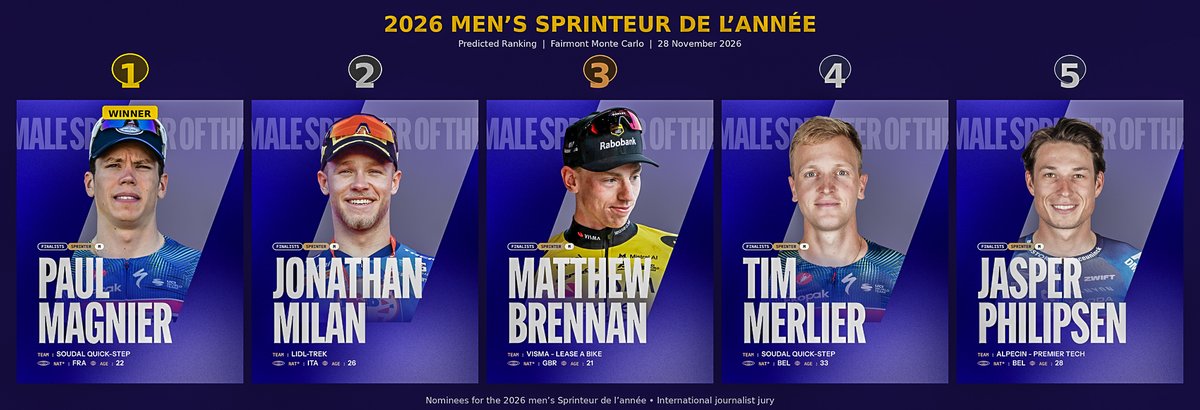
Nominees for the 2026 men’s Sprinteur de l’année (new award at the 28 November Fairmont Monte Carlo ceremony, decided by the international journalist jury):
Matthew Brennan (Visma-Lease a Bike, GBR, 21)
Paul Magnier (Soudal Quick-Step, FRA, 22)
Tim Merlier (Soudal Quick-Step, BEL, 34)
Jonathan Milan (Lidl-Trek, ITA, 26)
Jasper Philipsen (Alpecin-Premier Tech, BEL, 28)
This is the tightest field of the night because pure sprinting finally has its own prize, and all five had genuine cases built on volume, Grand Tour impact, WorldTour quality, or one-day prestige. The jury weighs consistency, the prestige of the wins, head-to-head results, and overall season narrative more than raw tallies alone.
Predicted ranking (top to bottom).
1. Paul Magnier (winner)
2. Jonathan Milan
3. Matthew Brennan
4. Tim Merlier
5. Jasper Philipsen
1st:
Paul Magnier is the most complete package and the clear favourite for a jury that has historically rewarded the rider who best combines volume with high-prestige results.
He finished the season with 15 professional wins — the most of any pure sprinter and second only to Tadej Pogačar in the entire men’s peloton. Those wins were spread across 10 different races, from February (two stages + points jersey at the Volta ao Algarve) through October (stages at the Tour of Guangxi).
That longevity and breadth matter.
The decisive block was the Giro d’Italia. He won stages 1 (Burgas, taking the maglia rosa), 3 (Sofia) and 18, and took the points classification — the only rider among the five nominees to win a Grand Tour points jersey.
He repeatedly beat Jonathan Milan head-to-head in that race (fourth behind Magnier in Burgas, second to him in Sofia, third on stage 18).
Beating the man who had the highest WorldTour win count, in a Grand Tour, is a powerful jury argument.
He is also the only one who combined more than ten wins, a Grand Tour points jersey and a WorldTour one-day race (Hamburg Cyclassics). That mix of quantity, a major classification, and a genuine classic-style victory is unique in the field.
At 22 he is the face of the new generation of sprinters, and he is French — a factor that has never been irrelevant at a L’Équipe-run ceremony, especially with a concurrent French Rider of the Year nomination.
How the others rank behind him:
2nd:
Jonathan Milan has the strongest pure WorldTour record (9 WorldTour wins, the most of any sprinter). He took three stages + points at the UAE Tour, three consecutive stages at the Tour de Pologne, the final stage of Tirreno-Adriatico, the opening stage of the Renewi Tour, and the Italian national road title. His track form was extraordinary (individual pursuit world title + world record under 3:59). Yet he managed only one Grand Tour stage (the Rome finale of the Giro) and lost the direct duel to Magnier. His UCI ranking was also the lowest of the group. Quality is high; the decisive head-to-head and the points jersey gap cost him the top spot.
3rd:
Matthew Brennan produced the single most historic result: five stage wins on his Grand Tour debut at the Vuelta a España (stages 2, 5, 11, 16 and 17). That had not been done since Fons De Wolf in 1979. He also won Kuurne-Brussels-Kuurne and finished with 12 wins overall and a strong UCI ranking (28th). The Vuelta haul is extraordinary and will collect votes, but the bulk of his success was concentrated in one race and he did not match Magnier’s breadth or Milan’s WorldTour volume. Many will see him as the outstanding rookie (he is also nominated there) rather than the outright sprinter of the year.
4th:
Tim Merlier was relentlessly prolific with 14 wins, including three Tour de France stages (7, 8 and 12) — the most of any sprinter in France — plus Scheldeprijs, three stages at the Tour de Hongrie and a double at the season-ending Eneco Tour. He is a proven, hard-to-beat pure sprinter. The case is volume and the Tour stages. He lacks a Grand Tour points jersey, a major one-day classic, and the same WorldTour density as Milan or the narrative of Magnier. Solid top-four, but not the winner.
5th:
Jasper Philipsen still had a strong season (10 wins, 7 at WorldTour level, highest UCI ranking of the group at 8th). He took Gent-Wevelgem / In Flanders Fields, the Copenhagen Sprint, Nokere Koerse, the overall and multiple stages of the Renewi Tour, the Tour of Belgium overall, and one Tour de France stage. He was competitive but was more often the hunter than the dominant force, and he did not match the others on either volume or Grand Tour stage count. A very respectable season that simply sits below the exceptional years of the top four.
The margin between Magnier and Milan is the narrowest of the five.
Everything else is clear. Magnier’s combination of the highest win total, the Giro points jersey + stages, the head-to-head supremacy over Milan, the WorldTour classic, and the full-season consistency is the most complete argument the jury will see.