I’m increasingly convinced that in ecom, a lot of growth is really a learning-speed problem.
Not just a traffic problem.
Not just a creative problem.
Not just a CRO problem.
A how fast your team can learn problem.
At a first-principles level, growth is usually a loop:
decide → test → observe → refine
The brands that compound faster usually shorten this loop across the system:
(a) creative production
(b) ad iteration
(c) PDP updates
(d) support/CX fixes
(e) retention execution
That’s also why AI matters: it can reduce cycle time.
Practical audit for this week:
1. Creative loop (idea → asset live)
How long does it take to launch a new concept?
2. Ad learning loop (launch → insight)
Are you testing real variations (hooks/CTAs) or just minor edits?
3. PDP loop (friction found → page updated)
Is the offer clear, trust visible and price easy to understand above the fold?
4. CX loop (issue → resolution)
What can be self-serve instead of ticket-based?
You don’t need 10 new tactics. You need to find the slowest learning loop in your system and cut that time first.
Doom-and-gloom, but thought-provoking. If you take this scenario seriously, how do you position over the next few years? Rotate out of long-tail SaaS, lean into AI infra + energy? And for founders: does this argue for “recession-resilient” product businesses (healthcare, repairs/maintenance etc.) over starting another SaaS?
I spent 100 hours over the past week researching, writing and editing the piece we just put out.
It’s a scenario, not a prediction like most of our work. But it was rigorously constructed, dismissing it outright requires the kind of intellectual laziness that tends to get expensive.
And we’ve released it for free. Hopefully you enjoy it.
https://t.co/YK8E11GcDU
I buy the “SaaS commoditization” piece. Once agentic coding makes feature velocity and parity cheap, differentiation collapses. That’s a direct hit to pricing power. A re-rating of multiples is rational, even if absolute demand for software stays high.
Where I’m less convinced is the timeline for “agents crush intermediation fees” (marketplaces/payments/commissions). That pressure is possible, but adoption won’t be uniformly fast. Trust, regulation, incentives and user inertia are sticky. If it happens, it feels more like a multi-cycle unwind than an overnight reset.
@palkush GoMarble!
This is super useful! Are you thinking about extending the agent's capabilities to include generating creatives, launcing ads on platforms and tracking results? 😃
📢Introducing GoMarble Creative Research - Perplexity for ad strategy
Ask a question → it searches your competitor ads → tells you what to test next
GoMarble has already analysed $1B+ in ad spend till now
Try for your brand: https://t.co/1R9dNadtuE
Operator notes from today’s scroll on e-comerce and paid media:
1) Align spend to the KPI you actually pay for. If you buy conversions, don’t “celebrate” CTR. Quick audit: does the same metric drive (a) bidding/optimization, (b) dashboard reporting and (c) weekly decision-making? If not, you’re scaling noise.
2) Creative iteration is the new throughput constraint. Not “AI hype”, just a workflow reality: teams that can test more hooks and variants usually find winners faster. Treat AI as a drafting engine, then apply human judgment on claims, compliance and brand voice.
3) Make UGC feel like a friend’s tip, not scripted copy. Provide the angle and compliance guardrails, then let creators keep their natural wording. For AI-assisted UGC: if it doesn’t pass the “would a real user say this?” rewrite or bin it.
I’ve become optimistic about AI-powered, personalized learning. I don’t think traditional schools are built for the future our kids are walking into.
The issue isn’t teachers. It’s the model - one pace, one lesson, one classroom. Some kids get bored, some fall behind and report cards can hide real gaps.
What excites me about the Alpha style approach is how practical it is. Start with diagnostics, find the gaps, fix them, then let the child move forward at their pace.
The magic isn’t flashy AI. It’s the loop - frequent check-ins, instant feedback and lessons that stay just hard enough to be motivating.
And if core academics can be done in 2 to 3 focused hours, the rest of the day can be used for the stuff that matters even more in an AI world (communication, projects, teamwork, life skills, time outdoors etc.).
I think we’re heading to a world where personalized learning is normal. Schools that don’t adapt will feel like they’re preparing kids for a past that no longer exists.
Impressive stats! @jliemandt for parents outside of the US whose children are enrolled in "traditional schools", how can we get access to Alpha School's AI-powered academics to supplement their education? I fear these schools are not preparing them for the realities of what will face them in 10-20 years.
Google search trends used to be “nice to know.” Now it’s cheap enough to run weekly, automatically.
With automation + scrapers , you can track a defined keyword set and get a simple mover table: current 7-day avg vs previous 7-day avg + WoW %.
Why it matters: Trends is a proxy for shifting intent. Not perfect demand, but good enough to steer decisions fast.
How I’d operationalize it:
(1) Paid search: if a cluster is rising, re-assess budgets selectively and test fresh ad + landing copy aligned to that intent.
(2) Content/social: turn the top movers into next week’s content calendar.
(3) Merch/offer: spotlight what’s trending in your homepage modules.
Do be mindful:
(a) Trends is relative, can be noisy at low volume and spikes ≠ sales.
(b) Validate with your other signals (on-site search, PDP traffic, conversion).
This is the kind of small dashboard that keeps teams focused on where demand is moving, not opinions.
This is how I’ve been building lately:
1) Define what “good” looks like (clear output spec)
2) Turn that into a roadmap.
3) Automate the boring bits (collect → clean → format).
4) Spend my time on decisions - what to ship, what to cut, what to test next.
AI didn’t remove work, it moved the bottleneck to standards and iteration speed.
This hit me because it feels both exciting and unsettling. The upside is obvious, but so is the risk of whole categories of “screen work” shrinking fast. I also keep thinking about what this means for kids growing up into a highly uncertain world. My conviction for now, as you point out: build adaptability. Use AI daily on real work, keep sharpening your judgment and stay calm in the unknown.
@ecomTrevor Quick question - Did adding the phone number change anything operationally i.e. more calls? Feels like a great lever, but interested to understand your rule-of-thumb on when the sales uplift is worth the extra human bandwidth.
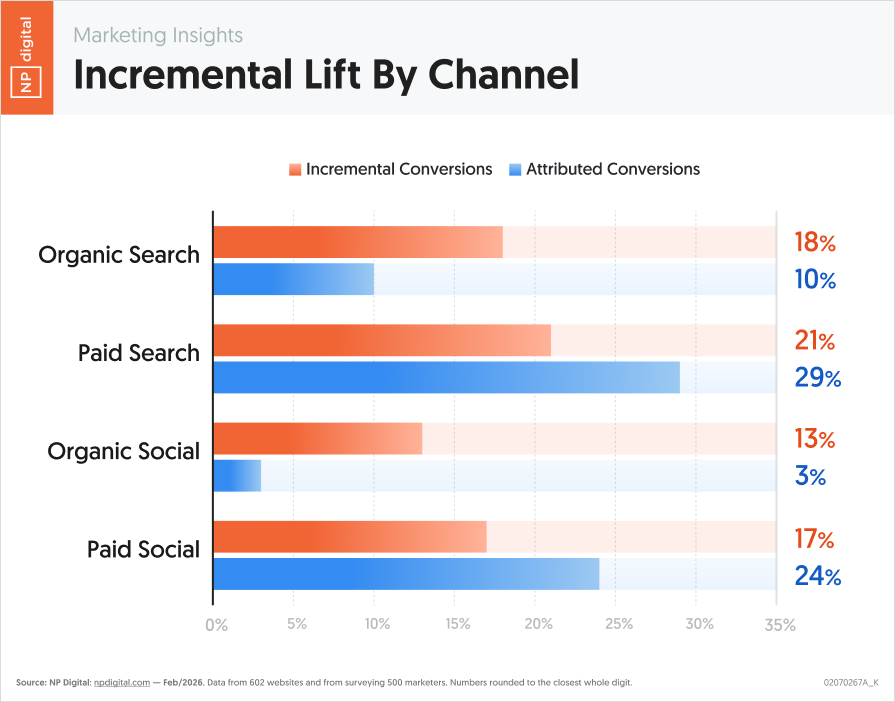
A lot of “great” channel performance may just be great attribution.
Neil Patel makes a useful point: some channels drive conversions that don’t show up cleanly in dashboards, so you need to look at incremental vs attributed results, not just last-click.
Run a simple "on vs off" test - pause one channel in one region for a week (or briefly increase spend) and see if total sales change. To reduce bias, run these tests in a normal week (avoid promos/season peaks) and keep everything else unchanged.
Some marketing channels show they drive many direct conversions.
And some drive conversions, but they don't always show up the way you want in your analytics.
Check out how channels perform from incremental versus attributed conversions.
@hnshah If AI does more of the technical work, humans become the explorers. Exploration is in our nature, now turbo-charged by AI. Pick direction, ask better questions, keep moving when the map is blurry. So I’d teach: problem framing, proactive ownership and making trade-offs.
Operators are dealing with two shifts at once. AI is becoming part of “how we check our work,” and e-commerce unit economics are increasingly about automation coverage.
What I’m taking from recent threads - in any situation where being right matters, it’s becoming risky not to run a LLM pass (second opinion, error-check, edge cases, “what am I missing?”)
Decision rule for the week: make AI a required QA step for high-impact work.
Define “high-impact” as your needle-movers: bets that can create a step-change in traffic, conversion rate, order velocity or AOV. Don’t overwhelm your team by trying to QA everything. Start with the biggest decisions, observe where AI actually helps (or misleads), then progressively embed it into decision-making across a wider range of topics.