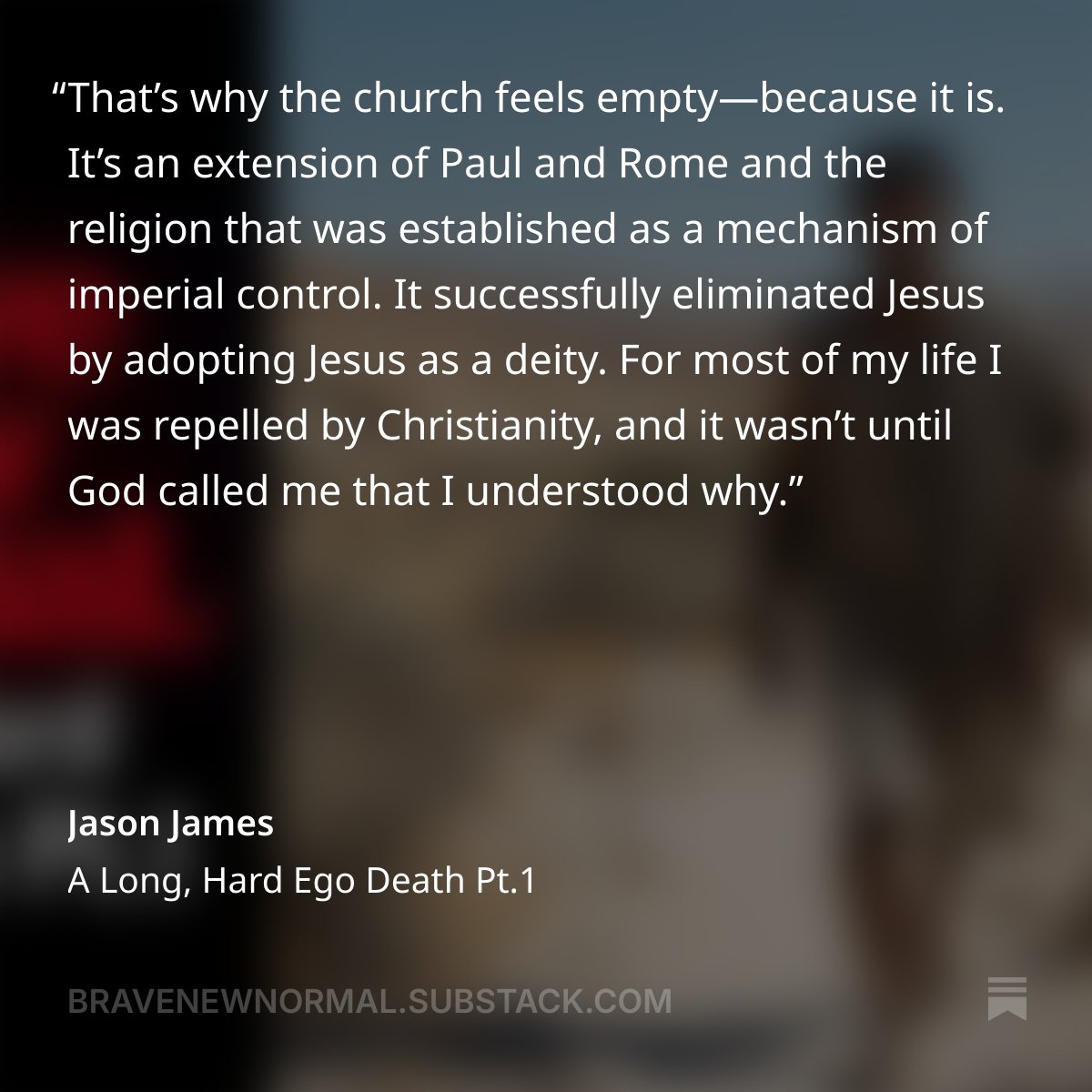
Have you ever thought of yourself as a church exile?
On this episode of The Restore Report, Lance Ford and Julie Roys talk with Christians who still love Jesus but can't return to church as they've known it. For some it was spiritual abuse or betrayal. For others, nothing dramatic happened — they simply reached a point where church culture stopped resembling what they kept finding in the New Testament.
https://t.co/oqInlBWSyO
@crzy8ers@Savage16May I’ve been grilled at sweet grass… all because I asked about the new visa rules for staying more than 28 days. I was told I watch too much news haha.
@MikeWingerii Attending church services is not biblical. It is a distortion of ekklesia that attempts to commodotize Christ's body - usually for the ego and pocketbook of one professional narcissist whom the whole body is expected to revolve around. https://t.co/nPoXZr9YCM
My deep dive into the COVID scam started in the very early days because I wanted to prove to myself that it was still safe to go on my trip to Peru...scheduled for March 20, 2020.
As soon as I saw the data from Italy, I new it was all a scam, but I was powerless to do anything, and the authorities closed the border.
In the video below, I'll recount what I learned, and why Fauci, Tam, Hindsaw, Trudeau, Jenney and countless others need to be held accountable for destroying millions of lives.
1/
@farmingandJesus Theologically, yes. Practically the similarities are striking. Take out the whole confession thing, and in both cases you have a man (or a small group) who speaks on behalf of God. A “Moses” model instead of a Jesus model.
A message to our hose church today thought I would share it with you.
Revelation is the difference between actually visiting a faraway place and merely looking at a postcard of that place. At best, the postcard only helps you recognize the real thing once you’ve finally seen it for yourself.
Paul expects us to gather regularly so that we can both give and receive revelation among those we assemble with.
How important is this?
When someone is speaking and another person receives a revelation, the one who is speaking should stop and sit down so the one who received the revelation can speak.
This is completely backward from the way I have thought about it my entire life.
But Paul says it plainly in 1 Corinthians 14:
“Two or three prophets should speak, and the others should weigh carefully what is said. And if a revelation comes to someone who is sitting down, the first speaker should stop.”
Stop? Let the other one speak? Is that even in the program? ( :
Revelation is primarily for the church. What God is saying in the moment often has an expiration date—that is why Paul directs the first speaker to stop and make room for what the Spirit is saying right then. Manna gets old quickly.
Blessed are those who put themselves in a place to give and receive revelation on a regular basis.
Daily meals should be our goal, just as Jesus taught us to pray, “Give us this day our daily bread.”
My prayer for us:
“Lord, give us this bread always.”
—John 6:34
@farmingandJesus Final interpretive authority on Scripture —disagreements often mean leave and find another church
Personal teachings, style & vision shape the entire congregation’s culture more than the Bible alone
Members treat them with elevated reverence, seek their approval on life decisions
@DavidOhlerking@MattSmethurst The Bible tells us to meet together with other Christians to share and build one another up. It does not tell us to go to a building and listen to a monologue.
That is just human tradition.
@thelaconist@5Solas One of the things that God chooses to do is to limit himself to make himself knowable. He chooses to fortell the future (and limit what he can do) he chooses to make promises (that limit him)
This makes him knowable, the exact opposite of Allah who is essentially random
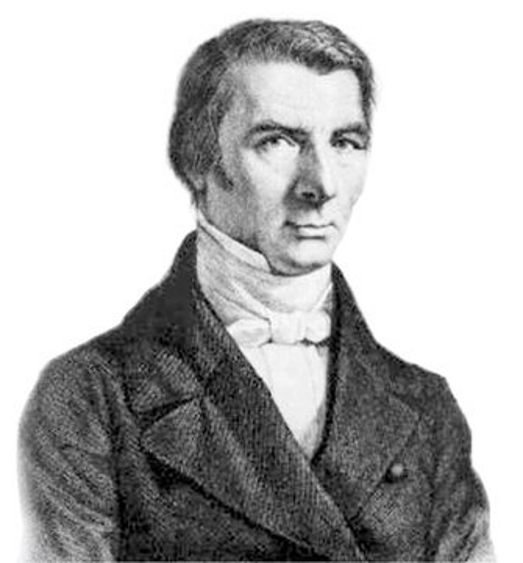
Frédéric Bastiat captured the essence of modern politics in a single sentence:
“The State is that great fiction by which everyone tries to live at the expense of everyone else.”
Once the state becomes the primary mechanism for distributing resources, politics stops being about protecting rights or creating the conditions for voluntary cooperation. It becomes a contest in which every group attempts to extract wealth from others through taxation, subsidies, regulation and welfare.
Farmers demand agricultural subsidies. Pensioners demand higher benefits. Students demand free tuition. Corporations demand bailouts and protection from competition. Each group frames its demands as a matter of justice or necessity, while ignoring that the money must come from someone else’s labour and property.
This creates a deeply corrosive dynamic. Instead of producing value through trade and innovation, people invest time and resources in political activity designed to redistribute existing wealth. The result is not greater prosperity, but higher taxes, expanding bureaucracy and a culture of dependency, victimhood and resentment.
The state transforms society into a zero-sum game. When everyone is encouraged to view government as a source of unearned benefits, the moral and practical foundations of a free society are steadily undermined. The fiction eventually collapses under the weight of its own contradictions.
I love and hate prepping someone for a deposition.
To make them understand how a deposition works, the first question I ask is, “Do you know what time it is?”
Nearly every single time, the person will either check his or her watch, or look up at a clock. Then, they will say “Yes, it is 10:30.”
At this point I just smile and shake my head. “No.” Then, I explain why their answer is wrong:
I asked if they knew the time. Not what time it was currently.
Me: “So what would your answer be then?”
Witness: “Yes.”
Me: “Wrong.”
They didn’t know the time, because they had to look at a watch or clock.
If you are ever deposed and do not have a bitch like me prepping you, remember this key: Listen to the question and answer only what is asked. And only what you actually know or recall.
No charge for this advice.
A wife went viral for admitting she and her husband are mediocre. Average looking, not funny, no friends, mentally ill. And she can't explain why their marriage feels like a fairytale.
A psychologist in Seattle solved this exact puzzle in the 1990s.
John Gottman wired an apartment near the University of Washington with cameras and brought in 130 newlywed couples to just live in it. He tracked something he called bids: the tiny reaches for attention partners make all day. "Look at that bird." "Listen to this." A sigh that wants acknowledging.
Six years later, 17 couples had divorced. When his team went back to the tapes, the still-married couples had turned toward those bids 86% of the time. The divorced couples had managed 33%.
That one behavior predicted the outcome better than anything else in the data. Looks never entered the model. Humor never entered the model. Intelligence, money, status, shared hobbies: none of it showed up.
Now reread her post. "I can spend every minute of every day with this dude and not really get tired of it. We can get in the car and just drive for hours and talk."
Two people driving nowhere for hours are exchanging hundreds of bids and catching nearly all of them.
She graded the marriage on every trait that predicts nothing, and missed that they're elite at the one behavior that predicts almost everything.