Emergency departments often see a spike in injuries around Thanksgiving, including cuts from holiday meal prep.
In its look at common holiday cooking injuries, @ConsumerAffairs highlights ACS guidance on preventing kitchen cuts and responding if one happens. Simple steps like using a stable cutting board and applying firm pressure to control bleeding can make a difference.
Read the article: https://t.co/GYuBlcI5EU
Two services in one visit still mean two kinds of work. Medicare’s new rule reduces payment for certain visits and procedures provided on the same day.
ACS’s Thomas Tsai, MD, FACS, explains the concern in Becker’s 👇https://t.co/m4fG23YVCv
ACS medical student and resident members: submit a 500-word abstract on a state or federal advocacy effort for a chance to present at #ACSLAS27. Selected presenters receive $500 toward travel.
Deadline: November 23. Review the requirements: https://t.co/aCvYhuCiFT
In the latest ACS Bulletin, Joseph V. Sakran, MD, MPH, MPA, FACS, and Robert P. Sticca, MD, FACS, explain opportunistic bilateral salpingectomy: removing the fallopian tubes during another abdominal or pelvic operation when appropriate for the patient. https://t.co/9u192aCQBJ
Could one doctor’s visit become two?
NBC News examines how Medicare’s new rule could affect same-day care and includes the ACS’s opposition to discounting distinct visits and procedures.
For people on Medicare, a trip to the doctor for a sore knee or a suspicious spot on the skin ends with a quick shot or a biopsy. Starting next year, they may have to make multiple visits. https://t.co/M4uzISTA8G
General surgeons may have an opportunity to help reduce ovarian cancer risk during planned surgery.
A new ACS Bulletin article explores the evidence for removing the fallopian tubes during another procedure and why the conversation starts before surgery. https://t.co/0uDjjywd9j
What can surgical research tell us about micromobility injuries, access to cancer surgery, and care for people with Crohn’s disease?
Three new @acsJACS studies take on those questions. Swipe through the findings below. 👇
New research in JACS examines micromobility injury, access to cancer surgery, and outcomes after Crohn’s disease operation.
Scroll through for a finding from each study, then read the full articles:
➡️Micromobility Injury Patterns and Resource Use in US Trauma Centers: https://t.co/FWxP9tYxi8
➡️Gastrointestinal and Hepatopancreatobiliary Cancer Surgical Deserts and Population Cancer Mortality: A National County-Level Analysis: https://t.co/dIzH0JNcO1
➡️Preoperative Advanced Therapy Use and Anastomotic Complications After Elective Surgery for Crohn’s Disease: https://t.co/JTGzS21kIK
AI is becoming part of surgical care, raising questions about how it informs decisions and what patients should know. The ACS is bringing surgeons’ experience into the policy conversation through its AI & Surgery: Leading in Policy Development series.
Explore the first session: https://t.co/G1zX94ujHL
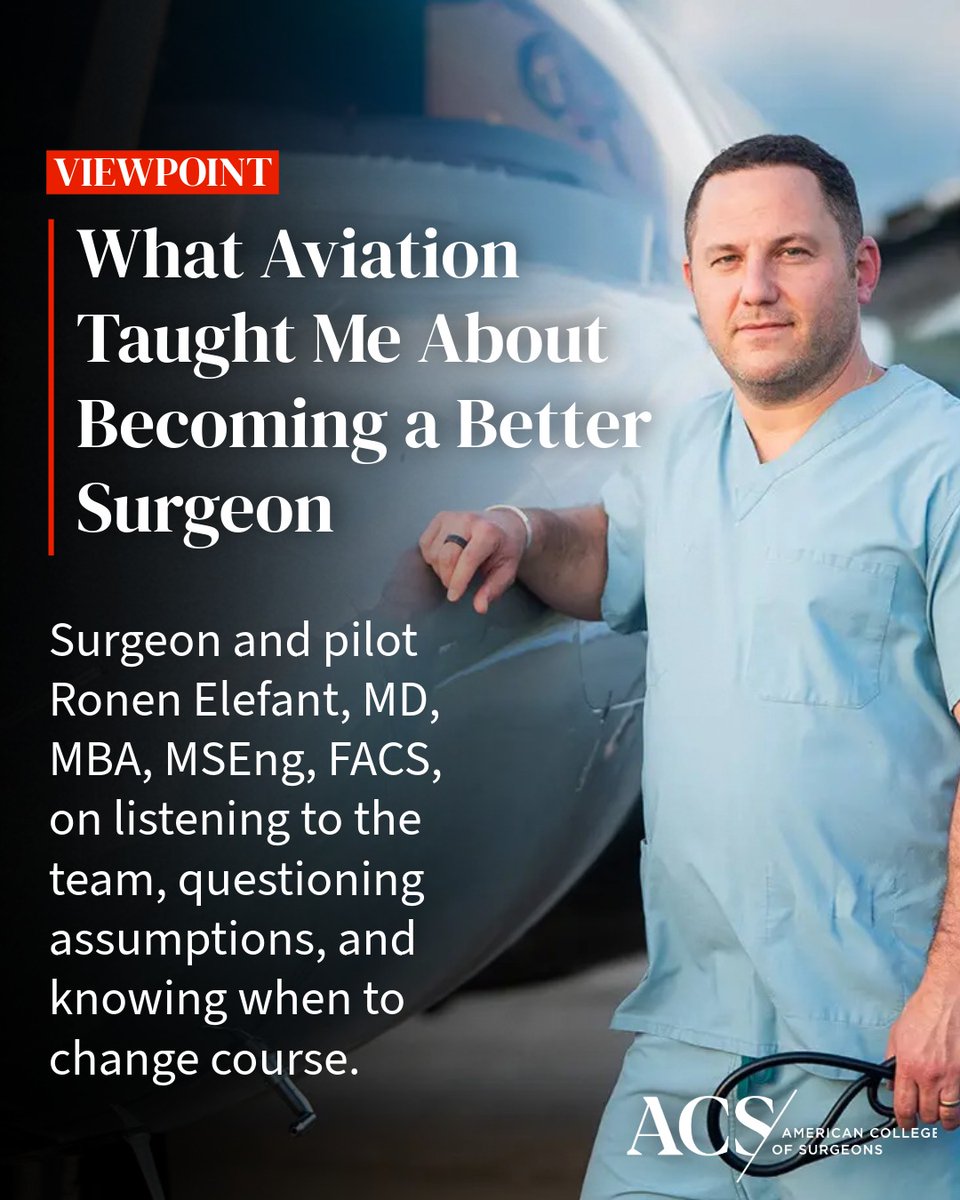
When a flight doesn’t go to plan, pilots must know when to change course. Ronen Elefant, MD, MBA, MSEng, FACS, sees a lesson for surgery: question assumptions and listen when teammates speak up.
Read his ACS Bulletin viewpoint: https://t.co/i06iYYO8yz
GTA VI has missions. Surgical residents have the 2 a.m. page. 🎮
The ACS Fundamentals of Surgery Curriculum® lets residents work through virtual patient cases and practice clinical decisions before facing them in real life.
Explore ACS FSC: https://t.co/hTiC7rBfZ3
Pursuing a surgical leadership role? The ACS Pathways to Surgical Leadership seminar brings Associate Fellows and Fellows together to learn from surgical leaders and explore their next steps.
April 10 in Washington, DC | #ACSLAS27
Apply by November 30: https://t.co/kbkAbtRVCI
Surgery in space sounds like science fiction. Surgeons are already studying it. 🚀
Join former NASA flight surgeon Mark Campbell, MD, FACS, on Nov. 19, 1–2 p.m. CT, to explore the history and challenges of surgical care beyond Earth.
Register: https://t.co/aP8IH28evn
One in four older adults falls each year. This #NationalInjuryPreventionDay, the ACS is calling for fall risk assessment before the first fall.
Read our recommendations:https://t.co/nD01eCvhCL
ACS members can apply for a $12,000 tuition award toward Brandeis University’s Executive MBA for Physicians. The program is designed for practicing physicians who want to build skills in leadership, policy, and innovation.
Apply by November 20: https://t.co/iK7zqjwBS2
“Please try again later” has made a lot of appearances lately.
For surgical practices, a system outage can disrupt more than a workday. What’s your backup plan when a service you rely on goes down?
A 2025 ACS Bulletin story shows why preparing matters: https://t.co/J7pZJRUEUj
#TQIP26 in one word. 💬
A big thank you to everyone who joined us in Anaheim to share ideas, strengthen partnerships, and celebrate what makes this community so special.
We really are better together. See you next year in Las Vegas!
Please join us in saying congratulations to the surgical team at Baptist Medical Center South on being named one of 42 hospitals to receive meritorious recognition from the American College of Surgeons (@AmCollSurgeons) for our surgical outcomes in both all cases and high-risk cases! 🏆
This recognition was derived from a score based on eight risk-adjusted outcomes measured 30 days after surgery. While some hospitals received the recognition for all cases and others for high-risk cases, #BaptistSouth was one of only 42 hospitals in the country to be recognized for both.
This is a wonderful testament to the surgical team's talent, expertise and meticulous attention to detail, all of which play a critical role in keeping our patients safe. It's humbling to receive this recognition, and we hope you'll join us in praising this amazing team in the comments! 💙
Learn more about what this recognition represents here: https://t.co/oYaWUBwZN8
@nbcsnl's “Sister” sketch sparked an important conversation on caregivers and support for older patients. While the elder care service depicted may be fictional, the obstacles facing both caregivers and older patients after operation are real.
A qualitative study by Zeineddine and colleagues found for older adults recovering from fecal ostomy surgery, care-partners played a critical role in providing emotional support, ostomy care, transportation, meal preparation, and assistance with daily activities. However, patients frequently encountered unanticipated support needs, inconsistent care-partner availability, reluctance to ask for help, and financial burdens on caregivers. The findings highlight the importance of identifying care-partners before operation, anticipating recovery needs, and developing individualized support plans to improve preparation for recovery after discharge.
Find the full study at: https://t.co/JdZpJ9HXdZ
The ACS has released new Best Practices Guidelines for Transfusion in Trauma to help trauma teams coordinate care from the scene of injury through the hospital.
Learn more: https://t.co/SAbunAXAMP