AMEA Unleashed is on 7 channels. Today they carried gas from Israel to Egypt, an Abu Dhabi bid for a miner in Mozambique, Malaysia's data centres and the plan for the World Cup's commercial rights, and they can be followed wherever it is easiest.
X, for the posts as they go out and the replies under them, https://t.co/Eu61RWJujd
Telegram, for the posts in order in one quiet channel, https://t.co/xt1o9g9VLI
YouTube, for the short videos, https://t.co/1NZndZPbG5
Instagram, for the videos and the posts as slides, https://t.co/b7ZxFeWv6G
TikTok, for the videos and the slides, https://t.co/XdbvsVqfBb
LinkedIn, for readers who work on these regions, https://t.co/hO64Xhj5bb
The website, for the long articles by email, https://t.co/zVSut3QsFc
Please follow 1 more of them today.
Serbian car workers are about to be counted at a door Brussels built against China. Kragujevac first made Fiats in the 1950s, and at least 4,500 people there now build the Panda, hybrids included. From 1 December, the EU limits how many hybrids Serbia and Morocco can send it, at yearly levels that both of them passed in the twelve months to June. Morocco is in deeper, because Chinese firms have committed close to $10bn there, much of it to reach Europe with a Moroccan stamp. On hybrids, the stamp now has a ceiling. https://t.co/RYHuVeBvg2
Gulf lending to Pakistan did not end when the UAE took back its $3.45bn in April, whatever people say. It moved to the petrol pump. On Sunday, in Muscat, Oman's OQ Trading agreed a $200m credit line for Pakistan State Oil to buy fuel, after delivering more than 1m tonnes of petrol this year, so the seller is now the lender too. Riyadh had already put in $3bn to cover the Emirati exit. Sad, for a nuclear state. On Monday, dealers speaking for about 14,000 stations gave Islamabad 15 days to scrap daily pricing or they shut. Who does a government answer to when its supplier holds its tab?
Alibaba opened its sixth data centre in Malaysia last week, and by Tuesday the Malaysian government was preparing to tell operators whom to turn away.
Washington had put 7 firms on its trade blacklist on Monday, an Alibaba company in Singapore among them, and Alibaba calls the listing an error. Malaysia says it will not be a channel around American export controls, so its operators will be advised not to host, lease space to or serve any of the 7.
The same pressure reaches the Gulf. An American rule in force since 19 November asks for a licence when large amounts of advanced computing power go to firms headquartered in China, wherever the data centre stands. Alibaba runs its cloud in Riyadh with stc, the state-controlled telecoms company. In Abu Dhabi, G42 can buy advanced American chips without a licence until 6 April 2027. To keep buying them, it must become an American company or ask again. On Friday, Trump said that American companies will not be allowed to build data centres abroad at all.
That is a lot of oil money tied to buildings whose tenants another government can refuse.
Reader subscriptions keep this coverage going, at https://t.co/fzns4WlTpQ.
FIFA was ready to move the World Cup's commercial rights into a private company for up to 96 years, leaked files show. Investors led by Joshua Kushner, whose brother Jared is Trump's son-in-law, would have held part of it, and FIFA's own share could have fallen to 51%, against the 80% presented in July. Managers stood to earn $50m for every $1bn added to a $20bn valuation. FIFA dropped the plan on 1 August, after 3 continental confederations rejected it. It says its members would have had to approve it, and that FIFA officials could not have shared in the bonuses. UEFA is asking US courts for the documents, with a view to possible criminal action in Switzerland.
No Gulf fund was named in that plan, but Gulf money stands behind the family's other firm. The biggest backers of Jared Kushner's Affinity are the Saudi and Qatari wealth funds and Abu Dhabi's Lunate, and in August it joined the Saudi fund in buying Electronic Arts, the maker of EA Sports FC, for about $55bn.
The UAE has its own football trouble in England. An independent commission upheld 114 of 115 charges against Abu Dhabi-owned Manchester City, and found that sham commercial deals had improved its accounts by £900m. City says it is innocent and is appealing. Emirati officials have reportedly warned London that the ruling could reduce their appetite for large investments in the UK.
The Kushner plan and the Gulf's purchases look for the same thing, an exclusive right that pays rent for as long as possible. Football is being financialised and rentierised, and Europe is where the fight over it is now.
Uzbekistan's president promised about 40 investment projects worth $1.5bn in Jordan on Tuesday. The 2 countries traded between $12m and $45m in the whole of 2025, depending on whose count is used, and most of what Uzbekistan sells there is sweets, biscuits and dried fruit.
Jordan's own market explains little of this. Unemployment is above 21%, and the economy is expected to grow by 2.7% this year. What Amman offers is a position. It borders Syria, the West Bank and Israel, it is training police for Gaza with Egypt, and its king has a direct line to Washington and a religious standing that other Muslim leaders respect.
Indonesia's visits point the same way. Its president was in Amman in April 2025 and again in February, when he repeated an offer of up to 8,000 soldiers for Gaza and Jordan said it would support them. In between, the king went to Jakarta, where the 2 sides agreed to share intelligence on Gaza. Uzbekistan has joined the same Gaza board as Indonesia and said it would help to rebuild, without sending troops. On 6 November, the king also co-chaired a security meeting of Central Asian leaders in Astana.
Uzbekistan's ties to the Arab world already pay. Gulf investment in the country rose from $400m in 2020 to $11.3bn by the middle of this year. Uzbek companies now plan to look for uranium and rare metals in Jordan, and Jordan is selling itself as the base for investment in Syria. For Tashkent and Jakarta, Amman is a way into Gaza, Syria and Washington at once.
Morocco gets its direct flights from Israel back on 21 December, when El Al returns to Marrakech twice a week, with Arkia due on 4 January. Israel's Arabic account announced it with a painting of an old woman in Moroccan dress hugging a young woman with a suitcase, under the words "hearts longing to meet".
A day after El Al's announcement, King Mohammed VI wrote to the UN that he places the Palestinian cause at the level of Morocco's own national cause.
The flights had restarted in August, and were stopped by something that happened on the way from Dubai. On 30 September, a flydubai co-pilot attacked his captain on a flight to Tel Aviv, and Emirati prosecutors called it an attempted terrorist attack. Israel tightened security, including for flights on leased foreign aircraft, and El Al, Arkia and Israir all put off or stopped their Marrakech flights. Israel's transport minister has now cleared flydubai to come back too, if the security services agree. A Moroccan route and an Emirati one closed over the same incident, and they are reopening within weeks of each other.
The military side never stopped. The director general of Israel's defence ministry was in Rabat on 9 November, Israel is opening its first permanent defence attaché office there, and Morocco approved $14.7m for 2 unmanned boats shipped from the Netherlands, reported to be the Seagull of Israel's Elbit.
Tourists are far behind. Counts of Israeli visitors before the war run from about 70,000 to 100,000 a year, and up to 20,000 were expected this year. Moroccan civil groups called for the flights to be cancelled when they restarted. The painting puts a family face on ties that were kept going by the military.
Sudan looks set to send fighters to Saudi Arabia's war in Yemen again, with its own war unfinished. On Sunday, Abu Aqla Keikal, who leads the Sudan Shield militia, said several of his battalions will deploy abroad, now that they hold army service numbers. He named no country, but he came back from Saudi Arabia on 19 November, and Sudanese reports put the plan at 2,000 men, then 10,000 over 18 months. In 2015, Khartoum sent the RSF. It came home with Gulf money, and in 2023, it turned on the army. A Saudi family is spared some of the cost. Sudanese sons get two wars, two, and the funerals.
Malaysia will tell its data centre operators not to host, lease space to or serve 7 companies, a day after Washington put them on its trade blacklist. The US lists 3 of them under Malaysia, although Kuala Lumpur says 1 is not a Malaysian entity, and another is a Singapore unit of Alibaba, which says the listing is wrong.
Washington will not sell China the best Nvidia chips, and Chinese firms have been renting them in other countries instead. A US rule in force since 19 November goes after that. Chips now need a licence if they are headed for a data centre, wherever it is, that will give large amounts of computing power to a company headquartered in China. Centres already doing this have until 17 February to get one. Malaysia has approved 117 data centre projects and leans on Chinese tenants, and its trade minister says anyone who wants to stay in the game has to follow US regulations.
The Gulf looks next in line, because the rule does not stop at Johor. Alibaba, Huawei and Tencent all run cloud regions in Riyadh, and Alibaba's is a joint venture with stc, the state-controlled telecoms company. In Abu Dhabi, G42 can buy advanced US chips without a licence only until 6 April 2027, unless it becomes a US company. Both capitals can expect to be asked for what Malaysia has just done.
On 20 November, Trump said US companies will not be allowed to build data centres abroad, because China "will take all of them", and threatened a heavy tax on those that do. So the Gulf is under pressure over its Chinese tenants, and over the US companies building there too.
Drones struck 2 of Amazon's data centres in the UAE in March, and damaged a third site in Bahrain, during Iran's attacks on the Gulf. Data centres are now another area of warfare.
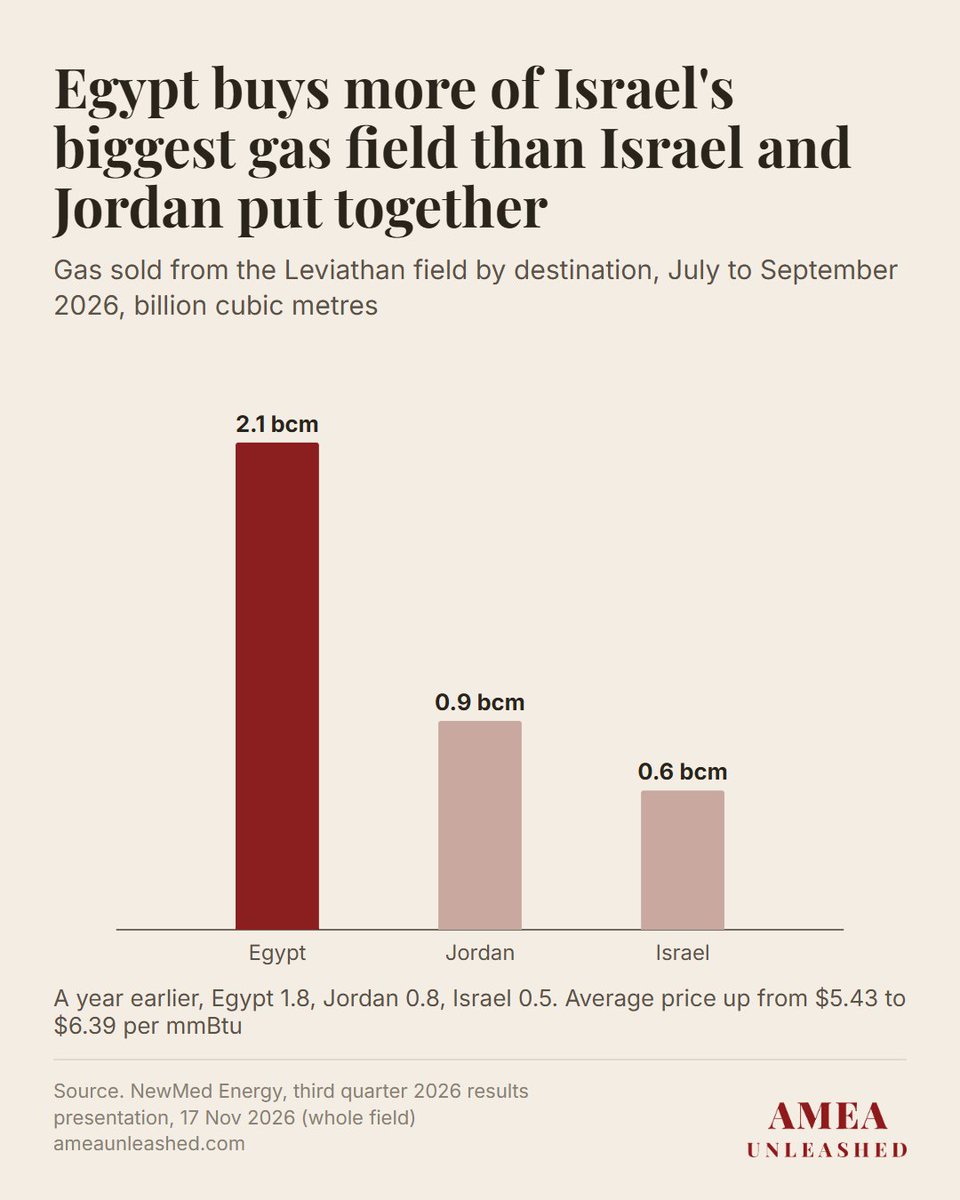
Egypt bought 2.1 of the 3.6 billion cubic metres of gas that Israel's Leviathan field sold in the third quarter, more than Israel and Jordan put together, and the chart showing it went up this morning. Earlier came the Abu Dhabi miner weighing a £352.8m cash offer for Kenmare, which digs its minerals out of the Mozambican coast.
On most apps, whether anyone sees either of those is up to an algorithm. The Telegram channel just sends them, charts included, one after the other from Asia, Africa, Europe and the Middle East, and it can be muted and read at the end of the day.
Telegram https://t.co/xt1o9g9nWa
Join there to get the posts as they go out.
Egypt bought more gas from Israel's biggest field this summer than Israel and Jordan put together, and the war made that gas dearer.
Egypt took 2.1 of the 3.6 billion cubic metres Leviathan sold between July and September. The average price across all buyers rose to $6.39 a unit, from $5.43 a year earlier, because Israel's export contracts follow the oil price, and the closure of Hormuz pushed oil up. The field took in a record $843m.
Egypt has already seen this supply switched off. Israel halted it at the end of February, when the attack on Iran began, and by mid-March Cairo was getting about 50 million cubic feet a day, down from 1 billion. And it still came back for more than last summer. Cairo can be as angry as it likes about Gaza, but every row with Israel now carries a risk to its gas.
A pipeline through Nitzana, on the border, is due in late 2028.
Abu Dhabi has asked Mozambique to name its tax bill on a titanium project in advance, and the amount has to be to the buyer's satisfaction.
That condition is in the terms that International Resources Holding and Kenmare published on 23 November. The Emirati firm may pay £352.8m ($461.6m) in cash for Kenmare, the Irish company that runs the Moma project, and it has until 15 December to say yes or walk away. It also wants Maputo to approve the change of owner "without any material amendment" to the contracts. A modest request, made to a government whose renegotiated terms only reached the company on 29 October.
In 2002, Mozambique gave Moma a 1% royalty, no corporate tax, no VAT and no duties. Moma got built, and those terms lasted more than 20 years. The renewal takes the royalty to 3% from 2025, 4% from 2030 and 5% from 2035 to 2044. A poor country waited two decades for a bigger share of its own sand, and before the addendum is even complete, the next owner wants it frozen.
The timing is clever, in a grim way. Mineral sands prices are weak, Kenmare has paused its dividend and owes $175.8m net, and without a bridge loan from the same buyer it expects to ask shareholders for at least $50m early next year. Last year, another group proposed 530p a share. Abu Dhabi is at 380p, and the board is minded to recommend it. The same buyer took Zambia's Mopani copper operation in 2023 for $1.1bn, and in 2025 it bought 56% of Alphamin, whose Congolese site digs about 6% of the world's tin. Moma supplies about 6% of the world's titanium feedstock, the raw material for white paint and jet parts.
Somalia expelled the Emirati ambassador on 19 November.
None of that slowed the buying further down the coast. Saudi Arabia, Turkey and Egypt are lining up against the UAE on the Red Sea, and Abu Dhabi, pushed out of one capital, is collecting the metals further south. Expect Maputo to answer the tax question quietly, and expect Moma to be in Emirati hands by the end of June 2027.
AMEA Unleashed is paid for by its readers, at https://t.co/fzns4WllAi.
Abu Dhabi is buying the yards where Southeast Asia builds its offshore oil and gas equipment, and a Malaysian company is the one selling.
On 23 November, NMDC Energy, the Abu Dhabi-listed arm of NMDC Group, signed a conditional deal to buy 100% of Wasco Berhad's engineering, fabrication and process engineering business for an enterprise value of $210m. That brings more than 500,000 square metres of yards, a 380,000 sq m site in Batam in Indonesia, a 110,000 sq m process equipment yard in Malaysia and a 25,000 sq m facility in Jebel Ali.
The buyer gets more than space. NMDC has worked in shallow water. Wasco's yards take it into deepwater floating production units and the prefabricated electrical rooms that LNG plants and data centres need, along with a client list of international operators and contractors. It says the aim is bigger engineering and construction contracts, bid from three countries.
The seller bought the Batam yard from Australia's MMA Offshore in 2022 for $15m, to take on larger international projects itself. Did that work out? Not as a Malaysian story, since four years later the business built on that yard goes to a Gulf state contractor.
Indonesia hosts the biggest of the three yards and has no part in the deal. Batam's welders will build for an owner in Abu Dhabi, a hard thing to watch for anyone who hoped the region would grow its own champions. The UAE has spent this month losing ground in Somalia, where its ambassador was given 72 hours to leave. In Asia, it keeps buying.
Wasco's shareholders and regulators still have to approve. Expect the deal to close in the first quarter of 2027, as NMDC says, and expect its first bids from the Batam yard on deepwater work around Malaysia and Indonesia before the end of 2027.
The Houthis took Yemen's whole Red Sea coast in September, Mokha, Perim and the Hanish Islands included, and now sit about 20 km from Africa. Every outside power that still wants a say over the sea has to build on the African side.
Egypt, Saudi Arabia and Türkiye back one camp there. The UAE, Israel and Ethiopia back the other. Somalia cancelled every Emirati port and base deal in January, Israel recognised Somaliland in December 2025, and the UAE's share of Sudan's official gold exports fell from 99% in 2024 to 56% in 2025. Traffic through Bab el-Mandeb was still 46% below its pre-crisis level in October.
The wars in Sudan, Tigray and Somalia's regions are fed from outside, because a local winner would hand its backer the western shore. Nobody holds it yet.
The full piece is free on the website. https://t.co/INQZAfnsYf
Reader subscriptions pay for this reporting, at https://t.co/fzns4WlTpQ.
Footage and photos unverified, shared on X by @iranconflict_ar and @MansourAlhrpfl. Other photos via Wikimedia Commons.
The Houthis now hold Yemen's whole Red Sea coast, so the fight has moved to the African side. Egypt, Saudi Arabia and Türkiye back one camp, the UAE, Israel and Ethiopia another, and the wars in Sudan, Tigray and Somalia's regions follow those lines, over ports, Sudan's gold, a seabed of metals and the cables between Europe and Asia. Nobody holds the western shore yet. https://t.co/INQZAfmV8H
Uganda has sold the right to sell its oil before a barrel of it has left the ground, and the holder of that right is registered in Bahrain. On Friday, the state oil company signed a ten-year deal making Vitol Bahrain the sole marketer of all the government's crude, at 66 cents a barrel, tied to a $2bn credit line from the same trader signed in December 2025, with repayment, sources say, riding on that same oil. Lend the money, sell the oil that pays it back (tidy). The first tanker out of Tanga will load under a Manama contract.
MENA Unleashed is now AMEA Unleashed, and it covers Asia, the Middle East, Europe and Africa.
The MENA label grew out of the borders European empires drew after the First World War, and it no longer describes how power, money and security move through the region. Gulf capital now finances ports, power grids and data centres from Central Asia to East Africa, and most of the region's oil and gas is sold to China, India and the rest of Asia. Saudi Arabia's defence pact with Pakistan grew in August into the Mecca Defence Alliance with Türkiye. Israel, Türkiye, the UAE, Saudi Arabia and Qatar compete across the Horn of Africa and the Sahel, a Greece-Israel alliance is reshaping the eastern Mediterranean, and Indonesia has pledged up to 8,000 troops for Gaza. Indian labour ensures the survival of the UAE.
The coverage stays open to the general public, with more videos and more contributors, and a specialised sister publication on the money behind the new region is in preparation. Existing subscriptions continue unchanged.
Read the full letter at https://t.co/RXpdQ537yN
Mohammed bin Rashid announced on 23 November that every federal government service in the UAE will move into a single AI assistant on the phone of every citizen, resident and visitor. The assistant, called Mira, will not only answer questions, but carry out transactions, coordinate with every agency, recognise the user and hand over their official documents, around the clock. It launches from March 2027.
His examples cover most of a person's dealings with the state, from a parent checking a child's grades and a patient speaking to a doctor, to an investor renewing contracts, a pensioner asking about payments and a citizen renewing a passport.
It builds on the April 2026 plan to run 50% of federal sectors, services and operations on agentic AI by 2028, and on the first AI agents for tax audits, rolled out in May.
One assistant that knows each person and acts for them also holds one record of their schooling, health, pension, contracts and documents. Who builds the model and where that record is kept are questions the announcement did not answer.
MSCI is now open to alternatives to cutting Indonesia out of its emerging markets index. On a call on 10 November, set up by Ray Dalio, MSCI's chief executive Henry Fernandez told Prabowo the firm did not necessarily intend to downgrade. Prabowo pledged tighter enforcement, including removing politically affiliated members from the board of the financial regulator. The head of Danantara, the state fund, was also on the call. Jakarta's index rose about 1.6% on Monday and the rupiah firmed to about 18,200 to the dollar.
In October, MSCI had moved to drop Indonesia 2 rungs to standalone status, below frontier, over opaque shareholdings, suspected coordinated trading and weak enforcement, with a decision by June 2027. The market has fallen about 40% this year, foreigners had sold a net $4.7bn of shares by mid-October, and one broker puts the money at risk at up to $11bn.
Danantara is also Indonesia's channel to Gulf capital, through a $4bn joint fund with Qatar's QIA and a plan to invest more in the Middle East. Its credibility with those partners depends on the same governance questions MSCI is raising.
Support independent coverage of these markets at https://t.co/fzns4WlTpQ.