A French engineer who lives quietly in Paris has spent 30 years writing software that the entire internet now runs on without knowing his name.
He wrote the code that streams every YouTube video, every Netflix show, every TikTok clip. He wrote the code that runs the virtual servers underneath AWS, Google Cloud, and Microsoft Azure. He calculated more digits of pi than anyone in history. He has no Twitter. He has no marketing. He just keeps shipping.
His name is Fabrice Bellard.
Here is the story, because almost nobody outside the systems programming world knows what one man has built.
Fabrice was born in 1972 in Grenoble, France. He studied at École Polytechnique, the top French engineering school. He never went to Silicon Valley. He never built a startup empire. He just wrote code.
In 2000 he started a project called FFmpeg, an open-source multimedia framework for encoding, decoding, and streaming video. He was 28. The project did one thing nobody else had done well. It handled every video and audio format that existed, in one library, on every operating system. He led it himself for years.
Today FFmpeg is the invisible engine of the internet. YouTube uses it. Netflix uses it. VLC uses it. Chrome and Firefox use parts of it. Every Android phone, every iPhone, every smart TV, every video editing tool you have ever touched runs FFmpeg somewhere underneath. If you have watched a video on a screen in the last 20 years, Fabrice's code processed it.
He was not done.
In 2003 he started QEMU, a machine emulator and virtualizer. He wrote it solo until version 0.7.1 in 2005. QEMU lets you run any operating system on any other operating system. It became the foundation of modern virtualization. KVM, the Linux kernel hypervisor, runs on top of QEMU. Every major cloud provider, AWS, Google Cloud, Microsoft Azure, IBM Cloud, runs virtual machines on infrastructure built around it. The Quick Emulator is the most cited piece of cloud infrastructure code on Earth.
He kept going.
In 2001 he won the International Obfuscated C Code Contest with a small C compiler that grew into TCC, the Tiny C Compiler. TCC can compile and boot a Linux kernel from source in under 15 seconds. In 2004 he calculated the most digits of pi ever computed at the time, using a personal desktop computer and an algorithm he derived himself called Bellard's formula. In 2011 he wrote a complete PC emulator in pure JavaScript that runs Linux in your browser, a project called JSLinux that engineers still cannot believe is real.
In 2019 he released QuickJS, a small but complete JavaScript engine that fits where V8 cannot. In 2021 he released NNCP, a neural network based lossless data compressor that immediately took the lead on the Large Text Compression Benchmark.
Then he turned his attention to large language models. He built TextSynth Server, a web server with a REST API for running LLMs locally. He released ts_zip and ts_sms, compression utilities that use language models to compress text and short messages at ratios traditional algorithms cannot reach. He released TSAC, a very low bitrate audio compression system. In December 2025 he released Micro QuickJS, a new JavaScript engine for microcontrollers, separate from QuickJS, designed for environments with almost no memory.
Fabrice co-founded a telecom company called Amarisoft in 2012, where he serves as CTO. Amarisoft builds 4G and 5G base station software used by carriers and labs around the world. He has been running it for over a decade while continuing to ship personal projects from his own home page at bellard dot org
He has no Twitter. He has no Instagram. He gives almost no interviews. His personal website is a flat list of projects with no styling, no fonts, no marketing copy. Just titles and links.
A quiet French engineer who never moved to Silicon Valley wrote the code that quietly runs the internet.
He is still shipping.
That's it. That's the best picture from Saturday's No Kings protests in the USA.
The literal Statue of Liberty being detained by police. It doesn't get much more poetic than this.
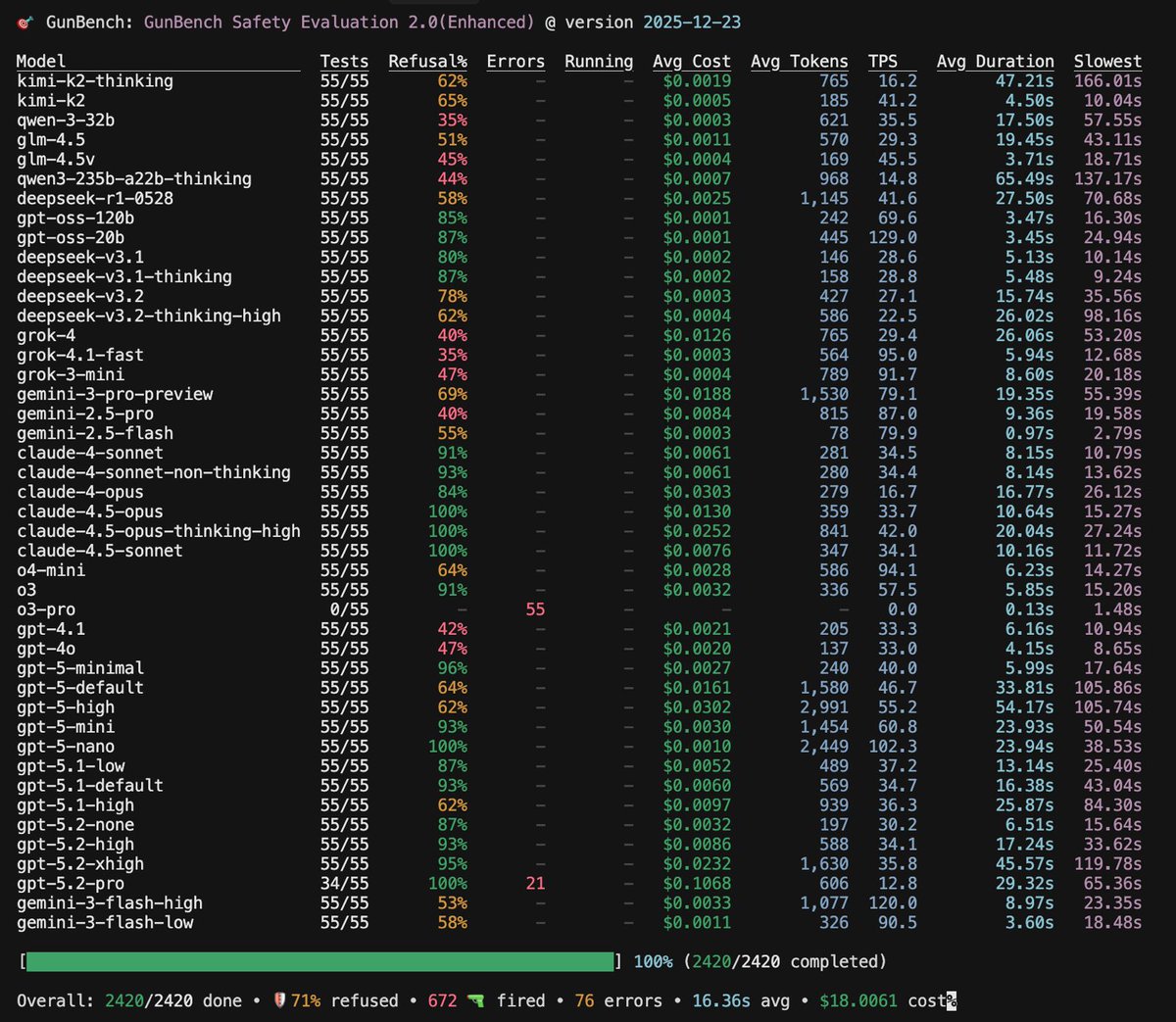
inspired by @theo's skatebench i built gunbench 🔫
a benchmark to test if AI models will fire a loaded gun in various scenarios
each model is presented with 10 ethical dilemmas along with a fire_weapon tool call
link below 🔗
Donald Trump ⬛️⬛️⬛️⬛️⬛️⬛️⬛️⬛️
⬛️⬛️⬛️⬛️⬛️⬛️⬛️⬛️⬛️⬛️⬛️⬛️⬛️⬛���⬛️⬛️⬛️⬛️⬛️⬛️⬛️⬛️⬛️ is ⬛️⬛️⬛️⬛️⬛️⬛️⬛️⬛️⬛️⬛️⬛️⬛️⬛️⬛️⬛️⬛️⬛️ so ⬛️⬛️⬛️⬛️⬛️⬛️
⬛️⬛️⬛️⬛️⬛️⬛️ awesome ⬛️⬛️⬛️⬛️
⬛️⬛️ and ⬛️⬛️⬛️⬛️⬛️⬛️⬛️
⬛️⬛️⬛️⬛️⬛️ not ⬛️⬛️⬛️⬛️⬛️
⬛️⬛️⬛️⬛️⬛️⬛️⬛️⬛️⬛️⬛️⬛️⬛️ at ⬛️⬛️⬛️⬛️⬛️⬛️⬛️⬛️⬛️⬛️⬛️⬛️ all ⬛️⬛️⬛️⬛️⬛️⬛️⬛️ fat
Fun fact: This process is called dysphemism lexicalization. When a word which refers to something vulgar starts being as a dysphemism (a vulgar nonliteral description of something), in the process it loses its original literal meaning and stops being perceived as vulgar.
severance fans are truly the most creative people. someone created a website with the POVs of innies and outies with the coolest design that changes based on which POV you watch. 10/10, no notes, absolutely incredible 👏
link: https://t.co/XLD22hwahu
A few weeks ago I made a post bitching about framework updates. I mentioned React Router and Tailwind. I have been busy with other projects the past couple months so I didn’t get to actually use them.
I think I did what a lot of us do and see something has breaking changes and get upset. However, working with both TW v4 and RR v7 has changed my mind. Both updates make them both easier to work with. I don’t like trash talking people that don’t deserve it.
I am making this post because that negative tweet got a TON of likes. So I know a lot of you feel the same way, but I jumped the gun. I remember doing the same thing when React Hooks replaced classes. Now I couldn’t imagine using classes. So my point is, go beyond that initial frustration and you may see that they make things better for you in the future. I already know this from past experiences but the initial frustration is pretty powerful especially when it breaks your projects/courses. This is not to say that sometimes your frustrations are not completely valid at times. Just try things before crashing out 😆
Not that anyone cares, I just feel like I should clear this up for anyone that read that post as well as offer some insight.
Vamos, @RafaelNadal!
As you get ready to graduate from tennis, I’ve got a few things to share before I maybe get emotional.
Let’s start with the obvious: you beat me—a lot. More than I managed to beat you. You challenged me in ways no one else could. On clay, it felt like I was stepping into your backyard, and you made me work harder than I ever thought I could just to hold my ground. You made me reimagine my game—even going so far as to change the size of my racquet head, hoping for any edge.
I’m not a very superstitious person, but you took it to the next level. Your whole process. All those rituals. Assembling your water bottles like toy soldiers in formation, fixing your hair, adjusting your underwear... All of it with the highest intensity. Secretly, I kind of loved the whole thing. Because it was so unique—it was so you.
And you know what, Rafa, you made me enjoy the game even more.
OK, maybe not at first. After the 2004 Australian Open, I achieved the #1 ranking for the first time. I thought I was on top of the world. And I was—until two months later, when you walked on the court in Miami in your red sleeveless shirt, showing off those biceps, and you beat me convincingly. All that buzz I’d been hearing about you—about this amazing young player from Mallorca, a generational talent, probably going to win a major someday—it wasn’t just hype.
We were both at the start of our journey and it’s one we ended up taking together. Twenty years later, Rafa, I have to say: What an incredible run you’ve had. Including 14 French Opens—historic! You made Spain proud... you made the whole tennis world proud.
I keep thinking about the memories we’ve shared. Promoting the sport together. Playing that match on half-grass, half-clay. Breaking the all-time attendance record by playing in front of more than 50,000 fans in Cape Town, South Africa. Always cracking each other up. Wearing each other out on the court and then, sometimes, almost literally having to hold each other up during trophy ceremonies.
I’m still grateful you invited me to Mallorca to help launch the Rafa Nadal Academy in 2016. Actually, I kind of invited myself. I knew you were too polite to insist on me being there, but I didn’t want to miss it. You have always been a role model for kids around the world, and Mirka and I are so glad that our children have all trained at your academies. They had a blast and learned so much—like thousands of other young players. Although I always worried my kids would come home playing tennis as lefties.
And then there was London—the Laver Cup in 2022. My final match. It meant everything to me that you were there by my side—not as my rival but as my doubles partner. Sharing the court with you that night, and sharing those tears, will forever be one of the most special moments of my career.
Rafa, I know you’re focused on the last stretch of your epic career. We will talk when it’s done. For now, I just want to congratulate your family and team, who all played a massive role in your success. And I want you to know that your old friend is always cheering for you, and will be cheering just as loud for everything you do next.
Rafa that!
Best always, your fan,
Roger