@CaxtonJP@OlufemiAwoyemi@OgbeniDipo External and financial indicators are improving but household welfare, debt, and security remain fragile. Does this suggest that reforms are delivering gains for markets before it works for citizens?
For 8 weeks, join us at the Nigeria Capital Market Masterclass as we explain the mechanics of Nigeria’s capital market. You will learn how markets truly work, from the structure of the ecosystem to regulations, products, operators, infrastructure, securities exchanges, depositories, technology systems, derivatives, investment banking, wealth creation, and the emerging digital architecture shaping the future of African finance.
Delivered across 14 modules by some of the leading practitioners and market leaders in the industry, the program combines practical market knowledge with deep institutional understanding of Nigeria’s capital market ecosystem.
Good People, if you want to understand one of the most important sectors of Nigeria’s economy and position yourself for opportunities in finance, investment, securities, and market infrastructure, this program is for you.
Pick your seat here; classes begin on June 15, 2026: https://t.co/yff1AB57nT
This one is a game changer … 🔥
it includes every aspect of of global money markets … vis-à-vis, Forex , commodities, crypto etc
Mad stuff from @Opollmarket
chart request anyone… i know i didn’t able to provide charts last time because of some personal reasons…
but i’ll do it now…
first time i’ll pick 10 token charts of who like repost…
Career is more than making money. Yet, money has a way of reducing many inconveniences of life. That is why I still find it strange that a young person can attend a university for four or five years and graduate without anyone making a deliberate effort to educate him or her on personal economy and finance.
Yes, universities teach corporate finance, accounting, economics, and broad frameworks on how companies and governments optimize factors of production to create value. But very few systems teach young people how to manage their own money, build assets, allocate capital, and develop long-term financial independence. For me, that remains one of the major gaps in modern education. If education is the liberation of the mind, financial liberation should be a required course.
As a banker, I learned one important lesson early: how much you earn is only a small component of financial success. Many people focus entirely on income while ignoring investment and associated allocation. But wealth is rarely built only from wages; wealth is built from systems, discipline, and compounding capital which is money with direction. Yes, money is a scalar quantity, but capital is a vector quantity, having both magnitude and direction {revisit your JSS3 Integrated Science notebook}.
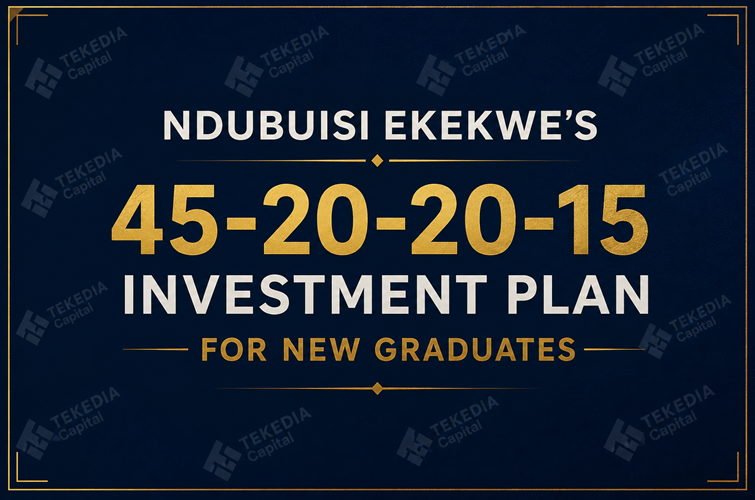
Interestingly, financial independence requires moving from a static phase to a dynamic phase, like mechanics in physics. In other words, you must take action. And taking action begins with having a plan. In my first month as a banker, I developed what I called the 45-20-20-15 Strategy, a simple portfolio allocation framework I still explain today in Tekedia Mini-MBA when discussing financial planning and personal economy for young professionals.
The structure was straightforward:
45% – Self and Family: (Car, accommodation, clothing, family, etc.)
20% – Personal Development: (Professional certifications, books, training, conferences, capability dev)
20% – Others: (Flexibility, lifestyle, emergencies, miscellaneous)
15% – Investments: (Dividend-paying stocks, etc)
Running simple projections using assumptions around dividends, compounding, inflation, and currency stability, I estimated that for every five years of disciplined investing, the portfolio could eventually generate the equivalent of about two years of wages without active work. (This did not turn out well as Naira lost value and messed up my model. Had I done this in US, a bestseller would have emerged).
That realization changed my understanding of money forever. Of course, my allocation system has evolved over time because life itself evolves. But one thing has remained constant: there is always a plan, including to compensate for Naira gyration.
Simply, if you do not allocate your resources consciously, circumstances will allocate them for you. But remember: circumstances are poor fund managers. Video here https://t.co/Ma30MVx0tK