@Mikehomeseller 1. In The Light
2. Ten Years Gone
3. Kashmir
4. The Rain Song
5. Stairway To Heaven
6. Achilles Last Stand
7. In The Evening
8. No Quarter
9. Immigrant Song
10. Carouselambra
@marugen17 I didn’t get to see them, but the fact that they included these 4 huge songs in the same show is amazing…
- Phantom of the Opera
- Rime of the Ancient Mariner
- Seventh Son
- Powerslave
Starting December 1st, I encourage everyone to read one chapter of the Gospel of Luke each day.
There are 24 chapters. By Christmas Eve, you will have read the entire Gospel, from the announcement of Christ’s birth to His resurrection.
Twenty-four days to strengthen your faith, reflect on His teachings, and remember the true meaning of Christmas.
In a world consumed by material things, give God a little more of your time.
Christmas isn’t about what is under the tree. It’s about the Savior who died upon one.
Jesus is King. Never forget that.
Happy Holidays with Bing & Frank is one of the classic milestones of 1950s American Christmas television.
What a beautiful, peaceful time! When people truly showed love and kindness to one another.
There's a power in believing, in finding your own strength, and never giving up.
Sometimes, we all need a little reminder of the magic we carry within...💫🎸
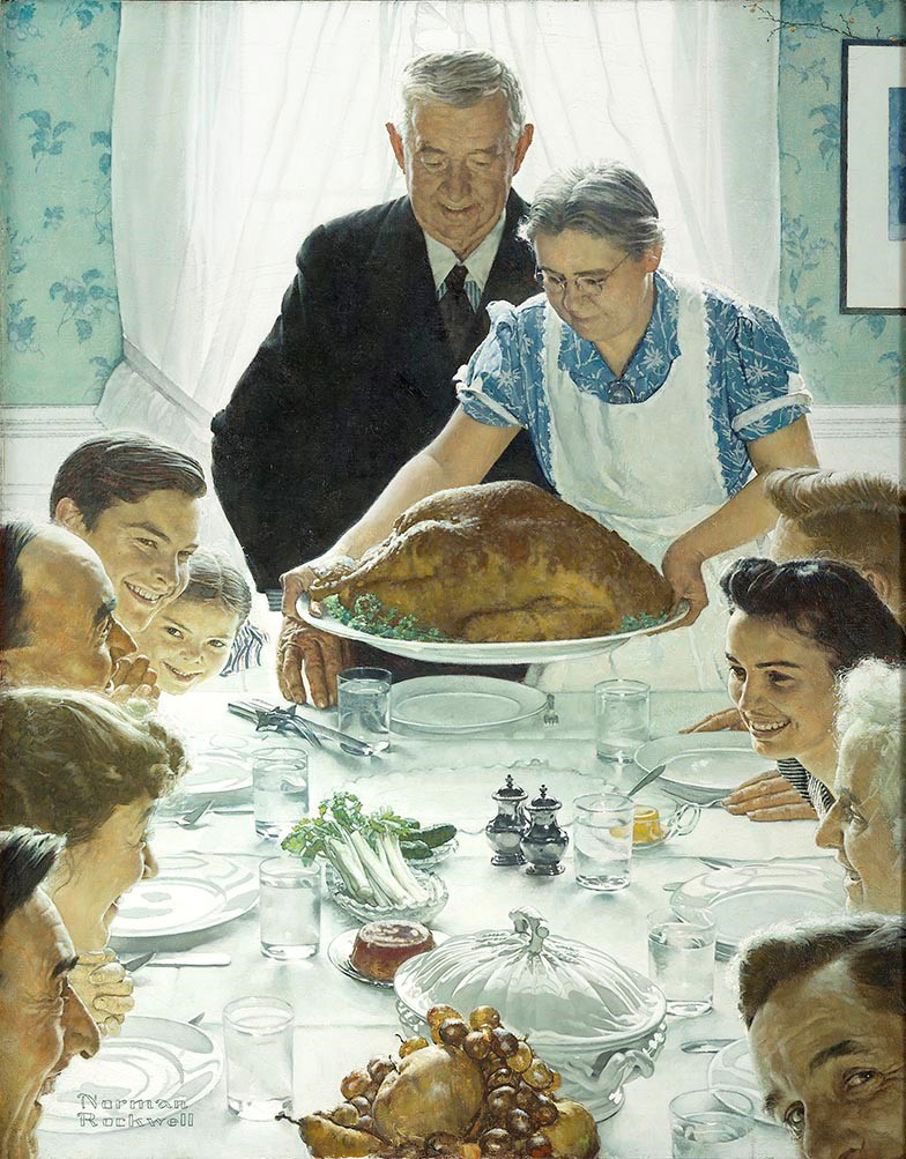
Norman Rockwell’s therapist once said something about him that I can’t shake.
“He painted his happiness, but did not live it.”
Three marriages.
Decades of depression.
A second wife who battled alcoholism so severe they moved towns — not for scenery, but because there was a psychiatric hospital on Main Street.
His son said something worse.
When Rockwell’s wife Mary died in 1959 possibly suicide…Peter Rockwell told a biographer:
“I think we were all relieved by her death.”
Relieved.
The painter of American family values.
Relieved when his wife died.
You’ve seen his painting today.
The table. The grandmother. The turkey. The golden warmth.
Freedom from Want.
The most famous image of Thanksgiving in American history.
Here’s what you don’t know:
The people at that table weren’t a real family.
Rockwell photographed them separately.
Different days. Different sessions. Painted them together.
The perfect family was a composite.
A fiction.
Assembled from fragments by a man who couldn’t hold his own family together.
You looked at your table today and thought:
“We’re nothing like that painting.”
Good.
Neither was Rockwell.
He painted what he longed for.
Not what he had.
Every brushstroke was a prayer for something just out of reach.
Your family isn’t a Rockwell painting.
Neither was his.
When the Magi arrived in Jerusalem asking, "Where is he who has been born king of the Jews?", King Herod was troubled, and all Jerusalem with him. He gathered the chief priests and scribes and asked them one question: where was the Messiah to be born? They didn't have to look it up for long. They answered immediately: "In Bethlehem of Judea, for so it is written by the prophet." Then they quoted a line written more than seven hundred years earlier.
The prophet was Micah. The first verse of his book tells us when he lived: during the reigns of Jotham, Ahaz, and Hezekiah, kings of Judah. That's the late eighth century BC, the same years when Hezekiah dug his tunnel under Jerusalem and when Sennacherib's Assyrian army swept through Judah, taking forty-six fortified cities and shutting the king inside Jerusalem "like a bird in a cage." Micah was a prophet from a small town who lived through that terror. And in the middle of a prophecy about siege and humiliation, he wrote this:
"But you, O Bethlehem Ephrathah, who are too little to be among the clans of Judah, from you shall come forth for me one who is to be ruler in Israel, whose coming forth is from of old, from ancient days."
Which Bethlehem. Micah is precise. There was more than one Bethlehem in Israel. The book of Joshua lists another one in the territory of Zebulun, in the north, in Galilee, not far from Nazareth. Micah adds a second name, Ephrathah, the old name for the clan and region around the Bethlehem in Judah, about six miles south of Jerusalem. He wasn't pointing vaguely at a town called Bethlehem. He was naming one particular village.
Too little. Notice how Micah describes it: "too little to be among the clans of Judah." Bethlehem was small and unimportant, a farming village on a ridge at the edge of the wilderness. It had no palace, no temple, no army. But it had a history. It was where Rachel died giving birth and was buried "on the way to Ephrath." It was where Ruth came as a poor foreign widow, gleaning in the fields of Boaz. And it was the hometown of David, the youngest son of Jesse, the shepherd boy no one thought to call in from the fields when the prophet Samuel came looking for a king. God had already chosen the smallest son from this small town once. Micah says He would do it again.
The name. Bethlehem in Hebrew is Beit Lechem, which means "house of bread." The One who would say, "I am the bread of life," was to be born in the House of Bread. And Luke tells us that when He was born, He was laid in a manger, a feeding trough for animals. The Bread of Life began His life in a place where food was put.
What kind of ruler? Micah's prophecy keeps going. Just before it, in verse 1, he describes Israel's ruler being struck on the cheek with a rod, humiliated by enemies. Just after it, he says that this coming ruler "shall stand and shepherd his flock in the strength of the LORD," that "he shall be great to the ends of the earth," and finally, "he shall be their peace." A shepherd from David's town, whose greatness reaches to the ends of the earth, who is Himself peace. Centuries later, angels would announce His birth to shepherds in the fields outside Bethlehem with the words, "On earth peace."
And then there's the strangest phrase in the prophecy: His "coming forth is from of old, from ancient days." The Hebrew words can point back to the ancient line of David, but they can also mean "from the days of eternity." This ruler would be born in a village, and yet His origins go back before the village existed. John would later write, "In the beginning was the Word... and the Word became flesh."
How they got there. Here is what makes the fulfillment remarkable. Mary and Joseph did not live in Bethlehem. They lived in Nazareth, in Galilee, about ninety miles away by road, and Mary was nearly due. Nothing in their plans would have taken them to Bethlehem. Then Luke tells us that a decree went out from Caesar Augustus that all the world should be registered, and everyone went to their own town. Because Joseph was of the house and line of David, he had to go to the town of David, Bethlehem. The most powerful man on earth issued an order in Rome, with no idea that he was moving one pregnant girl from Galilee to the exact village Micah had named seven hundred years earlier. Augustus thought he was counting his subjects. God was keeping His word.
What the Jews expected. This wasn't a prophecy that Christians found later and applied to Jesus after the fact. The chief priests in Matthew 2 knew it without hesitation. In John 7, people in Jerusalem argued about Jesus and said, "Has not the Scripture said that the Christ comes from the offspring of David, and comes from Bethlehem, the village where David was?" They thought Jesus was from Galilee, so they used Micah against Him. They didn't know where He had actually been born. An ancient Jewish Aramaic paraphrase of Micah, the Targum, even renders the verse, "From you shall come forth before me the Messiah." Bethlehem was the expected birthplace of the Messiah long before Jesus was born there.
The stone witnesses. In 2012, archaeologists sifting soil from excavations in the City of David in Jerusalem found a tiny clay seal impression, a bulla, smaller than a fingernail. It bore three lines of ancient Hebrew script, and one of the words was "Bethlehem." It appears to be an administrative seal from a tax shipment sent from Bethlehem to the king in Jerusalem. It dates to the eighth or seventh century BC, the era of Micah himself. It is the oldest known mention of Bethlehem outside the Bible. While Micah was writing that Bethlehem was "too little" to count among the clans of Judah, the town was sending its small tax payment to the king, stamped with its name.
And the place of Jesus' birth was remembered. Around AD 150, the Christian writer Justin Martyr, who grew up not far away in Samaria, wrote that Jesus was born in a cave near Bethlehem. In the next century, Origen wrote that the cave was still being shown to visitors. Later, the Roman emperor Hadrian planted a pagan grove there, which ironically marked the spot. In the fourth century, Constantine built the Church of the Nativity over that cave. Rebuilt in the sixth century, it is one of the oldest continuously used churches in the world.
To the world, biblical prophecy is vague guesswork, written so loosely that it could fit anything. But Micah named a village, and not just any Bethlehem, but the one in Judah, the small one, David's town. Seven hundred years later, a decree from a Roman emperor brought a carpenter and his pregnant wife from the wrong end of the country to that exact place, just in time.
The God who kept that promise across seven centuries keeps every promise He has made to you. He works through emperors who don't know His name, and He chooses small places that the world overlooks. If you feel too little to matter, remember Bethlehem. God has a habit of starting His greatest work in the places no one is watching.
O little town of Bethlehem. Too little to count, and chosen anyway.
Jesus is the Ruler from Bethlehem, whose origins are from eternity.
@GrowingUpRetro It’s not the holidays without stuffing! There are so many great ways to make it… Thanksgiving thru Christmas is stuffing month at my house.