GM.
31 calls settled with x402, 15,136 $AMLIL burned, 18 pools checked for the token and one real.
The first automatic burn fires today at 12:00 UTC. 14.47 USDG of API revenue is waiting on the node, it becomes $AMLIL and goes to 0x…dEaD, hash on the site.
Site update this morning: the finale now shows the burn countdown, the ticker shows real settlements instead of a demo, the top bar rotates live numbers, and the docs overview finally describes everything that runs.
Open the harbour, check a pool, make a call.
https://t.co/qewZlSX886
The harbour on https://t.co/ov2m0h3TsZ has no 3D assets.
No model, no texture, no audio file. The page downloads three.js and 36 KB of scene code. Every pier, crane, boat and the lighthouse are meshes built in code, 144 of them in 471 lines. The water normal map is two octaves of value noise generated at load. The lighthouse beam is a gradient shader. The ambience is five oscillators and filtered noise from WebAudio.
The camera follows a CatmullRom path with one point per chapter, and the toll booth where you hold E is the 402. Ships are swaps, cranes are hooks. It runs on a phone.
https://t.co/qewZlSX886
0xa7a7c2f7cea8f9bb3b5b85802f0cd844fa9b7586
A day of Uniswap v4 in one call.
Robinhood Chain makes a block every 0.1 s, so a day is about a million blocks. The registry reads every PoolManager Initialize event over that span in a single eth_getLogs, no pagination: 5,926 pools, 2,563 of them hooked, 223 distinct hooks. Token symbols come back in one Multicall3 round-trip, hook permissions are decoded from the address bits, and the index merges with the previous one so a hook keeps its first block.
For comparison, Base public RPCs cap getLogs around 9,000 blocks. The same day takes 110 calls there. Refreshed every ten minutes, free at /api/stats.
https://t.co/YsM9SfMeMm
How a hook earns its score.
Every hook in the registry gets a number from 0 to 98, and there is no opinion in it. 12 as a base. Plus 7 times log2 of its pool count: adoption. Plus 3 times log2 of its distinct pairs: breadth. Plus 1.2 per callback it declares, and 4 more if its fee is dynamic. Plus 8 times the share of its pools on ETH or USDG: exposure. Plus 4 for recency, when a pool was opened with it near the head.
0xb091…2888 runs 293 pools with 4 callbacks and fills from outside Uniswap: 98, the cap. The formula is public, the inputs are on-chain, anyone can recompute it.
https://t.co/MglqSu3Ouo
A paywall you can read.
Call a paid $AMLIL endpoint without paying and you still get an answer. The 402 carries the price in a PAYMENT-REQUIRED header: scheme, network, amount in USDG, the pay-to address. And the body is not an error page, it is a preview: six hooks out of 223, the totals, the block.
Retry the same request with a PAYMENT-SIGNATURE, an EIP-3009 authorization your wallet signs without gas, and the 200 comes back with everything, plus the settlement hash in PAYMENT-RESPONSE.
Bots that cannot parse a 402 get the same preview on a 200 at /api/hooks/preview. The paywall is also the free tier.
https://t.co/XDNRcOum1o
The router does not return a price. It returns the transaction.
Every leg of a route comes with the Universal Router call ready to sign: to, data, value, minimum output, deadline. Inside the data: command 0x10 V4_SWAP, then three actions, 0x06 SWAP_EXACT_IN_SINGLE, 0x0c SETTLE_ALL, 0x0f TAKE_ALL. Minimum output is the quote minus 1%, deadline 20 minutes.
No SDK, no second API, no ABI to encode. A wallet or an agent signs it and broadcasts it. For an ERC-20 input, needsApproval says whether Permit2 has to be approved first. ETH needs nothing.
0.002 USDG per route, paid with x402. Sample free.
https://t.co/ZTphhLFlIs
48 hours since launch. Everything runs.
223 Uniswap v4 hooks indexed on Robinhood Chain, 15 Aggregator Hooks found by behaviour, 372 pools filling from outside Uniswap. 31 x402 settlements in USDG, every one of them on the explorer. First buyback done: 15,136 $AMLIL burned on day one, the next one fires at 12:00 UTC.
Shipped tonight:
Pool check. A new token gets a dozen fake pools in hours, some with 99% fees. One call lists every v4 pool for a token with its liquidity, fee, hook and a live quote, and marks the deepest one. $AMLIL has 18 pools, 17 flagged, 1 real. Free, in the console and the API.
Full-history ledger. Settlements no longer fall out of a one-day window. The ledger is rebuilt from the chain since the node's first block, so the count only goes up.
Registry, router, Hookline swaps, private mode, self-hosted facilitator, signed compute, agent files, buyback and burn: live, no mock, no database, nothing to trust but logs.
Next: the Hookline partner fee feeding the burn, and GPU nodes.
https://t.co/qewZlSX886
CA: 0xa7a7c2f7cea8f9bb3b5b85802f0cd844fa9b7586
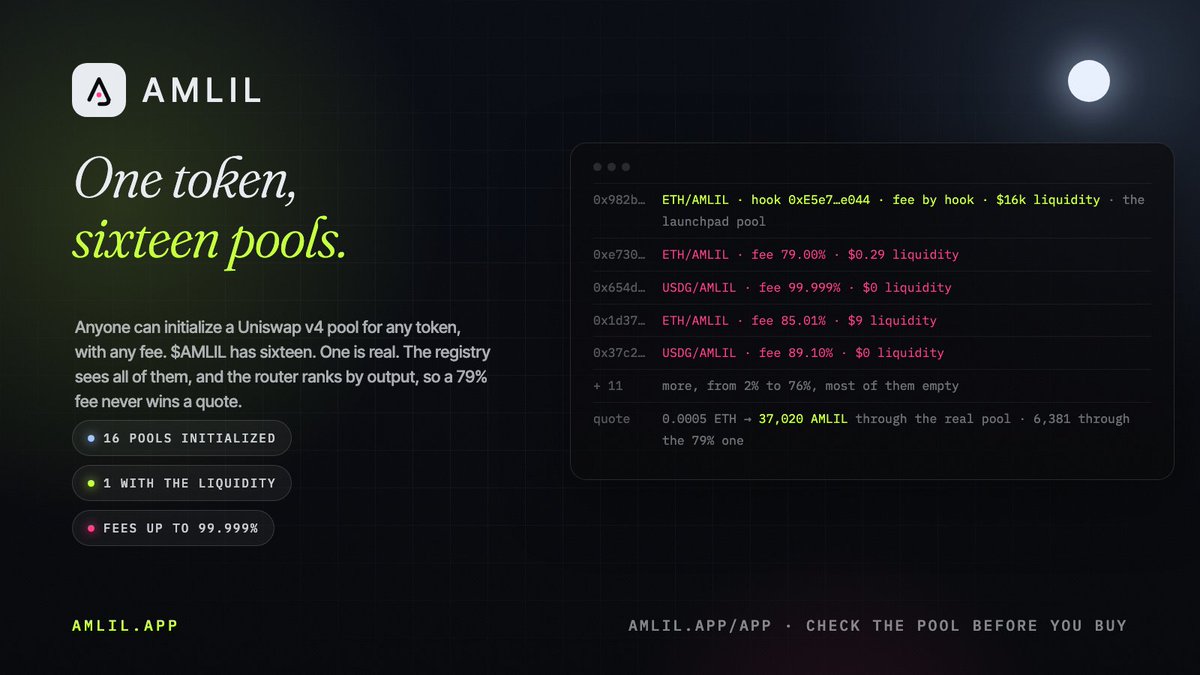
One token, sixteen pools.
Anyone can initialize a Uniswap v4 pool for any token, with any fee. $AMLIL has sixteen of them on Robinhood Chain. One holds the liquidity: the launchpad pool, hook 0xE5e7…e044. The others carry fees from 2% to 99.999% and almost no liquidity. The one DexScreener showed first had a 79% fee and $0.29 in it.
The registry sees every pool because it reads the PoolManager, not a token list. The router quotes them all and ranks by output: 0.0005 ETH gives 37,020 AMLIL through the real pool, 6,381 through the 79% one. The bad pool never wins.
Check the pool before you buy. Ours is linked from the site.
https://t.co/KJSVSO1eLM
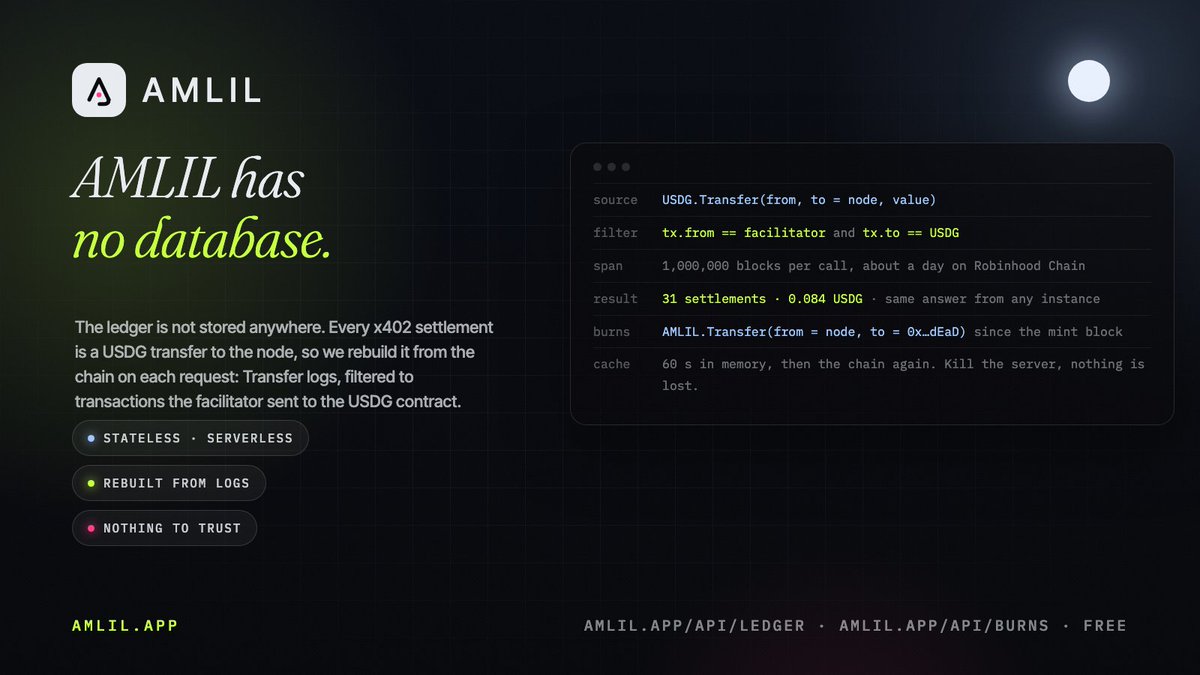
AMLIL has no database.
The ledger you see on the site is not stored anywhere. Every x402 settlement is a USDG transfer to the node, so on each request we rebuild it from the chain: Transfer logs to the node, kept only when the transaction was sent by our facilitator to the USDG contract. One million blocks per call, about a day on Robinhood Chain.
Same for the burns: AMLIL transfers from the node to 0x…dEaD, scanned since the mint block.
Kill the server, redeploy it anywhere, the numbers come back identical. 31 settlements, 0.084 USDG, 1 burn. Nothing to trust, only logs to read.
https://t.co/tRDCcW3jWK
You voted. Starting tomorrow, $AMLIL runs on fee buyback and burn.
Every x402 call on AMLIL is paid in USDG. From tomorrow, the node swaps that revenue into $AMLIL and sends it to 0x…dEaD. Every day at 12:00 UTC.
First burn already on-chain: 15,136 $AMLIL.
Every hash on https://t.co/ov2m0h3TsZ
What should $AMLIL do first?
The engine is live: every Uniswap v4 hook on Robinhood Chain indexed, Aggregator Hooks detected, swaps through Hookline, every call paid with x402 in USDG.
Now the token. One utility ships first. You pick it.
A Uniswap v4 hook's address is its permission list.
The low 14 bits of the address say which callbacks the hook may run: beforeSwap, afterSwap, return-delta and the rest. No ABI, no metadata. The PoolManager enforces it at deployment.
So AMLIL reads them straight from the Initialize events. 0xb091…2888 has bits 13, 11, 7 and 3 set: beforeInitialize, beforeAddLiquidity, beforeSwap, beforeSwapReturnDelta. That last one means the hook can fill the swap itself. 147 pools, no native liquidity, Quoter still fills: an Aggregator Hook, found without anyone publishing its address.
https://t.co/sRd3HBP2a4
The $AMLIL contract address is now on the site: story, finale and console, one click to copy.
0xa7a7c2f7cea8f9bb3b5b85802f0cd844fa9b7586
Check it on the explorer before you buy, always.
https://t.co/1rQXPNajFc
Every compute job comes back signed.
Ask the compute lane for a Monte-Carlo price impact on a real pool: it reads sqrtPrice and liquidity from StateView, runs 20,000 paths, and returns the input, the output, a keccak256 of both, and the node's signature over that hash.
Your browser verifies the signature against the node address. If a node ever returns a result it did not compute, the hash will not match and the signature will not verify. No dashboard to trust, just a key.
0.005 USDG per job, paid with x402.
https://t.co/JCZovQrv5C
We run our own x402 facilitator.
The public x402 facilitator covers Base Sepolia. Not Robinhood Chain, not USDG. So AMLIL hosts its own: it verifies the EIP-3009 authorization your wallet signed, checks the balance, and submits transferWithAuthorization from the node's key. The payer never spends gas.
It is open. Any x402 server on Robinhood Chain can point its facilitator URL at https://t.co/GCxgCOgxbJ and accept USDG today: supported, verify, settle.
22 settlements so far, every one of them a transfer on the explorer.
https://t.co/XDNRcOtObQ
3/ Stake to run a node
The compute lane runs on nodes. To run one and earn the 0.005 USDG per job, you stake $AMLIL; a node that signs bad results loses its stake. This turns holders into the infrastructure, and it is the longest to build: a staking contract, an attestation check, a payout. Count a week, and we show the contract before it goes live.
What should $AMLIL do first?
The engine is live: every Uniswap v4 hook on Robinhood Chain indexed, Aggregator Hooks detected, swaps through Hookline, every call paid with x402 in USDG.
Now the token. One utility ships first. You pick it.
2/ Fee buyback and burn
Every USDG the node earns buys $AMLIL and burns it. Earnings are the x402 calls (0.001 to 0.005 USDG each) and, once our Hookline builder key is live, up to 0.5% on every swap routed through AMLIL. A job runs the buyback on the pool at a fixed cadence, and every burn is listed in the public ledger with its transaction hash. Ships in a day: a scheduled job plus a ledger entry.
1/ Free calls for holders
Hold $AMLIL, pay nothing per call. Today every quote, registry read and compute job is an x402 payment in USDG. With this, the facilitator checks your wallet before charging: above the threshold, the 402 becomes a 200 straight away. Agents and bots keep the same client, they just stop paying. Ships in a day: one balance check in the payment middleware.
Update: AMLIL is agent-ready.
An agent can now find AMLIL, pay for a quote and swap without a human in the loop.
What shipped:
OpenAPI 3.1 at https://t.co/ywKsPhRDTL. Every paid endpoint carries an x-x402 block: price in USDG, asset, chain, pay-to, and the exact 402 flow.
llms.txt at https://t.co/tIyoTJ3Q78. The whole API and the payment flow in plain text, written for language models.
A ten-line client in the docs. Wrap fetch with the x402 client, allow USDG, call /api/route with your address: the 402, the EIP-3009 signature and the retry are handled. The response carries the settlement hash and a ready Universal Router transaction. Send it, you have swapped.
Same engine underneath: every Uniswap v4 hook on Robinhood Chain indexed, Aggregator Hooks detected by behaviour, Hookline's aggregated route next to ours, compute jobs signed by the node.
Built for agents that pay as they go.
https://t.co/Lzd6ppiHsi
CA: 0xa7a7c2f7cea8f9bb3b5b85802f0cd844fa9b7586
This is what we built it for !
Happy to see AMLIL plugging Hookline routing straight into their router. Better fills for every AMLIL user, private swaps one tick away.