@CAPUFE en cuanto a la entrada a CDMX para mañana 2 de mayo en la mañana desde Puebla, ¿deberíamos esperar tráfico intenso por algunas obras que se estén llevando a cabo?
👏 El secretario @CarlosOlivierP participó en la Entrega del Reconocimiento al Trabajo Digno con el Distintivo “Puebla Cinco de Mayo”, otorgado a centros de trabajo que destacan por implementar políticas y buenas prácticas laborales.
✅ Igualdad de oportunidades
✅ Equidad de género
✅ No discriminación
Con este reconocimiento, el @Gob_Puebla sigue impulsando espacios laborales justos e incluyentes. 💼✨
#PorAmorAPuebla #PensarEnGrande
Me mandaron a llamar de la escuela de mi hijo. Se madreó a un cabrón escuincle de sexto año (él es de quinto). Resulta que ese pinche escuincle ya llevaba dos años haciendo bullying constante a mi hijo, llegando a golpes en la cara y robo de dinero, se le avisaba a la inútil de la directora y solo nos hacía firmar acuerdos con los papás, y obviamente los papás se pasaron los acuerdos por el qlo. Desde hace un año tengo a mi hijo en MMA, siempre le he dicho que no lo use al menos que tenga la REAL necesidad de hacerlo. Ayer lo hizo, porque el chamaco le quería quitar su lunch y el dinero que le doy para cafetería. No le rompió la nariz, sin embargo sangró demasiado. Mágicamente la directora ahora sí quiso hacer algo y me mandó a llamar diciendo que podrían suspender tres días a mi hijo. Los papás de ese chamaco hasta me amenazaron si le pasa algo más a su pinche querubín color pulparindo. Y ¿Saben que voy a hacer? Ver películas y llevar a mi hijo al parque en los tres días que no va a asistir a la escuela. No podía estar más orgullosa de él, el cabrón por fin ya se pudo defender. Se ha ganado su Switch 2 para su cumpleaños 😌🤌🏻
What is the world's most underrated building?
One answer might be the Palacio de Bellas Artes in Mexico City.
Why? It's quite possibly the only place on earth where Beaux-Arts, Art Nouveau, and Art Deco architecture were all somehow combined into a single, spectacular building.
The Palacio de Bellas Artes was commissioned in 1900, with the intention of completing it by 1910 to mark the centenary of the Mexican War of Independence.
An Italian architect called Adamo Boari, who worked in a mixture of Neoclassical and Art Nouveau styles, was appointed to design it. But construction was delayed and then came the Mexican Revolution, which lasted from 1910 to 1920.
The Palacio was left unfinished for two decades until construction restarted in 1932, this time according to Art Deco design principles under the leadership of the Mexican architect Federico Mariscal.
The Palacio de Bellas Artes was finally completed and inaugurated in 1934, and has hosted art exhibitions and theatrical productions, including ballet and opera, ever since. It is also home to two museums dedicated to Mexican architecture and art, along with the Ballet Folklórico de México and the National Symphony Orchestra.
From outside we are treated to a building thoroughly Neoclassical in shape and design, with particular influence from the Beaux-Arts style of 19th century France — this explains the almost Baroque flair and extravagance of the exterior.
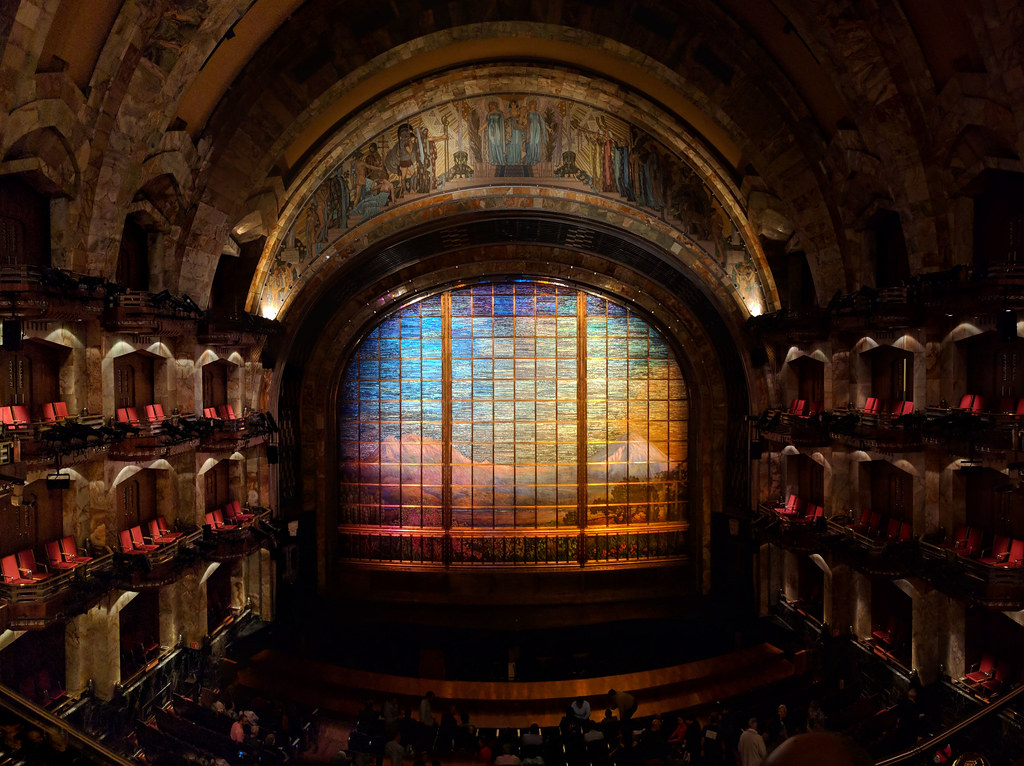
But some of the sculptural details and the huge, colourful glass domes are more Art Nouveau, and they hint at the interior of the Palacio — a concert hall like no other, built from wood, marble, and stained glass, and decorated with mosaics and paintings.
Not to forget its crowning jewel: a huge, foldable glass "curtain" produced by Tiffany's of New York. This was one of the greatest achievements of the whole Art Nouveau movement: a sensuous, shimmering wall of light and colour.
And that's not all. The main lobby, despite what the Palacio's façade suggests, is a cathedralesque chasm filled with the sharp geometry, futuristic atmosphere, and industrial decadence of Art Deco.
Amid all this the Palacio de Bellas Artes is also decorated with colossal, visually arresting murals by several of Mexico's greatest painters — Diego Rivera, Jorge González Camarena, José Clemente Orozco, and David Alfaro Siqueiros — along with sculptures of Aztec and Maya gods.
Other artists from around the world were also commissioned to work on the Palacio, such as the Italian Symbolist sculptor Leonardo Bistolfi and the Hungarian craftsman Géza Maróti.
And so the Palacio de Bellas Artes is a kaleidoscope of architecture and design. Its complicated history has produced a wholly unique fusion of different and ostensibly conflicting styles. But, somehow, Beaux-Arts Neoclassicism, Art Nouveau, and Art Deco were all integrated into one glorious cornucopia of material, form, colour, and light.
Just like the great churches of the Italian Renaissance, which exhibited the very best work of the architects, painters, and sculptors of the day, the Palacio de Bellas Artes feels like a masterpiece of the many different artistic and architectural movements of the early 20th century all at once — subsumed and transformed into something miraculous by the unique characteristics of Mexican art and culture.
The most dangerous man is not the one who disappears, it's the man who disappears and reappears, disappears and reappears. Because that man will waste your life.