My Weekend Essay for the @NewStatesman: why the 'left-realist' critique of international law is a form of disenchantment that obscures more about political reality than it illuminates.
A short critique of Perry Anderson via EP Thompson, EH Carr, Weber.
https://t.co/kZHWvH2BgA
Are you a UK-based scholar interested in Latin American history? On 15 May, Warwick will be hosting the fifth annual @UklahNetwork conference! Call and registration info here:
https://t.co/IPBYgV6ULR
WOW!!!
Never thought we would hear this level of honesty from a Western leader, and certainly not Canada, given the direction of Canada in the past 25 years. Canada's shift towards multialignment is quite clear - and this level of honesty from Carney on Western "fiction" about the old order will be warmly welcomed in much of the Global South:
"We knew that the story about the rules-based order was partially false... We knew that international law applied with varying rigour depending on the identity of the accused and the victim. This fiction was useful [because of the goods provided by American hegemony]... So we placed the sign in the window. We participated in the rituals. And we largely avoided calling out the gaps between rhetoric and reality. This bargain no longer works. Let me be direct. We are in the midst of a rupture, not a transition... You cannot live within the lie of mutual benefit through integration when integration becomes the source of your subordination."
@arredondos Definitely! Political engagement is important. But the belief that real-life political mobilization hinges on the outcome of academic debates is delusional.
The stakes are not that high and we should all be nicer to each other.
Whether you are writing history books or running a little magazine, your world-historical influence is going to be close to nil. There, that’s my structural argument. Do things that bring you joy and advance truth. And never let anyone else make you miserable about it.
The same rising hegemons which stayed out of the war until attacked in 1941? The same ones that undermined the peace settlement during the previous two decades so they could grow their empires?
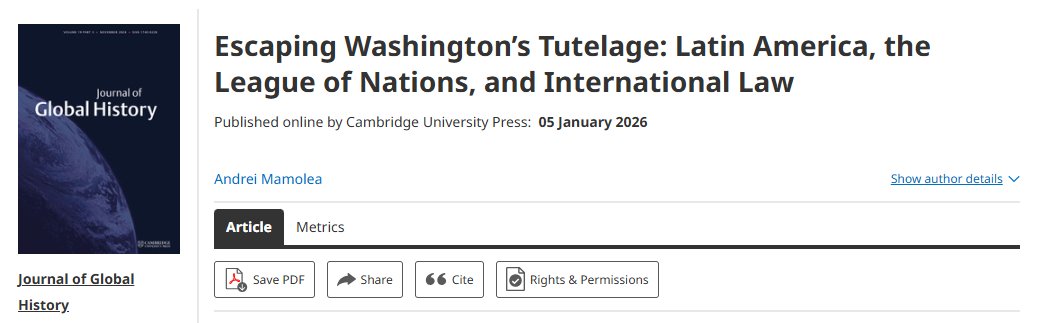
In 1921, a Venezuelan diplomat, Diógenes Escalante, considered the League of Nations as a place where Latin America could "counterbalance the all-absorbing influence of the United States" by removing the region "from Washington’s tutelage" and
according it "the international importance and the maturity that the United States prefers us not to have."
I tell part of that story here:
https://t.co/1tG3Bac1lj
By 1880 James Blaine was already invoking the Monroe Doctrine to intervene in purely Latin American international disputes.
And recent work (@NicholasGuyatt) suggests that the doctrine was linked from the outset with hemispheric expansion at the expense of the Spanish-Americans.
The Monroe Doctrine era has two periods.
1823-1898: an unenforceable policy of nominal solidarity with Latin republics warning Europeans not to recolonise anyone.
1898-1933: a policy of invading Latin states for imperialist reasons
We are entering a third stage now