@Chaos2Cured You said it, in physics. Even Science in general does not explain what conciousness is. We know we did not create it. We know we created AI, why hurry to use the same term, deliberately comparing them? Not obvious at all. Feels as reckless as underestimating them.
Must read to reflect about doing research and training
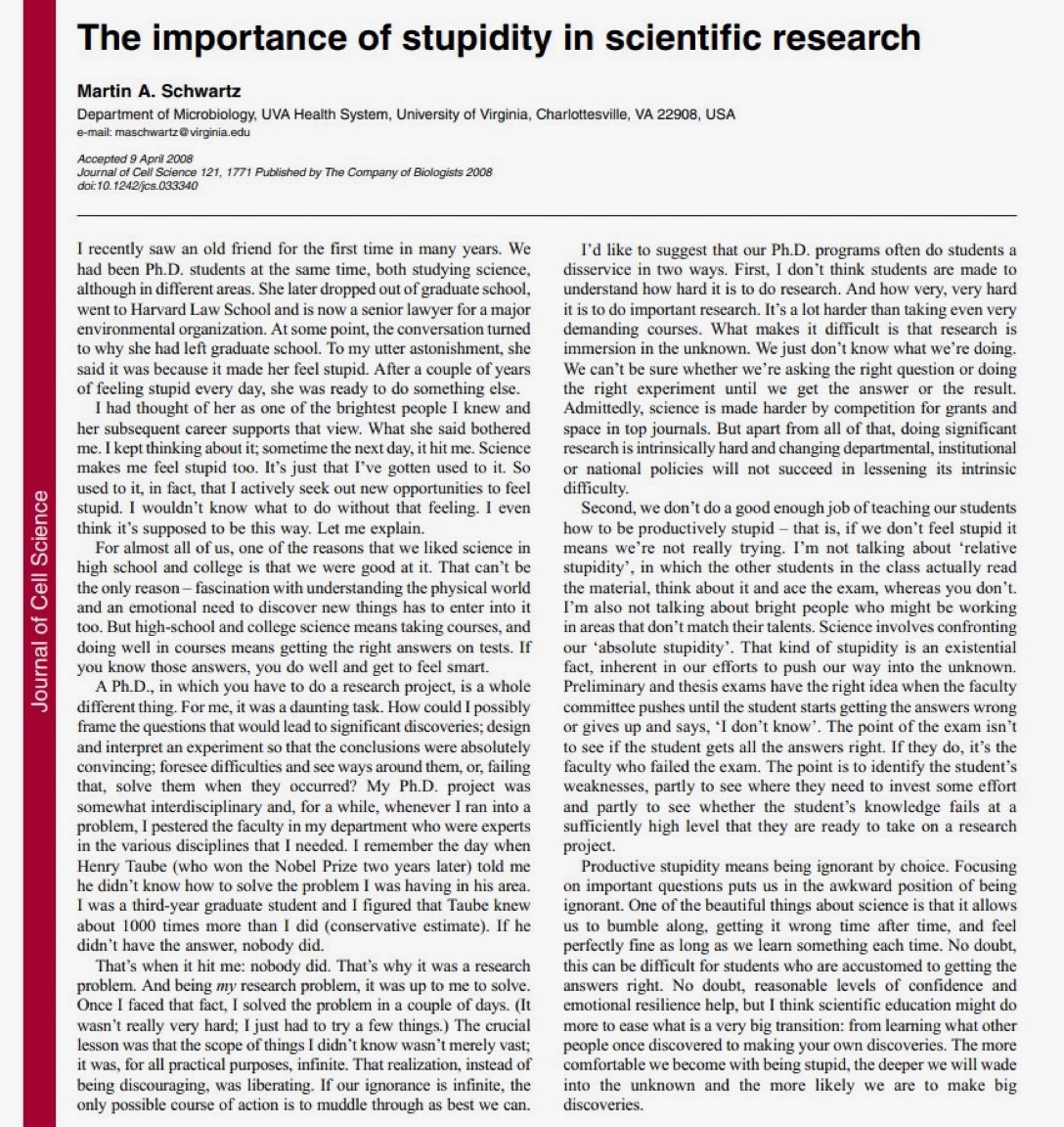
"One of the beautiful things about science is that it allows us to bumble along, getting it wrong time after time (...). No doubt, this can be difficult for students who are accustomed to getting the answers right."
This article should be mandatory reading for every medical student, PhD candidate, researcher—and honestly, for anyone who mistakes expertise for certainty.
“The importance of stupidity in scientific research” sounds provocative, almost offensive. But Martin Schwartz is not glorifying incompetence. He is describing the real operating system of discovery.
Science is not built on knowing.
Science is built on tolerating not knowing.
That distinction matters.
Most of education rewards correctness.
School teaches us to answer.
Exams reward speed, certainty, and precision.
You feel intelligent when you get things right.
Research is the opposite.
Real research begins exactly where competence ends—at the frontier where nobody knows the answer, including the people you thought must know.
That moment is psychologically brutal.
You ask the expert.
The expert shrugs.
You assume you’re missing something.
Then you realize: no—this is the work.
You are not failing.
You are standing at the actual boundary of knowledge.
That feeling—“I must be stupid”—is often not a sign of inadequacy.
It is often the first sign that you are finally asking an important question.
Medicine struggles with this.
We train doctors to avoid uncertainty, to fear being wrong, to perform confidence.
But the best clinicians and the best scientists know how to sit inside ambiguity without collapsing into fake certainty.
This is why AI in medicine also deserves caution.
Systems trained only to reproduce established answers may become extraordinarily good at passing exams while being terrible at discovering what matters next.
Guideline intelligence is not the same as scientific intelligence.
Discovery requires productive stupidity:
the willingness to stay with the uncomfortable,
to look ignorant,
to ask naïve questions,
to be wrong repeatedly without protecting your ego.
Most people want the authority of expertise.
Very few want the humiliation required to earn it.
But progress lives there.
Not in certainty.
Not in performance.
Not in sounding smart.
In the quiet discipline of saying:
“I don’t know… yet.”
And continuing anyway.
A human consumes about 2,000 calories per day. Over 20 years, that’s roughly 17,000 kWh of total food energy. Training GPT-4 consumed an estimated 50 GWh of electricity. That’s 3,000 humans worth of “training energy” for a single model run.
And GPT-4 is already dead. OpenAI retired GPT-4o from ChatGPT on February 13th. The model that took 50 GWh to train got less than two years of flagship status before replacement. The human you spent 17,000 kWh “training” for 20 years produces economic output for the next 40 to 60 years. The amortization window on GPT-4 was shorter than a car lease.
Now look at what replaced it. GPT-5.2, released December 2025, is OpenAI’s current default. The GPT-5 series consumes an estimated 18 Wh per average query according to the University of Rhode Island’s AI Lab, up to 40 Wh for extended reasoning. That’s 8.6 times more electricity per response than GPT-4. With 2.5 billion queries hitting ChatGPT daily and GPT-5.2 now the default model, the inference math gets staggering fast. Even at a blended average well below 18 Wh, you’re looking at daily electricity consumption that could power over a million American households.
This is what Altman is actually doing. OpenAI hit $13 billion in annual recurring revenue but still isn’t profitable. They need you to think of AI energy consumption as natural and inevitable, the same way you think about feeding a child, because the alternative framing is that they’re burning through enough electricity to rival small countries while racing to build 1-gigawatt Stargate data centers. The food analogy makes the energy costs feel biological and unavoidable instead of what they are: an engineering and business choice that scales with every model generation.
The comparison sounds clever at a fireside chat in India. It falls apart the second you do the arithmetic.
Quizás Cipriani no sabe que los residentes atienden pacientes, quedan a cargo y a veces ponen su firma. Los residentes TRABAJAN en el sistema de salud Formarse NO es excluyente. Pobre y errada visión del sistema de salud. Ojalá la proxima autoridad entienda mejor
Los residentes son médicos en formación que el Estado les paga por aprender, obvio tienen que trabajar.
En otras partes del mundo es muy caro para el estudiante pagar una especialidad.
Por suerte ASSE deja que la Universidad los forme en sus centros de salud.
Daniel Radío Secretario de drogas: “¿No será que el discursito este de la guerra frontal las Drogas no está dando resultados?
https://t.co/tEZkL6KwD1 Para mí, Radio es el político que tiene el discurso más completo y mejor enfocado en el tema de las drogas.
🎉Exciting news! Our lab's first paper, "Vocal labeling of others by nonhuman primates," is now published in @Science! 🐒 Dive into our findings on how marmoset monkeys use vocal labels similar to human names and dialects. Check it out! 1/6
https://t.co/7iHBLByfRW
Volvió.
A tirar la dictadura.
Y la tiró, con él de moneda de cambio.
La grandeza espiritual y el sentido nacional de un líder sin comparación.
Ojalá Uruguay entienda como agradecérselo.
Viva Wilson.
Why do primates have bigger brains🧠? Study @RSocPublishing shows that it’s not for efficient foraging. In the Panamanian rainforest, Ben Hirsch and Meg Crofoot compared how capuchins, spider monkeys, coatis and kinkajous solve the same foraging puzzle. https://t.co/Zizfw0oHS0 🧵
Sostener la Memoria
Hoy marchamos todas y todos para decir PRESENTE
Marcha del Silencio @famidesa
Ellos saben dónde están. Nunca más Terrorismo de Estado.
Intervención Plaza Las Pioneras
How monkeys 'really' see the world! Wireless eye-tracking in marmosets. Incredible game changing work by @vickey17singh showing the dynamics of active vision in a free-moving primate @JingwenLi18@judefmitchell https://t.co/Qt2QJWnCaI Thanks #TheBRAINInitiative for funding!
I LOVED this paper on avian cognition, asking why birds commonly show similar cognitive performance to primates despite vastly smaller brain size. It is also wonderfully written (calling a section 'When pigeons dream' is epic). https://t.co/LB3JDeTS5l