Dear friends, one of our OG Collection- Machine Hallucinations: Coral Dreams is getting an epic Burn project! If you're a holder or know a holder, please check our Discord to stay up to date on the next steps!
⚡️Civilization is shifting from an expansion system into a maintenance system.
And AI is arriving at exactly the moment biology stops supplying enough new humans to keep the old machine running.
That is enormous:
For most of modern history, societies were built around an implicit demographic engine. More young people meant more workers, more taxpayers, more buyers, more families, more homes, more credit, more consumption, more experimentation. Growth had biology underneath it.
That engine is weakening.
When the age structure inverts, the entire social priority stack changes. Older societies spend more energy preserving accumulated wealth, healthcare systems, pensions, housing values, and existing institutions. Younger societies spend more energy building, taking risk, forming households, starting companies, moving cities, having children.
So the danger is not simply “fewer workers.”
It is a civilization gradually optimizing for preservation over creation.
That has enormous consequences.
Politics gets older. Capital gets older. Institutions become more defensive. Fiscal systems become increasingly dominated by promises made to the past. Younger cohorts become smaller relative to the asset-owning electorate, while simultaneously carrying more of the tax burden needed to support it.
That creates a slow intergenerational pressure cooker.
And then AI enters.
Automation becomes the bridge between demographic decline and economic continuity.
If there are fewer humans available to drive trucks, process invoices, staff warehouses, care for the elderly, maintain infrastructure, build software, diagnose routine cases, manage supply chains, then the economic incentive to automate becomes overwhelming.
So AI and robotics stop being primarily labor-saving technology.
They become population-replacement technology.
That is the real shift.
And once that happens, the economic center of gravity moves from labor to ownership.
A world with abundant human labor rewards employment.
A world with scarce humans and abundant machines increasingly rewards whoever owns the machines, compute, energy, land, networks, data, and capital structures underneath them.
That creates a very strange society:
human labor becomes less central to production,
while access to productive capital becomes more central to survival.
Some human work becomes extraordinarily valuable because it remains hard to automate, especially trust, physical presence, care, judgment, leadership, high-level technical work.
A large middle layer gets compressed.
So demographic scarcity does not automatically mean workers win.
It can instead produce a bifurcation:
scarce human judgment becomes
expensive, routine human participation becomes unnecessary.
This is the first time Guns N' Roses ever played "Patience" live, a cramped room at CBGB, October 1987, about 100 people watching.
Appetite was stalled at #65. Axl's reading the lyrics off a sheet because they'd just written it. Weeks later, everything changed.
⚡️Germany committed slow industrial suicide.
The country got rich on cheap Russian energy, export dominance, industrial discipline, an undervalued currency inside the euro, and an American security shield. Then it treated all of that as permanent. It shut nuclear, made energy ideological, buried production under rules, hollowed the military, aged itself demographically, and absorbed migration at a scale its state and culture could not metabolize cleanly.
Then history came back.
Russia broke.
China stopped being a customer and became a rival.
Global trade got harsher.
Energy got expensive.
Industry lost edge.
And the German elite kept talking like process, guilt, and regulation were enough to run a civilization.
That is the real failure.
Germany forgot that an advanced industrial nation runs on power, borders, capital formation, engineers, and strategic realism. It tried to live as a posthistorical moral lecture while the rest of the world kept playing power politics.
The welfare state mattered.
The regulatory pileup mattered.
Mass immigration into a spiritually tired, bureaucratically rigid society mattered.
But the deepest wound was upstream of all of that.
Germany lost civilizational will.
It stopped believing in hard power.
Stopped defending industrial primacy.
Stopped treating energy as sacred.
Stopped acting like history could turn violent again.
Stopped behaving like a serious nation and started behaving like a rich administrative zone.
That chart is one shadow of the deeper thing. Relative GDP share falls partly because others rise, but the direction is still real. Germany has less force, less confidence, less energy advantage, less strategic autonomy, and less momentum than it used to.
The real answer is simple.
Germany spent decades converting strength into self-denial.
Now the inheritance is burning off.
@julianhosp Wie kommst Du auf so einen Schwachsinn, Saylor sei der einzige Käufer? Mein Gott Junge, BTC hat Dich reich gemacht, genieße Dein Leben und höre auf hier Märchen zu verbreiten…
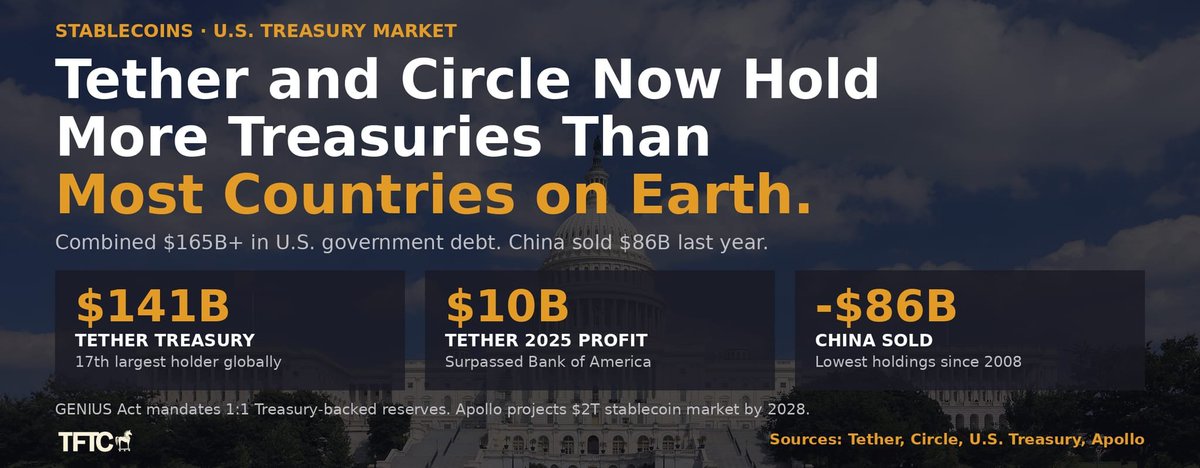
Tether and Circle now hold more U.S. Treasuries than South Korea, Germany, Saudi Arabia, and most sovereign nations on Earth. Combined, they hold over $160 billion in U.S. government debt. A decade ago, neither company existed in any meaningful way.
Here's what's actually happening.
The GENIUS Act, signed into law last year, requires stablecoin issuers to back every token 1:1 with reserves. Those reserves must be held in U.S. dollars, Treasury bills, or equivalent short-duration instruments. Congress didn't just regulate stablecoins. It created a legal mandate to buy Treasuries at scale.
Tether alone holds $141 billion in Treasury exposure. $122 billion in direct T-bill holdings. The rest in overnight reverse repos. That makes Tether the 17th largest holder of U.S. government debt globally, above South Korea, Germany, and Saudi Arabia.
Circle's USDC reserves hold another $24.5 billion in Treasuries, with 93% of total reserves in overnight repos and short-term government securities.
This is not an accident. This is architecture.
China dumped $86 billion in Treasuries over the past year. Its holdings hit the lowest level since 2008. Japan, the largest foreign holder at $1.2 trillion, is signaling a slow drawdown. The traditional buyer base for U.S. debt is shrinking.
Stablecoins are filling that gap. Apollo estimates the stablecoin sector could reach $2 trillion by 2028. At that scale, stablecoin issuers would hold more Treasuries than Japan.
The U.S. government now has a structural incentive to grow the stablecoin market. Every dollar minted as USDT or USDC creates automatic demand for U.S. government debt. The dollar gets exported globally through crypto rails. Treasuries get a new captive buyer class. Dollar dominance extends without a single aircraft carrier.
Tether posted $10 billion in profit through the first three quarters of 2025. That surpassed Bank of America. It nearly matched Goldman Sachs and Morgan Stanley. The company has roughly 300 employees.
Stablecoins are not a crypto sideshow. They are the newest pillar of U.S. monetary infrastructure, quietly becoming one of the largest and most reliable buyers of American debt on the planet.
I'm Iranian-American. I hold both of those identities and I won't apologize for either one.
As an American, I want this country to be smart. Not just strong. Smart. And what I'm watching right now is the opposite of smart. It's the same playbook we've run decade after decade. Overwhelming force, premature victory laps and zero understanding of what the other side is actually doing.
As someone of Iranian descent, I know something most American analysts don't: The regime has been thinking about this war for 40 years. Not hoping for it. Preparing for it. Everything designed around: "What do we do when America comes?"
The answer was never "win a dogfight." The answer was: Death by a thousand cuts. Make the Strait impassable and make the missile defense systems run dry. Make the world economy scream. Make the Gulf countries question their choices.
And that's what we're seeing as our media is high fiving over destroying the Iranian Navy, a Navy that was laughable or Iran's fighter jets, which were so out of date that nobody ever thought Iran had a real air force.
I'm not rooting for Iran. I have family there who are terrified. I'm rooting for America to be honest with itself. I've watched us confuse blowing things up with winning my entire adult life. At some point, you have to ask, if we keep winning wars like this, why does nothing ever get better?
This isn't about being anti-war or anti-American. It's about being anti-stupid.