@AMS_edd @Dcheeth2 @daveatherton It’s a minefield no doubt but I’m sure if they could have done it cheaper by now they would have ! The only way around it is a complete overhaul of the laws and rules. Licensing rules are soo far down the road there’s probably no turning back now lol.
@AMS_edd @Dcheeth2 @daveatherton I think it would be related to what their employees main job would be defined as. I think social workers for example will drive children around as the transport side isn’t their main occupation. Someone employed to drive for the school runs would mean fall under PH laws.
@AMS_edd @Dcheeth2 @daveatherton I’m sure the law covers every loop hole possible. You can’t just pick up people and pay drivers. By paying the drivers to transport 3rd party individuals it automatically becomes private hire. If there was a way round these laws they’d be doing it already.
@x551000 @Dcheeth2 @daveatherton TfL have map tests, English tests, safety and regulation tests.
Once they pass them they go out and get £40k motors on finance to comply with vehicle legislation. I don’t know how they afford it and I don’t know how local councils would be able to cover the cost of all that.
@NickBuckleyMBE The Supreme Court ruled against Uber who tried to make small companies have the same VAT charging model as them.
The government could smell money and was never going to let it drop until they got what they wanted.
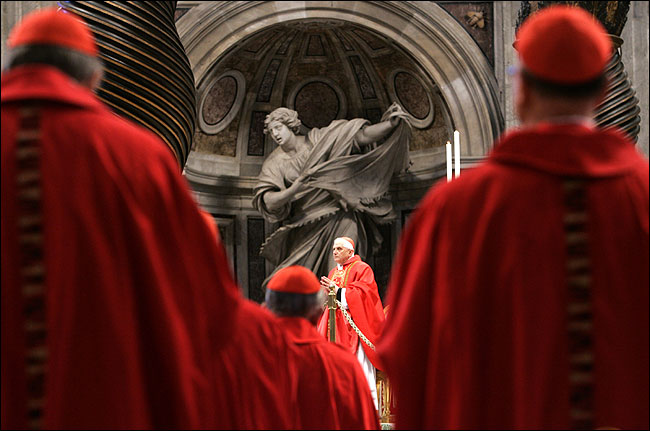
A day before his election as pope, Cardinal Joseph Ratzinger delivered one of his most famous and prophetic speeches.
Coining the phrase 'Dictatorship of Relativism', he predicted how the West would see those who believe in anything imposing their will on those who had traditional beliefs.
It is a compelling and very powerful read, especially in light of recent events in the West:
'How many winds of doctrine have we known in recent decades, how many ideological currents, how many ways of thinking. The small boat of the thought of many Christians has often been tossed about by these waves - flung from one extreme to another: from Marxism to liberalism, even to libertinism; from collectivism to radical individualism; from atheism to a vague religious mysticism; from agnosticism to syncretism and so forth. Every day new sects spring up, and what St Paul says about human deception and the trickery that strives to entice people into error (cf. Eph 4: 14) comes true.
Today, having a clear faith based on the Creed of the Church is often labeled as fundamentalism. Whereas relativism, that is, letting oneself be "tossed here and there, carried about by every wind of doctrine", seems the only attitude that can cope with modern times. We are building a dictatorship of relativism that does not recognize anything as definitive and whose ultimate goal consists solely of one's own ego and desires.
We, however, have a different goal: the Son of God, the true man. He is the measure of true humanism. An "adult" faith is not a faith that follows the trends of fashion and the latest novelty; a mature adult faith is deeply rooted in friendship with Christ. It is this friendship that opens us up to all that is good and gives us a criterion by which to distinguish the true from the false, and deceit from truth.
We must develop this adult faith; we must guide the flock of Christ to this faith. And it is this faith - only faith - that creates unity and is fulfilled in love.
On this theme, St Paul offers us as a fundamental formula for Christian existence some beautiful words, in contrast to the continual vicissitudes of those who, like children, are tossed about by the waves: make truth in love. Truth and love coincide in Christ. To the extent that we draw close to Christ, in our own lives too, truth and love are blended. Love without truth would be blind; truth without love would be like "a clanging cymbal" (I Cor 13: 1).
Let us now look at the Gospel, from whose riches I would like to draw only two small observations. The Lord addresses these wonderful words to us: "I no longer speak of you as slaves.... Instead, I call you friends" (Jn 15: 15). We so often feel, and it is true, that we are only useless servants (cf. Lk 17: 10).
Yet, in spite of this, the Lord calls us friends, he makes us his friends, he gives us his friendship. The Lord gives friendship a dual definition. There are no secrets between friends: Christ tells us all that he hears from the Father; he gives us his full trust and with trust, also knowledge. He reveals his face and his heart to us. He shows us the tenderness he feels for us, his passionate love that goes even as far as the folly of the Cross. He entrusts himself to us, he gives us the power to speak in his name: "this is my body...", "I forgive you...". He entrusts his Body, the Church, to us'