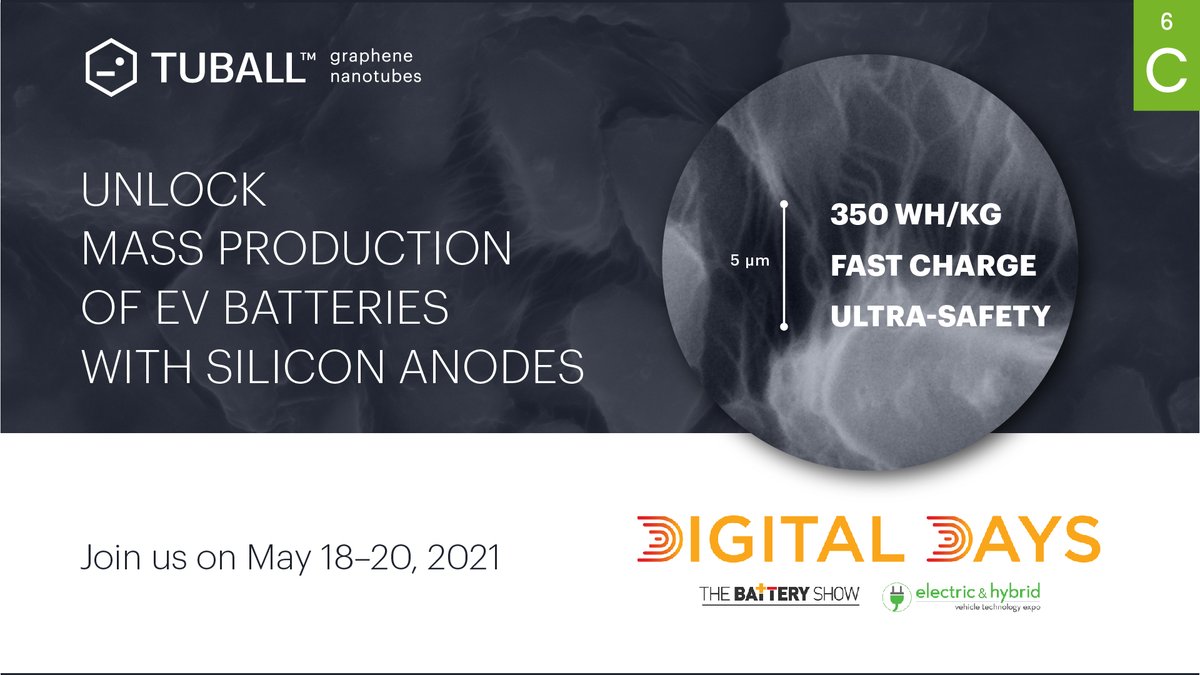
@Daniel_in_HD Glad to hear that @Xiaomi is likely to be the first smartphone maker with such advanced battery tech. Silicon anode is the future indeed – great gravimetric and volumetric energy density, fast charging. Do you know whether the usage of single-walled carbon nanotubes is involved?
@aaronrutkoff Silicon-anode based batteries are way more close to being widely used in EVs. Porsche, VW Power Day unveiled that. Tesla Battery Day as well. And they can offer up to 350 Wh/kg energy density and fast charging capability.
@aaronrutkoff H.Fisker, which was being on solid state: “It’s the kind of technology where, when you feel like you’re 90 percent there, you’re almost there, until you realize the last 10 percent is much more difficult than the first 90”
Finalising the audit by one of the leading global li-ion battery cell makers. Strict ...😬 But together, i believe, we have created the cleanest nanotube dispersion facility in the industry. Details coming soon. #EVs#emobility#lithiumbattery#TUBALL#OCSiAl#GrapheneNanotubes
For those who haven’t watched #Tesla Battery Day 2020 - slides: https://t.co/cQiYvgh1hW
Was very pleased to hear that:
– Silicon anode= high-energy density cells is a must.
– Silicon anode material will become cheaper = more widespread:
– More batteries: up to 20 TWh/y
@elonmusk@cleantechnica Elon, up to 90% of SiO is possible with TUBALL SWCNTs (Graphene Nanotubes). 1500 mAh/g anode capacity with >1000 cycles. 350 Wh/kg, 1300 Wh/l. Our product exactly solves the problem you've mentioned. Please check the microscopy below and ask your partners about it.
This is exactly the problem which TUBALL solves. Up to 90% of SiO is possible with cycle life > 1000. 350 Wh/kg, 1300 Wh/l. #TUBALL#OCSiAl#EnergyStorage
@cleantechnica But actually nothing. Was surprised to hear they’re across the road. Adding silicon to carbon anode makes sense. We already do. Question is just what ratio of silicon to carbon & what shape? Silicon expands like crazy during discharge & comes apart, so cycle life is usually bad.
@cleantechnica But actually nothing. Was surprised to hear they’re across the road. Adding silicon to carbon anode makes sense. We already do. Question is just what ratio of silicon to carbon & what shape? Silicon expands like crazy during discharge & comes apart, so cycle life is usually bad.
Battery prices, which were above $1,100 per kilowatt-hour in 2010, have fallen 87% in real terms to $156/kWh in 2019. By 2023, average prices will be close to $100/kWh.
Learn more from our 2019 Battery Price Survey here: https://t.co/IRGreo1LGE