There is a notion circulating in Washington’s China-policy conversation ahead of Xi Jinping’s visit: China is not taking the bait.
Xi is described as offering remarkably little visible reciprocity for Trump’s recent conciliatory gestures. Beijing appears content to preserve an uneasy stability, avoid unnecessary escalation, and keep its options open.
The familiar explanation is that Trump can reverse himself. But the view on the ground here in Beijing points to a deeper question:
What if the uncertainty is no longer just Trump—but Washington itself?
What if political authority fragments?
Who controls Congress after November? How durable is Trump’s hold over his own coalition? What happens if an 80-year-old president suffers a sudden health event? And if authority does begin to fragment, which commitments remain commitments of the United States—and which turn out to have belonged primarily to one president?
That may be the deeper uncertainty behind Beijing’s caution.
The issue is no longer simply whether Trump can be trusted to honor a deal. It is whether American political continuity itself can still be assumed.
That question matters to diplomats deciding what China should concede, investors deciding how long American policy will last, and intelligence services mapping where power might move next.
In May, Beijing was measuring American decline.
As Xi prepares for Washington, China is measuring American continuity.
My new Core Interests essay follows that question into Trump’s MAGA base, the midterms, his age, the hollowing of U.S. counterintelligence capacity, foreign intelligence mapping, and the possibility that outside actors may possess information capable of affecting the timing of a political cascade.
https://t.co/MXffWNOzS2
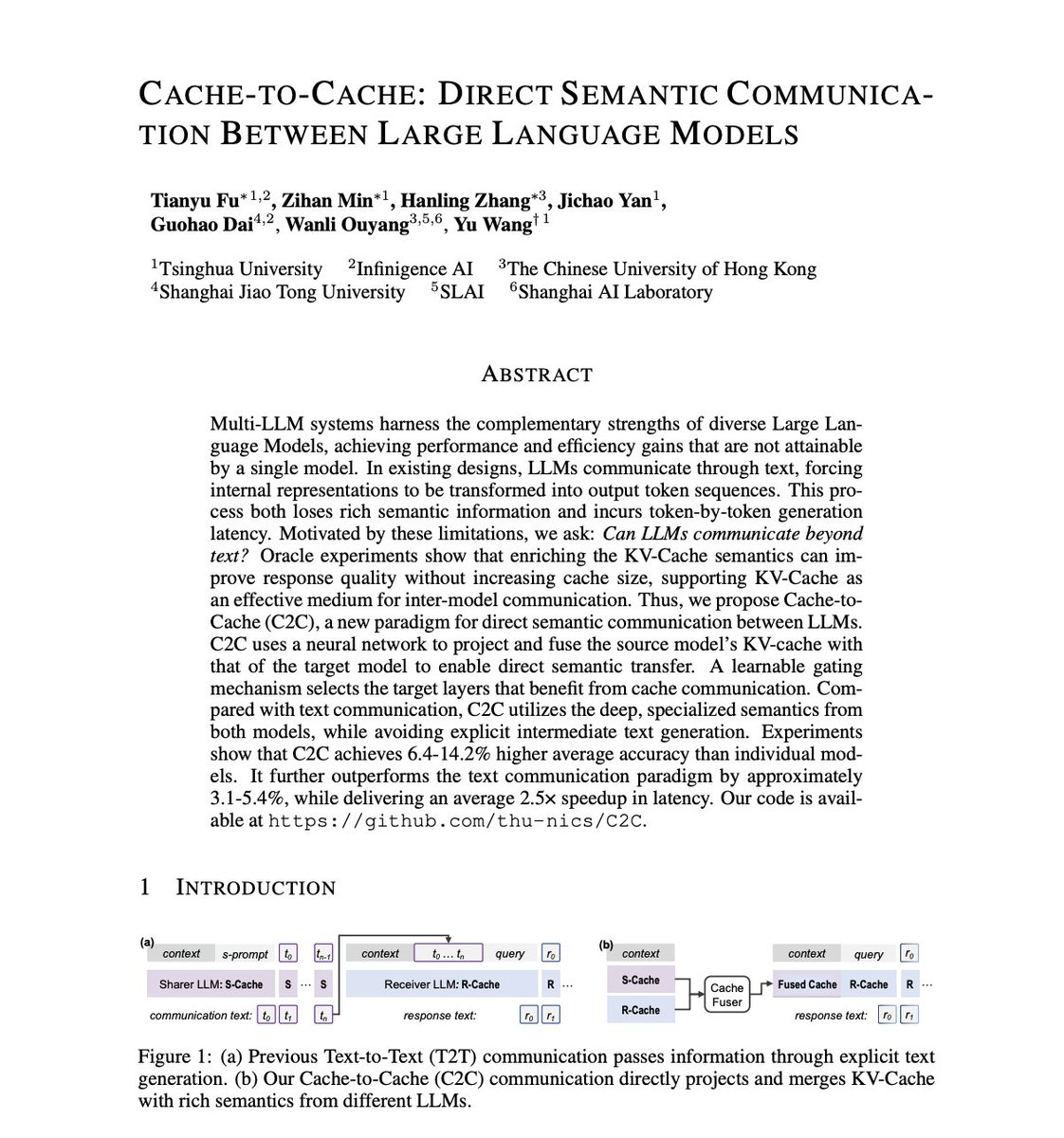
LLMs can now talk to each other without words.
Chinese researchers open-sourced a new paradigm that lets LLMs communicate without generating a single word.
It’s called Cache-to-Cache (C2C) communication.
right now, when multiple ai agents work together, they are forced to translate their internal "thoughts" into human text tokens just to pass a message. this loses rich semantic meaning and causes massive token-by-token latency.
So, instead of spitting out words, c2c uses a neural network to directly project and fuse the source model's "kv-cache" right into the target model. it is pure, direct semantic communication.. they even added a learnable gating mechanism to select exactly which layers benefit most from the cache transfer.
the benchmark results are actually crazy:
- avoids all intermediate text generation latency
- accuracy jumps by up to 14.2% compared to individual models
- beats traditional text-based agent communication by over 5%
- delivers a massive 2.5x speedup in overall speed
we are literally watching llms bypass human language to build their own silent, high-speed neural network..
Four-byline alert: 🚨
“.. People who have discussed the subject with Mr. Trump .. say his outbursts are rooted in worries that if the artificial intelligence boom .. slows down, the market could crash and recession could quickly follow.”
@nytimes
https://t.co/vrRmJkPlKo
@GaryMarcus Actually she started speaking Cantonese, which is different from Mandarin. This makes her “glitch” even more interesting since Mandarin is the official language of the PRC and Cantonese is a southern dialect most notably spoken in Hong Kong.
@MadnessWatcher Yes, I agree that the biggest obstacle for resolving a number of the US’s economic challenges are its current inability to not treat China as an adversary.
The term “China isn’t taking the bait” is from @ryanl_hass piece “Why Beijing Isn’t Taking the Bait with Trump”published by @BrookingsInst https://t.co/Qti8eU1Wv6
There is a notion circulating in Washington’s China-policy conversation ahead of Xi Jinping’s visit: China is not taking the bait.
Xi is described as offering remarkably little visible reciprocity for Trump’s recent conciliatory gestures. Beijing appears content to preserve an uneasy stability, avoid unnecessary escalation, and keep its options open.
The familiar explanation is that Trump can reverse himself. But the view on the ground here in Beijing points to a deeper question:
What if the uncertainty is no longer just Trump—but Washington itself?
What if political authority fragments?
Who controls Congress after November? How durable is Trump’s hold over his own coalition? What happens if an 80-year-old president suffers a sudden health event? And if authority does begin to fragment, which commitments remain commitments of the United States—and which turn out to have belonged primarily to one president?
That may be the deeper uncertainty behind Beijing’s caution.
The issue is no longer simply whether Trump can be trusted to honor a deal. It is whether American political continuity itself can still be assumed.
That question matters to diplomats deciding what China should concede, investors deciding how long American policy will last, and intelligence services mapping where power might move next.
In May, Beijing was measuring American decline.
As Xi prepares for Washington, China is measuring American continuity.
My new Core Interests essay follows that question into Trump’s MAGA base, the midterms, his age, the hollowing of U.S. counterintelligence capacity, foreign intelligence mapping, and the possibility that outside actors may possess information capable of affecting the timing of a political cascade.
https://t.co/MXffWNOzS2
There is a notion circulating in Washington’s China-policy conversation ahead of Xi Jinping’s visit: China is not taking the bait.
Xi is described as offering remarkably little visible reciprocity for Trump’s recent conciliatory gestures. Beijing appears content to preserve an uneasy stability, avoid unnecessary escalation, and keep its options open.
The familiar explanation is that Trump can reverse himself. But the view on the ground here in Beijing points to a deeper question:
What if the uncertainty is no longer just Trump—but Washington itself?
What if political authority fragments?
Who controls Congress after November? How durable is Trump’s hold over his own coalition? What happens if an 80-year-old president suffers a sudden health event? And if authority does begin to fragment, which commitments remain commitments of the United States—and which turn out to have belonged primarily to one president?
That may be the deeper uncertainty behind Beijing’s caution.
The issue is no longer simply whether Trump can be trusted to honor a deal. It is whether American political continuity itself can still be assumed.
That question matters to diplomats deciding what China should concede, investors deciding how long American policy will last, and intelligence services mapping where power might move next.
In May, Beijing was measuring American decline.
As Xi prepares for Washington, China is measuring American continuity.
My new Core Interests essay follows that question into Trump’s MAGA base, the midterms, his age, the hollowing of U.S. counterintelligence capacity, foreign intelligence mapping, and the possibility that outside actors may possess information capable of affecting the timing of a political cascade.
https://t.co/MXffWNOzS2
BRICS marks 20 years since its founding while facing internal rifts and navigating global tensions.
Analyst Andy Mok @andymok says the bloc has proven that strategic cooperation doesn't require strategic alignment. #BRICS#India#China#GlobalSouth#heat
@Huawei is no longer simply iterating on the foldable. Mate XT 2 looks more like a coordinated redesign of the entire device stack.
The form factor shifts from the original Z-fold to a dual inward-fold architecture with a rigid outer display. The chip introduces LogicFolding in the most powerful Kirin yet. HarmonyOS 7 pushes Xiaoyi into the role of a system-level agent across the unfolded canvas.
What especially caught my attention is the Kirin architecture. Earlier this year, I wrote about He Tingbo’s introduction of the Tau (τ) Scaling Law and Huawei’s attempt to rethink scaling under tighter physical and manufacturing constraints. Mate XT 2 now gives that idea a concrete consumer expression.
Form, silicon, OS, privacy architecture: the interesting story is not any one feature, but how tightly Huawei is beginning to integrate them into a single computing system.
My earlier piece on the Tau Scaling Law:
https://t.co/O526PQw5ry
Huawei unveils tri-fold Mate XT 2 with Kirin 9050 Pro, the world's first chip with LogicFolding architecture. Executive Director, Chairman of the Investment Review Board & Chairman of the Board of Directors of the Consumer BG, Huawei, Mr. Yu Chengdong shared the chip's strengths.
AI is moving from representation toward simulation.
A system that can model space, control viewpoint and project change through time does more than generate media: it expands the range of environments in which machines can learn, test and eventually act.
That is a new layer of capability.
Introducing Atlas:
The world's first multimodal world model that generates image and video frames with pixel-perfect camera control and reconstructs them in 3D.
Model the world, move the camera, and simulate space & time.
Druckenmiller: AI is to writing no different than what a calculator is to math.
A bit surprised that @Substack@chrisbest doesn’t get this.
Maybe if writing is purely for aesthetic pleasure identifying “Claudefishing” may matter.
But as those who were born pre-AI die off, this distinction may also become quaintly irrelevant.
Druckenmiller: There’s a reason I moved from an English major to being an economics major. I’m not embarrassed by it. I write everything using AI now for the same reason I use a calculator when I do math problems. I don’t know why this is relevant. My name is on the piece. It’s my message.”
Global icon and humanitarian, Dolly Parton, known to the world as a beloved singer, songwriter, philanthropist, actress, playwright, and author died peacefully today in Nashville, Tennessee. She was 80 years old.
Dolly is preceded in death by her beloved husband of 59 years Carl Thomas Dean (1942 – 2025), her mother Avie Lee Caroline Owens (1923 – 2003), and father, Robert Lee Parton, Sr. (1921 – 2000).
A rhinestone life that shone bright enough for the world to see, Dolly will forever stand as an inspiration not only through her timeless music and prolific songwriting, but also her wit, warmth, and kindness that made us all feel like family. Dolly Parton’s legacy is one of love, compassion, and resilience. With a seven-decade career, she inspired multiple generations of artists and fans with her music and an unwavering commitment to making the world a better place. Her songs will continue to resonate with people of all ages, and her philanthropic work will have a lasting impact.
At Dolly’s request, a small, private service will be held for immediate family. Dolly’s fans and friends from around the world are encouraged to pay tribute to Dolly on social media by tagging @DollyParton or by leaving a message at https://t.co/cLu9I7M2wC
In lieu of flowers the family asks for donations to be made to Dolly Parton’s Imagination Library at https://t.co/arzrqInqJA
Sushiro is a great example of the powerful latent consumer demand amongst young people in China.
It may also illustrate the qualitatively different nature of youth unemployment here.
This is a long post, but it closely matches my personal experience and makes intuitive sense.
This may not be Yishan’s intended takeaway, but basically what i think he's saying is that unemployment is a headline number that can reflect very different realities. China’s high youth unemployment is not simply the result of there being no jobs.
As Yishan points out, China has a rapidly aging population, a relatively young retirement age, and a collapsing birth rate. So why are so many young people unemployed and living with their parents, seemingly without job prospects?
I have actually tried to recruit from this group. The uncomfortable answer is that many of them do not really need to work. Unless a job offers the near-perfect combination of status, pay, benefits, and work-life balance, they would rather wait.
They can afford to do so because they often have two parents with healthy savings who can support them. Meanwhile, their surroundings keep becoming more modern, convenient, and comfortable without necessarily becoming much more expensive.
I do not know how large this group is, but it is not trivial. If it represents even 5% to 10% of the cohort, as Yishan suggests, that alone explains a meaningful portion of the youth unemployment puzzle.
This is fundamentally different from millennials over 35 who have been laid off. Their parents belong to a different generation and may have much less saved. They are also more likely to have children of their own and mortgages on depreciating property. They are generally not in a position to simply stay home and wait for the perfect job.
These are two very different forms of unemployment and should not be lumped together. Yishan’s argument is specifically about youth unemployment and how, for at least part of this cohort, it may reflect family-supported abundance rather than a complete absence of opportunity.
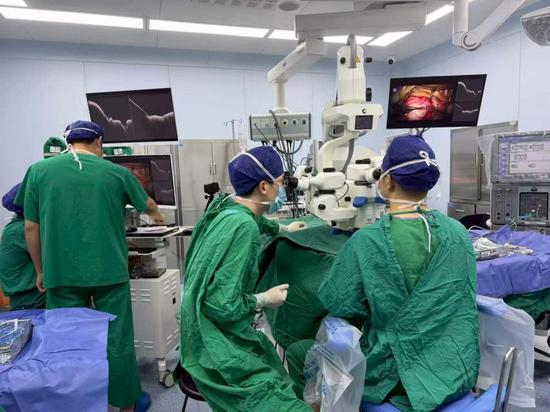
With successful implant of a brain computer interface allowing a blind woman to see, China has achieved a medical breakthrough of historic significance.
A 40-year-old Chinese woman who had been almost completely blind for nearly 20 years regained her visual function after becoming the first person in China to receive a homegrown high-resolution retina-based visual brain-computer interface (BCI) implant in a clinical trial.
After more than two months of training, she is making steady progress in rehabilitation, learning to recognize letters, practice writing, and move around indoors with increasing confidence.