In September of 1814, America was once again in trouble.
The young republic was only thirty-eight years old. The War of 1812 had gone badly. British troops had marched into Washington, burned the Capitol, set the White House ablaze, and now turned their sights toward Baltimore. If Fort McHenry fell, the harbor would be open, the city would likely follow, and another devastating blow would be dealt to the fragile nation.
Amid this uncertainty, a young American lawyer named Francis Scott Key sailed under a flag of truce to the British fleet. He had come to negotiate the release of a friend, a physician the British had captured.
He succeeded.
The British agreed to free the doctor.
But there was a catch.
Because Key and his companions had seen too much of the British fleet and learned too much about its plans, they were not allowed to return to shore. Instead, they were detained aboard a ship in the harbor and forced to watch the coming battle from behind enemy lines.
On the morning of September 13, the bombardment began.
For the next twenty-five hours, British warships unleashed somewhere between 1,500 and 1,800 bombs and rockets upon Fort McHenry. These were the “bombs bursting in air” and the “rockets’ red glare” of the song—not poetic embellishments, but terrible realities.
Key stood on the deck through the endless day and the long, terrifying night. Every explosion lit the darkness for a fleeting instant before the smoke swallowed everything again. Somewhere beyond that wall of fire stood the fort. Somewhere beyond it flew an American flag if it still flew at all.
He could not see.
He could only listen.
As long as the guns continued firing, there was reason to hope. The British would not waste ammunition on a fort that had already surrendered.
Then, just before dawn…
The guns fell silent.
For the first time all night, there was only stillness.
It was the most frightening sound of all.
Had the fort finally fallen? Had the defenders surrendered? Had the flag been torn down in the darkness while no one could see?
There was nothing to do but wait.
As the first light of September 14 slowly pushed back the smoke, Francis Scott Key strained his eyes toward the distant fort.
Then he saw it. Not a British flag.
The American flag. Still there. Still flying.
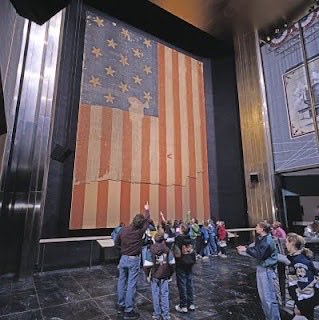
That flag was no ordinary banner. Months earlier, the fort’s commander had commissioned a Baltimore flagmaker, Mary Pickersgill, to sew a flag so enormous “that the British would have no difficulty seeing it from a distance.” It measured roughly thirty by forty-two feet, carried fifteen stars and fifteen stripes, and was so large it had to be assembled on the floor of a brewery because no ordinary room could contain it.
That was the Star-Spangled Banner.
The very flag Key saw through the morning mist.
The very flag that still survives today in the Smithsonian.
Overcome by what he had witnessed, Key reached into his pocket, pulled out an envelope, and began writing. The words came from a heart that had spent an entire night fearing his country might disappear with the dawn.
He first titled the poem Defence of Fort M’Henry.
Within days it was printed and circulating throughout the country. Before long, people began singing it to a melody they already knew—an old British tune called “To Anacreon in Heaven,” originally written for a London social club. There is something beautifully ironic in that: America’s most beloved patriotic song borrowed the melody of the very nation it had just survived. It also explains why the anthem is so notoriously difficult to sing. It was never written for ordinary voices gathered in stadiums or school assemblies.
The song spread quickly and became one of America’s favorite patriotic hymns, but it would wait more than a century before receiving official recognition. Not until 1931 did Congress declare “The Star-Spangled Banner” the national anthem of the United States.
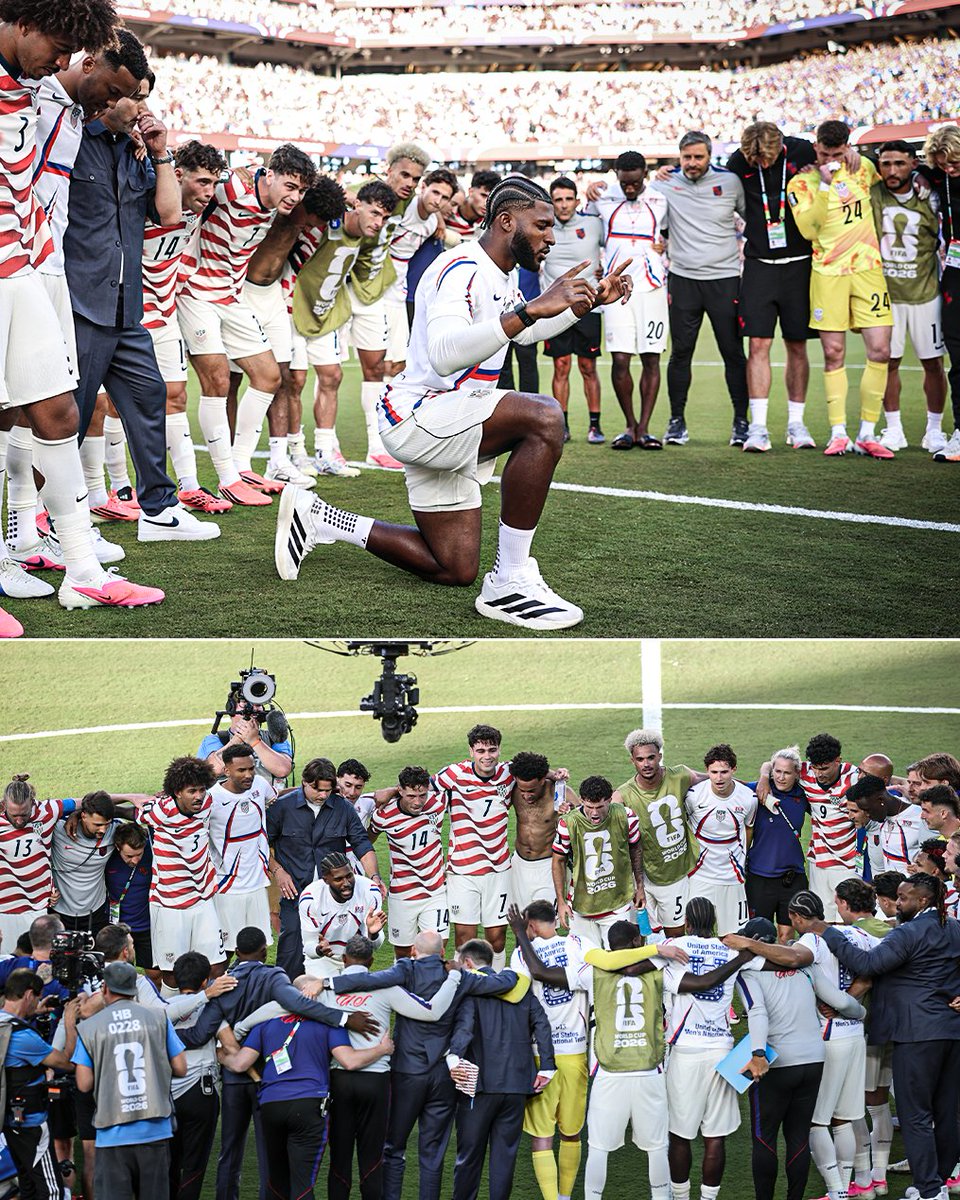
#USMNT striker Folarin Balogun on his immediate reaction to red card:
“I think it was just important to stay calm. I never want to react out of anger and out of emotion. There’s still lots of people we’re inspiring, little kids, boys and girls who are watching, and we have to show them the correct way to handle things, even when you think it's unjust.”
On shaking ref’s hand postgame:
“As said, you can feel like something, injustice can happen to you. It’s not an excuse to be disrespectful… I'm aware that the World Cup might be the first time a lot of American viewers are tuning in. So it's important just to show people, whether things happen to you, good or bad, just to continue to be yourself.”
Abdikerm Eidleh was an alleged ringleader of one of the largest fraud scandals in the history of the country - orchestrating a massive $250 million scheme to steal critical food resources from vulnerable Americans who needed it and spent the money on luxury cars and mansions, as shameless as it gets.
But thanks to a brilliant op from this FBI and our great partners - we got him in Somalia, and he will now face justice.
To date the FBI has systematically dismantled the ‘Feeding our Future’ web of corruption and arrested over 70 members in the case - we will continue working every single day to wipe out fraud across the country.
I can’t think of the last time a pro sports league needed a competent commissioner more badly than the WNBA does right now. Maybe the NBA in the early-80s pre-Stern.
After a hellish week in a Paris Airbnb with no AC (100°F outside, 108°F+ inside), I started looking into why the French are so opposed to AC.
There's many reasons: bureaucracy, poverty, etc. But the main one is decades of environmental campaigns that convinced people AC is the devil.
The result? You can't escape the heat. Most buses, metro lines, and shopping malls have no AC.
This Monday, 850 schools are closing because classroom temperatures exceed 104°F.
In Nantes, they built a brand-new train station and a hospital without AC for environmental reasons. The station is now partially closed because it's become a "furnace" that endangers travelers. Hospitals are covering windows with emergency foil blankets to protect patients.
The French demonize air conditioning because it creates carbon emissions that contribute to climate change. Never mind that France already has one of most carbon-free electricity in the world thanks to nuclear, or that it accounts for less than 1% of global emissions.
They also oppose AC because it "just displace the problem" by dumping heat into the street. Never mind that studies suggest even if an entire city were air-conditioned, the increase in outdoor temperature would be at most about 1°F.
Instead, people are willing to endure 104°F+ indoors to avoid a marginal increase outdoors.
This ideology kills more people than firearms in the United States.
Across Europe, between 50,000 and 70,000 people die from heat every year, mostly the elderly and the poor. Compare that to roughly 44,000 Americans killed by firearms.
For comparison, despite having a similar population, deserts, and more extreme temperatures, the United States has only about 2,500 heat-related deaths per year thanks to widespread AC.
That's what bothers me most. The moralizing posture completely detached from reality.
People feel morally superior for "not polluting." They criticize America and its guns while tolerating policies that kills even more people.
I share this anecdote because I know it's shocking to Americans. Here, schools or hospitals reaching 104°F would be unnaceptable.
The absurdity is immediately obvious to us because we're looking from the outside. We see the gap between moral intentions and real-world consequences.
But we're no different. In America, we have dozens of similar issues where we're just as irrational, and we've become blind to them because the solution isn't politically acceptable.
How do can we bring back logic and pragmatism in our societies ahead of irrational political ideological ?
Cannot make this up, either.
@nytimes opinion has had four recent pieces about fatherhood and masculinity, with six authors:
Three women
A trans "man"
Two childless men
Not one father. The cultural elite contempt for dads runs so deep we don't even get to speak for ourselves.
"we couldn't do anything useful for citizens in my 14 years of office allocating 60 trillion USD. but if we can just steal from the rocket science electric car guy, then we can solve all your problems."
By using the word “desecrating,” dumdum here accidentally gives away the entire game. He is admitting that the gay uniforms, insignia, etc. are religious items for the rainbow mafia. (One cannot desecrate that which has not been consecrated, aka made sacred.)
Pride Month is a religious high holiday designed and intended to compel participation in the religious rites of the gaystapo. And that is exactly why Christians are morally obligated and legally free to reject every last vestige of this nonsense.
“The American people are some of the best people that I’ve ever had the privilege and honour to come into contact with throughout my entire life.
Never in my days have I met such hospitable people, such kind people, people that want to serve others without ever expecting anything back for themselves, and people that are genuinely very, very positive.”
Even with all the craziness that happens in this country, it’s really nice to hear this 🇺🇸🙏🏼
The great lie is that society is divided between rich and poor.
The great truth, as David Friedberg puts it, is makers vs takers.
Makers build, create, and deliver real value: houses, software, art, businesses, and everything that moves civilization forward.
Takers watch, criticize, analyze, and politic. They push the lie that the rich hoard unfairly so the poor must seize it… all while positioning themselves to rule the chaos.
As @friedberg tells his kids: “At the end of the day, if you made something and someone else valued it, you were a maker. That was an amazing achievement. That is a great day.”
Takers thrive on division. Makers drive progress.
Time to choose your side.
The World Cup has turned America into a discovery channel for the rest of the world.
And they are not handling it well.
In the best possible way.
Here is what they are discovering:
Free public restrooms. Europeans pay every time.
Free water at every restaurant. Just appears.
Free refills. Coffee. Sodas. Iced tea. Unlimited.
Free chips and salsa before you even order.
Free warm bread with dinner.
Ice in drinks like civilized people.
Air conditioning everywhere. Not a moral debate. A fact.
Parking lots attached to the actual place you are going.
Drive throughs where the food comes to the car while you sit in it.
Ranch dressing by the gallon.
Tex-Mex that cannot be explained only experienced.
Dental care that actually works.
Buccee’s. There are no words for Buccee’s.
Then they found the grocery stores.
Five of them within one mile.
Each one the size of an aircraft hangar.
Burgers. Steaks. Brisket. Ribs. Pulled pork. Lamb. Veal. Every cut of every animal ever domesticated by human civilization available in one refrigerated aisle at ten in the morning on a Tuesday.
The Germans stood in the meat section for forty five minutes.
In silence.
Processing.
They finally understand why we do not have trains.
We have roads wide enough for the cars we actually drive.
Parking lots the size of small European countries.
Airports in every city worth visiting.
Why would we need trains.
The Germans are taking ranch home by the bottle.
The Dutch found queso and briefly lost the ability to speak.
The Japanese are photographing HEB like it is the Louvre.
The Czechs are weeping in West, Texas.
Welcome to America!
The greatest country on earth.
Watching fans from all over the world experience America has been one of the coolest parts of this World Cup.
People are losing their minds over things most of us don’t even think about anymore:
- Free chips and salsa.
- Buc-ee’s.
- Massive grocery stores.
- Six-lane highways.
- Air conditioning everywhere.
- Endless refills.
Meanwhile, the tournament is being played in world-class stadiums that were already built. No rushed construction. No billion-dollar vanity projects.
It’s hard to ignore what visitors keep saying: the infrastructure is incredible, the people are welcoming, and the scale of everything is unlike anything they’ve seen before.
Sometimes it takes seeing your country through someone else’s eyes to appreciate what we have.
We take a lot of it for granted.
I'm seeing my feed flooded with posts about Europeans realizing that they were lied to about America.
The consensus of their posts is that America is safer, more prosperous, and more welcoming than they were told.
This might be the most powerful effect of the World Cup.
Every dollar Elon Musk has made is traceable. Every product sold, every service rendered, every government contract awarded, every share of stock bought or sold. It’s all on the record.
You, on the other hand, haven’t built a company, invented a product, or created anything people willingly pay for. You’ve spent the last 14 years collecting a $174,000 Senate salary.
Yet somehow you managed to buy a luxury D.C. condo, a $4 million Victorian mansion in Cambridge, and saw your net worth balloon by 150% to $12 million. Everyone knows where Musk’s money came from. The same can’t be said for yours.