Just pointing out that I broke the story 7 months ago that Mandelson failed vetting from the security services and put it to Downing Street...so the idea that Downing Street only found out on Tuesday is complete nonsense.
https://t.co/9Zp14BGCoD
As a Bishop, I cannot stay silent. I have today drafted and sent an open letter to His Majesty King Charles III, the text of which reads as follows:
To:
His Majesty, Charles III,
King of the United Kingdom and the Realms,
Supreme Governor of the Church of England,
Bearer of the ancient title Defender of the Faith.
Your Majesty,
I write to you neither as a politician nor as a commentator, but as one of your loyal subjects who, as a bishop of Christ’s Church, cannot remain silent while the Christian foundations of this kingdom are steadily dismantled.
Sir, there are moments in the life of a nation when silence becomes a form of betrayal. If I refused to speak to Your Majesty now, this would be such a moment.
For more than a thousand years the Crown of this realm has stood in solemn covenant with the Christian faith.
The laws of this land were shaped by it.
The liberties of our people were nurtured by it.
The conscience of our civilisation was formed by it.
From the abbeys of medieval England to the parish churches of our villages, from the preaching of the Reformers to the missionary zeal that carried the Gospel to the ends of the earth, the Christian faith has not merely influenced Britain — it has defined her.
Yet today that inheritance is being quietly but deliberately eroded. Across the institutions of this nation there is a growing hostility toward the faith that built them.
Christian belief is mocked in the public square. Christian morality is dismissed as intolerance. Christian institutions are pressured to surrender doctrine in order to conform to the ideology of the age.
Within the very Church that bears the name of England, voices have arisen that appear more eager to mirror the spirit of the age than to proclaim the eternal truth of the Gospel.
Meanwhile, beyond the walls of our churches, powerful political movements openly speak of removing Christianity from its historic place within the life of this nation.
What would once have been whispered is now proclaimed openly: that Britain must become a post-Christian state.
It is in this context that I write to you, Your Majesty. For the British Crown does not stand apart from this crisis.
The Sovereign of this realm bears a title that is not merely historic but sacred in its origin and meaning: Defender of the Faith. Those words are not decorative. They are a charge.
They speak of a monarch whose duty is not merely to preside over the ceremonies of the Church, but to stand as a guardian of the Christian inheritance of the nation.
Yet many among your subjects now ask, with increasing anxiety: “Who will defend that inheritance today?”
They see a nation drifting from its foundations. And they ask whether the Crown will remain silent while that inheritance is dismantled.
Your Majesty, may I be so bold as to observe that your coronation oath was not a poetic formality. It was a solemn vow made before Almighty God to maintain and preserve the Protestant Reformed Religion established by law.
Those words bind the conscience of the sovereign. They remind the Crown that its authority is not merely constitutional but moral. The monarch is not merely a symbol of national continuity, but a custodian of the spiritual inheritance that shaped this realm.
History records moments when kings and emperors were confronted by the Church and reminded that their authority was accountable before God. In the fourth century Ambrose of Milan stood before the Emperor Theodosius I and reminded him that even the ruler of an empire must bow before the moral law of Christ.
That tradition of prophetic witness has never disappeared. Nor should it. For when rulers forget the foundations upon which their authority rests, the Church must speak — not with hostility, but with holy clarity.
And so, I write to say this, Your Majesty: The Christian character of this nation is under profound and accelerating assault.
If the Crown does not stand visibly and courageously in defence of that inheritance, history will record that the guardians of Britain’s institutions watched in silence as the foundations were removed.
The issue before us is not nostalgia. It is civilisation. Remove Christianity from the story of Britain and you do not create a neutral society — you create a moral vacuum. And history teaches us that moral vacuums are never left empty for long.
Your Majesty now stands at a crossroads that few monarchs in modern history have faced.
For the erosion of Britain’s Christian inheritance will not ultimately be judged by speeches made in Parliament or debates in the press. It will be judged by whether those entrusted with the guardianship of our ancient institutions chose to defend them — or merely preside over their quiet surrender.
You may preside over the quiet dissolution of Britain’s Christian identity. Or you may rise to the ancient responsibility entrusted to the Crown and speak with clarity about the faith that built this kingdom. The first path requires little courage. The second will require a great deal. But it is the path that history honours.
Your Majesty’s subjects are not asking for religious coercion. They are asking for leadership. They are asking that the sovereign who bears the title Defender of the Faith remember what that title means.
They are asking that the Crown hear the growing cry of anguish from Christians across this land who feel that the spiritual inheritance of their nation is being surrendered without resistance. And they are asking whether the Crown will stand with them.
For the faith that shaped Britain is not merely a cultural ornament. It is the wellspring from which our laws, our liberties, and our moral imagination have flowed. If it is cast aside, the nation will discover — too late — that it has severed itself from the very roots that sustained it.
Your Majesty, to many the Crown is a symbol of authority. But before God it is also a symbol of stewardship. And stewardship carries with it the duty to defend what has been entrusted.
May Almighty God grant Your Majesty the wisdom to discern this hour, and the courage to fulfil the sacred duty entrusted to the Crown.
Yours faithfully,
Bishop Ceirion H. Dewar FSHC
Missionary Bishop
Diocese of Providence
Confessing Anglican Church
@PhilHs10@RevBrettMurphy@revwickland@BishopRobert1@GBNews@TalkTV@danwootton@Jacob_Rees_Mogg@LozzaFox@BackBrexitBen@RupertLowe10@KemiBadenoch@JohnCleese
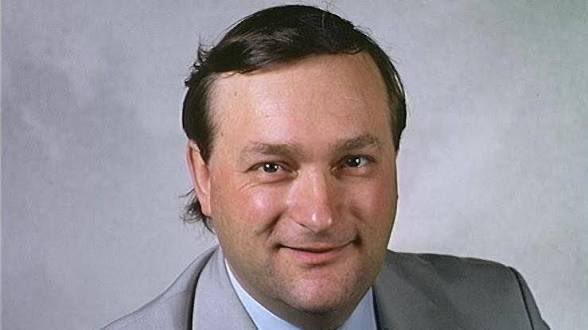
This is Nick Brown a Labour MP sacked because serious criminal allegations were made against him.
He was allowed to retire without any criminal investigation.
To this day not a single police force has investigated his alleged crimes.
No one in the British press is allowed to ask questions or report on this.
He was a very high ranking senior MP very well connected to all the Labour top knobs.
Don’t let this be forgotten.
It is rumoured the allegations if investigated would bring down the entire Labour government.
The Language of Submission
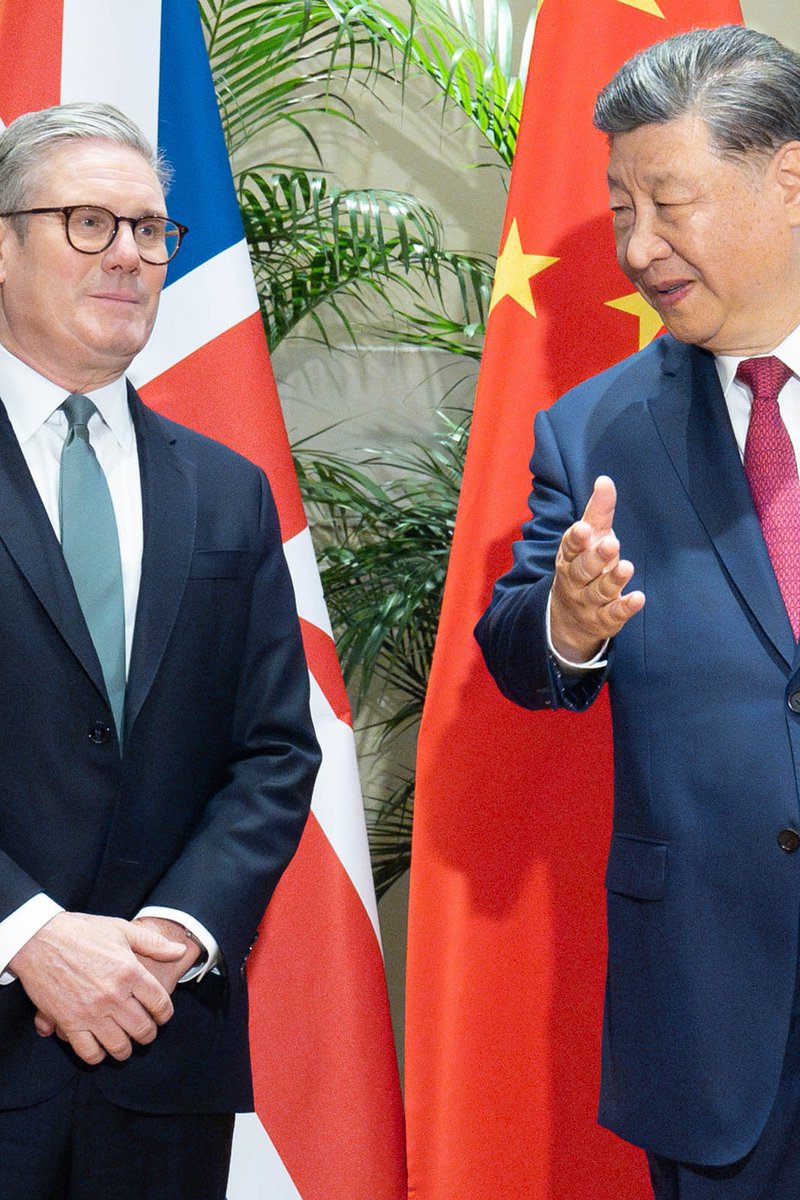
When a British Prime Minister flies to Beijing, words matter. Not because they soothe egos, but because they signal intent. This week, as Keir Starmer stood beside Xi Jinping, Britain did not just speak softly. It bent its language into shapes designed to avoid offence, blur judgment, and conceal reality. That is not diplomacy. It is kowtowing by syntax.
Starmer's visit has been wrapped in phrases so careful they dissolve on contact with the truth. China is said to pose "challenges". There are "huge opportunities". Britain will remain "clear-eyed". Relations have suffered from our "inconsistency". Each phrase is chosen to do the same job: downgrade threat, soften responsibility, and shift blame away from Beijing and onto ourselves.
China is not a "challenge". It is the primary enabler of Russia's war against Ukraine. Chinese components sit inside the drones and missiles hitting Kyiv. Chinese firms prop up Moscow's economy. Chinese intelligence is running one of the most aggressive espionage campaigns Britain has ever faced. To call that a challenge is to strip the word of meaning until it becomes harmless.
The same applies to "opportunity". Yes, China has 1.4 billion people. But British exports to China are falling fast. Goods exports have collapsed. The trade balance runs overwhelmingly in Beijing's favour. China sells to us. We do not sell to China. The end point of Xi's industrial policy is self-sufficiency and dependency for others. "Opportunity" here means access on sufferance, temporary and revocable, while knowledge is extracted and replicated. The word disguises decline as promise.
Then there is "clear-eyed realism", that favourite phrase of governments that prefer not to look too closely. Whenever a Prime Minister insists he is clear-eyed, it is usually because he wants the public to believe he sees danger while acting as if he does not. Realism, in practice, is used to justify retreat while claiming maturity.
The most revealing phrase of all is Starmer's claim that Britain's China policy has been damaged by "inconsistency". This is moral inversion. It treats British resistance as the source of tension and Chinese behaviour as a constant to be accommodated. Hong Kong disappears. Treaty breaches vanish. Espionage fades into background noise. Britain is recast as the unreliable party, China as the aggrieved one.
This framing is not accidental. It does vital political work. If Britain is the problem, then Britain must change. If China is merely responding, then China must not be confronted. Responsibility drains away from power and settles on restraint. Language like this is not decoration. It is preparation.
You do not approve a Chinese super-embassy beside the City's financial arteries without first emptying the public language of alarm. You do not retreat naval presence from the Indo-Pacific without first recasting power projection as an outdated obsession. You do not give up strategic footholds and deepen dependency without first convincing people that firmness is reckless and accommodation is wisdom.
China understands this perfectly. That is why its state media has portrayed Starmer's visit as a return of the prodigal son. Britain, chastened after years of "twists and turns", comes back to seek stable relations. The message is not subtle. Britain misbehaved. Britain has learned. Britain is ready to be reasonable. And Starmer, through his words, plays along.
There was a time when Britain refused to bow even when China demanded ritual submission. That refusal mattered because it drew a line. Today there is no ceremony, no kowtow. Just careful phrasing, quiet concessions, and a steady acceptance that sovereignty is something to be managed rather than defended.
This is how decline presents itself in a modern state. Not with collapse or panic, but with polished language and lowered expectations. Threats become challenges. Dependence becomes opportunity. Retreat becomes realism.
From trusted source in Tehran: Tell all of your friends [abroad], everyone you know: there is absolutely nothing else we can do here inside Iran. Nothing. They are killing people in such ways, they’ve descended upon people so brutally, they're attacking us in such ways... We’ve lost so many lives that no one dares go out anymore. They shoot directly with bullets. They kill outright. And even after killing, they come and behead you, and do countless other violent things to you.
For God’s sake, whatever can be done, you are the ones who can do it. You must not abandon these gatherings. All of you must keep these protests going. We cannot do anything inside Iran. Going out into the streets is literally suicide. It’s not about bravery anymore. It’s madness. You go out and they shoot you point blank. They don’t even ask why you came. They just kill you.
There is absolutely no way for us to gather unless we had weapons, unless we were armed like them. Otherwise they have weapons everywhere. There has been so much killing. So much.
So whatever is to happen now is up to you. You are the ones who can somehow save us. [Breaks down into a sob. Crying, the caller continues...] When you see what’s happening, when you hear what’s happening… I’ve done so much yelling and choked on so much teargas, my voice is bad.
We follow what you're doing. When we see you gather in protest in front of an embassy it brings us joy. It still gives us a lingering hope that we can do something. It's your responsibility now. We did absolutely everything we could. As our fellow Iranians it's your responsibility. You can influence foreign policy. You can tell the world what's happening. The placards you hold. The YouTube videos. Distributing images and video. Gathering in front of embassies. Even if you have just the weekends. Please do something for us on Saturdays and Sundays. Please don't let your gatherings get smaller as the weeks go on. No one will stop you there. No one will kill you. No one is singling you out. We don't even have the freedom to walk about in our own town. We no longer even know who is friend or foe.
We don’t even know who we’re speaking to anymore. We no longer know if those recounting what's happening is an enemy. Because if one wrong word slips from our mouths, they turn us into a corpse even before we've had a chance to return home.
For God’s sake, I beg of you, don’t abandon these gatherings. Our only hope now is you. What’s now obvious is that America won’t do anything. You’re our only hope. Please tell your friends. You’ve seen how many young people have been killed. So many, so many young people. For the sake of the youth.
I know that based on the videos that have reached Iran International [satellite station] since yesterday, now that the internet has come back briefly, they will probably cut the internet again and people will go into silence, the country will go back into a blackout.
For God’s sake, please help us. Help us save our country from these people. Stand together so we can live in a flourishing country. For God’s sake, help us.
We are in Tehran. What I saw in Tehran, and what they’re saying about the provinces and small towns... They couldn’t fully control Tehran’s gatherings with the forces they had, but in the small towns it was killing after killing. Towns with populations of only 20 or 30 thousand people truly had many deaths. Thousands, hundreds…
The things we’ve heard, the things we’ve seen go far beyond mass killing. It was horrific. Truly horrific.
I beg you. I beg you. Don’t abandon these gatherings. Please. #Iran #IranMassacre
🔴 The Shah of Iran speaks:
"Dear Iranians abroad,
The magnificent and powerful marches you held in recent days, in every corner of the world, from Australia to all across Europe, to Canada and the United States, have given strength and hope to our brave compatriots inside the occupied homeland. Your voice is the voice of the Iranian nation. I am grateful and deeply appreciative of you.
Today, as the Islamic Republic has dramatically raised the cost of people’s presence in the streets of Iran through ruthless massacres and military rule, your responsibility in securing international support for our compatriots has become even heavier. The importance of your role is greater than ever before. The continuation of your activities is necessary and essential: broader, more coordinated, more cohesive, and more targeted.
As I announced in the recent press conference in Washington, at this stage we have six specific demands from the international community.
All activities of Iranians abroad, from rallies, sit-ins, and marches, to meetings and correspondence with decision-makers and legislators, to informing the media and online networks, must be centered around these six demands:
First: Protecting the people of Iran by weakening the regime’s repression machine; especially by targeting the Islamic Revolutionary Guard Corps (IRGC), its commanders, command structure, and infrastructure.
Second: Maximum economic pressure by freezing the regime’s assets worldwide and targeting its secret fleet of oil tankers, known as the “ghost fleet.”
Third: Providing free internet access to Iran through Starlink and other secure communication tools, and disabling the regime’s ability to shut down the internet.
Fourth: Expelling the regime’s diplomats and pursuing legal action against crimes against humanity.
Fifth: The immediate and unconditional release of all political prisoners.
And sixth: Readiness for a democratic transition in Iran and recognition of a legitimate transitional government.
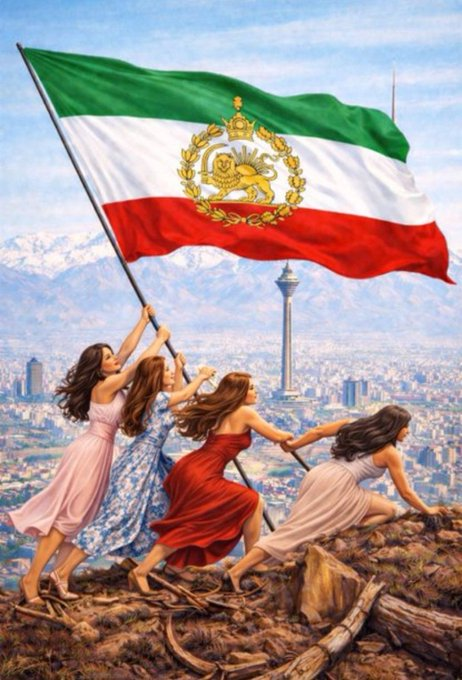
I ask all of you to remain united under the Lion and Sun flag of Iran - the flag for which tens of thousands of brave Iranians have sacrificed their lives to raise it again.
Put aside personal differences.
Avoid parallel actions and separate programs in the same city.
Align and coordinate your efforts so that they become more effective.
Remember that in the eyes of the world, you are the representatives of the great Iranian nation; therefore, your conduct must be dignified, civilized, and worthy of Iranian ethics and culture.
My team and I are carefully following your coordinated activities. Very soon, programs related to the “Global Day of Action and Solidarity with the National Revolution of Iran” will be announced.
The gaze of our honorable compatriots inside Iran, who are held captive by the occupying Islamic Republic regime, is upon us. Let us join hands so that their suffering may end sooner; so that they may reach the freedom and prosperity they so richly deserve. That day is closer than ever.
Long live Iran!"
Rubina Aminian was twenty-three years old. She was a student. She went to college, tried on jewellery, laughed into her phone, and believed her life was still ahead of her. On Thursday she joined a protest in Tehran after class. By the weekend she was dead, shot at close range in the back of the head and buried beside a roadside like discarded evidence. Shot in the back of the head is not crowd control. It is not panic. It is execution.
Rubina was not armed. She was not hiding. She was not a threat. She was a young Kurdish woman demanding the right to live freely in her own country. For that, the Islamic Republic killed her and then tried to erase her, refusing her family a funeral, surrounding their home with intelligence agents, forcing them to bury her quietly and without ceremony. This is how a regime tells its people that death does not end punishment.
Doctors describe hospitals flooded with bodies and shattered faces, protesters shot in the head and neck, bullets fired from rooftops, eyes destroyed by pellets, children among the dead. Parents are forced to identify their sons and daughters from screens showing bloodied faces while the internet is cut so the killing can proceed without witnesses. This is not loss of control. It is control stripped bare.
The order comes from the top. Ali Khamenei has handed repression to the men who exist for this purpose, trained to fire without hesitation and to disappear the evidence. When a state labels its own citizens "terrorists" and "offenders against God", it is not preparing dialogue. It is preparing mass death.
Outside Iran, something almost as chilling is happening. Silence. If Rubina had been killed by a Western-aligned government, her face would be everywhere. Her name would be spoken by politicians, celebrities, NGOs, and broadcasters. Marches would be organised. Statements would pour out. Moral certainty would arrive on schedule. Instead, she is barely mentioned.
The people who claim to speak for women say nothing. The activists who insist on believing victims are nowhere to be found. The institutions that lecture endlessly about justice retreat into caution and euphemism. Iran's internet blackout is matched by a moral blackout in the West. This silence is not ignorance. The facts are known, the images exist, doctors are testifying, parents are burying their children in secret. Silence, here, is a decision.
To speak plainly would require saying something uncomfortable: that an Islamic theocracy is murdering young women in the street, that this violence is ideological, not incidental, and that the people resisting it are not pawns of the West but among the bravest people in the Middle East today. Rubina Aminian did not die in a complex situation. She was killed because she stood against clerical rule, and that truth is what the silence is designed to smother.
She deserved a life. She deserved a future. She deserved a grave marked by love, not fear. The regime buried her by the roadside. The world buried her with indifference.
"Outside Iran, something almost as chilling is happening. Silence. If Rubina had been killed by a Western-aligned government, her face would be everywhere. Her name would be spoken by politicians, celebrities, NGOs, and broadcasters."
I am here today because I survived and I prevailed.
But that is not enough.
Not when Alon Ohel is still there.
Not when 59 hostages are still there.
Right now, Alon is trapped underground, alone, surrounded by terrorists who torment him. He does not know if he will ever see his mother, father, his entire beloved family again.
I will not leave him behind.
I will not leave anyone behind.
Their time has almost run out.
I am here before you now to give my testimony.
And to ask– where was the United Nations?
Where was the Red Cross?
Where was the world?
I know that you discuss the humanitarian situation in Gaza very often. But let me tell you, as an eye witness – I saw what happened to that aid.
Hamas STOLE it.
I saw Hamas terrorists carrying boxes with the UN and UNRWA emblems on them into the tunnel.
Dozens and dozens of boxes, paid by your governments, feeding terrorists who tortured me and murdered my family.
They would eat many meals a day from the UN aid in front of us, and we never received any of it.
When you speak of humanitarian aid, remember this:
Hamas eats like kings while hostages starve.
Hamas steals from civilians.
Hamas blocks aid from reaching those who truly need it.
491 days.
That is how long I starved, how long I was chained, how long I begged for my humanity. And in all that time, no one came. And no one in Gaza helped me.
No one.
The civilians in Gaza saw us suffering.
They cheered our kidnappers.
They were definitely involved.
I was freed less than six weeks ago.
I met President Trump at the White House and thanked him for securing my release and many others. I appreciate his efforts to free those still held hostage by Hamas.
I told him: BRING THEM ALL HOME.
I met with Prime Minister Starmer at 10 Downing Street.
I told him: BRING THEM ALL HOME.
Now, I am here before you at the United Nations to say:
BRING THEM ALL HOME.
No more excuses.
No more delays.
If you stand for humanity – prove it.
Bring them home.
My name is Eli Sharabi.
I am not a diplomat. I am a survivor.
BRING THEM ALL HOME. NOW.
Thank you.