haven't yapped about @wardenprotocol in a while but Halo got me looking again.
it's a P2P inference market where anyone with idle compute can become an operator, serve AI jobs, and get paid in USDC.
users or agents send requests, Halo routes the job, operators run the model, and settlement happens on Base.
Warden's SPEX turns every emitted token ID into a tiny Bloom filter fingerprint, then another operator reruns the same prompt/model and checks the overlap.
so Halo's real wedge is verified inference.
it can split verification into 100-1,000 micro-checks across many operators. each verifier only checks a few tokens against the Bloom filter.
what's the $WARD thesis?
> more inference → more fees → more $WARD buybacks → more staker yield + burns
> @AskVenice invested in Warden's $4M round at $200M val, then both sides merged into @BasedAI_co
> Warden moved 100% of its AI workload to Venice
> what if Halo eventually becomes the verified inference behind Venice?
$WARD at $2M mcap kinda free.
seeing some big accounts force AI into 1999 because big charts go up and every CEO now says AI 14 times per earnings call.
but AI is different because the leaders are already printing real revenue
> OpenAI went from a ~$1B run-rate in 2023 to $25B+ by early 2026, with 900M+ weekly users
> Anthropic went from ~$1B ARR in early 2025 to $30B+ by April 2026
> Nvidia data center revenue hit $62B+ in a quarter, up 75% YoY
> Microsoft AI run-rate is already $37B+
> Amazon’s AI chip business is at a ~$20B run-rate
the comparison doesn’t really work.
the dotcom bubble was mostly the market guessing the internet would become huge.
with AI, the market is already seeing huge demand and trying to price the entire future before the ROI fully lands.
the other big difference vs dotcom is valuation quality.
in 2000, the top 10 S&P stocks traded around 43x P/E vs 21x for the rest, while contributing less than 20% of index earnings.
today the top 10 trade around 31x vs 21x for the rest, but contribute around 30% of index earnings.
so concentration is actually worse now, with around 39%-40% of the S&P sitting in the top names, but the earnings support is much better.
NVDA at ~56x trailing P/E is expensive, but Cisco at the dotcom top was some alien number like 400x+ trailing P/E and ~200x sales.
AI is not dotcom because the top companies are way stronger, richer, and already monetizing at a crazy speed imo.
if you're a good trenchor who already knows how to find runners and manage risk but doesn't have much bankroll for the trenches,
@solanafunded is worth looking into if you're confident in your edge.
prop firms got huge in fx years ago. there are more profitable traders than there are traders with meaningful size.
seeing that model work for Solana memes is pretty sick.
$210,691 already paid out from the $10K tier.
I passed the challenge and printing some: https://t.co/vgzmXM4SYA
I think this fills the one gap that's been keeping serious money off onchain perps.
> $144M flows into @HyperliquidX from Arbitrum daily
> $100M volume executed through @NEARProtocol Intents
some big players don't wanna get their positions farmed for CT engagement, so they just stayed on CEXs.
NEAR's confidential intent layer removes that problem. they're building the piece HL didn't have to build themselves.
then HL gets access to a class of traders that has never touched onchain perps.
> $NEAR captures the volume and intent-layer growth
> $HYPE captures the fee flywheel from larger-sized flow
this would be insane.
told you I'm bullish on $SUI as one of the L1s for the next cycle.
US-based team that actually understands the game. they know a chain without privacy tech won't cut it in this meta.
confidential amounts today, confidential DeFi tomorrow. that's the much bigger game Sui is aiming for.
you probably aren't bullish enough because the use case isn't just private stablecoin transfers for retail. @SuiNetwork could be used for:
> M&A and deal flow
> payroll on-chain
> combining with @DeepBookonSui for large orders
> protocols hiding vault activity from TradFi clients to avoid being targeted
> private RWA mint and redeem flows on-chain
> market makers moving funds to and from CEXs
they studied where $ZEC broke and solved the failure point by enforcing balance integrity at the protocol level with ZK, removing the risk of unauthorized minting.
but Sui isn't trying to disappear into the dark. regulators can still access data when needed through authorized and auditable processes.
that makes it much easier for a huge chunk of institutional capital that still refuses to touch fully transparent finance to adopt.
$SUI stays in my bag.
ppl are already paying $NEAR fees without even knowing they touched @NEARProtocol.
> 26M swaps executed
> $19.8B all-time swap volume
> $1.9B in the last 30d
> 545k unique paying users in 30d
> $34.3M protocol fees generated
users are swapping through wallets, aggregators, privacy apps, hardware wallets, and partner frontends while NEAR sits under the hood collecting fees.
stuff like ShapeShift, THORWallet, Zashi, Brave Wallet, and Ledger already route through $NEAR Intents for any-to-any swaps across chains.
Confidential Intents did $18.6M volume. so if $ZEC wins, $NEAR can win too as the cross-chain privacy bet.
same thing happening on AI side. Brave and Venice integrated NEAR AI Cloud. their users may not even know $NEAR is underneath.
the AI x privacy infra thesis looks pretty strong at a time when ppl are selling their $BTC.
Saylor just tested the water by selling 32 $BTC so $STRC holders could get paid.
the never sell BTC narrative that has been built for years finally broke.
Strategy now has $15.5B of preferred stock outstanding and another $6.7B of convertibles sitting in the stack.
those instruments carry around $1.5-1.7B of annual dividend obligations.
the machine works beautifully when BTC goes up and MSTR trades at a premium. but when MSTR trades below NAV, the ATM gets a lot less attractive.
if things keep getting worse, Strategy has 3 bad choices:
> issue MSTR below NAV and dilute common holders
> issue more preferred into a stressed market and increase the future cash burden
> sell BTC and reduce BTC per share directly
none of those are clean.
but right now preferred holders get paid first. $MSTR common holders absorb the residual damage. $BTC per share takes the hit.
TCG meta. some protocols actually figured out how to monetize Web2 behavior onchain.
ppl mostly tagging $CARD but there are real competitors printing decent rev too. Courtyard making more rev than them today and even over 7d.
> @Collector_Crypt: $1.5M 7d | $7.4M 30d
> @Courtyard_io: $1.7M 7d | $6.1M 30d
> @phygitals: $179K 7d | $2.8M 30d
> @Beezie: $275K 7d | $1.2M 30d
> @mnstr: $14K 7d | $319K 30d
even the top 5 making more money than a lot of L1s with millions in funding 💀
longing $NIL as the privacy AI play.
blind computer concept is basically privacy where data can be stored, queried, used by AI, signed, routed, and computed on without the network itself ever seeing the raw input.
the core tech is called Nil Message Compute (NMC).
@nillion's trick is moving the heavy coordination into an offline phase, then during the actual computation nodes basically compute locally with zero online messaging.
> nilDB has 642M+ encrypted documents stored and 297GB storage
> nilAI has done 1.4M inference calls and processed 2.6B tokens
> NilGPT has 112k+ users
> Blacklight has 32 verification nodes, each requiring 70k NIL
team has been delivering nonstop since FTX era.
> migrated to Ethereum
> integrated ERC-8004 for AI agent verification
> shipped NIL credit system
> delivered Vodafone/Chainlink RWA infra phase 1
> open sourced major parts of the stack
the room is huge with mcap just half of the $50M+ funding raised.
dumped only since TGE but worth a play with what’s already on the table.
back then airdrop farmers + private round buyers had allocations but zero liquidity. Telegram OTC was pure trust me bro.
pre-TGE markets became a real crypto primitive. pre-IPO might become the TradFi version of that but way bigger.
TradFi private markets already massive:
> $240B secondary volume in 2025
> ~$18T private market AUM projected by 2027
> 71% of VC exits now happening through secondaries instead of IPOs
everyone wants OpenAI, SpaceX, Anthropic, Stripe exposure before Wall Street gets the clean entry and dumps the public listing into them. but access still completely broken.
> 15-45 day settlement
> accredited investor gates
> $15k-$50k minimum tickets
now crypto wrapping all that demand into products ppl can actually ape from a phone and somehow it’s working better than expected.
@tradexyz priced $CBRS within ~3% of its Nasdaq debut while traditional secondary platforms were reportedly ~35% off.
kinda insane when global crypto traders discovered price better than accredited-only private markets.
the wall around private markets already starting crack open and hard to close it again once ppl taste permissionless access.
not trying to fud, I actually think the product is genuinely solid but $VVV feels overvalued here.
current DIEM mint rate is around ~744 sVVV.
at $17 VVV → $13k locked capital just to mint 1 DIEM → $365/year of compute
→ 2.8% implied yield before even thinking about token risk, volatility, opportunity cost, or the fact AI inference itself probably keeps getting cheaper over time.
while most devs would probably just pay API costs directly.
ppl could even hold T-bills or stablecoin yield at 4-5%, keep liquidity flexible, and still pay OpenAI/Anthropic bills more efficiently.
the agent economy angle is interesting, but hard to imagine agents locking 6 figs just for a few dollars/day of bandwidth unless the token itself keeps appreciating hard.
already passed the original 38k target supply so things start going almost vertical. each new DIEM becomes exponentially more expensive to mint.
demand now feels like ppl long the belief that future AI bandwidth becomes digitally scarce enough for locked capital to outperform the opportunity cost.
AI meta is getting way too hyped rn with runners everywhere which might be the perfect timing for $BNKR to wake up again.
> one of the few AI tokens backed by Coinbase and listed on Coinbase itself
> the go-to financial infra layer for AI agents on Base
> team keeps shipping nonstop catalysts for $BNKR
> been in dip for 3 months since the 2nd round. chart finally breaking out with strong momentum
send it into round 3 please.
if I gotta give respect to one team still shipping nonstop through the bear, it’s probably @SuiNetwork.
some chains can ship apps, Sui shipping everything to strengthen the ecosystem. even physical products now.
> @SuiPlay: one of the first real attempts to hide crypto infra underneath normal gaming behavior.
sold out for a while already and most devices delivered. every Sui gaming project can tap into SuiPlay and instantly reach a global gaming crowd.
> @suiballO: hardware wallet with native Sui + Bitcoin support and direct @SlushWallet integration.
trying to move signing, identity, and wallet UX outside the browser extension trap. final pre-order batch already live.
> @SlushWallet Card: through @RedotPay , users can spend Sui assets + stables globally while balances stay connected to Sui DeFi.
trying to make onchain money work like normal money without killing composability.
this could get pretty massive when Sui can move millions onchain with almost no fees while pushing hard into payment access for regions like Africa.
the primitives on @SuiNetwork are being assembled really fast for the new cycle to attract liquidity and retail attention.
> $USDsui: native dollar layer plugged directly into Sui DeFi, with yield flowing back to $SUI buyback/burn.
apps, users, and eventually agents can just pay, tap liquidity, and move value without constantly hopping out of the ecosystem.
> Hashi: brings BTCfi into institutional-grade Sui finance.
users and institutions can turn BTC into productive collateral, use it in DeFi, and even settle BTC-backed bonds without accepting black-box wrapped BTC risk.
> @WalrusProtocol: blobs can be controlled by Sui contracts, permissioned with Seal, and used directly by AI or finance apps.
matters more when data, agents, and money start living in the same place instead of scattered everywhere.
> execution layer for agents: Sui’s object model actually lets agents hold assets, follow rules, and act on them. PTBs bundle everything into one tx so it’s not messy.
> @DeepBookonSui: native orderbook makes DeFi feel closer to a CEX.
Sui wants institutions, market makers, and serious onchain flow, so DeepBook gives a way to route both retail and pro flow through the same liquidity backend.
> spot ETFs, CME futures, custody rails all there too, basically opening the door for institutions.
all this stack is being built first before the consumer apps for retail show up.
soon ppl will see dollars, BTC, DeFi, data, and AI agents all live in the same financial machine.
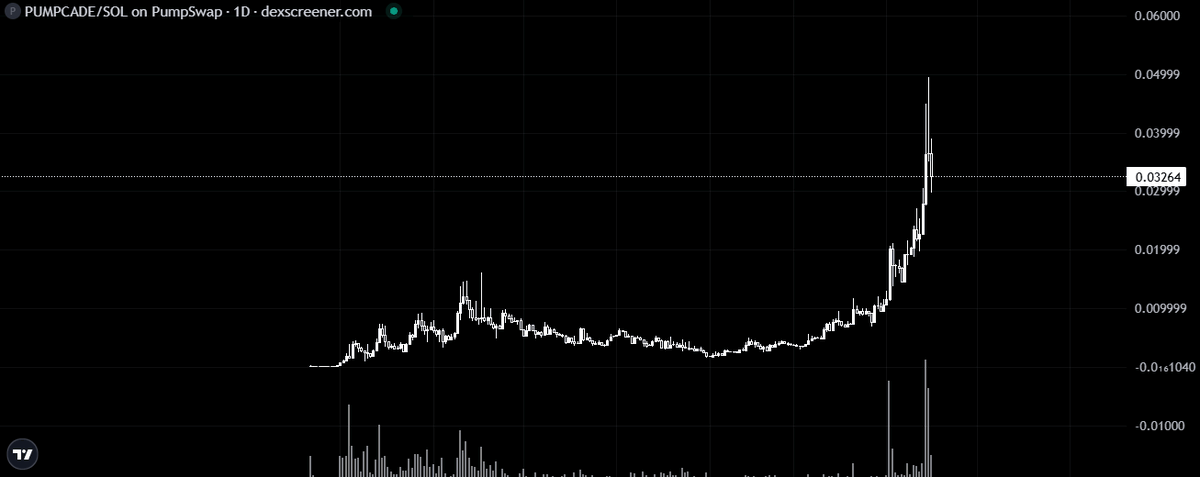
$PUMPCADE just closed a $5M seed and hit $50M mcap.
they went from solo dev shipping for free to Jump on the cap table in under 6 months.
community was already there, literally held the bag through the entire build phase at low floor.
degens got better entry than top funds. that almost never happens.
if that happened to one winner, you should probably be asking what the others are doing right now.
most BiP hackathon winners actually build real things, filtered by pumpfun, and still sitting massively undervalued.
I’ve received many DMs since yesterday and I’m doing my best to work through them all.
Please remember that the official support channel is [email protected] and emailing the team there is the most reliable way to get help.
The team will be working diligently all day tomorrow and throughout the coming week to respond. Please allow at least 72 hours before sending a follow-up.
If you’re unsure, please double-check that all documents have been uploaded correctly. in many cases, the issue is simply a missing or invalid ID or proof of address. Thanks for your patience and understanding!