A year ago, written about @AnilkumarDevara 's finds in Andhra Pradesh
Natives of Africa, ostriches once made India their home. Oldest nest in Andhra is further proof https://t.co/nsNeZVfDbC
@amjukar @atypical_SAPIEN @timesofindia "We wanted to say there may be a significant role of these local events in extinctions" but don't know why this caption appeared
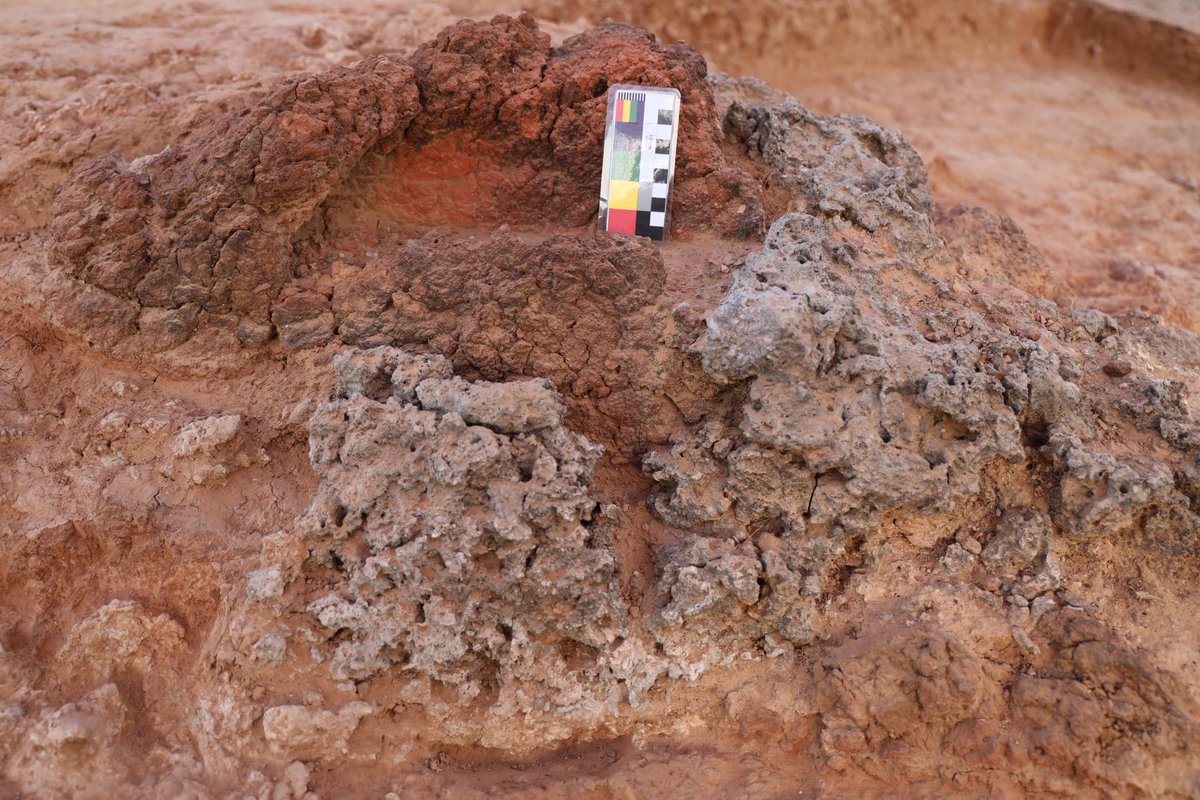
@Freshfromthefield we found the evidence of Late Pleistocene veld fires in the form of burnt termite nests and burnt clay patches associated with burnt animal bones from Southern Andhra Pradesh, India as part of the @TheLeakeyFndtn funded research.....more information soon
Happy to share the news that Anil Devara, who received a Wenner-Gren Dissertation Fieldwork grant in 2020 has a new publication in Frontiers in Earth Science! https://t.co/5jDw49u5P6
#freshfromthefield Hundreds of Ostrich Egg shell fragments from Late Pleistocene contexts identified at Motravulapadu, Andhra Pradesh, Southeast India part of the @TheLeakeyFndtn funded research. Probably a clutch. More information soon. Thanks to @TheLeakeyFndtn @atypical_SAPIEN
@atypical_SAPIEN Just to clarify that these lithics datable to terminal Middle Pleistocene has nothing to do with discussions on the continuity of middle palaeolithic technology in the region through Toba eruption presented in the paper.
@atypical_SAPIEN Yeah... but the lithics represented in this figure are way older than 74ka Toba eruption.....i cannot mention the date here now but it is terminal Middle Pleistocene
After a long Covid break, we began our in person workshops for children, beginning with exploring human evolution and prehistory. Here they are excavating a mock trench: part of a 3 hr long work shop