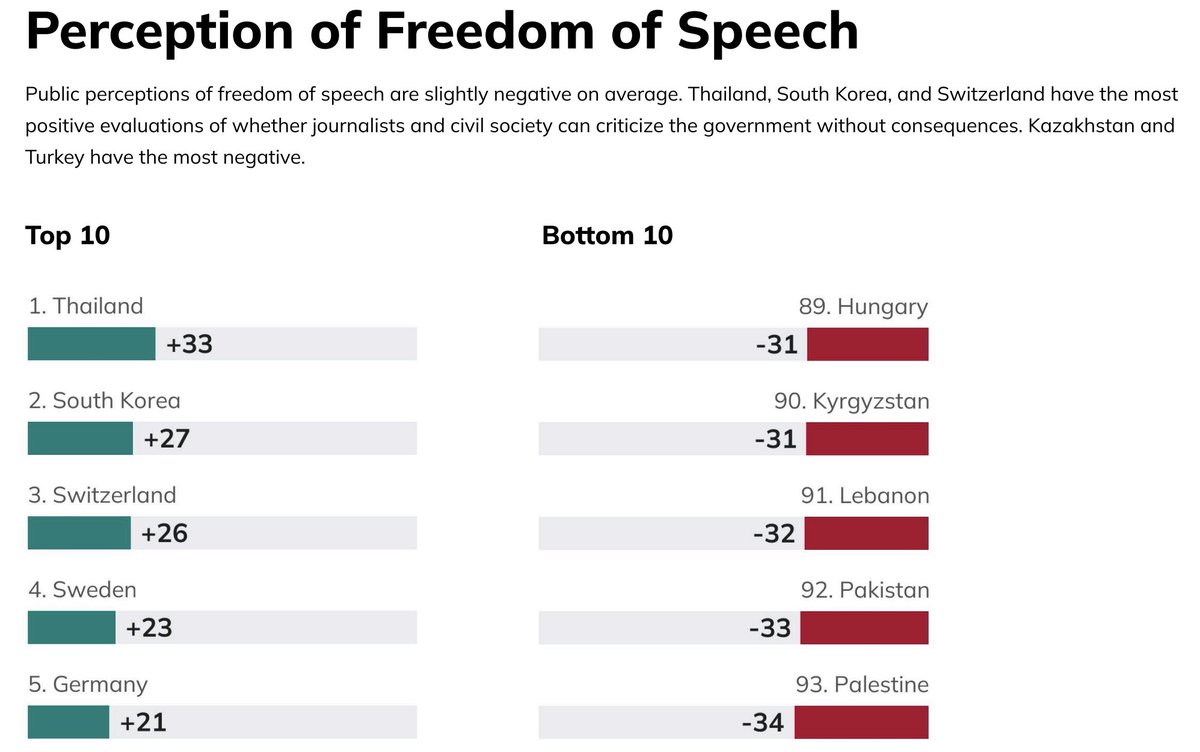
Thailand takes top place in public views of freedom of speech in the latest Democracy Perception Index. Could seem somewhat surprising, but perhaps if you don't consider that one thing...
The Chinese Room thought experiment runs like this, updated for modern times.
A man who speaks no Chinese is locked in a room. He receives a card bearing a Chinese character.
The man looks up the character in a table, and retrieves 16,384 numbers, each recorded to 3 significant digits of precision.
Following instructions in a rulebook, the man now multiplies those 16,384 numbers by a matrix with 16,384 rows and 16,384 columns, so 268 million entries. If he can multiply two three-digit numbers in 10 seconds, this will take him 85 years.
This represents one sub-operation inside on layer of a modern LLM. Each of 100 layers might have 3-6 sub-operations like this.
The man receives a series of 20 cards, with a total of 20 Chinese characters. So he repeats all of the huge sub-operations 2000 times. Some sub-operations take longer than 85 years, especially the 'attention' operations where each token collects data from all the previous tokens.
The man is immortal. He cannot be bored.
Many millions of years pass. The man finishes processing the original 20 cards. He now starts carrying out further operations on the numbers, that will produce hundreds of new vectors of 16384 floats, whose closest neighbors the man can look up to produce hundreds of Chinese characters.
Billions of years pass. The planet and sun containing the room are as immortal as the man himself.
Eventually a slip of paper slides out of the room, bearing a sequence of a few hundred Chinese characters.
===
Originally a woman had written "我在王府井和长安街的交叉口,需要到达颐和园": I am at the corner of Wangfujing and Chang'an and need to reach the Summer Palace.
The slip of paper that emerges contains the correct directions in Chinese: subway lines, transfers, the right exit to the east gate.
The woman follows them and arrives successfully.
Or maybe a Chinese mathematician, working on a forthcoming math paper, had requested help on a blocked step of a math proof. She gets back a valid mathematical argument, also in Chinese, and completes her paper, which will later pass peer review and publish.
===
But the human male inside the Chinese room knows nothing of this, for he does not know Chinese. He only multiplied numbers according to a rulebook. He's never seen a map of Beijing. He couldn't state a single one of the axioms used by the mathematician's proof.
That indeed is a valid fact, in the context of this thought experiment. But what follows from it about real life?
===
If you are wise, the moral of this story is that a large structure can contain knowledge that isn't in any single piece of the structure.
Pick up an accurate street map of part of Beijing. Even if the map's whole structure has a good pointwise correspondence to the actual streets of Beijing, that correspondence won't be visible in a single point of ink, or the molecules making up the ink.
It is formally "the fallacy of composition" to reason as if what is true of a part must be true of a whole.
The man in the Chinese Room isn't particularly necessary. We could replace the pen-and-paper multiplications with bits in transistors, and then the operation of AND gates and OR gates would be simple enough to replace the man with a trained immortal dog.
Or we could replace the dog with mechanical wheels and gears: stateless machinery with no internal memory at all.
So the moral, if you are wise, is that a machine operating on the vast arrays of numbers that encode Chinese, does not itself need to encode Chinese inscribed on its wheels or gears.
And similarly the man in the room doesn't need to understand Chinese, in order for the vast matrices to (somehow, nobody knows the details) encode a Beijing street map; or in order for giant dancing vectors of numbers to somehow understand math well enough to prove a new lemma in a new theorem.
===
But when Searle invented the Chinese Room thought experiment in the 1980s, the sort of AI that would *back then* pretend to talk to you, involved a handful of human-written rules for rewriting sentences. It was the sort of tiny computation that a human could do by hand in a couple of minutes, if not less.
So Searle thought he had proven that, since the man in the room didn't understand Chinese -- by dint of doing that handful of rewrites, that you easily *could* contain all in your own mind and look over -- then perforce no mere computer shuffling bits should EVER be said to understand Chinese, just in virtue of it manipulating mere bits. Because there could be a person inside the room, manipulating those bits, and HE wouldn't understand Chinese.
In fact this validly proves a different point, if you look at it sideways. Searle validly proved that the underlying circuit board of a GPU, that shuffles around the giant vectors and matrices, should not be said to understand Chinese. And this conclusion is true in our own world; if you look at the GPU's underlying circuit patterns, nothing about them will encode Chinese, any more than the man in the room has learned any Chinese.
The map that accurately matches the territory is not in the man, and it's not in the transistor diagram for the GPU. It's the pattern of dancing numbers that can plot accurate directions through Beijing or prove a new theorem.
But if you say that something about this experiment has proven that True Understanding cannot be in the vast arrays of numbers either -- by what right and law does that follow? Why wouldn't that Prove Too Much, if we're now allowed to throw around the Fallacy of Composition as if it were an inference rule rather than a fallacy?
The man doesn't encode a map of Beijing in his own brain -- he will at no point remember enough numbers at once for that. So if it's a rule that "whatever is not in the man's brain, cannot be in the larger system either", then we have proven that no system of mere bits can plot new, non-memorized paths between two points in a city that it's never been asked about before; and that contradicts our own observed reality.
So we cannot in general reason by the Fallacy of Composition from the man to the billions of numbers; because that would prove false things about numbers being unable to navigate streets -- or prove theorems, or drive cars, or play chess, etctera etcetera.
Then there is no reason to look at this whole thought experiment, and say that it proves the billions and trillions of dancing numbers, manipulated over the eons, do not Truly Understand Chinese.
===
So that is what the Chinese Room thought experiment actually describes and implies, as updated for the modern era.
And that contrariwise is what Searle and some other people used to think it proved, back when they thought AI meant one man applying rewrite rules from a rulebook for a couple of minutes.
@cafreiman An 80 year old with a million dollars is not what anyone thinks of when he says "million-ehz and billion-ehz!" Bernie is consistant. Don't front
@PaulAnleitner the gods were absent from the Illiad, and Julian Jaynes wrote a whole book about how early man just awaited divine command based on how little agency the human characters had in the Illiad. "Some god possessed me to do it!!"
@Philip_Goff RG is just saying he's a scientific "realist." He thinks scientific language is discribing actual phenomena, and a subsequent scientific project would not discover wildly differant explanatory structures that are also successful in guiding things like medicine and engineering.
@ShangguanJiewen They're the best capitalists in the world and it's not even close. What's the Deng quote about employing markets?... "so long as it catches mice why do we need to call it a cat?"
@talksmarttomee@DoctorPerin Not all PDs are cluster B. I get fearing the stigma of a less malleable diagnosis, but cluster A and C folks don’t need to be feared so much.
@keithedwards I don't like the righties, but I got the sense that we can't really read Sumerian. Our connection to super ancient Greek, Aramaic, Hebrew, and Chinese is much stronger. Re-educate me?