Speaker/writer/student of decision science. Latest book #QUIT out now! Author of #ThinkinginBets & #HowToDecide. I used to play poker. Navigating uncertainty.
Always trust your gut—or not? In this Season 6 episode of The Decision Education Podcast, guest @SpencrGreenberg and host @AnnieDuke, discuss the balancing act between intuition and analysis.
Check out the full episode for more thoughtful decision-making tips: https://t.co/GhxYwJREBA
Want to be in the know when Season 7 premieres? Join our mailing list! https://t.co/bq8G5tnbzJ
A Conversation with @AnnieDuke: Improving Your Decision Skills
If you've not heard her content on this topic before, here is a good start for you:
https://t.co/gnuX53LthG
Had a great chat with Stephen from Decidership about how to improve decision skills.
Stephen just shared that since our conversation, he has been "paying extra attention to not to telling other people what I think when trying to get feedback :) !"
Maybe some more helpful tools for you in our convo, too. Full convo here: https://t.co/0Udjs30P7G
I love this excerpt from my interview with @AnnieDuke, one of my favorite guests on the #RicherWiserHappier podcast. Here, she offers superb insights on how to avoid being irrational when we have a losing investment. https://t.co/XCqEgKTitC. I'm now sharing highlights like this on my new YouTube channel (@WilliamGreenMarketsandLife), including clips from my conversations with great investors like Ray Dalio, Howard Marks, Joel Greenblatt, Mohnish Pabrai, Tom Russo & many more. I hope you find it a helpful resource.
With the new workbook from @alldecisioned, “Raising Better Decision Makers,” families can practice building stronger decision-making skills together. The earlier we can introduce these life-changing skills in families, the better. Download today! https://t.co/KlCPiQ4ZLN
In my Substack column this week, I have a guest post with @SimoneStolzoff, a journalist from San Francisco. His new book, How To Not Know, is out this week. I liked it so much, I wrote a blurb for it. Check it out :).
I know you will enjoy this guest post from him as much as I enjoyed his whole book.
https://t.co/p1zaFLyYxa
Finance textbooks teach you about confirmation bias and expected value. But when you’re iterating so quickly in poker — hand after hand, decision after decision — it gets into your bones in a way that reading about it doesn’t. You develop a feel for probability that you can’t get from doing equations.
Annie Duke (@AnnieDuke) is a decision-making expert, former professional poker player, special partner at @firstround, and the author of Thinking in Bets (a national bestseller) and Quit: The Power of Knowing When to Walk Away. She also co-founded @AllDecisionEd, a nonprofit whose mission is to improve lives by empowering students through decision skills education.
In our conversation, Annie shares:
🔸 Her biggest lessons from the late Daniel Kahneman
🔸 How to use pre-mortems and “kill criteria”
🔸 The power of “mental time travel”
🔸 The relationship between money and happiness
🔸 The nominal group technique for better decisions
🔸 How @firstround improved their decision-making process using her techniques
🔸 A ton of tactical decision-making frameworks
🔸 Much more
Listen now 👇
- YouTube: https://t.co/3NNXhgaHAG
- Spotify: https://t.co/2wHtRIecww
- Apple: https://t.co/oGXDhnY9mG
Some key takeaways:
1. Use the “3Ds” framework to make better decisions for your org:
a. Discover: Collect individual opinions independently before group discussion and then share these with everybody prior to the meeting.
b. Discuss: Compare perspectives within the group, focusing on understanding points of disagreement rather than building consensus.
c. Decide: Make decisions independently post-discussion to minimize group influence.
2. Incorporate the word “nevertheless” into discussions, especially when making decisions or addressing disagreements. It acknowledges the other person’s perspective while affirming your decision or stance.
3. Replace confrontational language like “I disagree” or “you’re wrong” with phrases like “I don’t understand” so everyone feels heard and valued. If people feel heard, they are more likely to feel like they contributed to the decision, even when they disagree.
4. Use pre-mortems to set kill criteria. Before starting a project, imagine failure and what early warning signs might have predicted it. Commit in advance to reassess or pivot if you notice those red flags later on. This makes it easier to walk away when sunk costs and overconfidence bias loom large.
5. Know that if you’re considering quitting, it’s likely overdue. Uncertainty, sunk costs, identity, and ownership effects conspire to make us persist with failing efforts longer than we should. We wait for incontrovertible proof to quit. If quitting crosses your mind, examine if you’d start the project today given what you now know.
@Markmanson “Success does not lie in sticking to things. It lies in picking the right thing to stick to and quitting the rest.”
~Annie Duke
Quit: The Power of Knowing When to Walk Away
book summary in 4k
TOMORROW at 4pm ET: join our free EdWeb webinar for educators and school leaders, “Teaching Decision-Making Skills for STEM Readiness: From Classroom to Career” to explore how decision-making skills can deepen STEM learning and better prepare students for what’s next.
Our Education Senior Manager, Kevin Parkinson, will share practical ways to weave these strategies into what you’re already teaching, helping students navigate uncertainty, make informed choices, and connect learning to their future, without overhauling your curriculum.
Can’t watch live? No problem! Register and receive a link to the recording for on-demand viewing.
Register today!
https://t.co/psXUaZijVD
History is not just a record of past struggles. It is a source of strength.
That's what I told the women in the room as we closed #WLESummit last week.
225 leaders who run schools, districts, and states for 18 million students spent three days together. We heard from @AnnieDuke, @AgentNicoleLynn, kyla johnson-trammell, @HannaSkandera, Lara Dallman-Weiss, Katie Jenner, Sonja Santelises, Angélica Infante-Green, Kirsten Baesler, Kelly Sia, Page Fehling, Monica Rosen, Emily Hartnett, Dr. Susana Córdova, Dr. Susan Enfield, Dr. Fateama Fulmore, Dr. LaTonya Goffney, Dr. LaTanya McDade, Dr. Denise Watts, Dr. Mary Elizabeth Davis, and Dr. Margaret Crespo.
But the power of this Summit was never about who was on the stage. It was about who was in the room.
The women who lead the hardest jobs in American education. The women carrying impossible tradeoffs. The women who choose, again and again, to write their own stories instead of letting the world write them.
Our narratives are defined by our choices. What we stand for. Who we surround ourselves with. How we influence the world around us.
We also marked moments that will stay with this community.
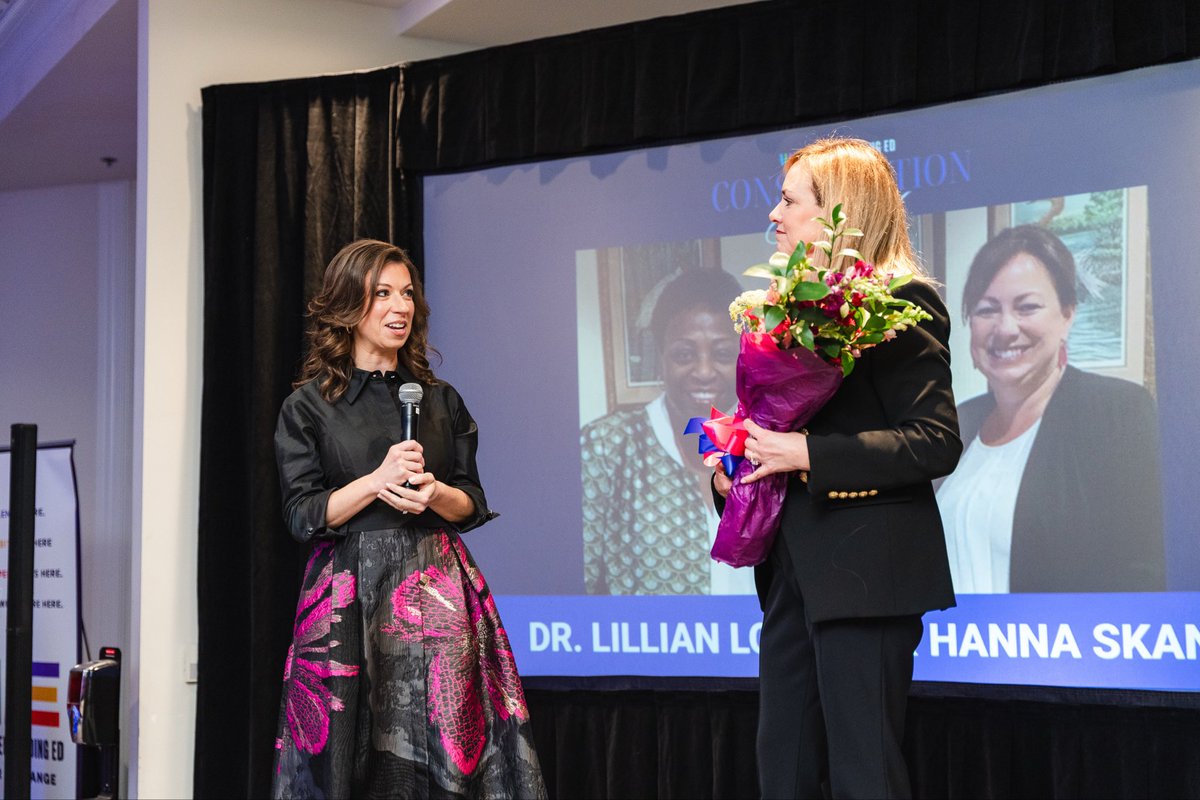
The first Constellation Award, honoring my @WomenLeadingEd co-founders @HannaSkandera and the late Dr. Lillian Lowery.
Recognizing my friend Dr. @KylaJTrammell for her leadership as board chair and everything she has helped build here.
We are not here merely as individuals. We are here as a collective, ready to confront what's ahead together. Because together, we are always stronger.
That's why this community was founded. That's why we gather each year. And that's why the women in this room will remain each other's supporters long after Summit ends.
#WomenLeadingEd #WLESummit
Teacher friends and colleagues:
@AllDecisionEd is looking for K-12 educators interested in helping us to refine the next phase of our On-Demand Learning Course! This self-paced, asynchronous course is estimated to take teachers about 3-4 hours to complete. The course will be available to complete in early May. Early registration is available below!
Register Here: https://t.co/aZoAwC5h3Y
Or as @AnnieDuke put it, “Thinking in Bets”.
You can’t directly calculate the future cost of current decisions, but you can reason about it probabilistically.
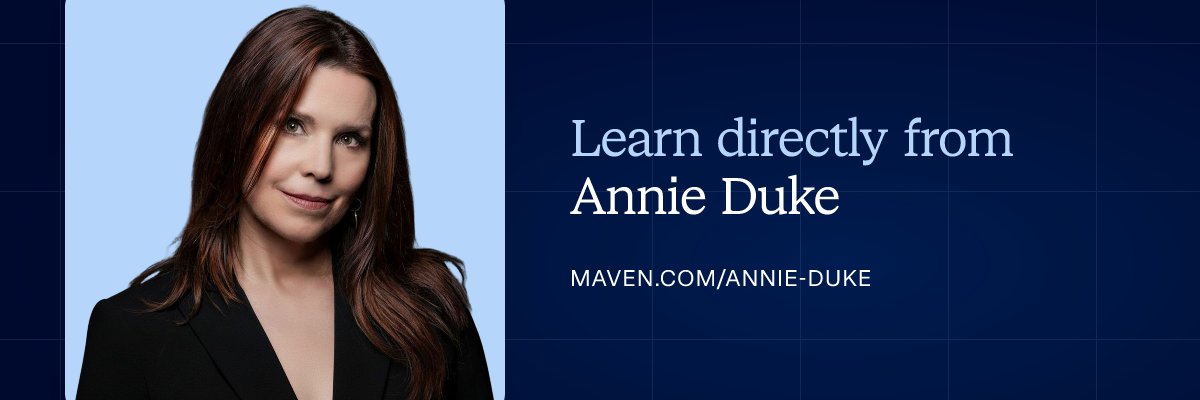
I’m excited to once again teach my online masterclass with Maven where we’ll be in a room, together, learning "How to Make Better Decisions."
In just a few hours, you’ll learn to:
• Make Higher-Quality Decisions
• Think More Strategically and Analytically
• Build Practical, Repeatable Decision Habits,
• Recognize and Reduce Cognitive Bias
• Build Confidence in Uncertain Environments
• Improve Team Decision-Making and Communication
Register today.
https://t.co/7qRyowOoLQ
Enjoyed joining @mrobbybones to talk about all things quitting, decision-making and bias on his podcast: @TheBobbyCast with @netflix
Check it out where you get your podcasts, or on Netflix at: https://t.co/53arOw4KTG