Good luck to everyone Pitching for the Planet today @Ri_Science. @ProfBeckyParker has put this amazing event together in which young people from all around the world get to share their ideas for tackling climate change and protecting nature.
I'm really proud to have been able to mentor one of the pitchers, Andrija Djurovic, but my best wishes go to everyone, and I'm only sorry that my and previous generations have left it to yours to sort this mess out.
Thank you to everyone that joined us at our Manchester and Exeter conferences! We’ve had a great time learning about different research projects, from the impact of global warming on microorganisms to investigating different hand-drying methods in school.
📍 Next stop – London.
📢📢 Judgement Day!📢📢
FWS wins in the Outer House of the Court of Session
For Women Scotland v The Scottish Ministers
Judicial Review of the Scottish Prison Service Policy for the Management of Transgender People in Custody Operational Guidance.
https://t.co/j5zXBiCqz4
'Who was staying awake worrying about Preston?'
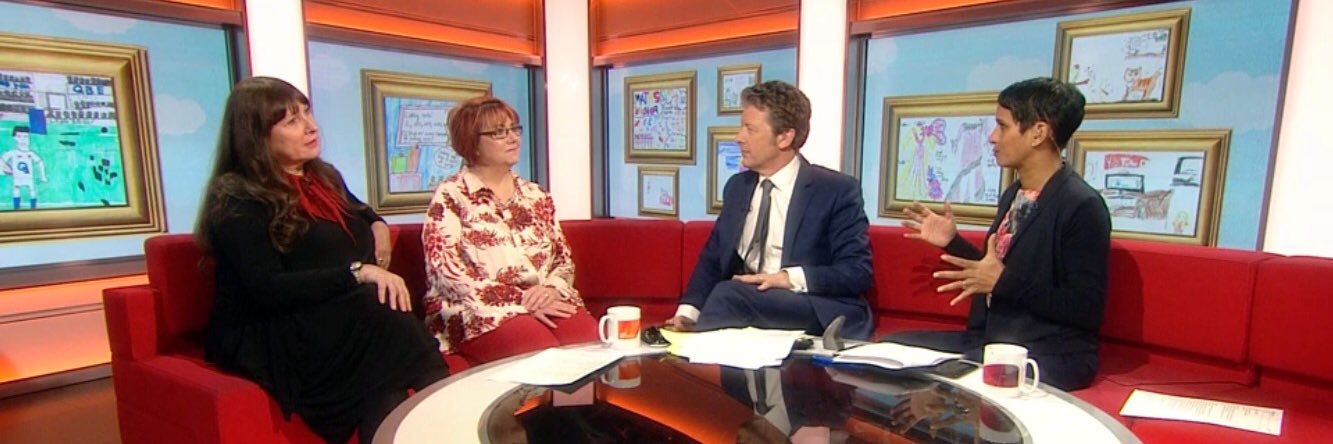
Rachel de Souza, Children's Commissioner for England, spoke to #BBCBreakfast about the 'shocking failures' in the murder of 13 month old Preston Davey who they had adopted by teacher Jamie Varley and his partner John McGowan-Fazakerley
https://t.co/Pw3Jwa0RbU
Step aboard the “Unhurried” – a vintage Polish train journeying through some of the country’s most beautiful landscapes. Our reporter Julia Gdula hopped on for a ride back to the 1980s.
Two shocking points were revealed in this judgment.
First, to their utter shame @LoveWestLothian actually submitted in their defence that they had special period toilets for girls. >>
Dr Neil Garrido, one of our Regional School Engagement Leads has had an article published in the Journal of Chemistry Education! 🎉📚
It explores how providing authentic research opportunities can have a positive impact on students, focusing on one of our projects: DNA Origami.
🔴Just Now. Henry Nowak’s father’s full family statement.
This is both heartbreaking and utterly harrowing.
Should be watched until the end and shared everywhere.
“The police did not believe him, he was dragged across the gravel, handcuffed and arrested.”
“He told the police 4 times he had been stabbed. One police officer said ‘I don’t think you have mate’. He told the police he couldn’t breathe, 9 times”
“Instead of being treated like a victim, police arrested him for assault and read him his rights. That was the last thing he heard. Henry did not die with dignity. He was not believed.”
“The way he was treated was inhumane and degrading”
**
“His murderer however WAS afforded decency. He WAS believed.
He was NOT handcuffed when arrested.
He was NOT handcuffed when transported to the police station.
As far as we understand, he was NEVER handcuffed AT ALL.
And while under arrest for Henry’s murder, police even took him to the kitchen so he could choose what he would like to eat.
… the contrast is unbearable”
**
“This is not a case about Sikhism, this is not a case about racism. This is a case about murder.
People should be able to walk openly through the streets of Britain carrying a 21cm blade.”
“Today Henry was believed”
**
His murderer has just been sentenced to 21 years in prison.
My heart broke in two listening to this. There must be a full investigation into the Police misconduct.
Rest in peace Henry. May his memory be a blessing.
Sending love and prayers to the family.
"Since an accusation of racism is far more damaging to an officer’s career than an accusation of incompetence, individuals are hugely incentivised to do everything possible to avoid it, with often tragic or perverse outcomes."
Outstanding by @edwest.
https://t.co/BP2GSPrzci
“It didn't just teach me about science; it also taught me about teamwork and how to pose and create my own research questions.”
Student-led research projects don't just deliver and consolidate knowledge. They also build skills in ways that the current curriculum alone cannot.
IRIS projects are cross-curricular, spanning subjects from geography to computer science. 🌍💻
Many schools use #IRISProjects to enrich student’s learning by taking part in authentic research.
Explore our projects:
https://t.co/dBbZEeHq3k
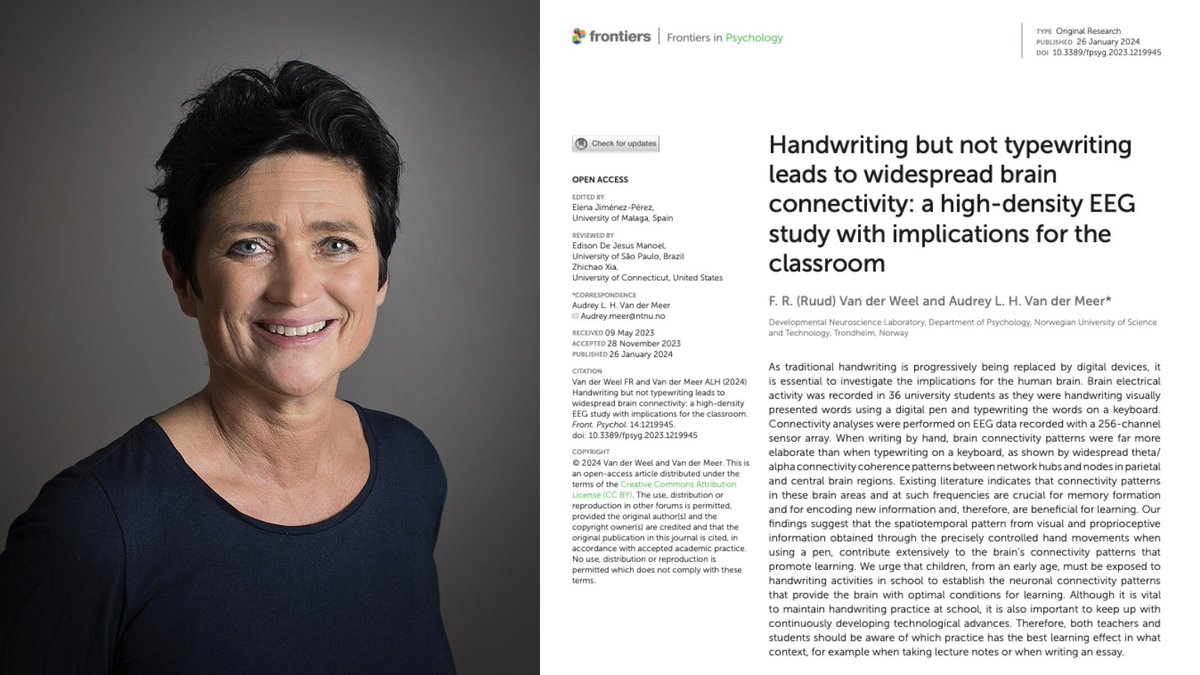
A Norwegian neuroscientist spent 20 years proving that the act of writing by hand changes the human brain in ways typing physically cannot, and almost nobody outside her field has read the paper.
Her name is Audrey van der Meer.
She runs a brain research lab in Trondheim, and the paper that closed the argument was published in 2024 in a journal called Frontiers in Psychology. The finding is brutal enough that it should have changed every classroom on Earth.
The experiment was simple. She recruited 36 university students and put each one in a cap with 256 sensors pressed against their scalp to record brain activity. Words flashed on a screen one at a time.
Sometimes the students wrote the word by hand on a touchscreen using a digital pen, and sometimes they typed the same word on a keyboard. Every neural response was recorded for the full five seconds the word stayed on screen.
Then her team looked at the part of the data most researchers had ignored for years, which is how different parts of the brain were communicating with each other during the task.
When the students wrote by hand, the brain lit up everywhere at once.
The regions responsible for memory, sensory integration, and the encoding of new information were all firing together in a coordinated pattern that spread across the entire cortex. The whole network was awake and connected.
When the same students typed the same word, that pattern collapsed almost completely.
Most of the brain went quiet, and the connections between regions that had been alive seconds earlier were nowhere to be found on the EEG.
Same word, same brain, same person, and two completely different neurological events.
The reason turned out to be something nobody had really paid attention to before her work. Writing by hand is not one motion but a sequence of thousands of tiny micro-movements coordinated with your eyes in real time, where each letter is a different shape that requires the brain to solve a slightly different spatial problem.
Your fingers, wrist, vision, and the parts of your brain that track position in space are all working together to produce one letter, then the next, then the next.
Typing throws all of that away. Every key on a keyboard requires the exact same finger motion regardless of which letter you are pressing, which means the brain has almost nothing to integrate and almost no problem to solve.
Van der Meer said it plainly in her interviews.
Pressing the same key with the same finger over and over does not stimulate the brain in any meaningful way, and she pointed out something that should scare every parent who handed their kid an iPad.
Children who learn to read and write on tablets often cannot tell letters like b and d apart, because they have never physically felt with their bodies what it takes to actually produce those letters on a page.
A decade before her, two researchers at Princeton ran the same fight using a completely different method and ended up at the same answer. Pam Mueller and Daniel Oppenheimer tested 327 students across three experiments, where half took notes on laptops with the internet disabled and half took notes by hand, before testing everyone on what they actually understood from the lectures they had watched.
The handwriting group won by a wide margin on every question that required real understanding rather than surface recall.
The reason was hiding in the transcripts of what the two groups had actually written down.
The laptop students typed almost word for word, capturing more total content but processing almost none of it as they went, while the handwriting students physically could not write fast enough to transcribe a lecture in real time, which forced them to listen carefully, decide what actually mattered, and put it in their own words on the page.
That single act of choosing what to keep was the learning itself, and the keyboard had quietly skipped the choosing and skipped the learning along with it.
Two studies. Two countries. Same answer.
Handwriting makes the brain work. Typing lets it coast.
Every note you have ever typed instead of written went into your brain through a thinner pipe. Every meeting, every book highlight, every idea you captured on your phone instead of on paper was processed at half depth.
You did not forget those things because your memory is bad. You forgot them because typing never woke the part of the brain that would have made them stick.
The fix is the thing your grandmother already knew.
Pick up a pen. Write the thing down. The slower road is the faster one.
Today, we are paying tribute to the Polish soldiers who fought for freedom in the Battle of Monte Cassino on 17/18 May 1944. After failed attempts by other Allied nations, the soldiers from the Polish 2nd Corps, under the command of General Władysław Anders, successfully gained control of the hilltops of Monte Cassino during this WWII battle.
Listen to the song "Czerwone Maki na Monte Cassino". The melody and the two opening stanzas were written on the night of the memorable battle. The third stanza was added after the victorious end of that battle. Feliks Konarski, a soldier of the 2nd Corps of the Polish Armed Forces in the West, authored the text.
Glory to the Heroes!