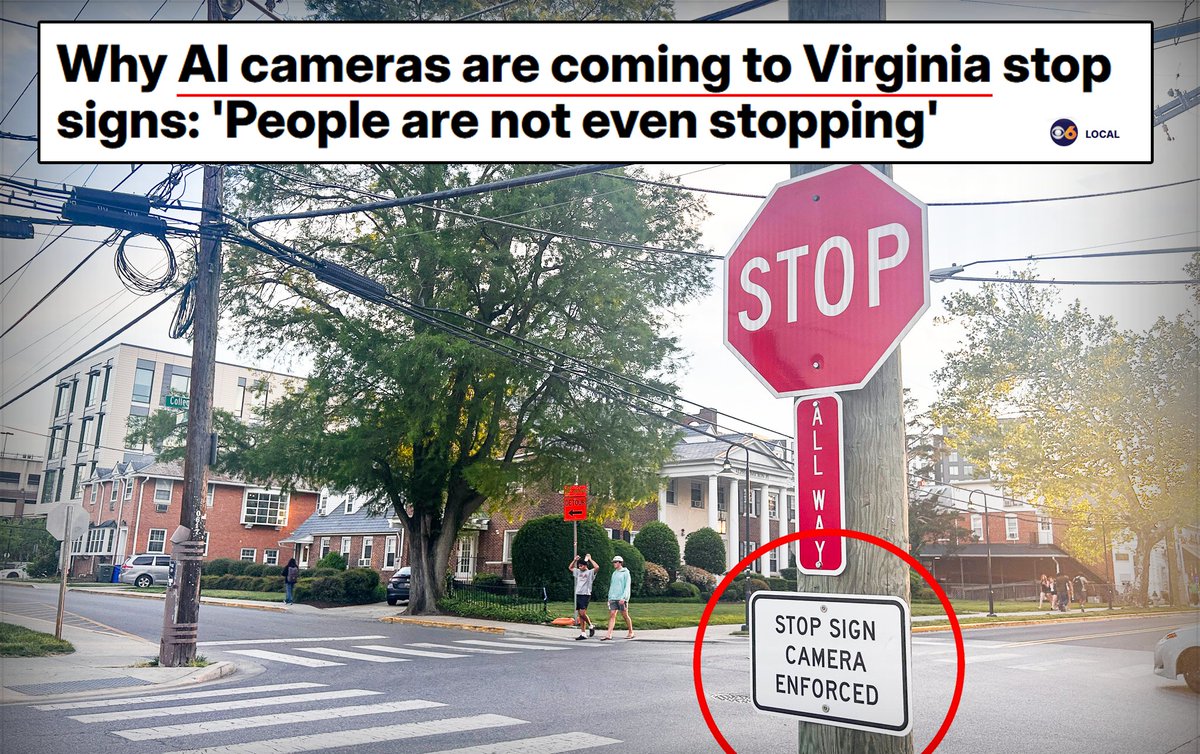
⚠️ Virginia is now rolling out AI‑equipped stop signs.
It will log drivers, and auto‑report to police.
Safety is always the sales pitch.
Do we really want every aspect of our lives to become an AI‑police zone, data‑harvesting checkpoint?
Virginians, stop this madness.
They say this, but what Flock ACTUALLY does is feed live camera data into an AI to profile everyone that the cameras see.
They take note of details about your car, where it saw you, and when. It can use these data points to figure out your schedule, and Law Enforcement can access this data and the cameras without a warrant. This isn't safety, this is effectively a tracking device in every car and a bypassing of the 4th amendment.
Flock is an evil company and should be booted out of every community it is in. Raise hell over this.
@HoloDoesDraw@voidb0rne Game companies explicitly state what they can or plan to do in their terms of service, which you must agree to before playing the game.
🔔ICYMI: A controversial deal in the U.S. could fundamentally rewrite internet freedom as we know it.
The congressional deal would trade the deregulation of artificial intelligence for unprecedented federal censorship powers.
A high-stakes compromise is quietly brewing in Washington as the White House negotiates with congressional leaders to fundamentally reshape the digital landscape.
Under the proposed deal reported by Axios, the federal government would strip states of their authority to regulate artificial intelligence—effectively halting progressive state-level efforts to hold tech companies accountable and restrict energy-heavy AI data centers.
In exchange, lawmakers would push through three major federal censorship bills: the Kids Online Safety Act, the NO FAKES Act, and a federal online age verification mandate. While framed as common-sense protections for minors, civil liberties advocates warn these measures represent an unprecedented expansion of federal control over online speech.
The backlash to this legislative trade-off cuts across typical political lines. Even conservative-backed organizations like the Foundation for Individual Rights and Expression (FIRE) have issued stark warnings, declaring that the package would dismantle the internet as we know it by empowering the Federal Trade Commission to dictate acceptable online speech.
Opponents argue that enforcing these rules would effectively eliminate online anonymity, while giving the administration an incredibly powerful tool to censor dissenting political views and control what users see on major platforms like Instagram.
As the White House maneuvers to secure congressional backing, Americans are left facing a troubling dilemma: the long-sought-after regulation of big tech and AI may come at the direct cost of their fundamental constitutional rights to free expression.
Source: Wilkins, J. (2026). Trump Moves to Deeply Censor the Entire Internet. Futurism.
@uncledoomer Man: Attempts to fight back to protect his constitutional freedoms.
Doomer, who grew up in the USA and is only able to share his opinion due to his constitutional freedoms:
The flock cameras currently being installed in America are every bit as dangerous as the AI data centers. Americans need to stand up for their 4th amendment rights and stop them.
What better way to celebrate freedom and the 4th of the July than a viral internet challenge to take back the country?
I humbly propose: #AnotherFlockDown
Every surveillance power ever enacted to "catch only the bad guys” has eventually been turned against ordinary citizens, journalists, and political dissenters.
We cannot allow our government to enter this advanced technological age without serious and effective guardrails on mass surveillance.