Rebel was nominated by Steve Gleason to take the Ice Bucket Challenge
Follow Rebel on Instagram:
https://t.co/BTezEnJVn9
ALS Support Organization, Lou Gehrig's Disease & ALS Resources Washington DC - I AM ALS https://t.co/7yd0s7HIZR
Earlier this year, 20 international research teams each received £100,000 through the Longitude Prize on ALS, a £7.5 million global challenge using AI to find new drug targets for ALS. Nearly 100 teams entered, representing leading universities, technology companies, and AI
large and detailed enough to reveal them. Answer ALS participants produced exactly that kind of data, and the teams competing for the Longitude Prize are now working with it. Learn more at: https://t.co/u0mRL1O2Gx #ALSResearch#AIinHealthcare#Neuromine#DrugDiscovery
Before Neuromine, this kind of data was scattered across separate labs in different formats and behind different restrictions. Now it all lives in one portal.
Explore Neuromine at: https://t.co/zSdB80Ks75
#ALSResearch#Neuromine#OpenScience#AnswerALS#EndALS
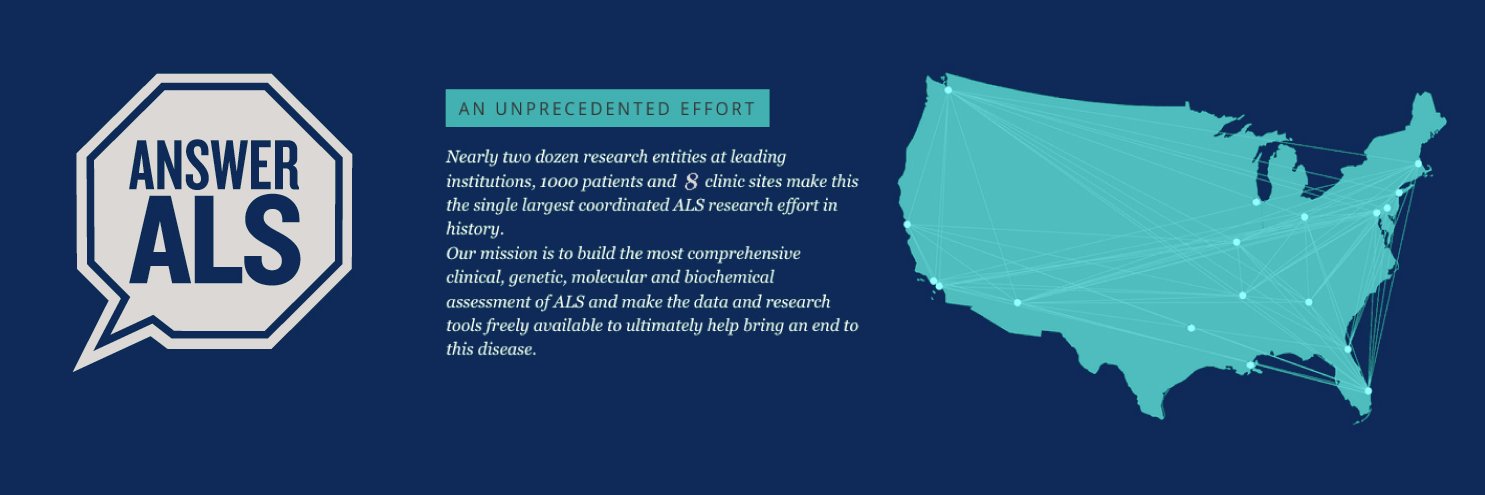
The Neuromine Data Portal is the largest open-access ALS research resource in the world.
It holds clinical and multi-omics data from more than 2,500 ALS patient profiles, linked to roughly 1,000 patient-derived stem cell lines and over 150 terabytes of harmonized data, including
whole-genome sequencing, gene expression, protein and biomarker data, epigenetics, and detailed clinical histories. Together these give researchers a full view of ALS biology in one place, free to any qualified researcher.
The Neuromine Data Portal is used by principal investigators at leading research universities, computational biologists at major pharmaceutical companies, graduate students working on early-stage hypotheses, and biotech founders running drug discovery.
In classrooms around the country, high school students are even building projects on real ALS data.
When that many researchers work from the same resource, redundant studies end and validated findings build on each other instead of starting from scratch.
Answer ALS invested $45 million to build Neuromine and generate the matched stem cell lines behind it.
The average independent ALS research project costs around $200,000, so by making more than 150 terabytes of data freely available, that original investment has translated into
over $210 million in research value across over 670+ projects.
Open data sharing can also shorten research timelines by up to 65%, which represents $30 to $40 million in saved time across the field.
Faster data access hands time back to the people who have the least time to spare. Building that speed took years of work, and keeping the portal fast and easily-accessible is driven by donations.
Getting from a hypothesis to an analyzable ALS dataset used to take 12 to 18 months.
With Neuromine, a researcher can go straight to data access, and to the matched biosamples that let them validate their hypothesis, in about two weeks.
across four continents.
Neuromine makes that scale of work possible. Hundreds of teams can work on the same biology at the same time instead of each having to build their own resource from the ground up.