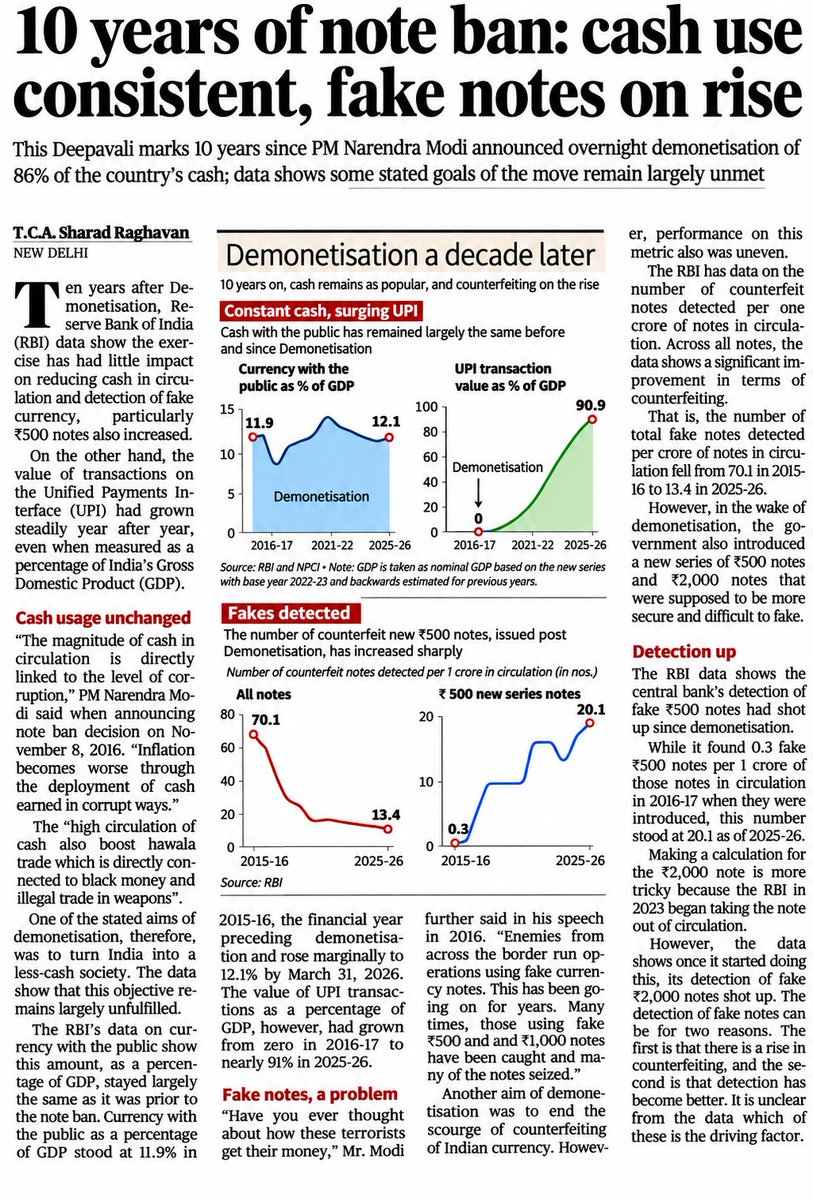
The Hindu's article on 10-year review of demonetisation highlights how its stated objectives of reducing cash circulation and eliminating counterfeit currency have largely remained unfulfilled.
UPI's phenomenal growth is cited as a positive outcome. But promoting digital payments was never a stated objective of demonetisation.
The technology was already available in 2016. Its inherent advantages, convenience and expanding acceptance would have driven its adoption even without demonetisation. Attributing this success to demonetisation is, therefore, questionable.
More importantly, the review overlooks perhaps the most damaging consequence of demonetisation: the destruction of economic activity, particularly in the informal and unorganised sectors.
The sudden withdrawal of 86% of currency in circulation paralysed cash-dependent businesses. Small enterprises were forced to close, construction and real estate activity suffered a severe setback, agricultural transactions were disrupted and millions of livelihoods were put at risk.
But the economic damage did not stop with the initial closures and job losses. It set off a powerful negative multiplier effect.
When workers lose their jobs, household incomes and purchasing power fall. This reduces consumption and aggregate demand. Businesses facing falling demand cut production, postpone investment and lay off more workers.
These additional job losses further depress consumption and demand.
Thus, an initial disruption propagates through successive rounds of contraction, creating a vicious cycle of declining employment, income, investment and output.
Nor can this damage be reversed simply by restoring currency circulation or introducing corrective measures.
Businesses that shut down lose customers, suppliers, skilled workers, working capital and market positions. Restarting operations requires fresh investment and additional costs.
Some enterprises may never reopen. Those that survive may take years to regain their former capacity.
This is the critical distinction between a temporary disruption and permanent economic scarring.
The economy may eventually recover its aggregate growth trajectory, but that does not mean the lost enterprises, employment opportunities, incomes and productive capacity have been restored.
The cumulative economic and social costs of such a shock cannot be captured merely by examining currency circulation, counterfeit notes or the growth of digital transactions ten years later.
A proper assessment must ask a more fundamental question: What was the net economic benefit after accounting for the destruction of livelihoods, productive capacity and economic activity?
That remains the most consequential, and perhaps the least adequately examined, aspect of demonetisation.
A monumental policy miscalculation, with economic consequences extending far beyond the night it was announced.
#demonetisation @INCIndia@INCTamilNadu@TNCCITSMDept@the_hindu
Dissolution of the Kurian Joseph Committee and transfer of its unfinished work to the State Law Commission:
Will Vijay's government demonstrate the same commitment to state autonomy through the State Law Commission by completing the unfinished work of the Kurian Joseph Committee and acting on its recommendations?
An official clarification from the government spokesperson would reassure those who look forward to stronger federalism.
@CMOTamilnadu #KurianJoseph
@ramjagdeesh_k Vijay knows the strength of alliances. He gave an open call for power share the moment he started his party. Unlike DMK, he is not a power monger. He would keep up existing alliances in 2029 too. Ignore calls of some over-enthusiastic fans.
I am also from Tamil Nadu.
The DMK ecosystem, of which @com_maruthaiyan is a senior member, seems willing to ignore the larger danger if that helps its political survival—and, in the process, weaken resistance to fascism by helping split the Opposition.
They could easily have followed the Kerala Communists’ approach: oppose Congress in Kerala while joining broader Opposition efforts at the Centre.
Instead, they choose to attack Congress relentlessly—because, for them, party comes first and ideology later.
BTW, if BJP/Modi happens to win again in 2029 and Congress is defeated, they may simply see it as settling political scores.
In such a situation, they may even be willing to adjust with BJP if it serves their party’s interests.
MY STRONG OPINION:
Anyone who does not want Opposition + student/youth movement unity at this critical time may be putting self-interest before democracy.
@com_maruthaiyan@neha_aisa@RahulGandhi@Bring_congress@INCTamilNadu@TNCCITSMDept
Why pick unnecessary fights with Congress when your stated goal is to restore democracy, @SauravDassss?
Stay focused on the larger mission. Building bridges with the Opposition can only strengthen the cause.
Congress is a historic organisation that helped bring democracy to India and built the nation brick by brick.
Disagree by all means, but respect its legacy....unless you’re serving someone else’s agenda.
Kind attention: All concerned citizens :
"the main disadvantage of #EVM based voting is that the whole system (from acquiring EVMs, managing software, hardware, storing and transportation of machines, conducting elections and declaring results ) is managed by human beings whose integrity and professionalism are assumed to be perfect."
The push for opposition unity is valid.
However, as a commoner, I believe CJP should avoid casual comments like, “The sorting game has been going on for 12 years now and people are losing patience,” which can undermine Congress’s efforts.
Congress has stood up to 'fascism' that has used various means to weaken the party it sees as the main threat to its agenda. “Congress-mukt Bharat” is not merely a slogan.
If CJP is genuinely interested in defeating the BJP, it is natural for the organisation to support the principal opposition on a common minimum agenda and begin working with it—unless its own agenda is different.
@SauravDassss
#CJP
OPINION:
WHY WOULD ‘HINDI PUSH’ NO LONGER BENEFIT THE COUNTRY?
Even before Independence, some nationalists sincerely believed that one common language would integrate India faster.
The idea continued in the Constituent Assembly.
Others, however, recognised the sensitivities of regions that did not want any language imposed on them.
The psychological reality is simple: a language that grows naturally can unite; one perceived as imposed can create resistance and division.
Had Hindi been allowed to spread slowly and naturally through Bollywood films, songs, literature and popular culture, it might have gained wider acceptance. Instead, making Hindi a matter of patriotism and national obligation created resistance, particularly in Tamil Nadu.
But the world has changed.
English has now become the global language of education, technology, international business and economic mobility.
Therefore, spreading English in India can do two jobs at once:
1. Serve as a common link language across India and with the world.
2. Give poorer Indians a powerful tool for education, employment and economic advancement.
If English can perform both functions, why does India need to promote another language as a compulsory link language?
Think of the millions of hardworking migrant workers from mostly the Hindi-speaking states who travel across India and abroad for better livelihoods.
Many are intelligent, skilled and disciplined, but have little or no English. Even functional spoken English could open doors to better-paying jobs across India, the Gulf and elsewhere—potentially transforming their families' economic prospects.
Let Hindi and every Indian language grow naturally through culture and choice.
Let English connect India and expand opportunity.
Let wisdom, not linguistic prestige, prevail!
#Hindi
#Two_language_formula
#TamilNaduGovernment
#TVKVijay
Sonia Gandhi never sought politics, even when her husband Rajiv was Prime Minister.
After Rajiv’s assassination, she stayed away for years until Congress leaders pleaded with her again and again to revive the party.
In 2004, she helped defeat the NDA and shattered the “India Shining” narrative by taking the message to rural India.
She then declined the PM’s post and enabled Manmohan Singh to lead the government.
Her greater contribution was political: she helped restore secular, pluralist politics to the centre of national governance and kept divisive forces at bay for a crucial decade.
She also helped change the direction of liberalisation. While reforms could disproportionately favour corporates, the UPA built a counterbalance for rural India and the poor through MGNREGA, RTI, RTE, food security and farm-loan relief—ensuring that growth reached wider sections of society.
Her foreign origin was repeatedly weaponised against her. Had Sonia Gandhi been born to Indian parents, perhaps divisive forces would have faced a decisive blow once and for all.
Her quiet humility concealed formidable political intelligence, patience and tactical ability.
To launch a campaign of humiliation against such a humble yet effective leader today is a cowardly act.
It reveals an inability to counter her political legacy with a proper political argument.
But there are millions of Indians like us who understand and value her invaluable and selfless service to the nation.
No campaign of humiliation can erase that contribution.
@RahulGandhi@priyankagandhi@kharge@INCIndia@INCTamilNadu@INCKerala@TNCCITSMDept@manickamtagore
Nehru’s Vision Beyond the Riots:
During the communal violence following Partition, Jawaharlal Nehru repeatedly risked his life confronting mobs.
In one widely recounted incident in Chandni Chowk, he saw an armed crowd threatening a Muslim tailor. He stopped his car, entered the mob and took a lathi from a policeman, confronting the attackers and helping save the man.
American journalist and editor Norman Cousins later noted that the sheer physical and moral courage of the Prime Minister entering a riot zone had a profound psychological effect on the masses. When rioters realised that “Jawaharlal—the Prime Minister himself” was confronting them, they dropped their weapons, abandoned the looted goods and scattered in shame.
How do you see this incident?
Was protecting minorities physically the only reason Nehru took such personal risks by stepping into rioting crowds with a lathi?
A strong NO.
This was about much more than protecting one individual or preventing majority dominance over minorities. Nehru was defending a larger vision of India—an India where every citizen, from Kashmir to Kanyakumari, could live with dignity, receive education, develop a scientific temper, realise his or her full potential and enjoy a better quality of life.
While many doomsayers around the world predicted in 1947 that India could not remain united because of its enormous diversity of religions, cultures, languages, communities and histories, Nehru—the architect of modern India—envisioned not merely a united, strong and developed India, but a nation capable of contributing to a world community founded on justice, cooperation and mutual help.
Why should India remain united - in detail!
Please read this👇
#Nehru_TheArchitect
#CongressParty
#GenZ
UNITED INDIA VS POLARISED INDIA
After Partition, Nehru did not allow communal riots to define India’s future. He confronted mobs, entered riot-hit areas and demanded protection for every citizen.
His larger strategy was transformative:
turn people from rioting to rebuilding.
“Unity in diversity” was not merely a slogan. It was also a nation-building and economic strategy.
A united society creates greater trust, uninterrupted economic activity, stronger MSMEs, wider markets, greater investment and better productivity—while reducing the enormous social and economic costs of conflict.
A polarised society pays the opposite price. Fear replaces trust, social energy is wasted on conflict, communities become divided, businesses face greater uncertainty and development gets distracted.
Pakistan offers an important contrast. Its failure to sustain a genuinely secular and inclusive national framework allowed identity conflicts to occupy enormous political and social space, often diverting attention from the long-term task of development.
Therefore, in my view, this was the first great contribution of the Indian National Congress to independent India: creating a national framework in which our diversity could become an asset rather than a source of permanent conflict.
That framework continues to strengthen the country even today.
Sadly, India risks moving away from that idea.
Under the BJP, polarisation has increasingly occupied political and social space that could instead have been devoted to jobs, education, skills, healthcare and growth.
The cost may not immediately show up as a single GDP number. But it can accumulate through declining trust, weaker social cohesion, lost opportunities, lower productivity and wasted human potential. Much of this cost may remain invisible until it becomes difficult to reverse.
There is another, less discussed, consequence.
A child raised in love and harmony learns to work comfortably with people of different religions, languages and cultures. That makes the child better prepared for a modern, multicultural economy—and potentially gives them an advantage in workplaces, including multinational companies.
A child raised in polarisation inherits a smaller social world.
I have worked in African and Gulf countries. I never found it difficult to mix with Africans and Arabs; instead, I enjoyed working with people from different cultures. This ability to adapt has been a valuable strength for Indians working across the world.
Unity therefore creates not only better citizens, but potentially better workers and a more capable workforce.
The choice between unity and polarisation is consequently not merely political or moral. It is also an economic choice—and a choice about our children’s future.
We must be conscious of this:
If polarisation continues, our children’s future will be less prosperous than it could have been.
India grows best when Indians work together.
God bless India! 🇮🇳
Note: This is the first of a series of posts I intend to write on the value of the Indian National Congress’s contribution to our country.
If you find this perspective interesting, follow me.
@kharge@RahulGandhi@priyankagandhi@INCIndia@INCTamilNadu@TNCCITSMDept@TVKVijayHQ@PChidambaram_IN@manickamtagore@jothims
#Congress #tvk #Unity_in_Diversity
Year-on-year GSDP growth percentages need to be viewed in context.
A high percentage in a single year does not automatically mean that a government has consistently delivered strong growth.
If the previous year had an unusually low base due to a genuine economic disruption, the following year's growth rate can look exceptionally high simply because the economy is recovering.
Furthermore, the global and national economic climates, along with year-specific factors like monsoons and natural disasters, play a significant role.
Rather than presenting a series of growth percentages as proof that one party “always performs well,” a fair assessment should evaluate the total increase in real GSDP over an entire tenure, the CAGR, performance relative to comparable states, and the national average.
Tamil Nadu's strong economic performance should certainly be acknowledged, but economic data should be used to inform debate, not as political advertising.
Growth percentages presented without context or base figures give a misleading picture.
An article in The Hindu today, titled "Madras built the engine and now Chennai is shifting gears," clearly illustrates how development over past centuries laid the foundation for today's growth. Please read.
The Tamil Nadu economy has been built by its people, industries, successive governments, workers, and the system as a whole.
We must remain truthful, united, and humble—no single political party can claim credit as a matter of right. One of the main issues with the DMK is its tendency toward self-praise and exaggerating its contributions.!
@arivalayam@INCTamilNadu@TNCCITSMDept@EPSTamilNadu@CMOTamilnadu@manickamtagore@TVKVijayHQ
#DMK #ADMK #TVK #Congress
#Tamilnadu
Madras built the engine, and Chennai is shifting gears!
This nice article gives an account of how Madras grew step by step over the centuries.
From a colonial trading centre to a manufacturing hub and now a diversified global business destination, Chennai’s development has been a long journey.
Long before Chennai became known as the “Detroit of India,” Madras was already laying the foundations of its automobile industry. Simson’s coach-building operations played a role in the early 1900s.
Later, from the late 1940s through the 1950s, Standard Motor Products of India, Ashok Leyland and Enfield played important roles.
TAFE, MRF, the Murugappa Group, the Shankar Group and India Cements were headquartered in Chennai. Indian Bank (1907) and Indian Overseas Bank (1937) were also established in Madras.
The setting up of the Guindy Industrial Estate in 1958 was another important milestone.
Then came the IT revolution, multinational companies, the contributions of IIT Madras and many other institutions and businesses—and the rest is history.
The lesson for our political ecosystem:
Tamil Nadu’s development has a history. Its present-day growth has been built over centuries. Successive governments, industries, entrepreneurs, workers, professionals and ordinary people have all contributed to this success story.
The foundations and structures that support growth today were built over a very long period. Our current GDP growth rests on those foundations.
Therefore, no five-year government—whether today or in the past—can legitimately claim exclusive credit for the GDP growth achieved in the current years.
Be truthful. Be humble.
#DMK #ADMK #Congress #TVK
https://t.co/EP2iW3VvrO
Well, leaving aside whether a person holding a constitutional post should participate in anti-abortion rallies, it is deeply disturbing that the world now calls it “progressive” to demand a blanket right to end the life of an unborn child.
What kind of progress celebrates the destruction of the most vulnerable human life—one that cannot speak, resist, or defend itself? Abortion is not progress; it is the gravest moral tragedy of our time.
@dhanyarajendran When there are numerous ways to prevent conception, treating abortion as an unrestricted remedy for avoidable irresponsibility is a reckless, wild behaviour!
@RKRadhakrishn When there are numerous ways to prevent conception, treating abortion as an unrestricted remedy for avoidable irresponsibility is a reckless, wild behaviour!