Sometimes, the loudest protest begins...
After the problem has already been solved.
That is when you stop following slogans.
And start following the timeline.
Before you decide who the villain is...
Read the timeline.
Because dates don't shout.
They don't trend.
They don't protest.
They simply expose the truth.
May 3.
NEET examination.
Within four days, the NTA detected fraud.
The very next day, it informed the police.
The investigation began.
The Government cancelled the May 3 examination.
May 12.
The Ministry of Education filed a written complaint.
The CBI registered the case.
Special investigation team (SIT) were formed immediately.
May 15.
Education Minister Dharmendra Pradhan addressed the nation.
He apologised.
Accepted moral responsibility.
Announced the re-NEET schedule.
Then came the bigger announcement.
From next year,
Major national examinations would move towards
computer-based, multi-encrypted testing (CBT).
A permanent safeguard.
Not another temporary fix.
Meanwhile,
The CBI moved fast.
Arrests began.
The network expanded.
Soon, 13 accused were behind bars.
June 21.
Fresh NEET examination conducted successfully.
July 16.
Results declared.
Now students wait for counselling.
But this story is bigger than one examination.
Paper leaks are not new.
Every student preparing next year will carry the same anxiety.
I am with students.
Now comes the real question.
If the examination was cancelled...
The re-exam was conducted...
The results were declared...
The investigation was underway...
And structural reforms were already announced...
Then what exactly is the endgame of this protest?
If the demand is...
"Remove the Minister."
Then what?
What comes next?
What reform is on the table?
What solution replaces the one already announced?
These are fair questions.
Another one is equally important.
Who loses the most...
If encrypted, computer-based (CBT) examinations,
make organised paper leaks almost impossible?
Students?
Or those who profited from the old system?
Coaching Mafia?
Corrupted Academicians?
Tainted Beuraucrats?
Or those who is taking advantage of students emotions.
Bhim Army?
Aam Aadmi Party?
Congress?
Communist Party?
One fact cannot be ignored.
If technology shuts the door on organised paper leaks...
An entire illegal ecosystem stands to lose.
That is why the real battle is bigger than one Minister.
Or even one Government.
Goverments will come and go.
Party will win and loose.
But this nation will remain.
And it should at any cost.
Bigger than one Leader or person.
It is about one question.
Will India finally dismantle the business model...
Built on stealing honest students' hard-earned opportunities?
That... is the fight worth having.
International media in the last 30 days: "India Hunger strike", "protests in India", "Floods in India."
🇮🇳India in the last 30 days:
July 19, 2026: Indian Gen-Z team wins 4 gold medals (top rank) at International Chemistry Olympiad and medals at the International Biology Olympiad.
July 18, 2026: Young Indians working at Skyroot Aerospace successfully launch Vikram-1, India’s first privately developed orbital-class rocket, from Sriharikota, placing payloads into Low Earth Orbit.
July 17, 2026: PM Modi flags off India’s first indigenous hydrogen-powered passenger train (10-coach set) from Jind station, Haryana, on the Jind-Sonipat route as an inaugural service.
July 14, 2026: DRDO completes successful military field trials of an indigenous scalable fiber-based Quantum Key Distribution (QKD) system for secure strategic communications.
July 13, 2026: Lucknow-Kanpur Expressway (63 km), India’s first barrier-free expressway with satellite-based tolling, opens to traffic.
July 12, 2026: Young Indian team wins 5 gold medals at the 56th International Physics Olympiad (IPhO 2026) in Colombia, securing joint world #1 rank.
July 11, 2026: RM Rajnath commissions INS Mahendragiri, the sixth Project 17A stealth frigate, in Visakhapatnam (~75% indigenous content).
Early–mid July 2026: Vimag Labs (Bengaluru) secures its 5th Indian patent for the Virtual Magnet Synchronous Motor (VMSM), a software-defined rare-earth-free electric motor platform.
Early July 2026: ISRO announces plans for a new Satellite Earth Station campus near Ledo in Assam to strengthen space communication in the Northeast.
Early July 2026: IIT Gandhinagar team wins a grant for developing indigenous liquid cooling plates for AI data centres, EVs, and high-performance electronics.
June 26, 2026: Nuclear heat-based hydrogen production facility (copper-chlorine thermochemical cycle) commissioned at Kalpakkam using Fast Breeder Reactor process heat.
June 24, 2026: ISRO successfully conducts hot test of semi-cryogenic engine power head at 175 tonnes thrust level.
June 24, 2026: RDSO (with ARAI) successfully conducts full-scale crashworthiness testing of LHB coaches for enhanced passenger safety.
June 21, 2026: PM Modi commissions three indigenously built warships in Kolkata: INS Dunagiri (Project 17A stealth frigate), INS Sanshodhak (hydrographic survey vessel), and INS Agray (ASW shallow water craft).
June 15, 2026: DRDO successfully flight-tests the indigenous Long Range Land Attack Cruise Missile (LRLACM) from Odisha; all objectives met.
June 10–11, 2026: DRDO conducts successful Phase-2 Ballistic Missile Defence (BMD) trials and anti-ship missile tests, demonstrating capabilities against long-range ballistic threats including ICBM-class.
Mid-June 2026: India’s defence production reaches a record ₹1.78 lakh crore in FY 2025-26.
Mid-June 2026: Maiden flight of the indigenous C-295 military transport aircraft highlighted as a major self-reliance milestone in aviation (with 40 aircraft under production in India).
June 13, 2026: First batch of women cadets trained at NDA commissioned into the defence forces. Marking the start of an women empowered era in defence.
He's Tukaram Mundhe, a 2005-batch IAS from Maharashtra.
Over the last few weeks, you might have heard his name. That is because he was recently appointed Commissioner of State’s Food and Drug Administration (FDA). Since taking charge, the FDA has been on an absolute warpath, raiding illegal, fake, synthetic, and adulterated products. From synthetic milk networks and adulterated paneer to illegal gutkha and unhygienic eateries, nothing has escaped his radar.
Mundhe has made it clear that even the most famous names will not get a free pass. His department shocked Mumbai by suspending the food licenses of iconic establishments, such as the 73-year-old Marine Drive ice cream parlor K. Rustom & Co., alongside famous eateries like Shalimar Hospitality, Noor Mohammadi Hotel, and Rahmaniya Restaurant, after surprise inspections uncovered severe hygiene violations, including live pests and expired ingredients.
Such is the fear of his crackdowns that, just two days ago, dairy farmers were caught on video spilling hundreds of liters of synthetic milk after rumors of an impending FDA raid spread.
This is his 25th transfer in a 21-year career, a testament to his refusal to bend to political pressure. It makes you wonder: if just one IAS officer can bring about so much change, where would our country be if every bureaucrat were as uncompromising and proactive as him?
I taught JEE physics for years. That paper breaks strong kids in three hours.
This exam is five hours of theory and five hours of lab work, and these five did close to perfect scores on it.
Let me tell you what actually happened.
The International Physics Olympiad is the world championship of school physics. It was the 56th edition. Held in Bucaramanga, Colombia, from July 5 to 12.
381 students. More than 85 countries. Every one of them the best physics student their country could find.
India sent five kids.
All five came back with gold.
Their names are Kanishk Jain from Pune. Riddhesh Anant Bendale from Indore. Rishit Garg from Dwarka in Delhi. Shresth Suraiya from Mumbai. Svarit Joshi from Ahmedabad.
We know a hundred cricketers by their nickname and not one of these boys. :)
That clean sweep put India at joint World Number One. Tied with China, Russia, Kazakhstan, South Korea and Taiwan.
Those are countries that pour serious money and national pride into science education. We are standing level with them.
Now here is what the exam actually was.
Two papers. Each five hours long.
The theory paper had three problems. One on the thermodynamics of paramagnetic cooling. One on the photoionisation of ozone. One on the dynamics of electron positron pairs.
The experimental paper was another five hours in a lab, working through heat transfer and thermodynamic processes in fluids.
That means you get given equipment you have never seen, and you have to design your own experiment, take your own readings, handle the errors, and reach a real answer.
Not multiple choice. No shortcuts. No pattern recognition. You either understand physics or you sit there for five hours.
HBCSE says the Indian students were near perfect on theory and excellent on the practical too.
Now, this was India's 27th appearance at the IPhO.
Across all those years, about 44 percent of Indian students have won gold, 41 percent silver, 10 percent bronze.
In the last ten years, every single Indian student has come home with a medal. 62 percent gold, 38 percent silver.
Not one kid has gone and come back empty handed in a decade.
Five golds in one year has happened only twice. This year, and in 2018.
So who built this.
The programme is run by HBCSE, the Homi Bhabha Centre for Science Education. It sits under TIFR, which sits under the Department of Atomic Energy.
They run the whole funnel. A national exam, then a national olympiad, then a brutal selection and training camp, and out of everyone in the country, five kids get on a plane.
The team was led by Professor Anwesh Mazumdar of HBCSE-TIFR and Dr Leena Joshi from St Xavier's College, Mumbai.
The scientific observers were Professor Ananda Dasgupta from IISER Kolkata and Nisha Kelkar from Gogate-Joglekar College in Ratnagiri.
Yes. Ratnagiri. A college in a small coastal town in Maharashtra.
This is public education doing something the private coaching industry could never do on its own.
The coaching industry is very good at one thing. Teaching you to solve a known problem fast.
That is what JEE and NEET reward, and I say that with love because I was part of that world.
But an olympiad paper does not have a known type. There is no shortcut chapter. There is no formula sheet that saves you. You have to sit with a problem you have never seen and think.
That is a completely different muscle. And a government funded centre has been quietly building it in Indian teenagers for 27 years.
So yes, be proud. Loudly.
HBCSE also shared that around 64 percent of India's olympiad medallists go on to do a PhD.
But only about 32 percent of medallists end up settling in India.
I do not say that to spoil the moment. These kids owe the country nothing. They earned every option they have.
But it should tell us something. We are excellent at finding this talent. We are excellent at training it. We are still not great at giving it somewhere worth staying.
Congratulations Kanishk, Riddhesh, Rishit, Shresth and Svarit. This is one of the best things an Indian did this year and most of the country will never hear about it.
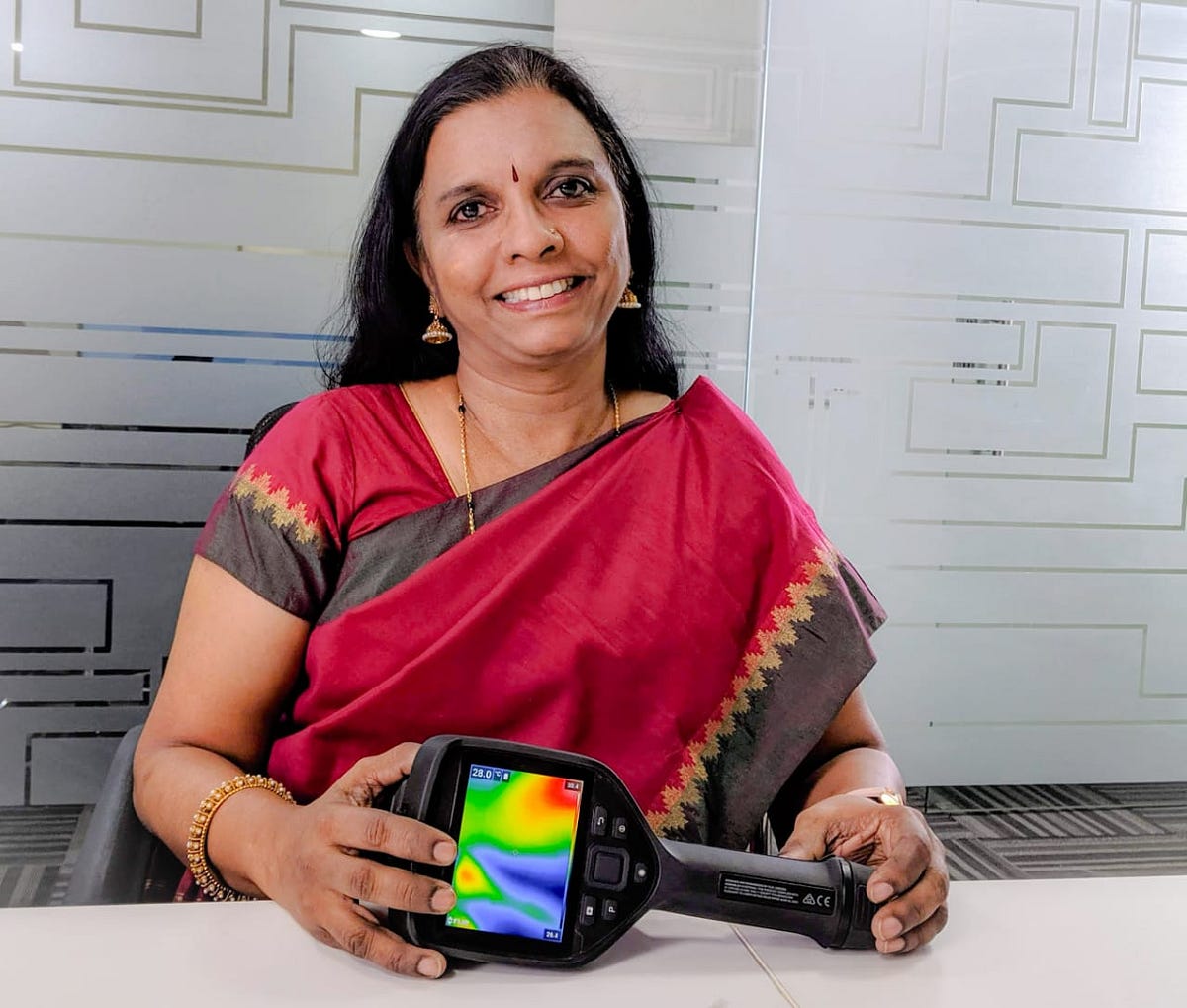
In 2016, Dr. Geetha Manjunath was heading AI research at Xerox's Bengaluru lab, a role that followed a PhD from IISc, a stint as Principal Scientist at HP Labs, and over two decades building enterprise AI systems. Then her cousin, in her early forties, was diagnosed with breast cancer at a stage too advanced to treat.
"The mammogram had missed her cancer earlier," Geetha would later say. She quit her job soon after.
Mammography, the global standard for breast cancer screening, has real limits. It uses ionising radiation, is often painful enough that women actively avoid it, and is known to be less reliable in younger women and in the dense breast tissue common across Indian women. In India, where breast cancer accounts for over a quarter of all cancer diagnoses and the five-year survival rate trails far behind the United States and Australia, late detection is not a statistic. It is the difference between a cure and a funeral.
Geetha had spent years working with thermal imaging on unrelated projects. She wondered if temperature variation in breast tissue could reveal what mammograms missed, and built the science to test it. The result, Thermalytix, requires no radiation, no incisions, and no physical contact: a woman sits before a thermal sensor for a few minutes, and an AI model trained on clinical data analyses the image.
Niramai Health Analytix, the company Geetha founded and now leads as CEO and CTO, has since screened over 300,000 women across more than 20 countries, built on 39 patents and validated in 55+ peer-reviewed clinical studies. Geetha herself has been named to Forbes India's Top 20 Self-Made Women and inducted as a Fellow of the Indian National Academy of Engineering.
For India, where cost and discomfort keep millions of women away from regular screening, a radiation-free test that can be deployed in a primary clinic is not a convenience. It is a chance to catch what would otherwise be caught too late.
@airfrance my daughter left her purse in the AF159, from DFW to CDG and did report at CDG, however seems like the purse continues to travel, currently in Mumbai. It has her phone, wallet and few other things. appreciate your help (P-L171532)
@AirFranceKLM#CDGParis#lostnfound
@NLinIndia Dear sir, its sad and shameful to see how #vfsglobal is fooling and tricking sr citizens who go for visa in upselling their premium services in the name of form filling etc, in spite of the fact that all the documents are in place.
@mpurbandeptt I have been trying to access the portal to pay property tax online for past 1 month, but site is not working. Can you please help.
I heard that if we deposit property tax early there is discount.
cc: @DrMohanYadav51@advpushyamitra
@Cold_Peace_@SaketGokhale But this is a global failure of US being able to handle this. In canada its 400 days. In NL next visa appointment is after 6 months.