I am pleased to announce the AsiaFlux Conference 2026, which will be held from Nov 23–28, 2026, in Bangkok, Thailand.
Important dates:
Abstract submission deadline: Sep 15, 2026
Training Course: Nov 23–24
Conference: Nov 25–27
Field Excursion: Nov 28
https://t.co/bIFZDAVCJ7
The National Science Library of the Chinese Academy of Sciences has stopped publishing its influential journal ranking, taking many researchers by surprise
https://t.co/KzuZxvCCBR
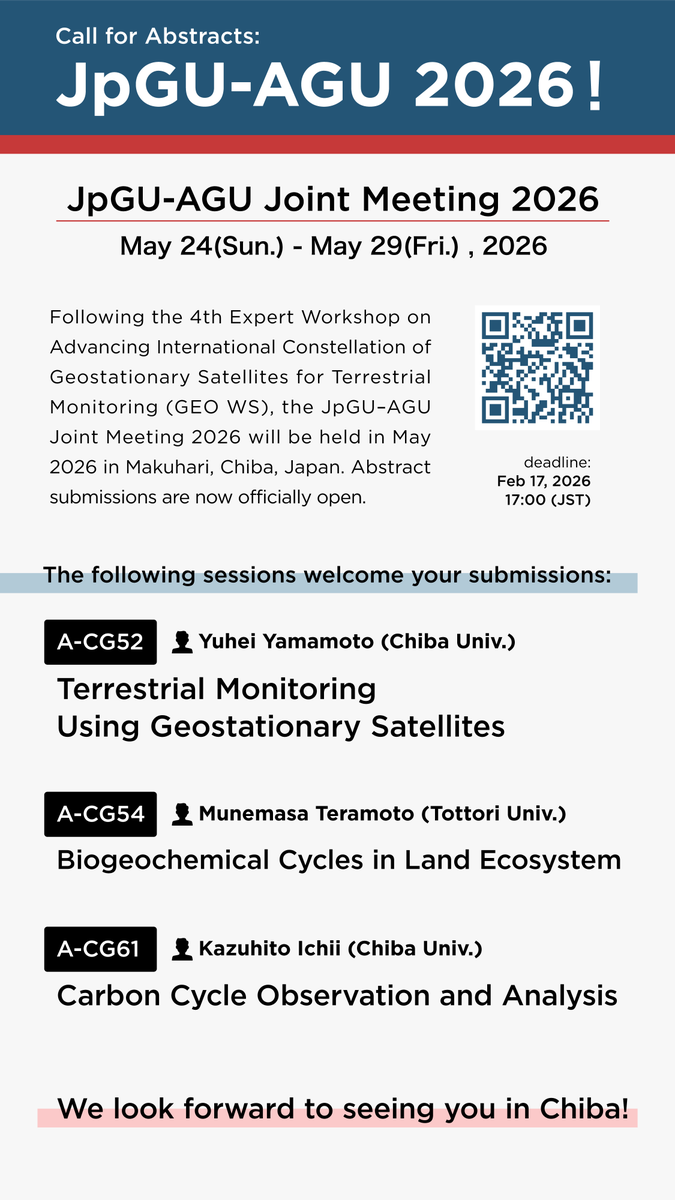
4th GEO workshop, Chiba, Japan - abstract submission and registration extended by Apr 17.
Dates: May 23-24 (WS) and 25 (excursion)
Venue: Chiba University, Japan
Registration and Excursion are free.
Application URL: https://t.co/QOFd8TZ64o
Honored to share that I’ve been selected as an Editorial Board Member for Remote Sensing of Environment. I appreciate all the support from my colleagues and the community.
Uncertainty anlaysis of #TRISHNA evapotranspiration (ET) algorithm to input data available now https://t.co/S4aeFzi4pS, and driver sensitivity analysis of ET models and its partitioning https://t.co/jZ5teiAdc5
ETH Zürich Grassland Sciences Group is hiring a Postdoc for the INETFLUX project on #forest CO₂ & evapotranspiration flux partitioning.
Supervised by Nina Buchmann.
📅 1 April 2026
👉 https://t.co/cHDYjNSuYd
#ecohydrology#EddyCovariance#FluxNet
We organize 4th GEO workshop (Geostationary Satellite Land Monitoring) in May 23-25, Chiba, and organize related sessions (GEO-satellite, Carbon Cycles) in JpGU-AGU 2026, Chiba, May 26-27. Looking forward to meeting you in the best season in Japan. Easy access from airport.
New paper out! 🌍We show how ET partitioning shifts under drought: soil dryness sharply increases evaporation sensitivity in grasslands, while forest transpiration becomes VPD-driven. ET control flips from soil → radiation across aridity. Big implications for TRISHNA/SBG/LSTM🔗
New paper out! 🌍We show how ET partitioning shifts under drought: soil dryness sharply increases evaporation sensitivity in grasslands, while forest transpiration becomes VPD-driven. ET control flips from soil → radiation across aridity. Big implications for TRISHNA/SBG/LSTM🔗
🌟 Article of the Week 🌟
This week’s featured article from IEEE Geoscience and Remote Sensing Magazine showcases a comprehensive survey on an important topic of remote sensing research.
🔍 This Week's Highlight:
Title: Advances in Methodology and Generation of All-Weather Land Surface Temperature Products From Polar-Orbiting and Geostationary Satellites: A comprehensive review
Authors: Aolin Jia, Shunlin Liang, Dongdong Wang, Kanishka Mallick, Shugui Zhou, Tian Hu, Shou Xu
📖 This research paper delivers the first holistic overview of cutting‑edge methods and datasets for all‑weather satellite‑derived land surface temperature, which is critical for climate, hydrology, and environmental monitoring.
🔗 Read the full paper here: https://t.co/wPsDZgtb0y
Stay tuned for more groundbreaking research every week as we celebrate excellence in geoscience and remote sensing! 🌍📡
#IEEEGRSS #RemoteSensing #Geoscience #lidar #ieeexplore #thermalinfrared
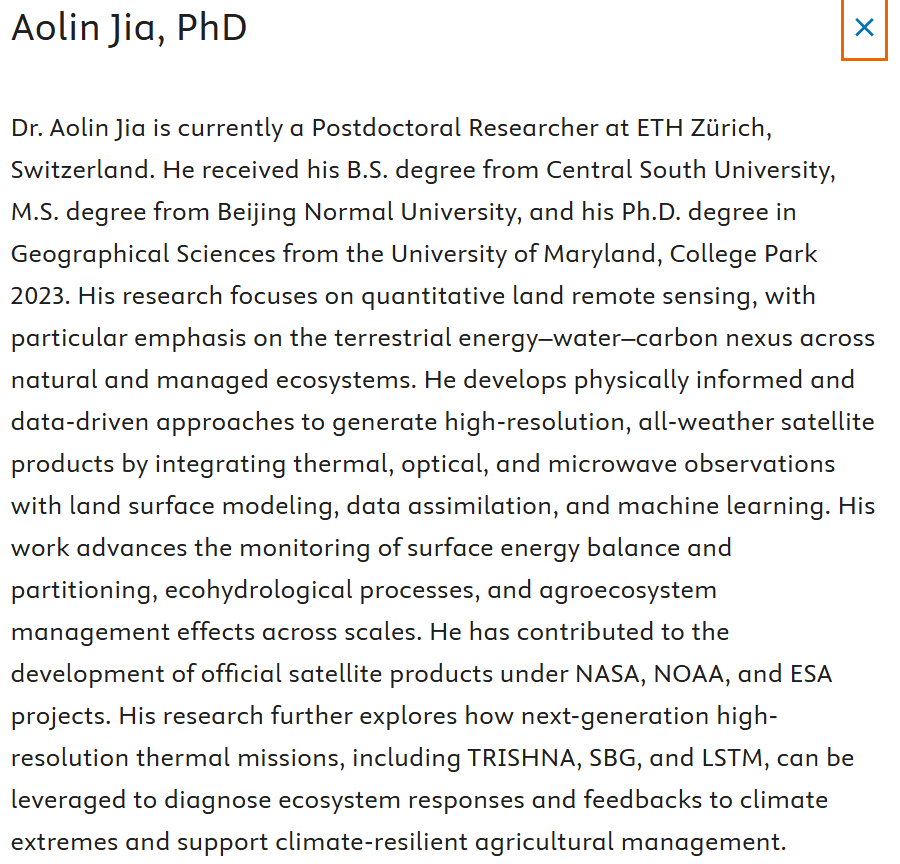
Starting a new chapter: I have joined ETH Zurich as a postdoctoral scientist, continuing my research in ecohydrology. Excited for the work ahead and to explore new ideas on remote sensing of water and GHG flux dynamics.
🇺🇸🇮🇳 The US-India #NISAR mission just launched, bringing game-changing radar tech to monitor Earth's surface, including crops! 🌾🌍 NASA Harvest is excited to harness this data to boost global agricultural monitoring and food security.
🔗 https://t.co/ArGSRX03Dj
2nd RSE paper this summer: Global dynamic parameterization and albedo maps of bare soil, stems, and green leaves. Reveals distinct biophysical impacts of vegetation components across ecosystems
🌍🔗 https://t.co/RfG2xcQ6w0
#RemoteSensing#Albedo#LandSurfaceModeling#Ecohydrology
Proud to share my new RSE paper on the Radiative Thermal Index (RTI)—a high-resolution drought indicator from ECOSTRESS LST, capturing soil moisture and vegetation water stress across Sub-Sahara and India. Scalable to #TRISHNA, #LSTM, and #SBG! 🌍🌡️
🔗 https://t.co/6EQ1FVfhh6
🎓 Calling all Geographical Sciences alumni 🌍
Please complete our Post-Graduation Alumni Survey!
📋https://t.co/LyipFe2c6e
🕒 It only takes a few minutes
Thank you for helping us build a stronger Geographical Sciences community at UMD! ❤️💛
Dear colleagues, we invite you to submit abstracts to our long-running AGU session: Vegetation Canopies: Physiology, Structure, and Function.
Submission link: https://t.co/AyyOELrZk6
How well plants use their photosynthesized carbon? Using global eddy covariance observations and ecological theory, our study reveals the pattern of vegetation carbon use efficiency (CUE) worldwide!@NUSgeog@NUSCNCS@Ameriflux https://t.co/VYdiTJdjiw
Our study "Global dominance of seasonality in shaping lake-surface-extent dynamics" is now published in @Nature. We reveal how seasonal rhythms govern the dynamics of ~1.4 million lakes globally.
🔗 https://t.co/0ZQYFJpIJd
#ClimateChange#RemoteSensing#Hydrology#LakeDynamic