@0h_it_Ivy@Cleo_Juliette_ Spent a semester in a course where all we did was read the Phenomenology cover to cover. I am still convinced I understood maybe 5% of that book at best.
My intro to phil professor told first-year me: "Kant's first Critique is the hardest book you'll read as an undergrad."
The next semestwr, I was assigned Heidegger and realized she was wrong.
I then enrolled in a course on Hegel and realized Heidegger wasn't all that bad.
@ablata_at_alba@PeterJAngel@modumdoll QCT has some great ideas but is not his best writing. Being and Time is by far the most precise of what I've read, but The Origin of the Work of Art is a much better example of the "poetic" style of his later work.
@ablata_at_alba@modumdoll Nietzsche is annoying, but I think that's because of what he says rather than how hard it is to understand what it is he is saying.
@modumdoll Kant and Heidegger both suffer from being jargon-ridden, but their use of jargon is both understandable and decodable once you understand the terms they use. Hegel, by contrast, is making statements whose content is near-indecipherable even if you understand the individual words.
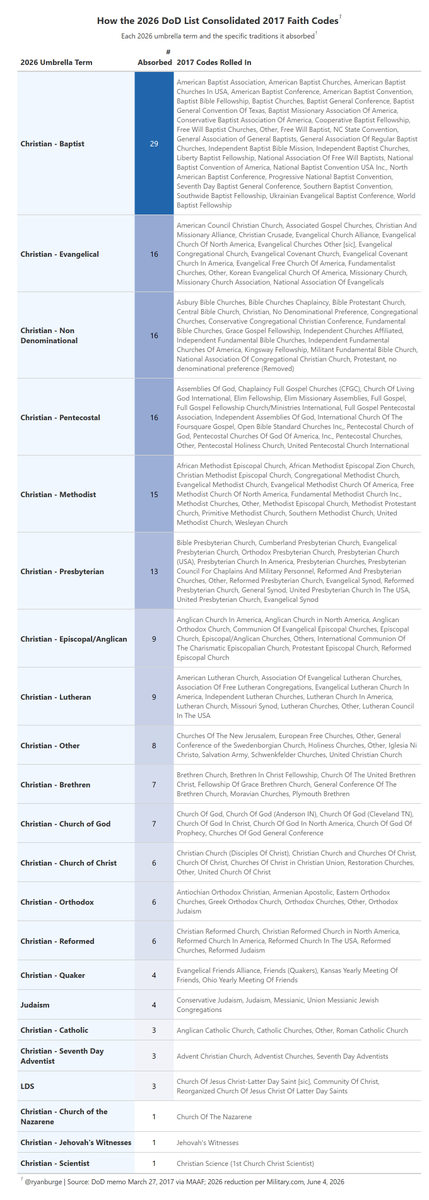
The US Military just made a bunch of changes to their list of Faith Codes.
The gist is that the old list used to include every single type of Baptist in a separate entry. Now, they are all under a single umbrella, "Christian - Baptist"
Another interesting choice is that LDS are not listed as Christians.
Hearing "15 minute city" and thinking that this means you are required to remain within 15 minutes of your home is like hearing that immigrants are "seeking asylum" and claiming that they are "coming from insane asylums."
So Oxford UK is to become a 15 minute city in August. Do people realise what a 15 minue City is?????? Do you realise they need a pass to leave it, even to go to work???? That they are fined if they go over the pass limit. They must have facial recognition cameras everywhere!!!!! Anyone on here from Oxford?????
@crystalwizard As someone who has done some (but admittedly not enough) service-oriented work while here, what's striking is the weird "oh how good for you" attitude you get from some of your peers when you talk about your summer plans, etc. Far too much value is placed on prestige.
@crystalwizard I made this post as someone critical of this mindset. I think that it is a serious cultural problem in "elite" institutions, and we need to work to change it.
The most common trait shared by me and my Harvard classmates is a prioritization of success over other aspects of our lives. The result is professional success but also neglected relationships and personal needs.
You can't have it all, and that is a lesson we rarely learn here.
ivy league grads are 0.5% of the population and more than 12 percent of all Fortune 500 CEOs, 32 percent of all New York Times journalists, and 13 percent of the wealthiest 0.1 percent of the population.
everyone assumes it's the teaching. it isn't. an economics professor at Dartmouth said he doesn't think there's a big difference between Ivy Plus professors and professors at other universities. i went to columbia. the headline professors mostly handed class off to TAs.
everyone's second guess is the network. also wrong on the timing. salary gaps between ivy and non-ivy grads widen over the career, not at graduation, which is exactly when prestige should matter most.
the real driver is the opportunity to learn how to succeed in an environment filled with the world's most talented and ambitious people. concentration of drive. you absorb the bar by sitting next to it.
@MartinCothran If you receive an education that trains you how to think and learn, then no development in tech can take away the value of your degree. If you train in specific skills and knowledge, then your degree's value is dependent entirely on the trends of the moment.
@thebigjuiceer These are a real problem! But, they are notably not PhDs, and the nuance is important if we want to avoid painting all graduate education as a scam.
As someone who has just been through the process, I can assure you, PhD admissions (at least in philosophy) are NOT easier than undergrad.
I applied to ~13 schools for undergrad and got into all but 3. I ended up at Harvard.
PhDs? 11 applications and 2 offers.
Masters and PhDs at elite universities are also way easier to get into than undergrad. An Ivy League masters doesn't really impress many people and they're cash grabs for elite schools. UChicago and Columbia are notorious for expensive masters that do nothing for your career.
@man_of_faults Although this was slightly different, as our main journal publishes professional philosophers but is undergrad run and edited, and we have a magazine form for undergrads to publish in.
Blue book exams are good AI-proofing, but we still don't have a good way of allowing students to demonstrate their ability to write long-form papers that involve research and careful prose-writing that is AI-proof. Does a solution to this even exist?
Look, Biden had his flaws, and we should have gone with Bernie back in 2024, but people in the progressive wing the Democratic Party definitely under value the extent to which Biden's policy agenda was a win for the left.