Most crypto wallets ask you to trust them.
Aperture asks you to verify instead.
Our wallet is fully open source with reproducible builds, so anyone can confirm the App Store binary matches the published source code byte-for-byte.
Why does that matter?
Because open source alone isn't enough. If the binary doesn't match the code, hidden changes or backdoors could exist without anyone noticing.
With Aperture, you don't have to rely on promises.
. Public source code
. Reproducible builds
. Hardware-backed private keys in Apple's Secure Enclave
. Face ID authorization
. No account
. No sign-up
. No subscription
Verify the wallet. Verify the build. Verify your security.
Download Aperture on the App Store.
#BitcoinRecovery #Ethereum #SolanaMemes #CryptoPrediction #CryptoWallet #Web3 #SelfCustody #OpenSource #SecureEnclave #iPhone #Privacy #Blockchain
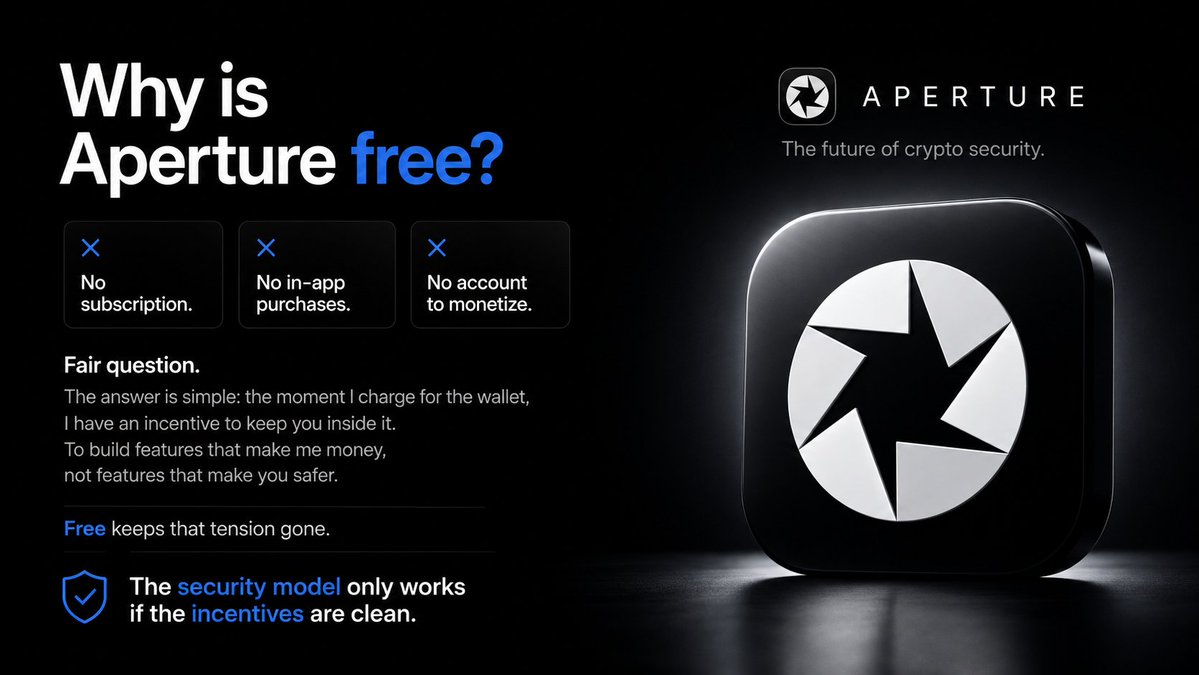
Someone asked me why Aperture is free.
no subscription. no in-app purchases. no account to monetize.
fair question.
·
the answer is simple: the moment i charge for the wallet, i have an incentive to keep you inside it. to build features that make me money, not features that make you safer.
·
free keeps that tension gone.
the security model only works if the incentives are clean.
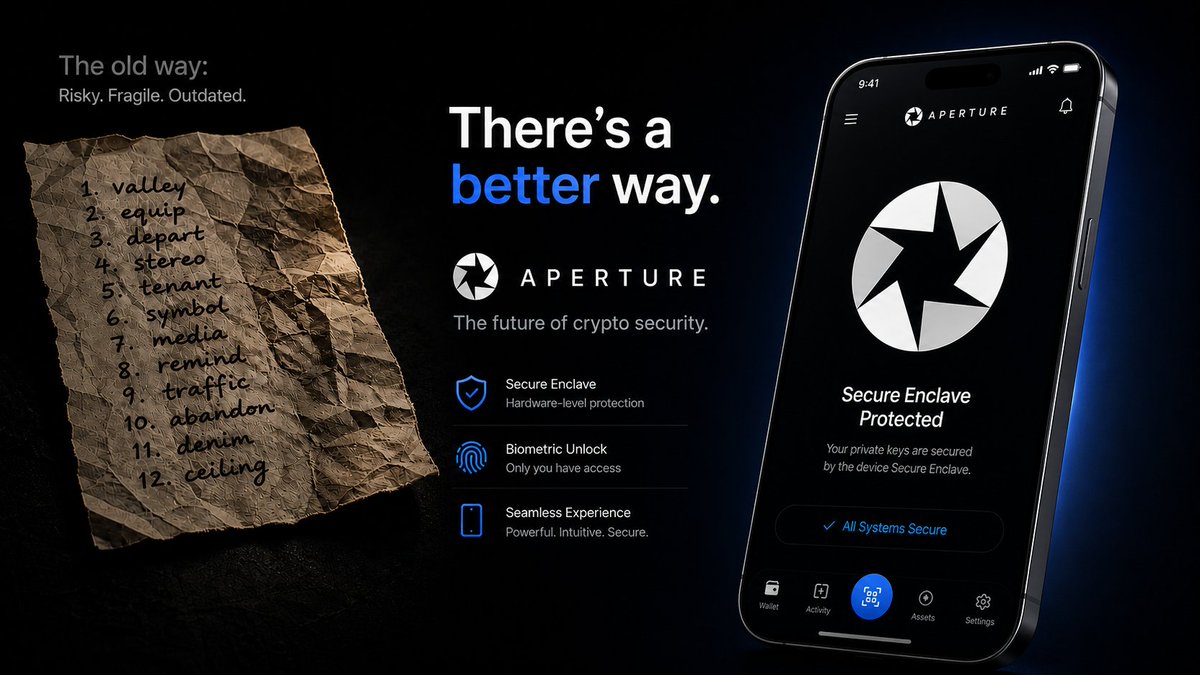
trust wallet, metamask, rabby — they all ask you to back up a seed phrase.
write these 12 words down. store them somewhere safe. don't lose them.
that's the security model. a piece of paper.
·
with Aperture, the key is generated inside the Secure Enclave and never leaves it. there's nothing to write down, nothing to store, nothing to lose to a house fire or a photo in your camera roll.
·
the seed phrase was always the weakest link. we just stopped using it.
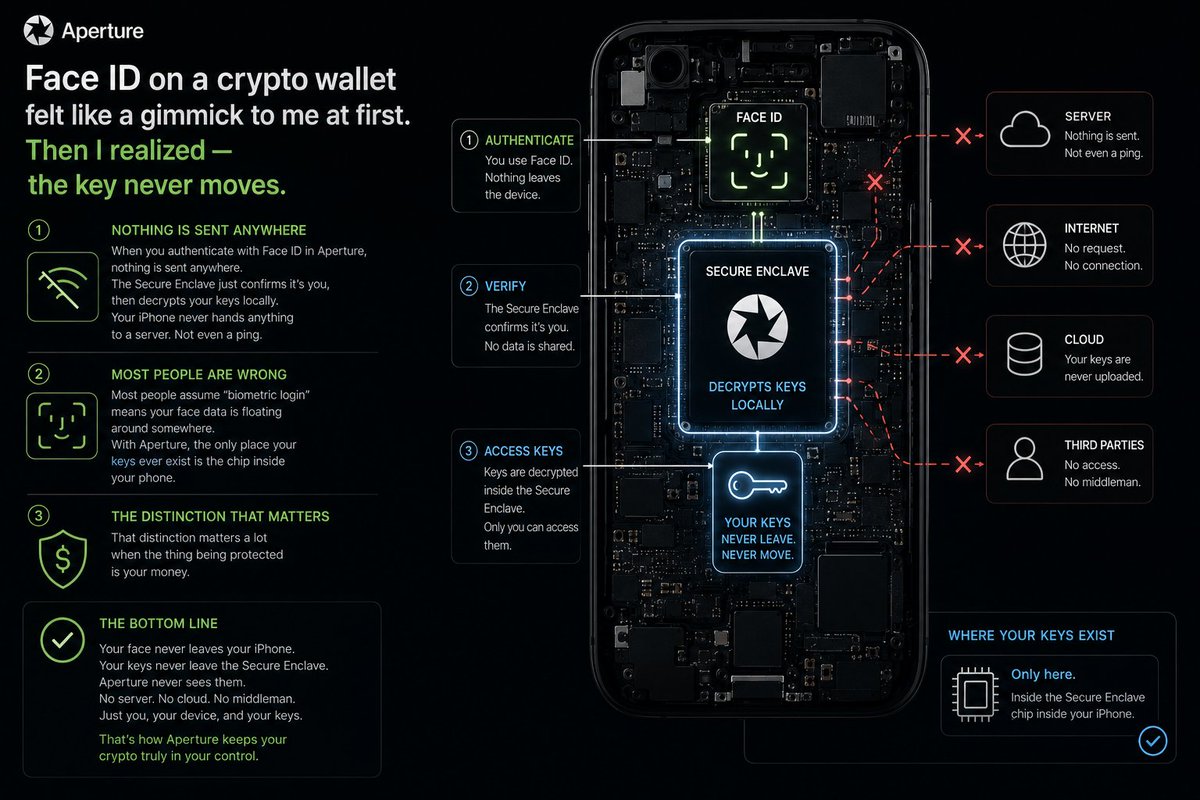
Face ID on a crypto wallet felt like a gimmick to me at first.
Then I realized: the key never moves.
When you authenticate with Face ID in Aperture, nothing is sent anywhere.
The Secure Enclave verifies that it's you, then decrypts your private key locally on your iPhone. Your device doesn't send your private key to a server, a third party, or even to us.
Most people assume "biometric login" means their face data or private keys are somehow leaving the device.
That's not how it works.
With Aperture, your private keys exist only inside the Secure Enclave—a dedicated security processor built into your iPhone.
Every cryptographic operation happens there. The private key stays there.
Your Face ID data never leaves the Secure Enclave.
Your private key never leaves the Secure Enclave.
Only the cryptographic result is returned to the app when needed.
That distinction matters when the thing you're protecting is your money.
we almost skipped the reproducible build.
it was extra work. most users would never check it.
but here's the thing about crypto — trust is the product.
anyone can say "your keys never leave your device." we wanted people to be able to prove it themselves.
so we made sure the binary you download from the App Store matches the source code on GitHub, byte for byte. independently verifiable. no faith required.
that single decision changed how we talk about Aperture entirely.
https://t.co/MRWkHhFTAQ
we shipped support for 24 chains in a single wallet.
no account. no login. no server ever sees your keys.
just open the app, scan your face, done.
i keep coming back to how weird it is that this used to require trusting a company with your money.
Aperture stores everything in your phone's Secure Enclave. the same hardware that protects your Face ID data. nobody — including us — can reach it.
if you've been sitting on a custodial wallet because self-custody felt complicated, this is the one to try.
https://t.co/MRWkHhFTAQ
the most common way people get drained isn't a bad password.
it's approving a contract they didn't fully read.
Aperture ships with no in-app swap, no dApp browser, no third-party contract approvals.
those features aren't missing. they were removed on purpose.
every one of them is a door. fewer doors means fewer ways in.
open-source was a hard call.
shipping the full codebase publicly means anyone can pick it apart, find flaws, copy it.
we did it anyway.
because trust in a self-custody wallet can't come from a blog post or a whitepaper. it has to come from the code itself.
4,200+ people have starred the repo. some of them have gone line by line through how Aperture handles key generation.
that kind of scrutiny is uncomfortable. it's also the only thing that actually means something in this space.
most crypto wallets are built for people who already know what they're doing.
that's the whole problem.
i've watched founders and devs bounce off metamask in under 10 minutes.
not because they're not smart. because the onboarding assumes you already speak the language.
we're building Aperture for the person who wants in but keeps hitting walls.
if that's you, come check it out: https://t.co/JjQi22zNTF
Let's get this straight.
1. FTX used your BTC to buy Luna.
2. BlockFi and Celsius gave your BTC to 3AC.
3. And Paypal just paid $510,750 to send $2k.
Turns out the only one who cares about your #Bitcoin is you.
Not your keys, not your coins.