Ordain
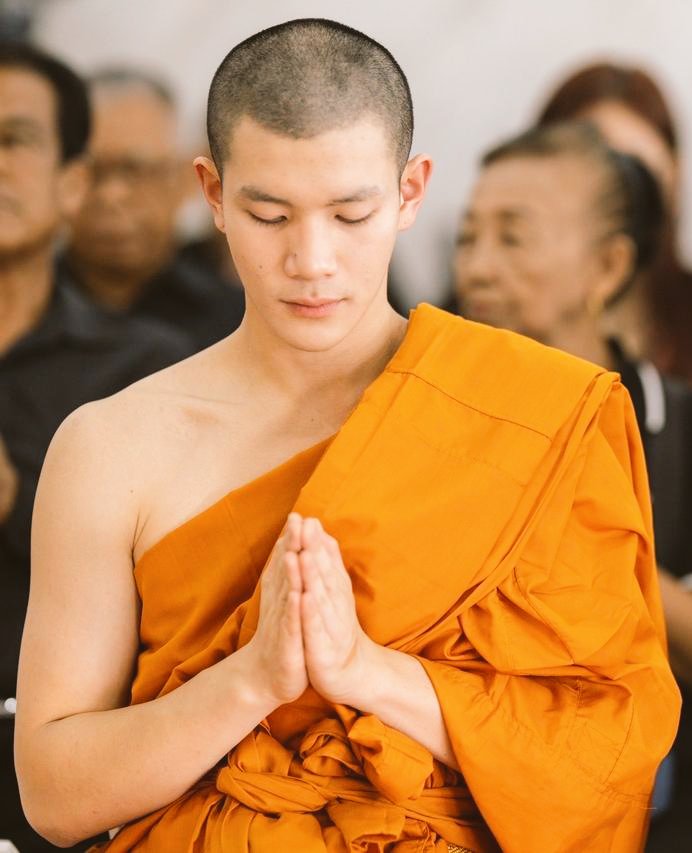
In the tradition of Thai Buddhism, the act of บวชหน้าไฟ (buat naa fai) — ordaining before the cremation fire — is regarded as one of the highest offerings a son can make to his father. It is a sacred expression of กตัญญู (katanyu), the deep gratitude and indebtedness that one holds toward one's parents, who are considered, according to the teachings of the Buddha, the first and foremost benefactors in this life. To be born, nurtured, and guided through the early stages of existence is a debt that no material gift can repay. By undertaking บวช (buat), even for a brief period, the son offers the immeasurable treasure of the Dhamma (ธรรมะ), a treasure that surpasses all worldly wealth, as a final act of love and reverence for his departed father.
The ordination at the moment of หน้าไฟ (naa fai) carries a profound spiritual significance. In Thai Buddhist belief, the accumulation of บุญ (bun), or merit, is essential for one's journey beyond this life. Through the act of ทำบุญ (tham bun) by entering the monastic order, the son generates vast merit, which he then dedicates to his father through การให้บุญ (kaan hai bun). This sacred transfer is believed to illuminate the path of the departed soul (จิต, chit), easing its passage through the intermediate state and helping it find a more favorable rebirth. In this way, the son's ordination becomes not only an offering of gratitude but a true spiritual gift, one that transcends even death.
At the threshold of life and death, in the solemn atmosphere of ordaining in front of the fire, the son stands as a bridge between the worlds of the living and the departed. The new robes he wears — symbolic of purity, renunciation, and the pursuit of awakening — bear witness to the truth of อนิจจัง (anicca), impermanence, a central pillar of the Buddha's teaching. To ordain at such a moment is to acknowledge with clarity and humility the fleeting nature of all things, to meet loss not with despair, but with the profound response of turning toward the Dhamma.
There is also a deep symbolic meaning attached to the timing. By ordaining right before the cremation, the son walks the final journey with his father as a monk — embodying purity, discipline, and the Dhamma itself. It is as if the father is being accompanied into the next world under the protection and blessing of the Buddha’s path. In this way, the ordination acts as a spiritual shield and a final, profound offering. In Thai cultural terms, this is seen as the ultimate way to “send off” a parent — with dignity, compassion, and the blessings of the Sangha.
At a deeper level, the ordination at Naa Fai also serves as a confrontation with impermanence (anicca), one of the central teachings of Buddhism. Death is the ultimate reminder that everything we hold dear will eventually change and pass away. By ordaining at the moment of his father's death, the son demonstrates an acceptance of this truth. He responds to loss not with despair, but with a reaffirmation of spiritual practice, temporarily stepping into the renounced life as a way to honor both his father and the reality of existence itself.
Thus, a Naa Fai ordination is not only a personal tribute to the father but also an act steeped in profound Buddhist meaning. It embodies gratitude, compassion, wisdom, and the understanding of life's impermanence, transforming grief into a sacred offering along the path of liberation.
Thus, ordain is not merely a ceremony, but a sacred vow of remembrance, gratitude, and transcendence. It is a final offering to the father, a luminous beacon sent forth with love and compassion, guiding him onward, while reminding the living of the noble path that leads beyond sorrow