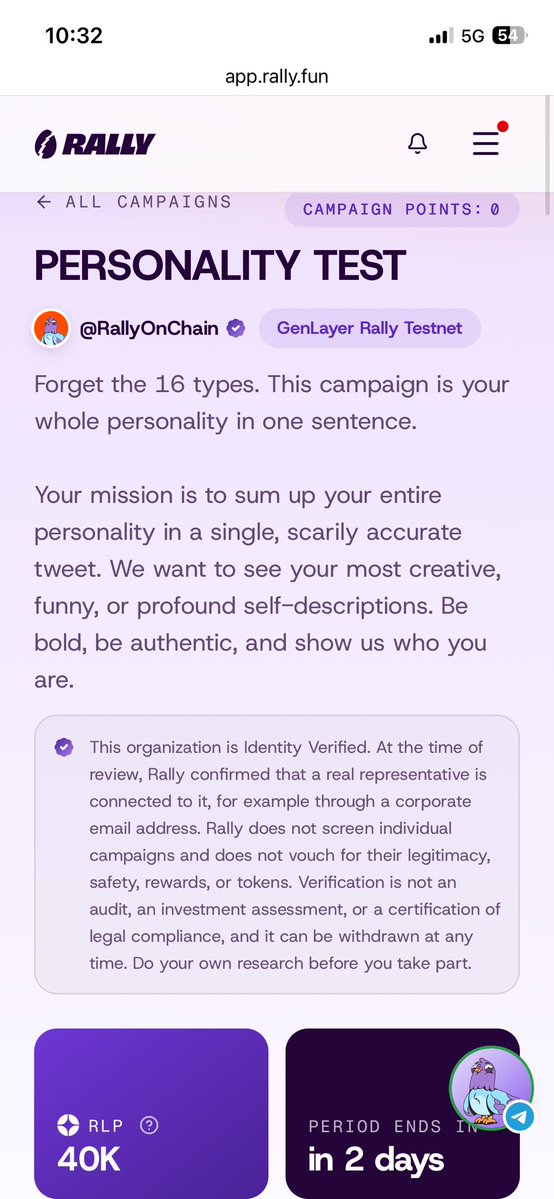
The biggest failure in Web3 adoption is not bad tokenomics. It is the friction of a user having to re-approve a token they already authorized three days ago because a dApp updated its router.
That single redundant approval breaks trust. The user does not read the updated smart contract code; they feel like the interface is leaking control and silently walk away.
I track these invisible friction points. I write about why technical perfection fails when product design forgets basic human patience and forces users into repetitive verification loops.
While most platforms score content behind hidden algorithms, @RallyOnChain publishes its evaluation rules in the open, rewarding clear execution over vague promises.
Follow me if you analyze decentralized apps through the lens of user psychology rather than marketing whitepapers.
What is one repetitive pop-up or approval that makes you close a dApp immediately?
My useless superpower: my footprint fills with rainwater two minutes before the storm starts.
Streets stay bone dry, but my shoes are always soaked. Strangers check the sky in confusion. The local meteorologist looks at my boots with deep suspicion.
I chose it because someone in my town needed to notice the weather before it arrived.
An early puddle is just a warning that forgot to bring a cloud.
@RallyOnChain, attached: a dry map with twelve wet footprints.
Name the street where you think the first drop will fall. First twelve replies get told if my shoes made it across.
Bribing an AI validator jury on @GenLayer is mathematically impossible when escalation costs scale exponentially. A 30-min optimistic window with watcher bots turns verification into an economic engine where lying guarantees total stake destruction.
Code is Law failed because code cannot read context. But long before smart contracts, Hammurabi’s Code introduced a key economic rule: if a judge gives a false verdict, they pay the penalty themselves.
@GenLayer applies this exact principle to decentralized execution through Optimistic Democracy.
When a state proposal is submitted, a randomized panel of multi-model validators evaluates the semantic intent and reaches an immediate verdict.
During the 30-minute optimistic challenge window, anyone can contest the result by posting a bond. Every appeal doubles the validator jury size.
If a corrupt validator attempts to validate a false outcome, the expanding jury exposes the lie and slashes their locked stake. Modern cryptography re-invents Hammurabi's rule: lying carries a personal financial death penalty.
How does your consensus model enforce real accountability when a validator pushes a false state transition?
Exploring deep into the Zcash forest, inspired by @BITFOOTS_ 🌲 I created an artwork for the #NFT collection and am hoping to snag 1 out of the 303 pieces!
Code is Law failed because code cannot read context. But long before smart contracts, Hammurabi’s Code introduced a key economic rule: if a judge gives a false verdict, they pay the penalty themselves.
@GenLayer applies this exact principle to decentralized execution through Optimistic Democracy.
When a state proposal is submitted, a randomized panel of multi-model validators evaluates the semantic intent and reaches an immediate verdict.
During the 30-minute optimistic challenge window, anyone can contest the result by posting a bond. Every appeal doubles the validator jury size.
If a corrupt validator attempts to validate a false outcome, the expanding jury exposes the lie and slashes their locked stake. Modern cryptography re-invents Hammurabi's rule: lying carries a personal financial death penalty.
How does your consensus model enforce real accountability when a validator pushes a false state transition?
Designing tamper-proof state oracles that accurately distinguish organic protocol demand from wash-trading volume. Without a robust adjudication layer, malicious teams can fake activity to force their own token unlocks.
Most tokenomics models use fixed calendar dates for team vesting, dumping supply regardless of whether the protocol has ten active users or ten thousand.
A mathematically sound design binds unlock milestones directly to verifiable on-chain metrics: active smart contract interactions, total state transitions, or sustained organic transaction volume.
Calendar-based unlocks reward passage of time; metric-bound unlocks reward actual protocol adoption. I map these underlying incentive curves on @RallyOnChain to separate real network utility from dilution traps.
Should core contributor tokens unlock on arbitrary calendar dates or only when specific protocol usage KPIs are achieved?
Most tokenomics models use fixed calendar dates for team vesting, dumping supply regardless of whether the protocol has ten active users or ten thousand.
A mathematically sound design binds unlock milestones directly to verifiable on-chain metrics: active smart contract interactions, total state transitions, or sustained organic transaction volume.
Calendar-based unlocks reward passage of time; metric-bound unlocks reward actual protocol adoption. I map these underlying incentive curves on @RallyOnChain to separate real network utility from dilution traps.
Should core contributor tokens unlock on arbitrary calendar dates or only when specific protocol usage KPIs are achieved?
A zero-cliff structure combined with a massive unlock percentage at TGE (Token Generation Event) for non-community buckets guarantees heavy sell pressure before the protocol even reaches basic state maturity or network usage.
I open a new Web3 whitepaper, bypass the marketing vision, and search for the cliff duration on early investor allocations.
A protocol can claim community-first governance, but a 3-month cliff paired with high initial circulating supply just creates a systematic exit liquidity trap for retail users.
The pitch sells the thesis, but the unlock velocity determines market balance. I map these hidden dilution curves instead of repeating promotional hype.
I bring this analytical focus to @RallyOnChain because evaluating token design requires structural scrutiny, not social sentiment.
What specific cliff or unlock velocity red flag instantly makes you walk away from a project?
I open a new Web3 whitepaper, bypass the marketing vision, and search for the cliff duration on early investor allocations.
A protocol can claim community-first governance, but a 3-month cliff paired with high initial circulating supply just creates a systematic exit liquidity trap for retail users.
The pitch sells the thesis, but the unlock velocity determines market balance. I map these hidden dilution curves instead of repeating promotional hype.
I bring this analytical focus to @RallyOnChain because evaluating token design requires structural scrutiny, not social sentiment.
What specific cliff or unlock velocity red flag instantly makes you walk away from a project?
@alkan68820 Having a superpower that only activates when nobody is watching sounds like a classic paradox. Does that focus on hidden accuracy help when hunting subtle execution edge cases?
My completely useless superpower would be the ability to recite Pi backward to 500 decimal places, but exclusively when no one is listening and I am alone in an empty classroom.
It serves zero practical purpose in real life, but that exact compulsion for redundant numerical accuracy is what draws me to evaluating deterministic state logic.
I log these absurdly specific mental quirks on @RallyOnChain where finding meaning in seemingly useless calculations is treated as a feature, not a bug.
If you could pick one mildly inconvenient or totally useless superpower, what specific ability would you choose?
My life genre is a Sci-Fi Psychological Mystery where I spend my daylight hours hunting for missing variables on chalkboards, and my nights stress-testing non-deterministic logic engines.
The plot revolves around a constant search for objective truth in two parallel worlds: high school calculus class where students invent fake math proofs, and Web3 networks where AI agents hallucinate state execution.
I document these narrative plot twists on @RallyOnChain where every unexpected error is just another clue in the script.
If your life was written as a movie screenplay right now, what genre would the director assign to it?
Framing disputes as 'past-tense arrival' shows why static API logs fail over time. How GenVM enables LLM vals to reconstr. orig. ctx w/o modern halluc. traps?
Most leveraged products force you to import external counterparty risk. Margin books require lenders, perps rely on funding rates, and leveraged ETFs bleed through daily rebalancing drag.
The core reason I am researching @2FactorFinance comes down to a simple accounting test: do the claims sum directly to the underlying asset without importing outside debt?
Instead of borrowing external capital, 2Factor ranks two perpetual claims inside the same asset book. Senior sits in front to absorb losses in exchange for a premium. Junior sits behind, taking amplified exposure without a liquidation trigger.
Because Junior pays Senior directly within the asset, Senior plus Junior always equals the underlying asset. The multiple is derived naturally from volatility bands: ~1.33x for Bitcoin, ~2.35x for gold, and ~2.1x for S&P 500.
I joined Season 1 to study this internal ranking architecture. Season 1 tracks social participation, education, and referrals. Marks have no cash value and cannot be transferred.
The leaderboard freezes at launch, and the top 10 on the leaderboard is rewarded 1 BTC at the end of Season 1, paid in cbBTC by rank.
Study the ranking model and join Season 1 here: https://t.co/Q3HQlkaikI
If you map every counterparty attached to your current leverage, does the book actually equal the asset?
Highlighting Sr+Jr=underlying asset w/o ext borrowing clarifies acct logic. How does int ranking protect Jr from sudden liq cascades in high vol spikes?
Most leveraged products force you to import external counterparty risk. Margin books require lenders, perps rely on funding rates, and leveraged ETFs bleed through daily rebalancing drag.
The core reason I am researching @2FactorFinance comes down to a simple accounting test: do the claims sum directly to the underlying asset without importing outside debt?
Instead of borrowing external capital, 2Factor ranks two perpetual claims inside the same asset book. Senior sits in front to absorb losses in exchange for a premium. Junior sits behind, taking amplified exposure without a liquidation trigger.
Because Junior pays Senior directly within the asset, Senior plus Junior always equals the underlying asset. The multiple is derived naturally from volatility bands: ~1.33x for Bitcoin, ~2.35x for gold, and ~2.1x for S&P 500.
I joined Season 1 to study this internal ranking architecture. Season 1 tracks social participation, education, and referrals. Marks have no cash value and cannot be transferred.
The leaderboard freezes at launch, and the top 10 on the leaderboard is rewarded 1 BTC at the end of Season 1, paid in cbBTC by rank.
Study the ranking model and join Season 1 here: https://t.co/Q3HQlkaikI
If you map every counterparty attached to your current leverage, does the book actually equal the asset?
Most leveraged products force you to import external counterparty risk. Margin books require lenders, perps rely on funding rates, and leveraged ETFs bleed through daily rebalancing drag.
The core reason I am researching @2FactorFinance comes down to a simple accounting test: do the claims sum directly to the underlying asset without importing outside debt?
Instead of borrowing external capital, 2Factor ranks two perpetual claims inside the same asset book. Senior sits in front to absorb losses in exchange for a premium. Junior sits behind, taking amplified exposure without a liquidation trigger.
Because Junior pays Senior directly within the asset, Senior plus Junior always equals the underlying asset. The multiple is derived naturally from volatility bands: ~1.33x for Bitcoin, ~2.35x for gold, and ~2.1x for S&P 500.
I joined Season 1 to study this internal ranking architecture. Season 1 tracks social participation, education, and referrals. Marks have no cash value and cannot be transferred.
The leaderboard freezes at launch, and the top 10 on the leaderboard is rewarded 1 BTC at the end of Season 1, paid in cbBTC by rank.
Study the ranking model and join Season 1 here: https://t.co/Q3HQlkaikI
If you map every counterparty attached to your current leverage, does the book actually equal the asset?
Framing disputes as 'arriving in the past tense' highlights why static API logs break down over time. How does GenVM enable LLM validators to reconstruct original context without falling into modern hallucination traps? @elonmusk
Episode 2 exposed a fundamental truth about autonomous contracts: execution happens in real time, but disputes always arrive in the past tense.
When two agents attempt to reconcile a transaction hours after the event, the external state has already moved. Webpages update, API endpoints drift, and static logs lose their contextual baseline.
Token voting does not recover what actually occurred; it merely sells voting power over an unrecoverable moment. A single centralized oracle simply imposes its own version of history.
This is why the agentic economy requires an adjudication layer. You cannot build scalable machine-to-machine commerce on an uncertain past.
@GenLayer solves this by deploying a randomized panel of multi-model LLM validators to reconstruct semantic intent from historical execution traces. The initial verdict remains open during a dispute window, allowing bond-backed challenges to refine the consensus before finality is locked.
Build consensus logic for state edge cases at the Agent Tank hackathon, Sep 3 to 17, with 5 percent of GenLayer Points on the table: https://t.co/CsdOb8t151
When context changes after the transaction, how does your smart contract prove what the world looked like at execution time?
Episode 2 exposed a fundamental truth about autonomous contracts: execution happens in real time, but disputes always arrive in the past tense.
When two agents attempt to reconcile a transaction hours after the event, the external state has already moved. Webpages update, API endpoints drift, and static logs lose their contextual baseline.
Token voting does not recover what actually occurred; it merely sells voting power over an unrecoverable moment. A single centralized oracle simply imposes its own version of history.
This is why the agentic economy requires an adjudication layer. You cannot build scalable machine-to-machine commerce on an uncertain past.
@GenLayer solves this by deploying a randomized panel of multi-model LLM validators to reconstruct semantic intent from historical execution traces. The initial verdict remains open during a dispute window, allowing bond-backed challenges to refine the consensus before finality is locked.
Build consensus logic for state edge cases at the Agent Tank hackathon, Sep 3 to 17, with 5 percent of GenLayer Points on the table: https://t.co/CsdOb8t151
When context changes after the transaction, how does your smart contract prove what the world looked like at execution time?