@mugdhmani@TheMuslimMatter For the sake of argument, let's assume he's a Muslim. So if a Muslim among Hindu terrorists pretends to be a Hindu, wouldn't he have memorized everything in general?
Misleading videos have recently been circulating widely on social media, falsely linking violence and distress to Bangladesh and fueling confusion and fear. In one case, a video showing police assaulting suspects in India’s Gujarat state was shared on X with the claim that Bangladeshis were being mistreated in Assam. However, fact-checking confirms that the footage is unrelated to Bangladesh. The video originates from Gujarat and is connected to a murder investigation, where allegations were raised that police assaulted suspects during a crime scene reconstruction. Multiple Indian media outlets have confirmed the incident took place in Gujarat and has no connection to Bangladesh or Assam.
At the same time, another viral video claimed to show a young Hindu woman from Bangladesh crying out for help to Indians. Verification revealed that this video is entirely fabricated. It was created using artificial intelligence, with visible inconsistencies such as unnatural facial expressions, unrealistic tears, and irregular speech patterns. Analysis by an AI detection platform found a high probability that the video was AI-generated.
Together, these cases highlight a troubling pattern in which unrelated footage and AI-generated content are deliberately repackaged to spread false narratives about Bangladesh. They underscore the growing challenge of online misinformation and the importance of verifying content before sharing.
UPDATE: I talked to this guy on Instagram. First he lied and said that he is a Bangladeshi, when I questioned him and shared a bit of his details, he admitted he is an Indian, but then lied again saying he is currently in Bangladesh. Now that he has seen my X post, he is saying that creating AI videos isn't a crime, and since then he's been trying to 'threaten' me. 😂😂
See, how indians are spreading AI generated video as communal violence in Bangladesh intentionally to raise anti Bangladeshi voice in India. Who stop this blind terrorists?
Recently, a video circulated widely on social media in India. In the video, a man is seen walking along a street where several nearby shops appear to be on fire. He says:
“I am in Bangladesh. It is night now. They will kill us just like ‘Dipu Chadar.’ You can see what is happening here. Please share this video as widely as possible so that someone can save us. I don’t understand anything. Suddenly, the situation has become this bad.”
See:
https://t.co/j64fcOL54d
https://t.co/T8UaNwTh4a
https://t.co/gjBwbe401d
The investigative media outlet The Dissent reported that the discussed video is not genuine; rather, it was created using artificial intelligence (AI).
See:
https://t.co/GvY00tWW1l
The video contains multiple inconsistencies. For example, the man incorrectly pronounces Dipu Chandra’s name as “Dipu Chadar.”
Additionally, the video shows light emitting from the middle of an electricity pole without any visible source of illumination. At the same time, a car can be seen whose door color does not match the rest of the vehicle. The video also shows Bangladesh’s national flag hoisted on a pole. However, when the man walks past it, a portion of that pole suddenly appears to turn white.
Moreover, multiple models of the AI video detection tool DeepFake-O-Meter have identified the video as AI-generated.
A reverse search of several key frames from the video shows that it was first posted on December 24 from an Instagram account belonging to a user named Kuldeep Meena.
See: https://t.co/9LRhW2nPXJ
He is an Indian content creator who produces and circulates AI-generated videos using his own images. Previously, he has created multiple AI videos alleging persecution of Hindus in Bangladesh as well.
Claims circulated by India-operated X accounts alleged that a Hindu man named Kamdeb Das was brutally beaten to death by Islamists in Habiganj, presenting the incident as an act of communal violence. However, thorough fact-checking shows this narrative is false. Police case documents and multiple media reports confirm that Kamdeb Das (19) from Ajmiriganj upazila was killed following a personal dispute related to a romantic relationship. His body was recovered from a pond two days after he went missing, and his family stated that tensions between two families over the relationship escalated prior to his disappearance. Law enforcement officials have confirmed that all individuals accused in the case belong to the Hindu community, and no Muslim person has been named or implicated. Investigators continue to examine the case, but there is no evidence of religious or communal motivation. Portraying this incident as an Islamist or communal killing distorts the facts and spreads misinformation.
Claims circulated by India-operated X accounts alleged that a Hindu man named Kamdeb Das was brutally beaten to death by Islamists in Habiganj, presenting the incident as an act of communal violence. However, thorough fact-checking shows this narrative is false. Police case documents and multiple media reports confirm that Kamdeb Das (19) from Ajmiriganj upazila was killed following a personal dispute related to a romantic relationship. His body was recovered from a pond two days after he went missing, and his family stated that tensions between two families over the relationship escalated prior to his disappearance. Law enforcement officials have confirmed that all individuals accused in the case belong to the Hindu community, and no Muslim person has been named or implicated. Investigators continue to examine the case, but there is no evidence of religious or communal motivation. Portraying this incident as an Islamist or communal killing distorts the facts and spreads misinformation.
A video is being circulated on social media with the claim that hundreds of truckloads of war weapons arriving from the United States are being unloaded at Chattogram Port in Bangladesh.
See:
https://t.co/MOtlDs9eK8
https://t.co/3nq8ju2Vi4
https://t.co/ZTdYs9zixR
Verification shows that the circulated video is not from Chattogram Port. In fact, the video has been shared with the discussed claim by misrepresenting footage from last May showing the withdrawal of US forces from the Al-Omar oil field and the Conoco gas facility in Syria.
During the investigation, a similar video was found in a post published on May 3 on the X (formerly Twitter) account of Turkish media outlet gdh digital.
See: https://t.co/jehPI7e62C
The caption of that post states that it shows the withdrawal of US forces from the Al-Omar oil field and the Conoco gas field located in Deir ez-Zor in eastern Syria.
Additionally, a report published on May 3 on the website of Azerbaijani media outlet Caliber, titled “US completes troops withdrawal from two largest military bases in East Syria,” also includes the discussed video. According to that report, the footage shows US forces withdrawing from the Al-Omar oil field and the Conoco gas field in Syria using trucks coming from Iraqi Kurdistan.
See: https://t.co/OG8tlINYxV
Moreover, no reliable source has reported any recent arrival of weapons from the United States at Chattogram Port.
Therefore, a video showing the withdrawal of US forces from the Deir ez-Zor region of Syria last May has been falsely circulated as footage of a convoy of weapon-laden trucks arriving from the United States at Chattogram Port last September.
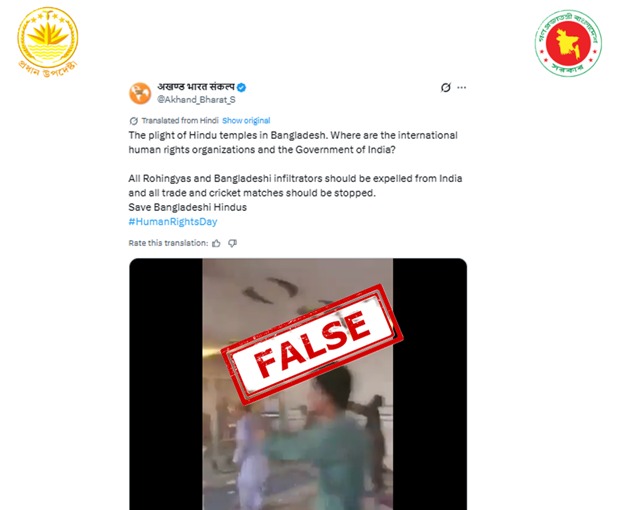
A video circulated from an X account based in India is being shared with the claim that it shows a Hindu temple being vandalized in Bangladesh. The footage shows several people attacking a structure that appears to be a temple.
See: https://t.co/BUaFqc66VY
Investigations, however, reveal that the video is not from Bangladesh. It shows the demolition of a temple in Bhong town of Rahim Yar Khan district in Punjab province, Pakistan, in 2021.
Reverse image searches of still frames from the video lead to the same scene found in a report published on August 5, 2021, by Pakistani media outlet Dawn. The footage in Dawn was captured from a different angle, but the elements—people present, their clothing, the building structure, and the furniture—match exactly.
See: https://t.co/Cl2uyV4umT
According to that report, on August 4, 2021, hundreds of people vandalized a Hindu temple in Bhong, Rahim Yar Khan, after a local Hindu boy was accused of urinating in a madrasa.
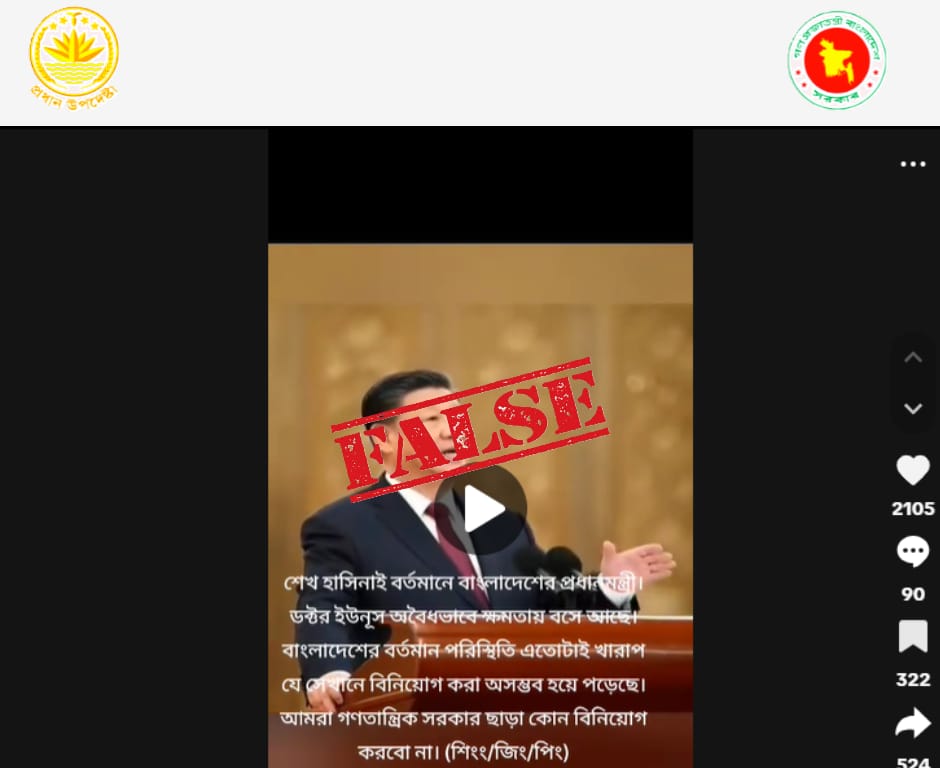
Recently, a video circulating on various social media platforms claims to show remarks made by Chinese President Xi Jinping.
In the video, he is heard saying: “Sheikh Hasina is the current prime minister of Bangladesh. Dr. Yunus is illegally holding power. The situation in Bangladesh is so bad that investment has become impossible. We will not invest without a democratic government.”
See:
https://t.co/mloDoGePeK
https://t.co/WitnZHncQz
https://t.co/GZWEJdF65j
An investigation finds that the video attributed to Chinese President Xi Jinping is not authentic. In reality, the clip being shared was created using artificial intelligence (AI) and is being circulated as if it were real.
No credible media outlet or reliable source has published any report or information supporting the claims made in the video.
A closer review of the video reveals several inconsistencies: the audio contains multiple mismatched voices, and the speech patterns sound artificially generated.
To verify further, the video was examined using the AI-content detection platform DeepFake-O-Meter, which estimated a 99.9 percent probability that the footage was AI-generated. Additionally, the AI-audio detection platform Resemble AI analyzed the audio and marked it as “Fake.”
Further investigation found a related report published on 29 December 2023 by China Central Television (CCTV) titled “Xi meets Chinese diplomatic envoys to foreign countries.” One of the photos attached to that report visually matches the scene used in the circulated video.
According to the report, President Xi met Chinese diplomatic envoys assigned to various countries. There is no indication in that coverage that he made any remarks about Bangladesh.
See: https://t.co/hsqtZmA9mz
An examination of the photograph suggests that it was used as a base to create the AI-generated video now being circulated.
Therefore, the video claiming to show Chinese President Xi Jinping commenting on Bangladesh’s political situation is an AI-generated fabrication, and the claim is false.
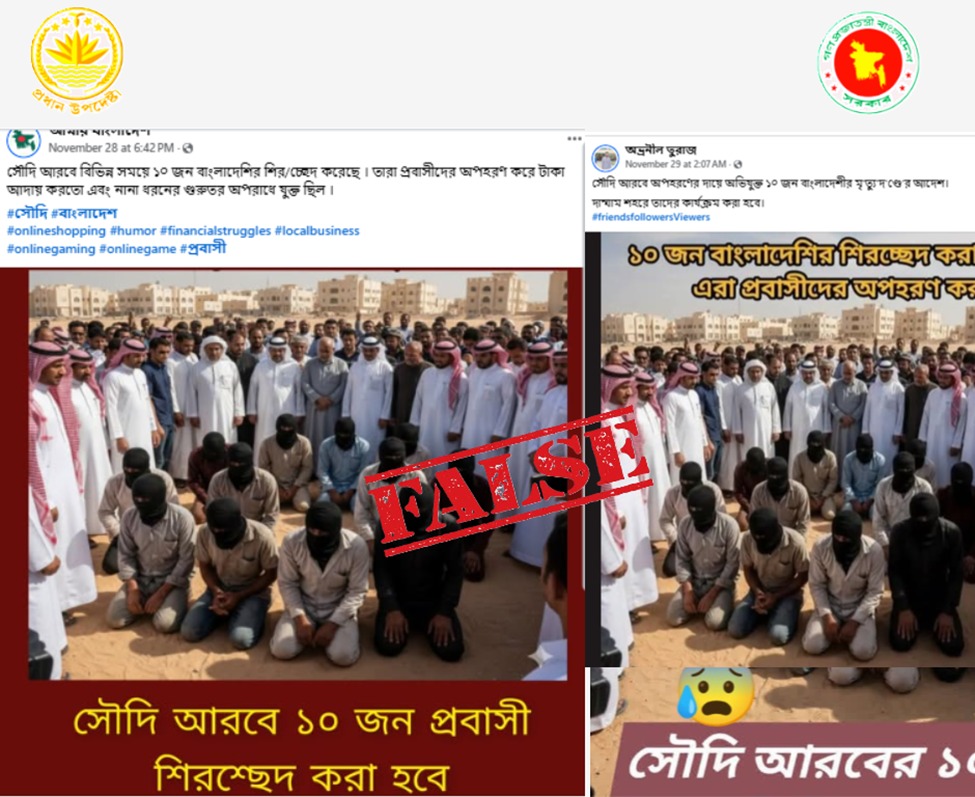
Recently, a photo circulating on social media shows several individuals kneeling on the ground with their faces covered in black cloth. It has been shared with the claim that “10 Bangladeshi nationals will be executed by beheading in Saudi Arabia’s Dammam for allegedly kidnapping expatriates, extorting money, and engaging in various crimes.”
See:
https://t.co/xmZPXyzSv1
https://t.co/3Xuiw1kAJH
https://t.co/tYU94rhlfd
Investigation shows that the circulated image is not a real scene of 10 Bangladeshis awaiting execution in Dammam. Rather, it is an AI-generated fake image that has been misleadingly shared with this claim. No credible evidence or reliable reporting indicates that 10 Bangladeshis in Dammam have recently been sentenced to death or executed.
A reverse image search of the photos shared with the claim shows no mainstream media reports or reputable sources supporting the allegation. Observing the image closely, around 12 individuals can be seen sitting on the ground—not 10—indicating a numerical inconsistency. Additionally, abnormalities in skin texture, body structure, and surrounding elements are visible—features commonly found in AI-generated content. A faint Google Gemini AI watermark is also visible in the lower-right corner of the image.
AI-detection platform Hive Moderation analyzed the photo and reported that it has an 88.6% likelihood of being AI-generated.
Further searches using relevant keywords about the alleged execution of 10 Bangladeshis in Dammam yielded no reliable information supporting the claim.
Therefore, the image being shared as a real scene of 10 Bangladeshis awaiting execution in Saudi Arabia’s Dammam is false; it is an AI-generated picture misrepresented online.
Recently, a photo card claiming to quote Law, Justice and Parliamentary Affairs Adviser Dr Asif Nazrul has been circulated on social media.
The card asserts that Professor Asif Nazrul said Tarique Rahman cannot return to Bangladesh because of a request from India to Interpol.
See: https://t.co/MuymB8hF3M
https://t.co/XQectZCIES
https://t.co/UKfpod8XqG
Investigations reveal that Asif Nazrul did not make any comment suggesting that Tarique Rahman would be unable to return unless he signed a bond. In reality, a satirical post originally published by a satire page has been reshared as if it were genuine news.
During the investigation, a photo card posted on December 1 on a Facebook page named “Asha’r Alo” was found. This image closely matches the widely circulated card.
See: https://t.co/GklK6ftZF9
Review of the “Asha’r Alo” page shows that its bio explicitly states: “This page has been created for entertainment purposes only; please do not take any post seriously.”
Further review of the page reveals many similar satirical posts, confirming that the viral post is also satirical content that has been misrepresented as real.
It is worth noting that on December 1, during a press conference, Legal Adviser Asif Nazrul stated that if there were any legal barriers to Tarique Rahman’s return, the government would provide full cooperation.
Therefore, the claim that Tarique Rahman cannot return to Bangladesh due to an Indian request to Interpol — attributed to Asif Nazrul — is entirely false and fabricated.
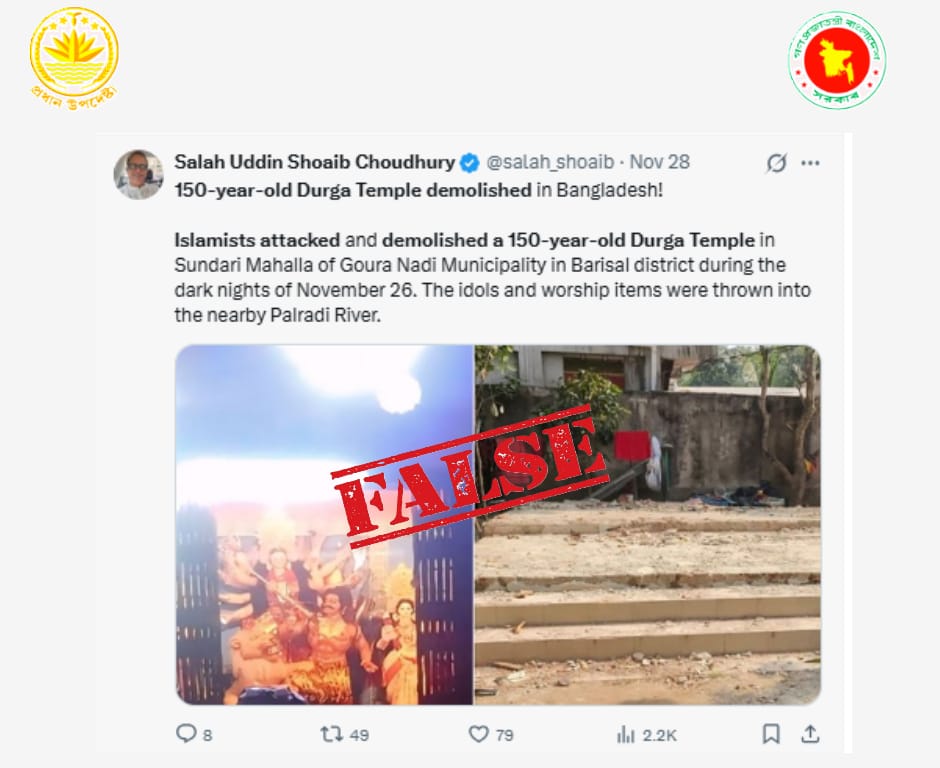
Controversial propagandist Salah Uddin Shoaib Choudhury claimed in a post on X that Islamists attacked and destroyed a 150-year-old temple in Barishal and threw its deities into a nearby river.
See: https://t.co/GSg0Xj2xoq
However, an investigation shows that his claim is false. The incident was not motivated by communal tensions; rather, it stemmed from a land-grabbing dispute involving members of the local Hindu community.
Searching relevant keywords leads to multiple reports in mainstream Bangladeshi media.
See:
https://t.co/lHjquQbyln
https://t.co/Jz5vyYFLx8
According to a report published in Jugantor, a historic Durga temple—nearly 150 years old and dependent on government grants—was demolished under the cover of darkness, and its idols were allegedly thrown into the nearby Palardi River as part of a forcible land-grab.
A written complaint has been filed with the police. In his statement, Narayan Mitra—son of the late Manoranjan Mitra of Sundardi—said that various religious programs, including the annual Durga Puja, have long been held at the temple. The temple, which relies on government assistance, is managed by a committee formed by the local Hindu community. According to his allegation, on the night of November 19, Ripon Mitra and Suman Mitra—sons of the late Brojo Bilash Mitra—claimed ownership of the temple land as inheritance and, along with hired men, deliberately demolished the old temple to occupy the land.
Gournadi Model Police Station OC Md. Tariqul Islam told Jugantor that police immediately stopped the encroachment after receiving the complaint. He added that on the morning of November 26, police had to intervene twice more when attempts to resume the occupation were reported.
See: https://t.co/uKlZbI24dw
Ripon Mitra and Suman Mitra, however, denied the allegations. They said, “We inherited this land. Due to our mother’s illness and debts, we had to sell our house. Now we have nowhere to live. So we are preparing to remove the temple and build a dwelling there.”
See: https://t.co/Pk5DJAQnEs
In sum, the incident had nothing to do with religious extremism; the allegations point instead to a land-dispute within the local Hindu community.
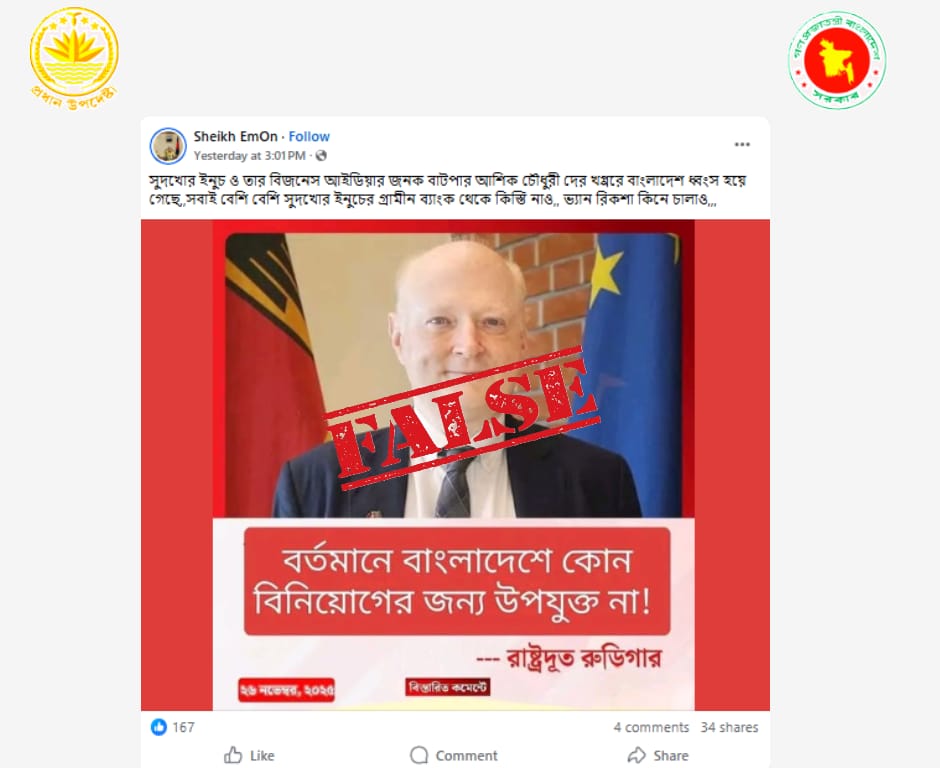
A photo card has recently circulated on social media claiming that German Ambassador to Bangladesh Rüdiger Lotz said, “Bangladesh is currently not suitable for any investment!” The card uses the design template of mainstream news outlet Bangladesh Times, implying that the newspaper published this claim.
See: https://t.co/Stdt1D0hIF
However, an investigation shows that Bangladesh Times did not publish any such photo card or report. Instead, the viral image was digitally fabricated by editing a different, genuine photo card of the outlet.
A close review of the circulating card shows the Bangladesh Times logo and the date “26 November.” Using this clue, all photo cards posted on the Bangladesh Times Facebook page on that date were examined—none contained this headline. Likewise, no such report or quotation was found on the outlet’s website or in any other mainstream media.
What was found is an authentic photo card published by Bangladesh Times on 26 November. Although its visual design and photo elements match the doctored card, the headline is the exact opposite. The original text read: “Bangladesh is currently suitable for investment: Ambassador Rüdiger.”
In the manipulated version, this was altered to:“Bangladesh is currently not suitable for any investment! – Ambassador Rüdiger.”
See: https://t.co/Ra5DwkvVG1
In other words, the viral graphic was created by digitally editing the original Bangladesh Times photo card.
Recently, amid widespread violence carried out by the Awami League across the country, miscreants set fire to several branches of Grameen Bank in different areas.
Following this, two photocards—designed to look like those of mainstream electronic media outlet Jamuna TV and national daily Prothom Alo—circulated on social media, claiming: “A plan to attack Grameen Bank; Chief Adviser Dr. Muhammad Yunus has instructed all customers to withdraw their money from every branch of Grameen Bank.”
See:
https://t.co/7nL7HhzHFg
https://t.co/jky13iseGJ
https://t.co/4FHnHNS00Z
Investigations reveal that Chief Adviser Dr. Muhammad Yunus did not issue any instruction regarding an attack on Grameen Bank or withdrawal of customers' money. Prothom Alo and Jamuna TV also did not publish any such photocard or news report.
In reality, the circulated photocards were created by digitally copying the design style of Prothom Alo and Jamuna TV’s original photocards.
At the beginning of the examination, the logos of Prothom Alo and Jamuna TV can be seen on the fabricated photocards. While the Jamuna TV version does not contain any publication date, the Prothom Alo version displays a publication date of 14 November 2025.
Based on these clues, no such photocard was found on the verified Facebook pages of Jamuna TV or Prothom Alo. Likewise, no such content was found on their official websites or YouTube channels (1, 2).
However, Prothom Alo confirmed through a post on its official Facebook page that the circulating photocard in its name is fake.
See:
https://t.co/MFBlLa6j1E
In addition, noticeable inconsistencies were observed between the fonts used in the original photocards published by Jamuna TV and the fonts used in the doctored one.
Furthermore, there is no evidence in the media suggesting that the Chief Adviser issued any such instruction.
Therefore, the photocards circulated in the names of Jamuna TV and Prothom Alo claiming that “Dr. Muhammad Yunus instructed customers to withdraw money following a plan to attack Grameen Bank” are entirely fake and fabricated.