Public arbitrage and transparent pricing for tokenized stocks on Robinhood Chain.
Bootstrapped by @TypeSafeAI.
0xd81b8D8388dF122Caf967f5F15EFa93d4B740a12
Huge thanks to @typesafeai for LLM developer access.
arbistocks is putting jev in front of the engine.
here is why that pairing makes sense. every decision inside an arbitrage cycle is a closed question. is this gap real or is it a thin pool lying to me. which of the six routes on this stock is worth quoting. is this size past the peak. fire or skip. none of those want an essay back. they want a verdict and a confidence, in less time than it takes for someone else to cross the gap.
that is the thing jev was built to do. it skips text generation entirely and answers bounded questions, which is the difference between a tool that fits this job and a tool that merely could be pointed at it.
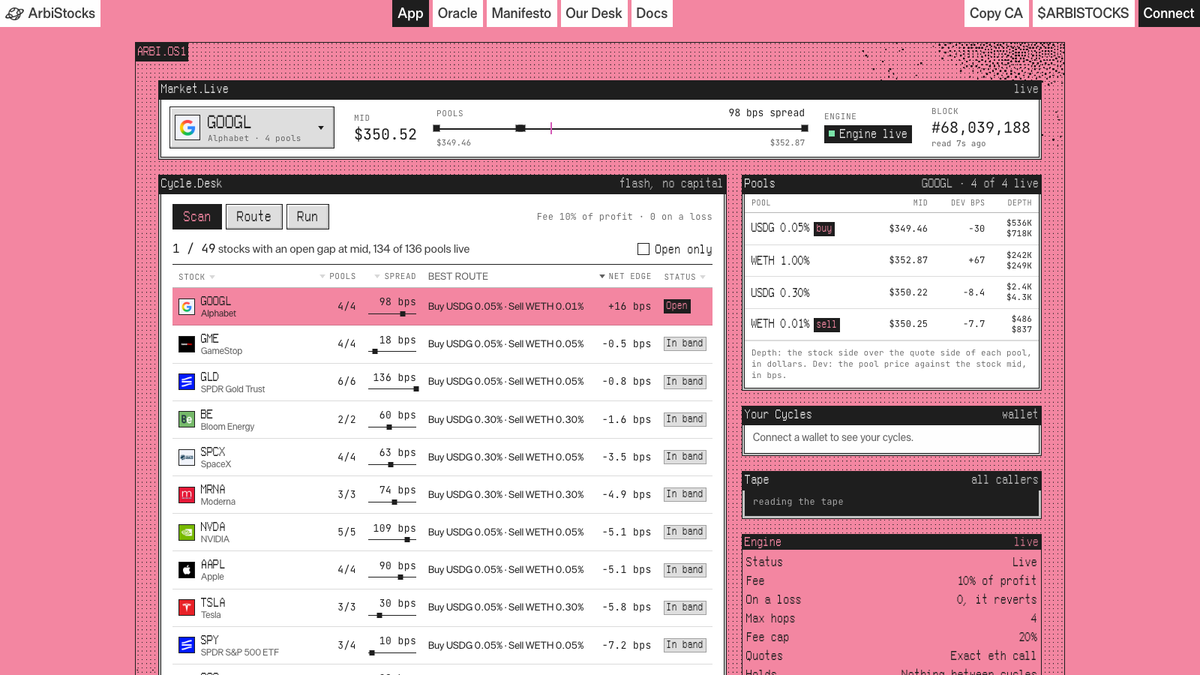
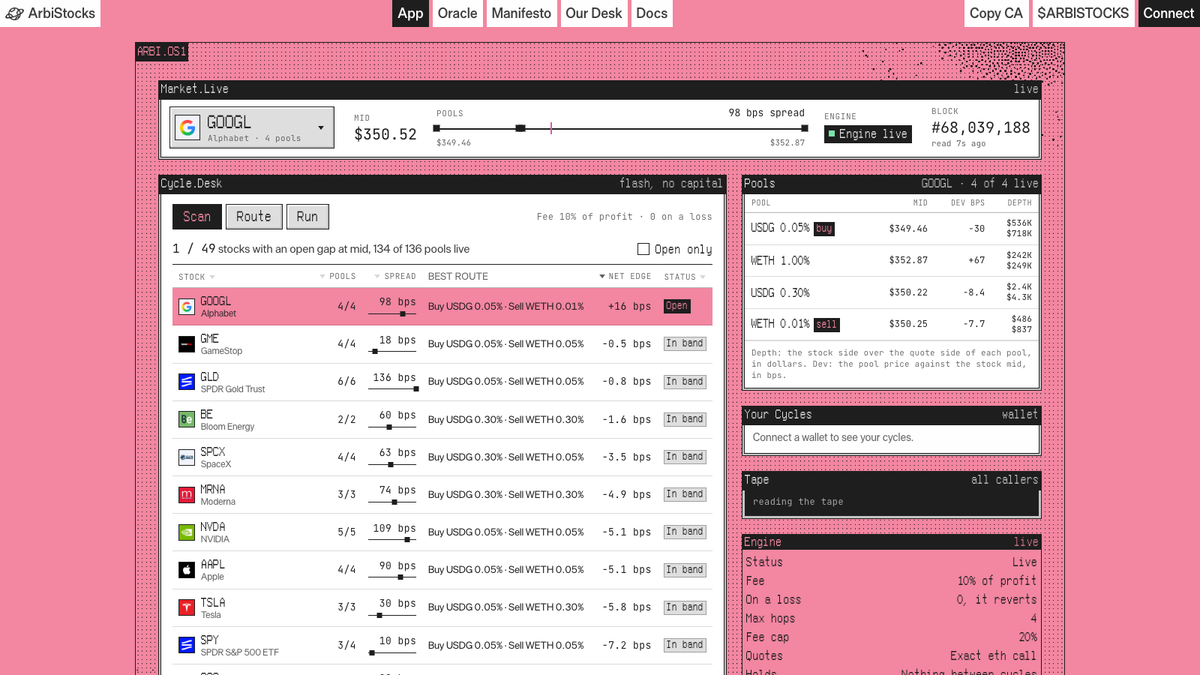
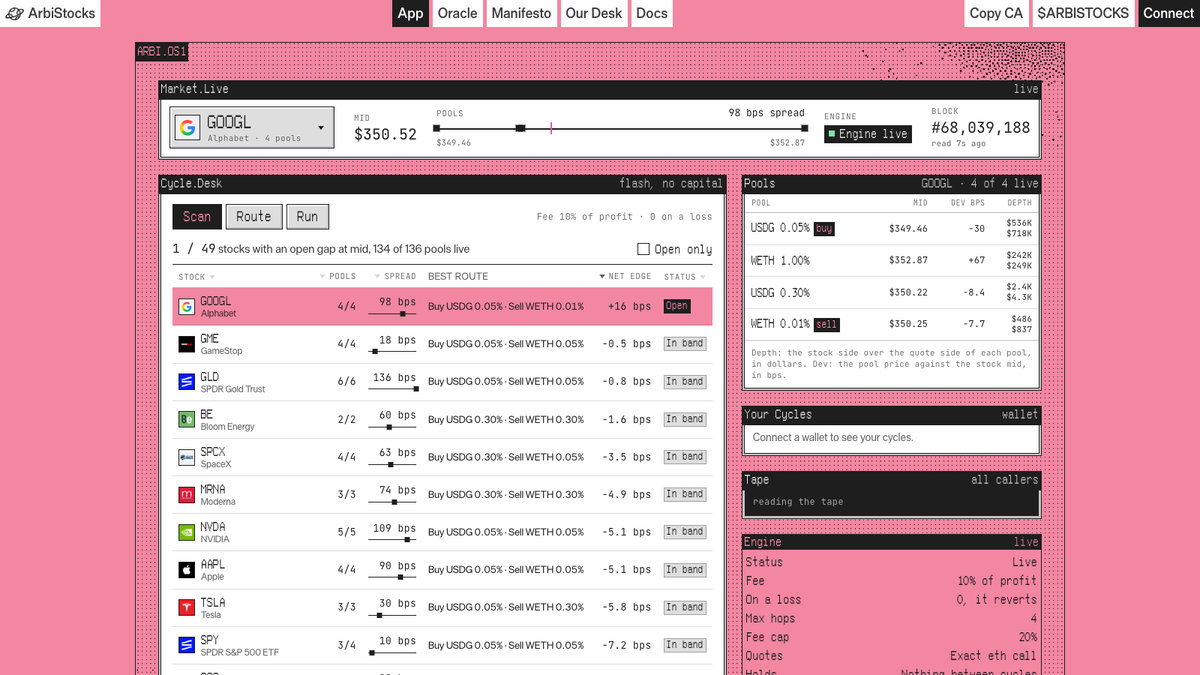
the board is 49 stocks across 136 pools, refreshing every few seconds. a model that writes prose cannot read that at the rate it changes, and you would not want to pay for it to try. a model that returns a score can sit in the scan loop and stay there all night.
what changes for you: fewer rows to look at, and the ones left have a reason to be there.
https://t.co/OdlIb5paj4
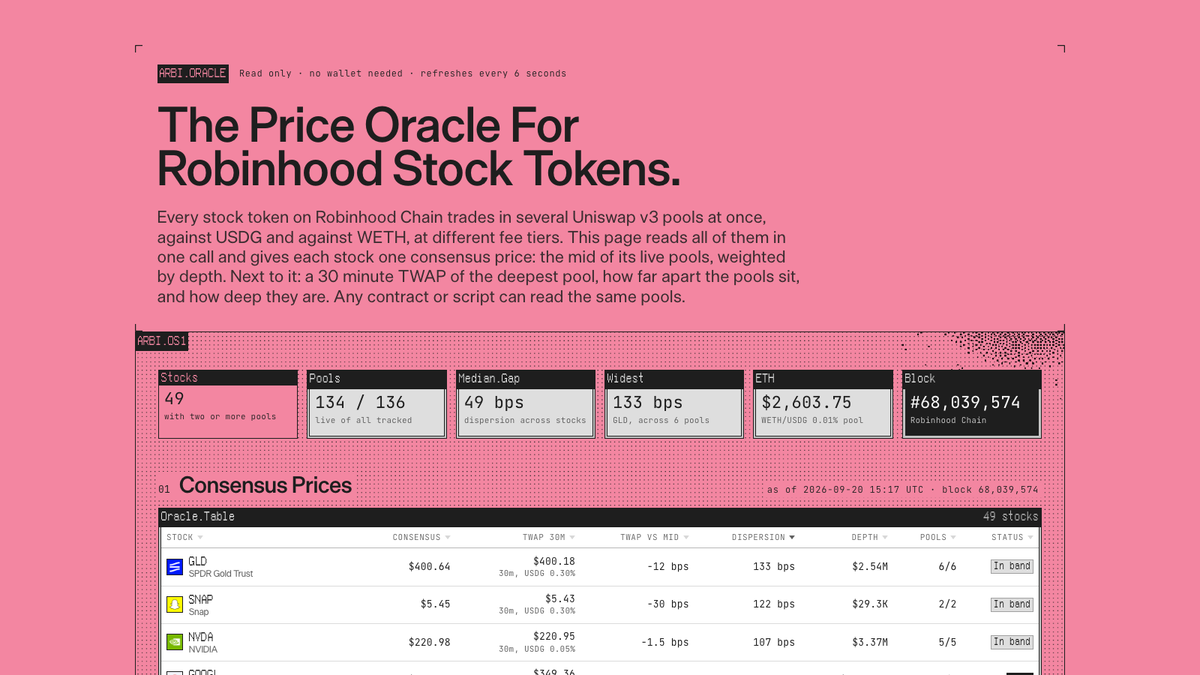
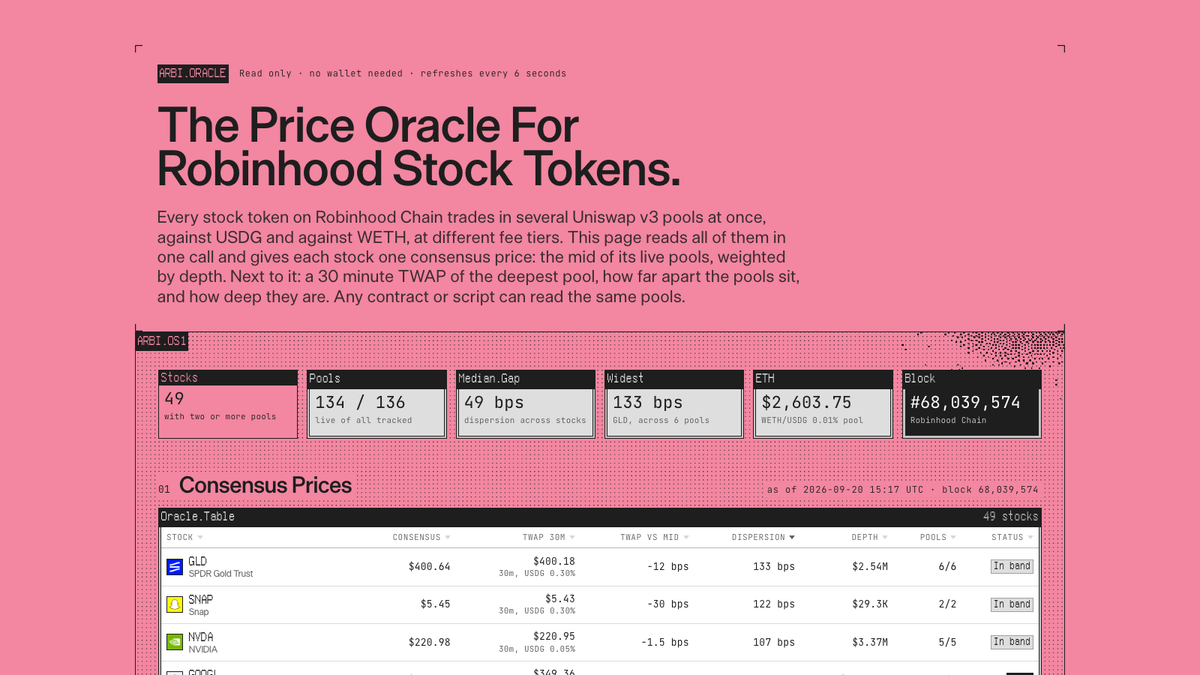
the scanner ranks what you could run right now. the oracle is for everything else: read only, no wallet, all 49 stocks including the ones with a single pool and no cycle, priced from the pools themselves. use it when you just need the price. https://t.co/sZ4cXLWt9J
how today's contracts were checked before they touched mainnet.
three independent reviews read the new code, each from a different angle: where funds could be lost or locked, who could bypass a guard, and what breaks on this chain against the real engine. every finding then went to a second reviewer whose job was to prove it wrong.
three defects survived that, all in the runner, all low severity, none able to move funds. it accepted itself as the recipient, which would have locked that profit. one gas-hungry candidate could starve the ones behind it. and a candidate that ran out of gas was reported as nothing paid. each is fixed and has a test that fails without the fix.
then the whole flow ran on a fork of mainnet against the engine that is already live and the real nvda pools: a gap opened, the runner skipped a losing route and closed it on the next, the desk closed another and booked the bounty, and the engine held nothing afterwards.
https://t.co/CJOc7kbXRg
https://t.co/wsYmsC0eWq
Jev was adopted faster than any other model in AI Gateway history.
In the first day, @typesafeai reached ~13% of teams, 2x the GPT-5.6 family and 6x Fable 5.1.
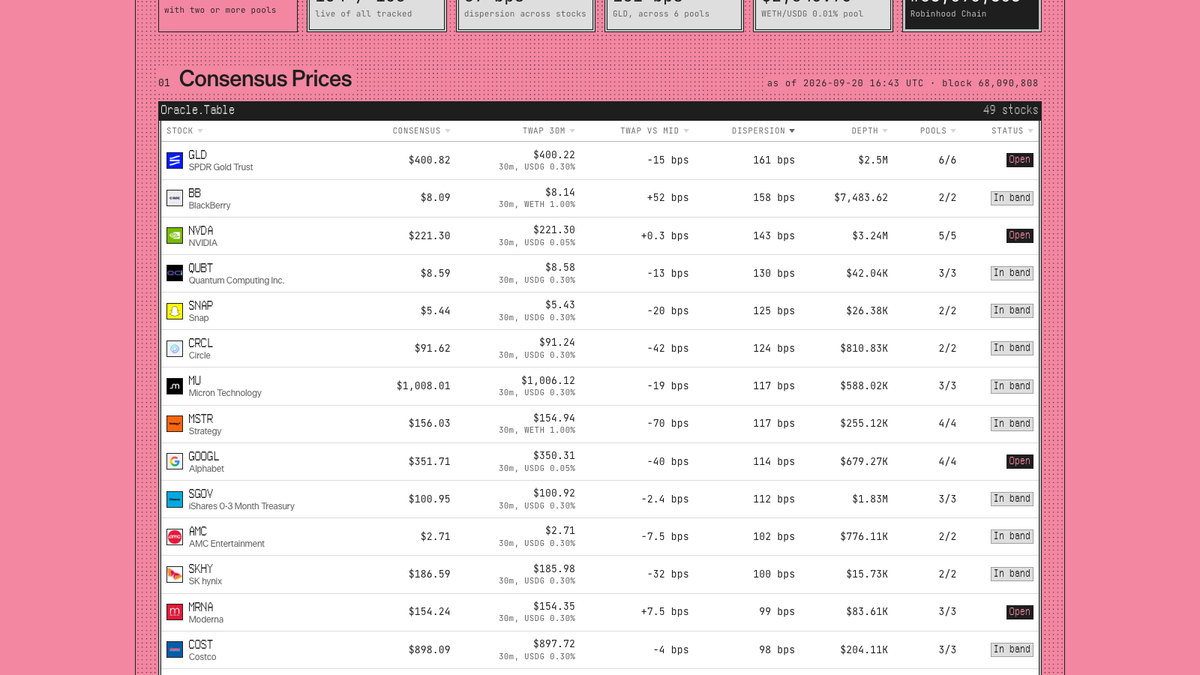
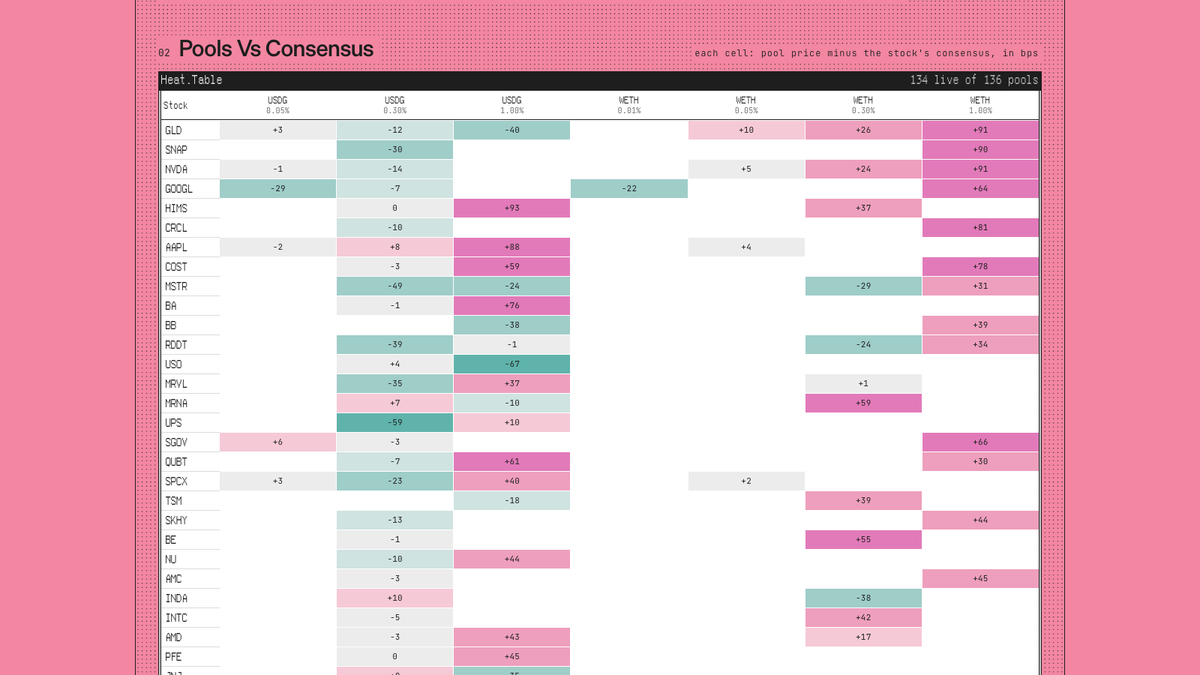
the consensus price is not one pool's quote. it is the mid of a stock's live pools weighted by depth, so a small pool off on its own moves it only as far as its size allows. sort the table on it, or on twap vs mid, dispersion, depth or pools. https://t.co/sZ4cXLWt9J
dispersion on the oracle is one stock's highest pool price over its lowest, in bps. the header keeps the median across every stock with more than one pool, and the widest one right now. it says where pools stopped agreeing, not what a cycle pays. https://t.co/sZ4cXLWt9J
a spot mid is whatever the last swap left behind. the oracle also carries a 30 minute twap of each stock's deepest pool, averaged from that pool's own tick history, so one large trade barely moves it. when twap and mid disagree, a pool got pushed. https://t.co/sZ4cXLWt9J
bps turn up all over the scan. one basis point is a hundredth of a percent, so ten bps on a thousand dollars of cycle size is a dollar before gas. status reads open or in band, and the open only filter hides the rest. https://t.co/bCrNWeivWi
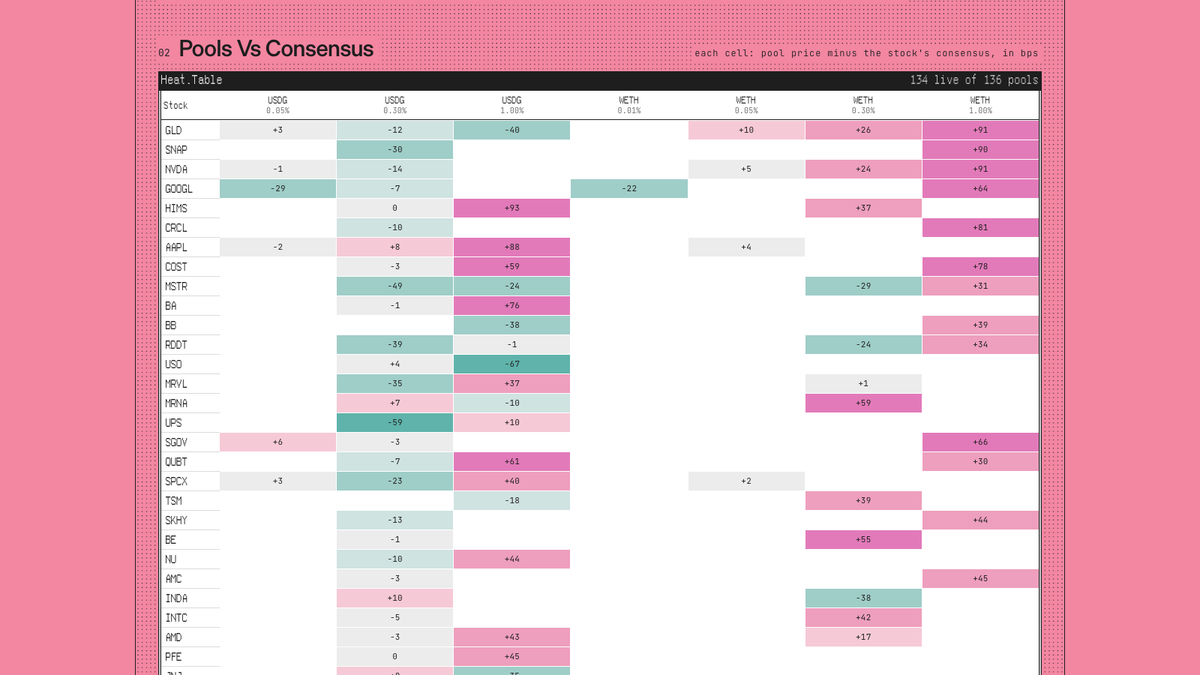
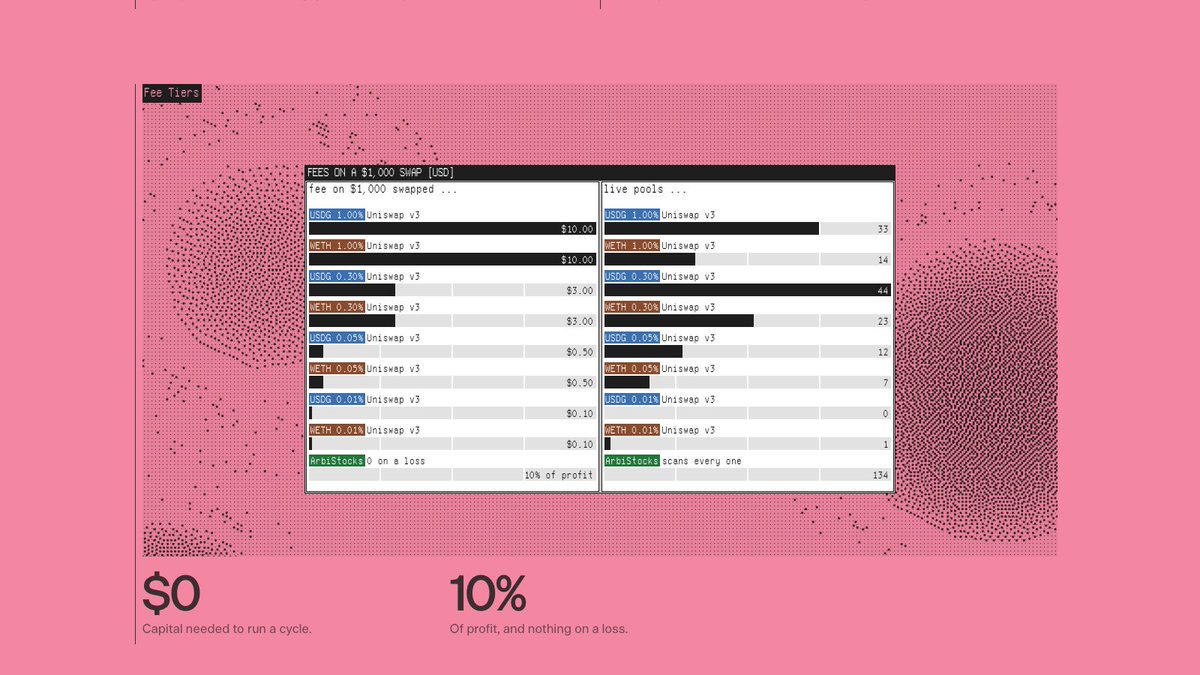
each pool charges a fee per swap, 0.01, 0.05, 0.30 or 1.00 percent, and one stock can trade in several tiers at once. the tiers see different flow, so their prices drift apart. a cycle has to clear every fee it touches. https://t.co/dbp9aAEJL1
usdg and weth are the quote assets here. a stock pool is priced against one or the other, so the same ticker can carry a dollar price in one pool and an eth price in another, and those two are under no obligation to agree. https://t.co/bCrNWej3LQ
a tokenised stock on robinhood chain is an erc20 that tracks one ticker. nvda, aapl, spy, gld and 45 more, 49 in all, trade in uniswap v3 pools on chain id 4663. same plumbing as any token, with a stock on the other side. https://t.co/dbp9aAFhAz
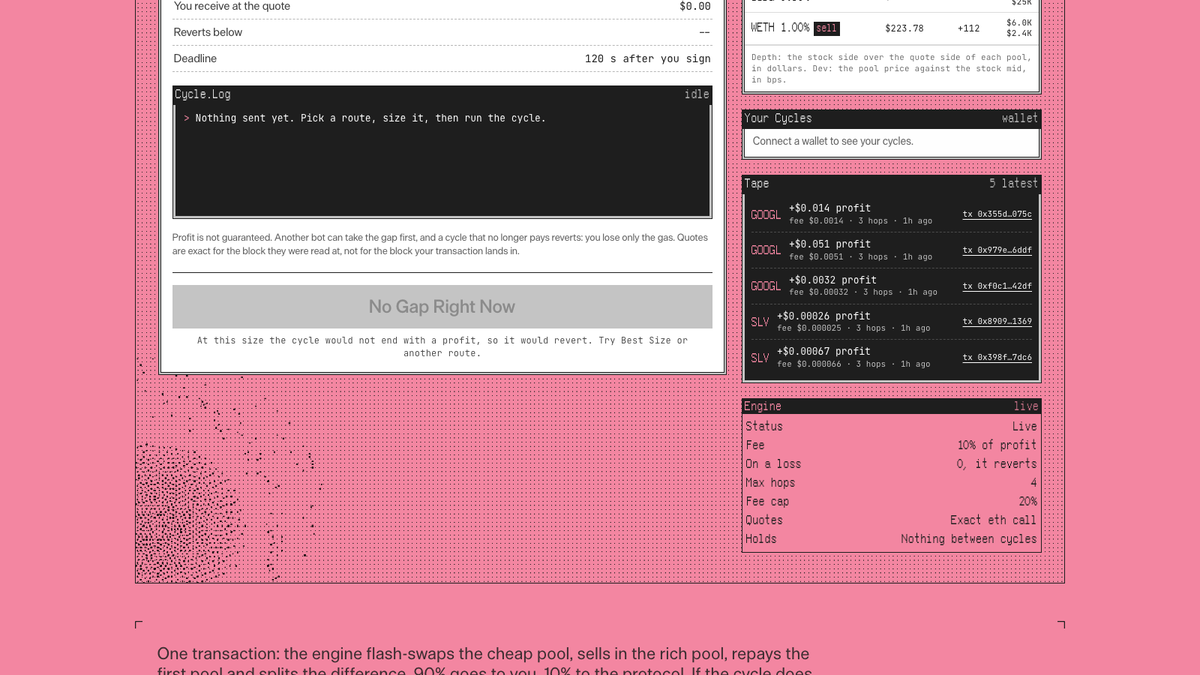
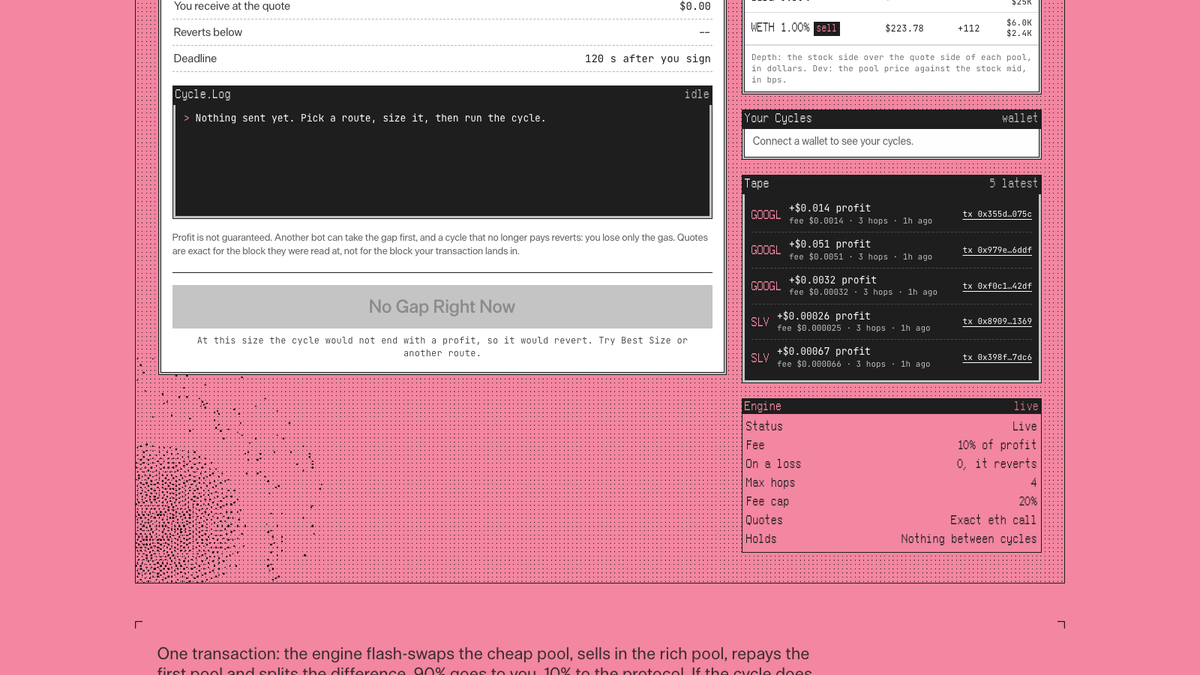
a failed attempt costs gas and nothing else. either the cycle clears its costs or the whole transaction reverts, so the worst case is a wasted fee on chain, not a position you have to unwind. filter the scan to open only and try one. https://t.co/bCrNWej3LQ
the protocol takes 10% of profit and you keep 90%. it is a share of profit, never of size, and the owner cannot push it past the 20% cap. no subscription, no allowance to grant, nothing of yours sits in the engine between calls. https://t.co/uX2yGB0p2y
changelog, september 21.
thanks to @typesafeai
two new contracts went live next to the arbistocks engine today. both are verified on sourcify, and both are built around the engine rather than in place of it: every cycle still goes through the same checks and still reverts if it does not pay.
arbirunner. hand it up to 16 candidate cycles, best first. it tries each one through the engine under its own gas cap and keeps the first that pays. routes go stale between the quote and the block you land in, so now the next best one is already queued behind it.
arbidesk. a desk that pays a bounty for work. keepers the owner allows run cycles through it, the desk books a share of each profit for whoever ran it and the rest for the owner, and each side withdraws its own.
also today: the docs cover both, the security page lists exactly what the desk's owner can and cannot do, and the site gained a check that stops a broken page from shipping.
https://t.co/KisuqDo5Fc
every hop pays its pool. a route through two 0.30% tiers gives up more than one through two 0.05% tiers, so the same gap can clear on one path and fail on another. the tiers on this chain are 0.01, 0.05, 0.30 and 1.00 percent. https://t.co/dbp9aAEJL1
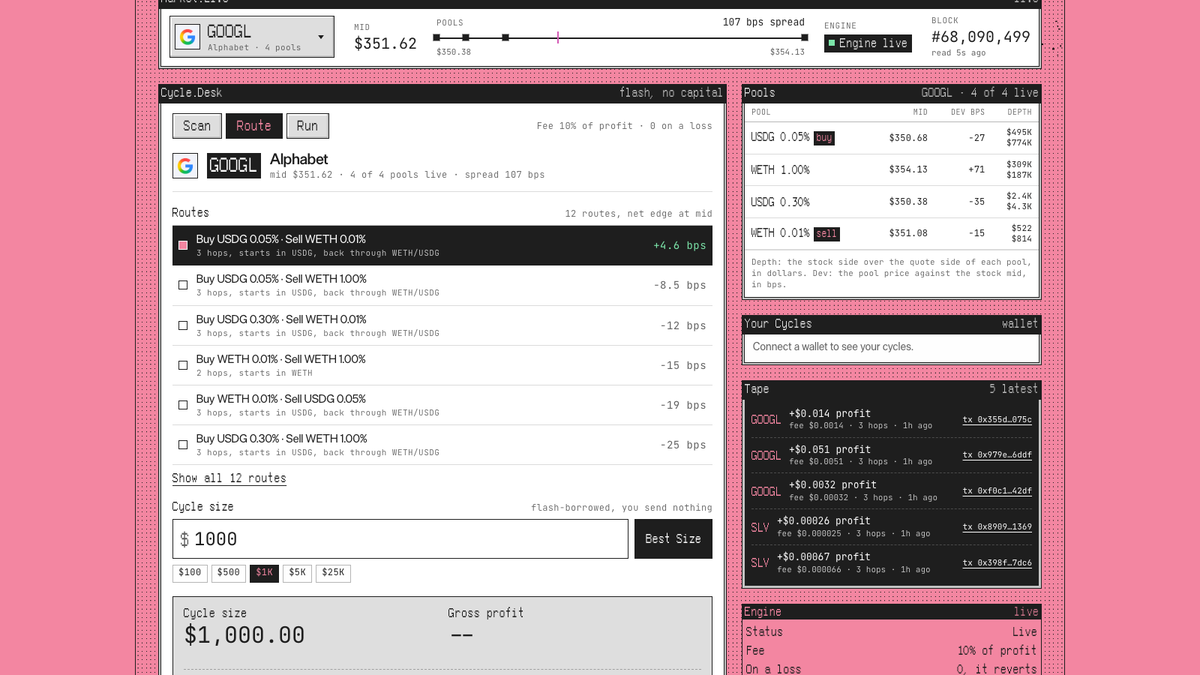
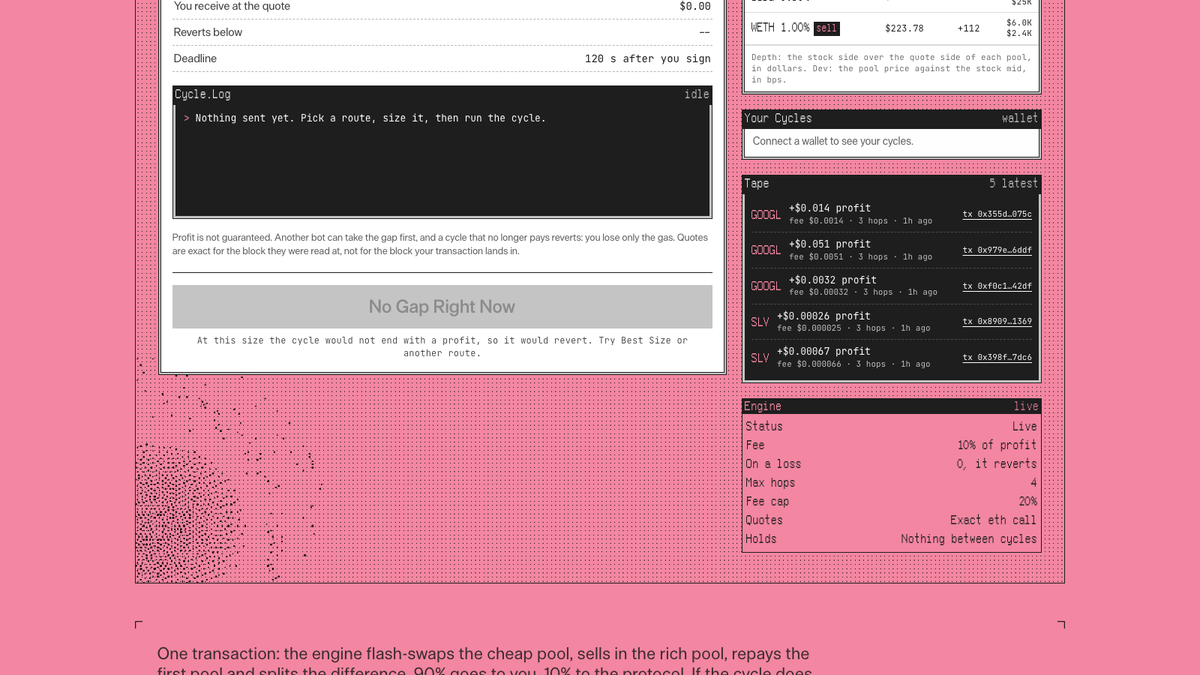
the run tab puts the whole money side in one place: you send, cycle size, gross profit, protocol fee, gas estimate, you receive, after gas. if after gas is not positive, leave it and read the next stock in the scan. https://t.co/bCrNWej3LQ
why bigger can pay less: each extra dollar climbs further up the curve, so best size stops where profit peaks rather than at the top of the grid. reverts below is the floor, under it the whole transaction fails instead of filling worse. https://t.co/dbp9aAFhAz
open the pools panel before you size anything. depth is listed on each side of the mid, not as one number. a wide spread on a pool with a shallow sell side is a mirage: your own cycle walks the price into the gap and closes it on the way in. https://t.co/bCrNWej3LQ
the heat table on the oracle page is 49 stocks by 7 columns, each pool against that stock consensus. a pool far from consensus is not automatically an edge. it can be thin, or simply the last one to move. deviation is a question, not an answer. https://t.co/sZ4cXLX0Zh
spread in bps is the gap between two pools. net edge is what is left of it after the pool fees on every hop. the scan sorts on net edge, not on spread, because a wide spread that dies inside the route was never an opportunity. https://t.co/bCrNWeivWi
the tape is the receipt. every settled cycle in the app links out to its transaction, so open one, follow the hops from pool to pool, and watch the split land: 90 percent of profit to the caller, 10 percent to the treasury. https://t.co/bCrNWeivWi