What if someone else had your dream?
The dream you had last night might have visited a stranger on the other side of the world too.
Archetype Matrix is chasing that question. An experimental project inspired by Jung's idea of the collective unconscious.
Discover your archetype. See where you connect.
Archetype Matrix
The Collective Unconscious Network
Android: https://t.co/6TPLTuqoli
iOS: https://t.co/0kj9EFUufD
Archetype Matrix: A Sample Dream
The Dream
I’m walking along the shore when the ground suddenly splits open, and a sun emerges from beneath it. But the sun is no bigger than a soccer ball. At that moment, the stars in the sky begin to shine even brighter. On the horizon, the letters O, S, and R appear.
Emotion:
Fear
Archetypes entered into the system:
Small Sun
Bright Stars
Split Earth
The Letter O
Archetypes don’t have to be single words. In Archetype Matrix, you can enter symbols using up to four words each.
Enter the symbols from your dream into Archetype Matrix. Discover whether the same archetypes and emotions appear in other people’s dreams, too.
Maybe someone else has dreamed your dream, too.
Archetype Matrix
The Collective Unconscious Network
Sometimes life seems to have a strange rhythm.
Good things 'or bad things' can start happening one after another. For a few days, it may feel like luck is on our side. Then, at another time, setbacks seem to follow each other. Viewed separately, these events may seem completely unrelated. But when they come together, they can feel like parts of a larger pattern.
But is there really a pattern?
Is it coincidence? Our mind’s tendency to search for connections? Or could there be something we haven’t noticed yet?
Archetype Matrix is an experimental space designed to collect these experiences and observe the patterns that emerge over time.
We record emotions and archetypal words, then look beyond individual experiences to see what happens at a collective level.
Let the data speak.
"İnsanın yozlaşmasını dilin yozlaşması takip eder."
"Yeni imgelerin yaratılması son bulur ve eski kelimeler, olmadıkları şeylerin tanımları için kullanılarak bozulmaya uğratılır."
Çok geçmeden bu aldatmaca kendini gösterir, kelimeler anlamayı ve duygulanmayı tetikleme güçlerini yitirir."
— Ralph Waldo Emerson | Doğa
Congenitally blind people have reported dreams featuring a snake, an old woman, or the sensation of being bitten. And these dreams aren't experienced through images, but through sound, touch, and emotion.
According to Carl Gustav Jung, archetypes are shared, universal structures rooted in the collective unconscious.
So how does a mind that has never seen recognize these symbols? Are archetypes passed down not through the eyes, but through the very experience of being human?
That curiosity is exactly what lies behind Archetype Matrix.
Whoever we are, could our minds be speaking a shared language deep down?
Новолуние, полнолуние… а что с нами происходит в эти дни?
Мы посмотрели записи 186 человек в Archetype Matrix и разделили лунный цикл на четыре четверти. Вот какие архетипы и эмоции заметно чаще появляются в каждой из них:
Новолуние: Олив (2,5×), на поверхность выходит страх
Первая четверть: Священник (3,4×), выделяется трепет
Полнолуние: Болото (4,0×), снова трепет
Последняя четверть: Черная змея (2,8×), чаще всего грусть
Самый сильный сигнал дает полнолуние. Болото записывают в четыре раза чаще среднего, будто в эти ночи нас тянет вглубь, в застоявшиеся чувства.
А как проходит полнолуние у вас?
#архетипы #юнг #луна #полнолуние #эмоции #самопознание
The network of the collective unconscious.
Archetypes, emotions and synchronicities written every day by people around the world come together in one place.
Archetype Matrix
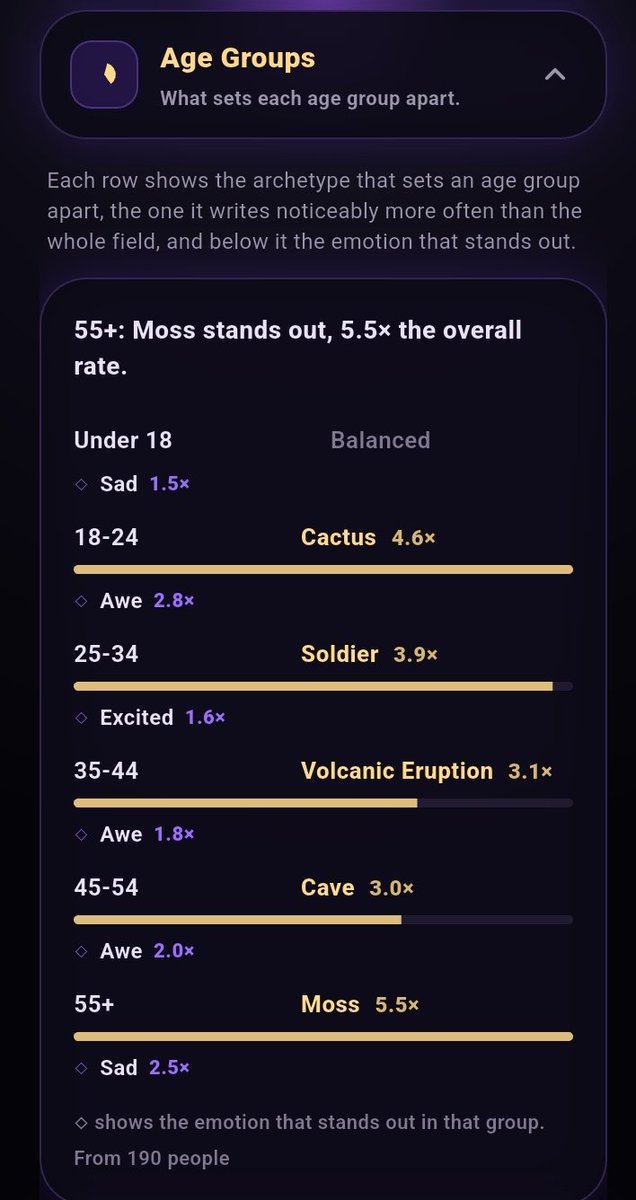
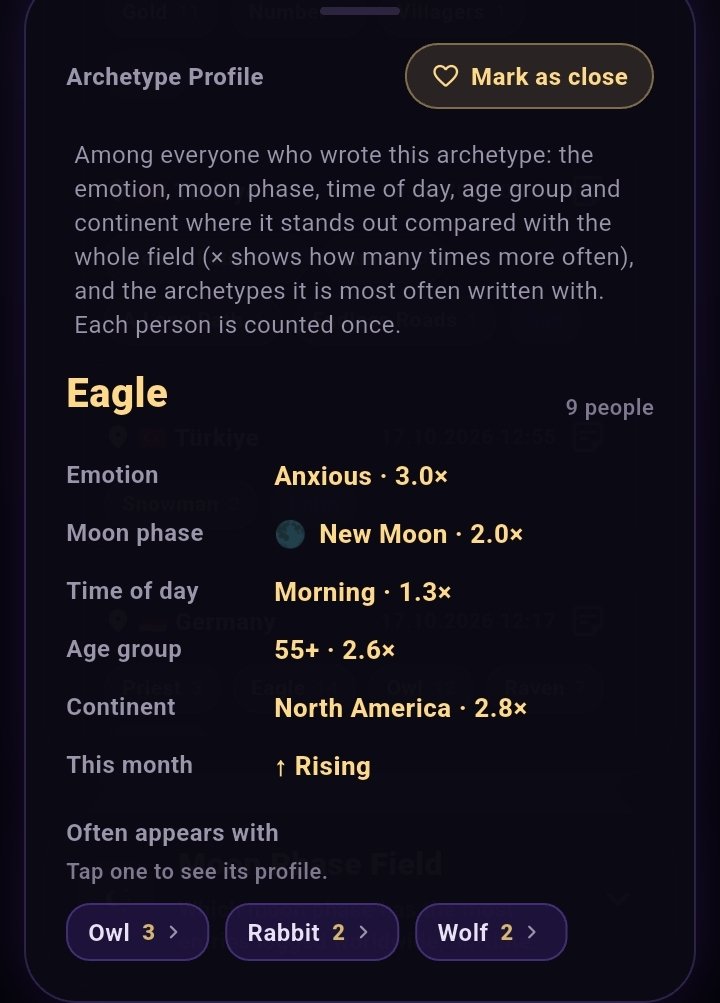
Pick an archetype and see how the collective lives it. Snake shows up most in angry afternoons, among 18 to 24 year olds. The data is just starting to grow, so add your own dreams and watch it change.
Early patterns in Archetype Matrix
Shadow writers log "tired" 3.5× more often.
Mirror goes with happy. Money with angry.
Small sample so far, but it's getting interesting. Which archetype feels like you right now?
@89_sims It's not really symbol to symbol. The emotions are what people actually felt that day.
Jung was always interested in how the images we're drawn to connect to what we're going through, that's kind of the whole idea.
I think there may have been a misunderstanding. Our main focus isn't dreams or dream interpretation. Drawing on Carl Gustav Jung's theory of the collective unconscious, we're trying to turn the archetypes and emotions people report into meaningful statistical data.
We don't interpret dreams. Dreams are just one of the places where archetypal images can appear. These images also show up in myths, stories, art, and our everyday thoughts. Even the first image that comes to mind can be connected to an archetype.
Our goal isn't to interpret. It's to explore whether shared patterns emerge in this data over time.
The same dreams surface again and again across the ages, each time wearing a different name.
In Goethe's Faust, the human soul strikes its bargain with darkness. Jung reads that bargain anew in the language of the unconscious and pours his own inner journey into the Liber Novus. The same archetypes have wandered through the centuries in different guises, because we all draw from the same collective unconscious.
Archetype Matrix was born from that idea: an app that brings to life the notion of meaningful coincidences coming together. Every day, the mood and archetype you log merge with data from people all over the world, forming a shared pattern. No one interprets it for you, and no one speaks on your behalf. Only the numbers speak, and sometimes what they say feels eerily familiar.
📱 Android: https://t.co/6TPLTuqoli
🍎 iOS: https://t.co/0kj9EFUufD
Active imagination is a method of psychological exploration developed by Carl Jung. At its core, it's the conscious mind deliberately engaging with images, emotions, or figures that arise from the unconscious.
For Jung, the unconscious isn't just repressed thoughts. It shows itself in dreams, fantasies, symbols, and images that appear spontaneously.
Here's how it works: in a calm state, a person follows an image that arises in the mind, without forcing it. A forest appears. A door stands in the forest. Behind the door, an old man waits. The person begins speaking with this figure mentally, observing what it says and what they themselves feel.
The key point is that the story isn't consciously invented. The image is allowed to find its own direction.
Jung's goal was to open a dialogue between the unconscious and the conscious mind, helping a person move toward individuation, toward psychological wholeness.
Active imagination is not dream interpretation. Instead of assigning a symbol a fixed meaning, it observes what that symbol evokes in the mind and how it unfolds on its own.
What's striking is this: a person lets the image emerge without forcing it into a predetermined meaning. No ready-made interpretation. The process is left to find its own course.