Very sad to learn that Mona Khalil died after weeks in the ICU following an Israeli strike that levelled her home in Mansouri. She was a very well-known environmental activist and dedicated her life to saving endangered turtles. She stayed in the south despite Israeli strikes because of her love for the land.
She was a civilian, a renowned figure but Israel targeted her house.
CNN profiled her in 2017 here: https://t.co/ZaMRnuS4zf
“I live every day to the fullest and don’t worry about tomorrow,” she told the newspaper.
🚨BREAKING: Israel has just bombed Jabal Amel Hospital in South Lebanon – COMPLETELY destroying 3 apartment blocks full of INNOCENT civilians.
We CANNOT allow Israel's barbarism to be normalised.
END wepaon sales to Israel now @Keir_Starmer
🚨🇮🇱 NEW: President Trump reportedly told Benjamin Netanyahu that he was “fucking crazy” and that “everybody hates Israel because of [the Lebanon bombing]” during a recent phone call
[@Axios]
I recently spoke with @RaniaKhalek on BreakThrough News about the history of anticolonial resistance and the left in Lebanon, US and Israeli policy in the country, and how the the state's sectarian regime reproduces inequality and thus internationalized civil war.
BREAKING: An Israeli air attack that targeted the town of Shaqra in southern Lebanon has killed at least five people and wounded two others, according to Lebanese media.
🔴 LIVE updates: https://t.co/y5oXjpvdZm
Israel has just killed Lebanese journalist Fatima Ftouni. I am honoured to have known her.
Just at the beginning of the month she reported on Israel killing seven members of her own family live on air.
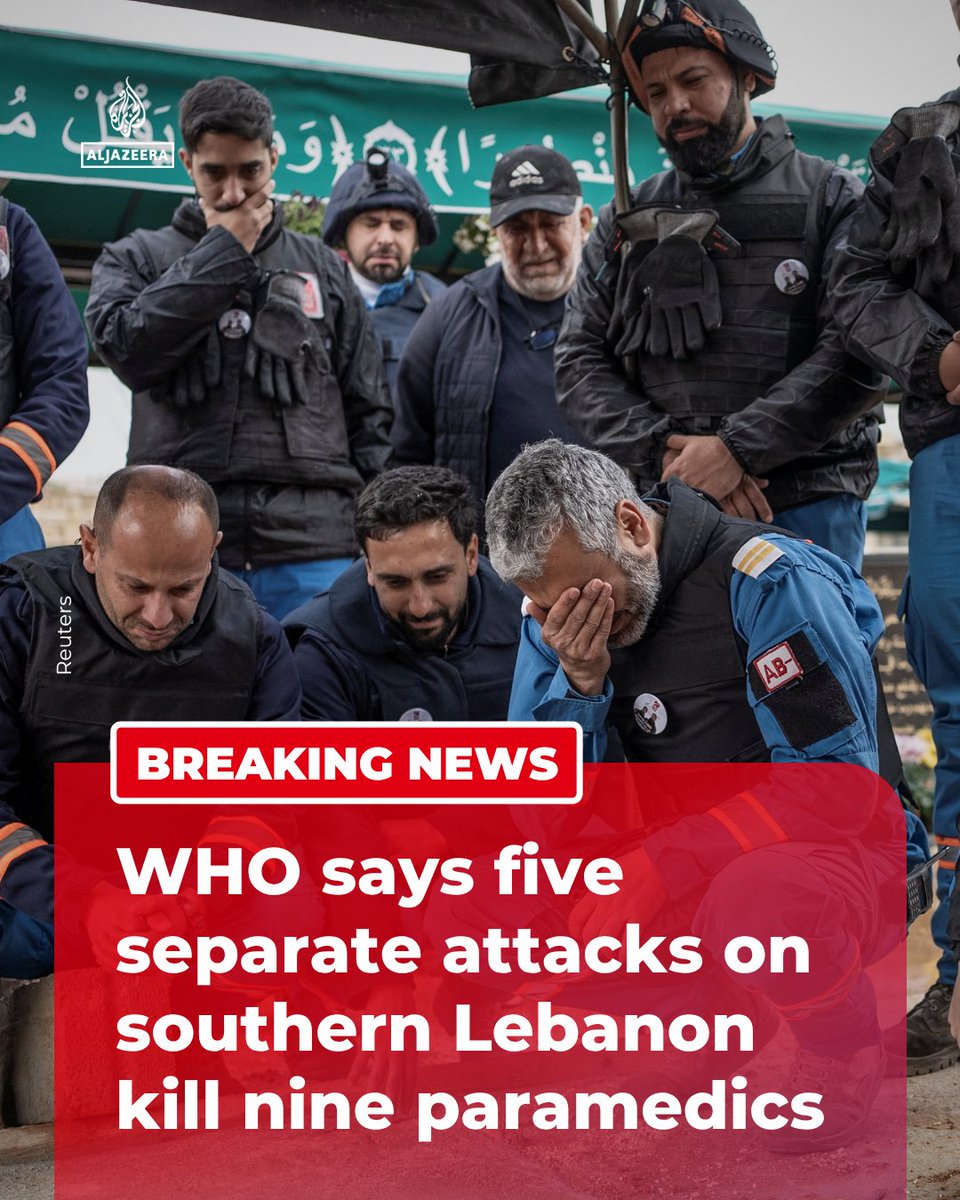
BREAKING: The World Health Organization (WHO) says nine paramedics have been killed and seven others wounded in five separate attacks on healthcare in southern Lebanon.
🔴 LIVE updates: https://t.co/4Vxv8D0LKa
BREAKING: Three people have been killed, including two journalists, after an Israeli strike on a media car in southern Lebanon.
The Israeli military have said those killed worked for Hezbollah affiliated channels.
Live updates: https://t.co/Oh9HezhzAS
Here's what a few hours in the life of Lebanon's National Lifeline for Suicide Prevention (1564) sound like during #war time:
- A 23-year-old displaced mother from South Lebanon (Khyem) calling from inside a car in Saida (now known as the transit city) - where she is living with her 3 young children because shelters are full.
- An 88-year-old man displaced from Southern #Beirut calling to ask for basic assistance
- A young man calling from Southern Beirut, currently under attack, calling because he and his mother had nowhere safe to go.
- Another caller described feeling “مخنوق” — suffocated by the density, the noise, the uncertainty created by war.
And in the middle of all of this:
- A 16-year-old girl who attempted suicide
- A 23-year-old struggling with addiction after a suicide attempt yesterday
- A mother with cancer caring for a child with epilepsy while seeking help for her suicidal daughter
- A man who was about to end his life with shattered glass before picking up the phone
This is the daily reality of answering Lebanon’s National Lifeline (1564), where every call reflects the collision of our crises: war, displacement, poverty, chronic illness, addiction, and the silent toll on mental health.
In contexts like #Lebanon, a crisis hotline is much more than an emotional support line. It becomes a first point of access to the entire health and social protection system.
In a single shift today, our team provided:
- suicide intervention and safety planning
- emotional support during acute distress
- referrals for psychiatric care and medication
- shelter and humanitarian assistance referrals
- support for displaced families
- guidance for parents responding to suicide attempts
- connection to emergency services and NGOs
Behind each call is a trained responder, a volunteer, holding space for someone who may have nowhere else to turn, while silently living many of the same struggles themselves.
In times of war, mental health emergencies do not pause. They multiply, and set the stage for the long term psychological consequences that follow conflict.
Lebanon’s National Lifeline continues to operate 24/7, responding to hundreds of calls each month from people facing the most difficult moments of their lives.
Every call our volunteers answer, is a proof of why this Lifeline is essential to our national infrastructure, and must be protected and sustained.