Stop renting your players to ad networks.
The invisible stablecoin rail bringing instant, compliant micro-stakes competitions to casual games.
Boarding soon
The ad model was supposed to monetize 2B casual players and captured 40M.
The gap is a structural one. Competitive attention has had economic value — the infrastructure to capture it didn’t exist.
Skill-based cash competition is the missing layer: opt-in, verifiably fair, legal in most jurisdictions. Web2 proved the demand before the rails existed to support it.
Arka is that layer — turning casual play into real-stakes competition, no crypto knowledge required for players, stablecoin settlement in the background, and a rev-share model built around the players ads couldn't reach.
#skillgaming #stablecoin
Always-on settlement going live changes the math for any product where payout speed is the trust layer.
Skill competitions need instant escrow and instant release, not T+1.
Circle Current Session Recap: Always-On Settlement Rewrites the Bank Operating Model
Circle Current is a series from Circle that brings together industry leaders to explore what’s next in the internet financial system.
Always-on settlement is moving from pilot to production, with stablecoin rails giving banks a practical path to move funds 24/7.
What’s changing:
→ Settlement is moving beyond banking hours
→ Liquidity can move with less delay
→ Prefunding requirements can start to shrink
→ Treasury and operations teams need to adapt to continuous money movement
Visa’s rollout shows this is no longer an edge case. For banks, the shift is bigger than faster payments. It is an operating model change.
Read the blog for more details: https://t.co/3pgL68AMcv
@circle Good to see euro-denominated stablecoins getting real distribution. Growth is the easy part. The harder signal is whether wallets stay active after onboarding incentives dry up.
The rails are finally getting legitimized, and it’s time to about the consumer-side use case that actually drives volume.
Competitive attention is the distribution layer programmable money has been waiting for.
Today’s compromise on stablecoin yield marks meaningful progress in the CLARITY Act negotiations. Regulated payment stablecoins are accelerating global economic activity, strengthening both the digital asset and banking sectors, and unlocking dramatic new utility and velocity through the advent of programmable and natively digital money.
As USDC has demonstrated, these instruments are scaling rapidly across domestic and global markets—powering cross-border payments, serving as a reliable store of value, enabling collateral mobility in capital markets, and supporting emerging models like agentic commerce. The GENIUS Act was a critical milestone in advancing institutional adoption of dollar-denominated payment stablecoins, and the CLARITY Act represents the next step in modernizing U.S. financial market infrastructure for a digital, global economy.
We support today’s bipartisan compromise and commend policymakers for advancing a pragmatic, pro-innovation framework. We look forward to working with Congress to move this legislation forward.
The United States faces a clear choice in digital assets: lead or be led. Today’s progress is an encouraging signal that the U.S. is choosing to lead.
Introducing the new Stripe Treasury:
• Hold funds in multiple currencies and stablecoins.
• Instantly transfer money to US businesses on Stripe for free.
• Pay anyone in 160 countries with just their email address.
• Earn credits on balances to apply towards Stripe fees.
• Spend funds with a Stripe card.
• Get 2% cash back on card purchases.
• View balances in the Stripe mobile app.
• Use Treasury from any AI app with the Stripe MCP.
Stablecoin infrastructure efficiency creates real space for consumer applications.
Great opportunity to build sustained competitive attention through skill-based plays.
We’re unlocking stablecoin payments around the world.
Nium operates in 190+ countries. All their customers can fund payouts in USDC and settle to their local currencies, with no wire delays.
We're excited to see @NiumGlobal integrate @Coinbase's stablecoin payment infrastructure, enabling their customers to fund cross-border payouts in USDC and settle in local fiat across Nium’s global network of 190+ countries.
No prefunding. No wire delays. Stablecoin payment infrastructure runs entirely behind the scenes. 🧵
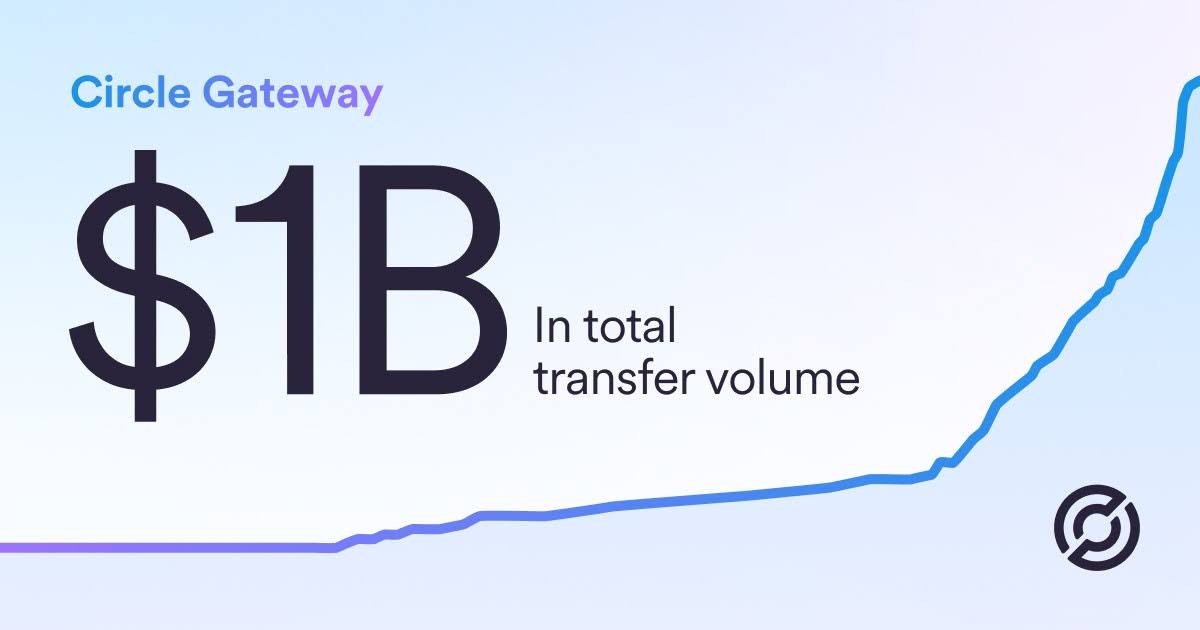
Circle Gateway has surpassed $1B in total transfer volume.
As more builders and businesses operate across chains, unified liquidity is becoming a bigger part of how value moves.
@BSCNews@circle Automated USDC payouts with reduced complexity is exactly the kind of infrastructure needed to make stablecoin settlement practical at scale.
Casual gaming lives on microtransactions, but traditional card rails make small purchases almost impossible.
Credit card fees of 1.5–3.5% turn a $1 item into an unprofitable transaction for studios.
To work around this, most games force players to buy $10 or $20 bundles of in-game currency first.
#stablecoins #payments #fintech
The result is frustrating for everyone.
Players lose transparency when they can’t simply buy what they want. Studios face delayed settlements and players drop off when cards expire or payments fail.
The whole system is clunky and opaque.
But with stablecoin supply hitting a record $315B in Q1 2026 and USDC continuing to grow, these problems are becoming solvable.
USDC escrow lets casual matches become skill-based competitions with instant T+0 payouts and programmable rev-share. No bundling, no delays. Invisible wallets and fiat on-ramps handle the rest for players who have no specific knowledge.
Gaming is the beginning. The bigger thesis is turning billions of daily casual sessions into real economic activity.
First notable split between USDC and USDT since 2022. Most of this shift comes from everyday money movement. Regulated, transparent stablecoins are winning the settlement layer.
LATEST: 📊 CEX.IO says stablecoin supply hit a record $315 billion in Q1 2026, with USDC rising $2 billion while USDT fell $3 billion, marking the first major split between the two since 2022.