There is something fascinating about nuclear power.
A relatively small power station can supply electricity around the clock for decades, without burning mountains of coal or gas.
Once fuel is loaded, it can run for years before replacement. Yet for all that efficiency, nuclear energy leaves behind a problem that has helped hold back its expansion,
What do we do with the fuel afterwards?
What makes this stranger is that the fuel is not actually exhausted. After roughly three to six years inside a conventional reactor, around 95% of it is still uranium.
But most of that is uranium-238, which the reactor cannot readily split. The smaller supply of readily fissionable uranium-235 has dwindled, while products that absorb neutrons have built up.
Engineers can keep the reactor producing steady heat by adjusting its controls, but eventually the fuel has to come out. Keeping it longer is possible with better fuel designs, it is not as simple as leaving it there for another decade.
And then comes the difficult part.
Removed fuel is still hot from radioactive decay and spends years cooling underwater. France has built an industry around recovering uranium and plutonium for further use, with some plutonium made into fresh fuel.
What remains as high-level waste can be immobilized in glass. But neither method makes radioactivity disappear. Some isotopes remain relevant to disposal safety for tens of thousands of years, or longer.
So how do you contain something for longer than any structure we have ever maintained?
Finland's answer is to stop depending on maintenance. Its Onkalo repository is designed to place spent fuel about 430 metres underground, inside copper and iron canisters surrounded by swelling clay and bedrock.
If one barrier eventually deteriorates, the others are meant to slow the movement of water and radioactive material.
For all that nuclear power has to offer, managing its radioactive waste remains one of the biggest hurdles to its wider adoption.
Mate, do you even realise how far-fetched this is?
SINGULUS has just 325 employees and €83M in projected annual revenue.
Its first SpaceX production line, due in 2027, will produce just a few hundred MW annually.
Getting to 100 GW means scaling that capacity by several hundred times.
They might not even get anywhere near that by 2030.
This is industrial fantasy
For decades, anti-tank mines were relatively simple weapons.
Bury an explosive beneath the ground and wait for a heavy vehicle to drive over it. But Russian engineers developed something considerably more sophisticated a mine that can detect an approaching tank, identify it, and attack it from above without ever being touched.
Meet the PTKM-1R, a Russian top-attack anti-tank mine reportedly costing more than $20,000 per unit.
Unlike conventional pressure-activated mines, it carries four acoustic sensors and two seismic sensors that listen for approaching vehicles and detect their ground vibrations, with a claimed detection range of around 100 metres.
And identifying the target is only the beginning.
Once an appropriate target enters its engagement range, the mine launches an autonomous submunition into the air.
Using infrared and radar sensors, the projectile searches for the vehicle below before detonating an explosive charge that forms and accelerates a metal penetrator downward. It can penetrate at least 70 millimetres of armor, exploiting the relatively thin protection on a tank's roof.
The PTKM-1R has been deployed in the Russia-Ukraine war, although its actual battlefield success rate remains publicly unverified.
But consider the economics. A mine costing approximately $20,000 could potentially disable a tank worth $5 million, an illustrative 250:1 difference in equipment value, provided the attack succeeds.
What fascinates me is how far military engineering has evolved.
A weapon once designed to wait passively beneath the ground now incorporates advanced sensors, signal processing, target recognition and autonomous attack capabilities.
The sophistication is extraordinary. But the real question is whether all that engineering delivers enough battlefield effectiveness to justify its cost.
Why do nations target the engineers behind their rivals' most advanced technologies?
- Under Hitler's wartime regime, Nazi Germany developed the V-2, the world's first operational long-range liquid-fuel ballistic missile. Its engine consumed 130 kilograms of propellant every second.
- Turbopumps forced fuel and liquid oxygen into a combustion chamber reaching 2,700°C. Extreme pressures, violent vibrations and thermal stresses had to be controlled simultaneously.
- Modern high-performance engines are even more demanding. Cryogenic propellants, precision valves, specialised alloys and intricate cooling systems must work together. One critical defect can destroy an entire rocket.
- Building an engine is only half the challenge. Perfecting its efficiency, reducing weight and achieving consistent reliability demand years of experimentation. Every failed test consumes money, materials and engineering time.
- America's Saturn V F-1 engine illustrates this. Despite understanding the physics, engineers conducted roughly 3,200 full scale tests to overcome destructive combustion instability.
- When Nazi Germany collapsed in 1945, the Americans shipped components for roughly 100 V-2 rockets home and recruited German engineers. The Soviets also acquired machinery, technical documentation and specialists. France recruited German rocket engineers too.
- The knowledge spread further. In the 1950s, the Soviets supplied China with missiles, rocket engine technology, blueprints and technical experts. India later benefited from French liquid engine technology. Both subsequently developed advanced capabilities of their own.
- This is why engineers and scientists become prime targets for industrial espionage. Chinese intelligence officer Yanjun Xu targeted aerospace specialists through paid technical presentations, seeking proprietary engineering knowledge from companies including GE Aviation.
- The real prize is often knowledge that drawings cannot convey failed experiments, manufacturing processes and the engineering judgment accumulated over decades. Acquiring it can shorten an otherwise enormously expensive development journey.
A century after the first liquid-fuel rocket, only 12 countries have ever demonstrated independent orbital-launch capability.
Understanding the physics is one thing. Mastering the technology, reproducing it reliably and developing what comes next is another.
That hard won human expertise is precisely what makes the people behind strategic technologies so valuable.
In September 1916, Britain introduced a machine that would fundamentally change warfare.
The tank.
Built to cross trenches, survive machine gun fire and break through fortified positions, it gave armies something they desperately needed, protected mobility.
For the next 110 years, increasingly sophisticated weapons would be developed specifically to destroy it.
And repeatedly, the tank's future would be questioned. Yet the machine kept returning, transformed by the very weapons designed to eliminate it.
> The first British Mark I tanks could barely reach 6 km/h.
> They frequently broke down, became stuck and struggled across difficult terrain.
> Yet they brought armoured firepower into positions infantry could scarcely cross.
> By 1917, hundreds were being deployed in major offensives.
> Germany responded with armor piercing ammunition and dedicated anti tank rifles.
> The century-long contest between armor and the weapons designed to defeat it had begun.
Then came World War II, and the weapons hunting tanks became considerably more dangerous.
> High-velocity anti-tank guns could penetrate thick armor.
> Minefields could immobilize entire armored formations.
> Germany introduced the Panzerfaust, giving infantry a cheap, portable weapon capable of threatening tanks.
> America developed the bazooka, using shaped charges to penetrate armor.
> A soldier carrying a relatively inexpensive launcher could now threaten a machine costing vastly more.
> Yet tanks evolved with sloped armor, stronger guns, better engines and improved mobility.
> They remained central to mechanized warfare.
But the greatest crisis of confidence was still to come.
> In October 1973, Israeli tanks advanced against Egyptian defenses during the Yom Kippur War.
> Egyptian infantry carried Soviet Sagger guided missiles, RPGs and other anti-tank weapons.
> During one disastrous counterattack, Israel's 162nd Armored Division lost 83 of its 183 tanks.
> Relatively small weapons, operating within prepared defenses, had devastated a formidable armored force.
> Military commentators began questioning whether guided missiles had made tanks obsolete.
> In 1977, The Washington Post published an article titled Army Leaders Betting Billions That Tanks Aren't Obsolete.
> Yet armies were already investing heavily in a new generation of armored vehicles.
And what followed was an extraordinary transformation in tank engineering.
> Conventional steel gave way to increasingly sophisticated composite armor.
> Explosive reactive armor offered additional protection against shaped-charge weapons.
> Powerful engines allowed some tanks weighing over 60 tonnes to approach 70 km/h on roads.
> Stabilised guns, laser rangefinders and computerised fire control transformed their accuracy.
> Thermal imagers made night fighting far more effective.
> The Abrams, Leopard 2 and Challenger emerged as formidable modern combat systems.
> In 1991, coalition tanks demonstrated their effectiveness during the Gulf War
> Less than two decades after the missile shock of 1973, armored warfare remained extraordinarily relevant.
But anti-tank weapons were evolving too.
> Guided missiles became more accurate, portable and capable of attacking vulnerable areas.
> The American Javelin introduced fire and forget guidance and top-attack capability.
> During the 2006 Lebanon War, Hezbollah's missiles penetrated several Israeli Merkava tanks.
> Even advanced armor remained vulnerable.
> Israel subsequently fielded Trophy, an active protection system capable of intercepting incoming threats.
> Tanks could now attempt to destroy approaching weapons before impact, rather than relying entirely on armor.
And then came Ukraine.
> Since February 2022, more than 4,400 Russian tank losses have been visually documented.
> Mines, artillery, missiles and drones have all contributed to the destruction and attrition.
> But inexpensive FPV drones have fundamentally changed the threat facing armored vehicles.
> Some costing only hundreds or a few thousand dollars can threaten tanks worth millions.
> A tank surviving one strike may face another, and another, before it can escape or be recovered.
> Persistent aerial surveillance has made armored movement increasingly dangerous.
> And once again, the familiar argument has returned: the era of tanks is finally over.
But armies are already preparing for what comes next.
> Poland is investing billions in new tanks, while European armies continue ordering advanced Leopard 2 variants.
> America is developing the M1E3 Abrams, prioritizing lower weight, improved survivability and reduced logistical demands.
> Engineers are exploring integrated sensors, automated defenses and new ways to counter drones.
> The battlefield has changed, but the military requirement for protected mobility and heavy firepower has not disappeared.
There is a remarkable historical irony here.
The tank was invented because the weapons of its time had made movement across the battlefield extraordinarily dangerous.
Over the following 110 years, mines, rockets, guided missiles and increasingly sophisticated ammunition repeatedly challenged its survival. Each time, armies adapted the machine and the way it fought.
Now drones have brought the tank to another crossroads.
The advantage may currently lie with the inexpensive drones hunting it, but history offers a compelling reason to expect another reinvention.
Perhaps the tank isn't obsolete. Perhaps it's the tank designed for yesterday's battlefield that is.
Much of the modern West was built in a few extraordinary decades.
After the Second World War, Europe rebuilt shattered cities while America laid out interstate highways, suburbs, airports and industrial corridors.
Concrete went into the bridges, tunnels, dams and buildings that made prosperity possible. They became symbols of modern prosperity.
Now that same world is growing old.
By 2050, infrastructure built in 1960 will be 90 years old. Age alone doesn't condemn a structure, but water, salt, traffic and corrosion never stop working. Repairing a working bridge can be harder than building anew.
France has an estimated 30,000-35,000 bridges with structural condition problems. Germany has identified roughly 8,000 motorway bridge units needing modernisation. In America, nearly 45% of bridges have passed their original design lives, with broader infrastructure investment projected at $33 trillion through 2050.
And the world that manufactures the concrete has changed.
France produced 22.2 million tonnes of cement in 2007. By 2024 it produced 13.9 million. The United States made roughly 84 million tonnes in 2025.
China and India together made 2.17 billion tonnes, nearly 57% of global output. Two countries now manufacture more cement than the rest of the world combined.
That gap matters because cement is not an industry you rebuild on demand. Kilns require quarries, energy, specialist equipment, permits and transport.
Meanwhile, Europe's working age population is projected to shrink rapidly, skilled construction labour is scarce, and clinker production is carbon intensive.
China's construction boom has peaked, leaving its enormous cement industry facing growing overcapacity, while India's manufacturing capacity continues expanding.
Across the West, infrastructure cannot be renovated indefinitely. Eventually, repeated repairs become costlier than rebuilding, precisely when declining demographics, expensive labour and shrinking cement production make reconstruction increasingly difficult.
By 2050, the contrast could be extraordinary. China and India will possess relatively modern infrastructure and immense manufacturing capacity, while Europe and America face decades of costly rebuilding.
Europe and America built early and reaped decades of economic dominance. The Concrete Century could now determine whether they can rebuild at scale and retain their position as the world's leading economic powers or cede ground to an Asian economic supercycle.
@benjitaylor There should be a way to post photos from multiple different posts into one post.
Right now you cannot pick 2-3 photos from various different posts and add them together and post as one.
There is something fascinating about nuclear power.
A relatively small power station can supply electricity around the clock for decades, without burning mountains of coal or gas.
Once fuel is loaded, it can run for years before replacement. Yet for all that efficiency, nuclear energy leaves behind a problem that has helped hold back its expansion,
What do we do with the fuel afterwards?
What makes this stranger is that the fuel is not actually exhausted. After roughly three to six years inside a conventional reactor, around 95% of it is still uranium.
But most of that is uranium-238, which the reactor cannot readily split. The smaller supply of readily fissionable uranium-235 has dwindled, while products that absorb neutrons have built up.
Engineers can keep the reactor producing steady heat by adjusting its controls, but eventually the fuel has to come out. Keeping it longer is possible with better fuel designs, it is not as simple as leaving it there for another decade.
And then comes the difficult part.
Removed fuel is still hot from radioactive decay and spends years cooling underwater. France has built an industry around recovering uranium and plutonium for further use, with some plutonium made into fresh fuel.
What remains as high-level waste can be immobilized in glass. But neither method makes radioactivity disappear. Some isotopes remain relevant to disposal safety for tens of thousands of years, or longer.
So how do you contain something for longer than any structure we have ever maintained?
Finland's answer is to stop depending on maintenance. Its Onkalo repository is designed to place spent fuel about 430 metres underground, inside copper and iron canisters surrounded by swelling clay and bedrock.
If one barrier eventually deteriorates, the others are meant to slow the movement of water and radioactive material.
For all that nuclear power has to offer, managing its radioactive waste remains one of the biggest hurdles to its wider adoption.
In October 1957, the Soviet Union launched Sputnik aboard a rocket originally built to deliver nuclear warheads across continents.
America had yet to place a satellite in orbit. Seven months later, an improved version of that Soviet rocket carried the 1,327 kg Sputnik 3 into space. America's first satellite, Explorer 1, had weighed just 14 kg.
The rocket was the R-7, developed under Sergei Korolev, an engineer born in present day Ukraine whose identity remained a Soviet state secret.
Its engineering was extraordinary for the 1950s. Four liquid fuel boosters surrounded a central stage, with 20 main combustion chambers firing together at liftoff.
Instead of building one enormous engine, Soviet engineers combined smaller chambers, turbopumps and kerosene oxygen propulsion into a vehicle capable of lifting heavy spacecraft into orbit.
USA desperately wanted to understand its capabilities.
American U-2 spy planes photographed the Soviet launch complex in 1957. In 1959, a CIA U-2 intercepted 30 seconds of telemetry from a Soviet missile test, helping intelligence analysts assess its propulsion systems.
The R-7's descendants launched Yuri Gagarin and generations of satellites. Across the broader family, including early missile tests, more than 2,000 launches have been recorded, with a success rate of approximately 96%.
Modern Soyuz variants can lift roughly 8 tonnes into low Earth orbit. The Soviet Union is gone. Almost seven decades of rocket development have passed.
Yet nearly 70 years later, Russia still relies on a modern descendant of Ukraine born Sergei Korolev’s original design to launch its cosmonauts into orbit.
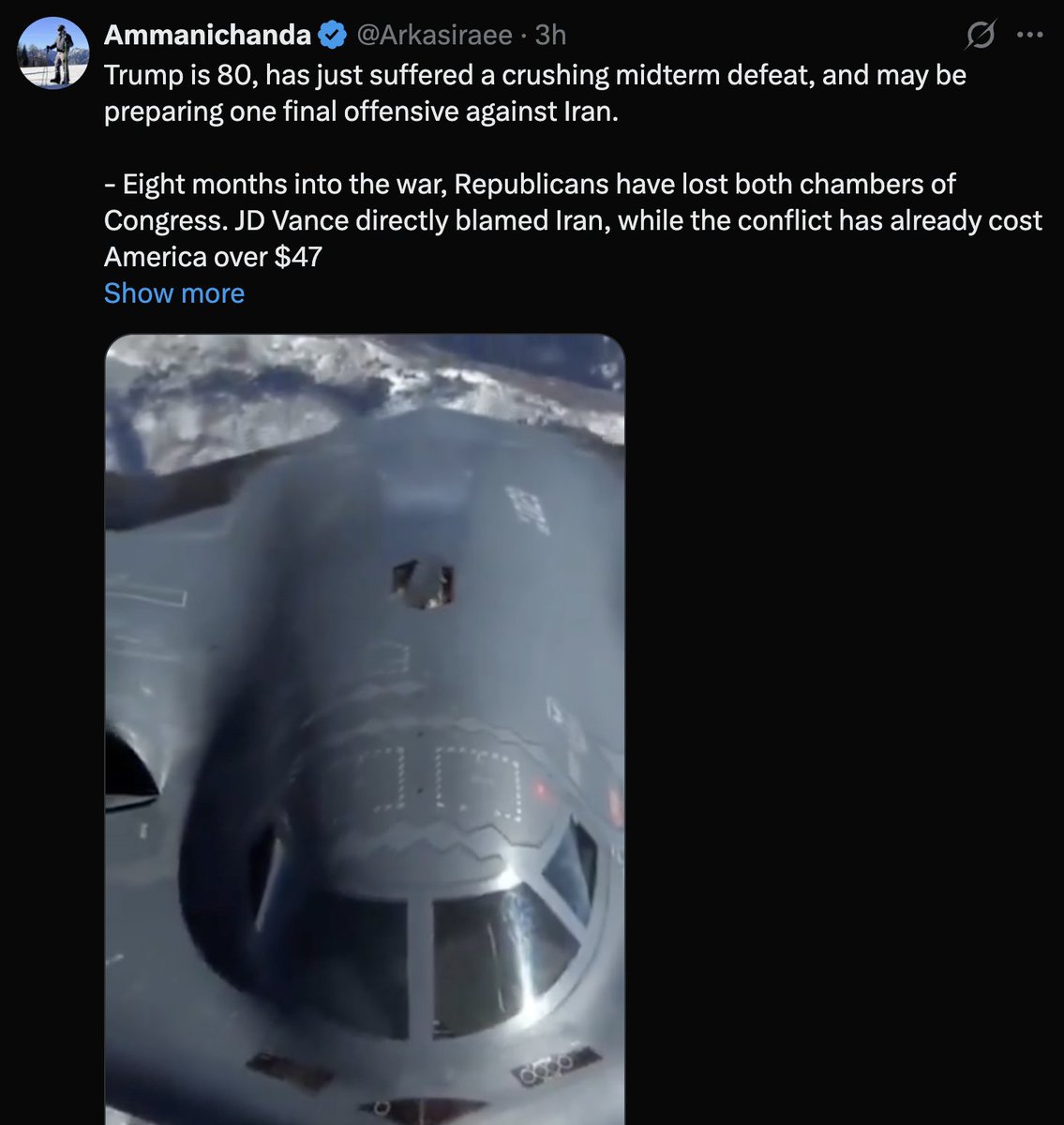
Trump is 80, has just suffered a crushing midterm defeat, and may be preparing one final offensive against Iran.
- Eight months into the war, Republicans have lost both chambers of Congress. JD Vance directly blamed Iran, while the conflict has already cost America over $47 billion, including roughly $29 billion in expended munitions.
- Yet Iran doesn't need to defeat the American military to inflict enormous damage. Disrupting the Strait of Hormuz has driven global energy prices higher, making a prolonged conflict increasingly expensive.
- Two American carrier strike groups, USS George Washington and USS George HW Bush, are already operating in the Middle East, supported by guided-missile warships and combat aircraft.
- A third, USS Theodore Roosevelt, reached Singapore on November 6, accompanied by a cruiser and two destroyers. It is heading toward the Middle East to relieve George Washington, potentially creating a temporary three carrier concentration by Nov 20th.
There is a remarkable precedent.
- On June 22, 2025, at approximately 2:10 AM Iranian time, seven B-2 stealth bombers struck Iran's nuclear facilities with 14 GBU-57 bunker busting bombs, completing a 36 hour round trip mission from Missouri. The attack occurred early Sunday morning under a waning crescent Moon, just 17.5% illuminated at midnight.
- Despite that operation, the nuclear question remains unresolved. Before the strikes, Iran possessed an estimated 440.9 kilograms of uranium enriched to 60%. International inspectors still cannot verify its present whereabouts or condition.
- Now America is offering up to $20 million for intelligence about Iran's nuclear facilities, equipment, personnel and their movements. The very program Trump previously claimed to have devastated remains an intelligence priority.
- American officials have reportedly warned regional governments about possible renewed strikes and Iranian retaliation. On November 8, a Russian Defence Ministry aircraft also landed in Israel. Its passengers and purpose remain unknown.
- Meanwhile, Qatar is attempting to broker an agreement over Hormuz, the American blockade and nuclear inspections. The negotiations remain far apart, while renewed military operations are reportedly still under consideration.
My reading is that another major American offensive could be intended not to prolong this war, but to secure one final military achievement before attempting to end it.
November 20 to December 15, 2026 is the period to watch closely.
There is no confirmed order for such an attack. But the political pressure, military movements, unresolved nuclear intelligence and regional warnings form a pattern worth examining.
Whether these developments are independent events or the early signs of a larger decision, only time will tell.
The world has accumulated nearly 448,000 tonnes of spent nuclear fuel, with about 322,000 tonnes still in storage.
Starship is designed to carry around 100 tonnes to low-Earth orbit, not beyond Earth's gravity.
Even at that capacity, clearing the stored inventory would require over 3,200 launches. Starship has flown just three times in 2026 so far. At that pace, we're talking over 1,000 years!
And that's before accounting for heavy radiation-shielded containers, additional propulsion, and the biggest concern, a launch failure that breaches containment could disperse highly radioactive material into the environment.
Reusable rockets help enormously with costs, but they don't eliminate these risks.
@21hasantr For all the technological advancements in espionage, mankind has yet to invent a device more effective than a good old fashioned honey trap.
Imagine NVIDIA’s most advanced Rubin GPUs being used to generate AI videos of Jensen Huang getting honey trapped by a Chinese spy.
At possibly the most challenging moment of Jensen’s career, his own technology could be powering the memes about his generational fumble.
The plan is to leave the waste underground permanently, not retrieve it every 30, 50 or 100 years to replace the containers.
Finland's Onkalo facility is designed to isolate spent nuclear fuel for at least 100,000 years, using copper-and iron canisters, swelling clay and roughly 430 metres of bedrock.
Even if a container eventually deteriorates, the surrounding barriers are designed to prevent dangerous amounts of radioactive material from reaching the environment.
The repository is expected to operate until the 2120s, after which it will be permanently sealed, with no routine maintenance required.
The entire Finnish nuclear waste management and disposal programme is estimated to cost around €6 billion, funded by the nuclear operators themselves.
NASA actually studied this seriously back in the 1970s, but the economics and risks were enormous.
The world has already discharged nearly 448,000 tonnes of spent nuclear fuel, with roughly 322,000 tonnes still in storage.
Even a Falcon Heavy can carry only 63.8 tonnes to low-Earth orbit, which isn't permanent disposal. Sending it beyond Earth requires considerably more energy, and protective containment adds further weight.
The bigger problem is launch reliability. A rocket failure carrying highly radioactive waste could breach its containment and disperse radioactive material into the atmosphere or surrounding environment.
Reusable rockets have improved the economics in the last decade, but burying waste in carefully engineered geological repositories remains far more practical than repeatedly launching radioactive material through Earth's atmosphere as of now.
Things might change in the next decade.
It's astonishing how much communication technology has changed in barely one generation.
Just 32 years ago, some telephone calls still depended on machines like this. Dialling a number sent electrical pulses to a local exchange, where electromagnets activated physical switches to establish a connection.
For an international call, that connection could pass through multiple exchanges and thousands of kilometres of cables before reaching another local exchange and finally ringing someone's telephone.
Every conversation occupied network capacity. During emergencies, when available circuits filled up, callers could find themselves repeatedly trying to get through.
Even in 1992, the new transatlantic cable was designed to carry 80,000 simultaneous telephone conversations.
France retired its last electromechanical public exchange in December 1994. Today, billions of people can communicate across continents through digital networks, with live video travelling in real time.
The sheer scale of technological progress in telecommunications over just 35 years is almost impossible to comprehend.
Imagine NVIDIA’s most advanced Rubin GPUs being used to generate AI videos of Jensen Huang getting honey trapped by a Chinese spy.
At possibly the most challenging moment of Jensen’s career, his own technology could be powering the memes about his generational fumble.