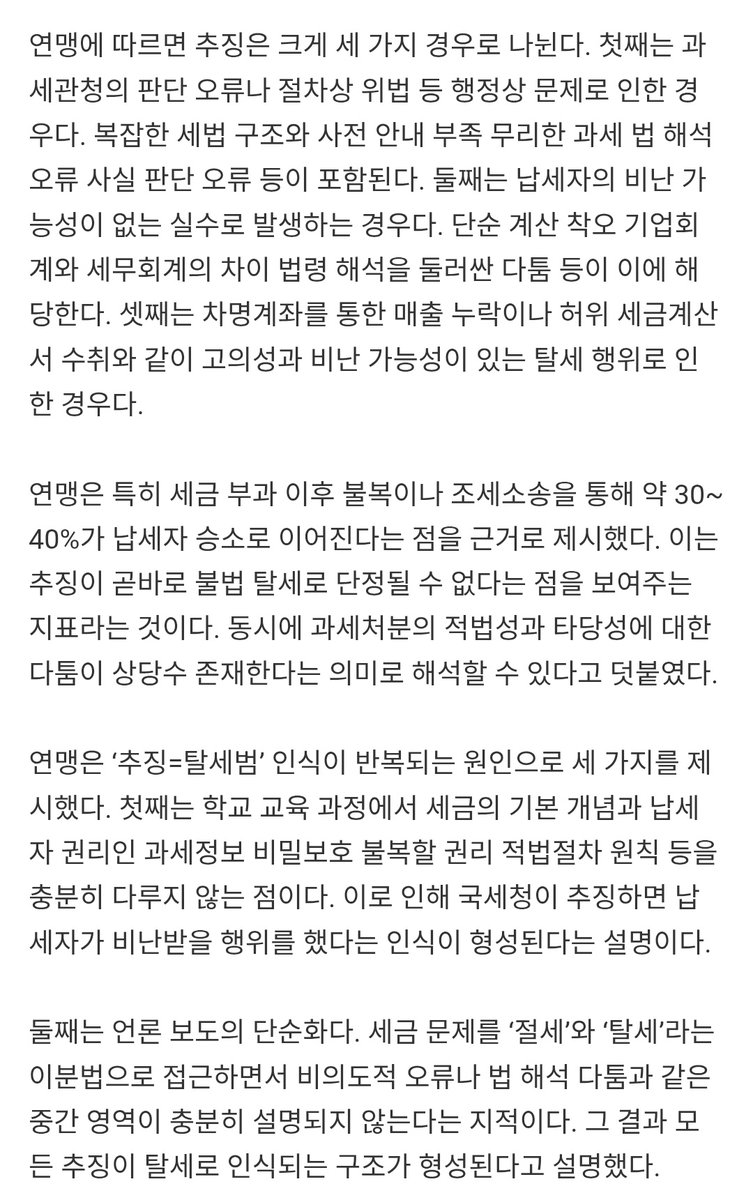
(+) The Association particularly cited that approximately 30–40% of objections or tax litigation cases following tax imposition result in victories for taxpayers. It argued that this demonstrates that a tax reassessment cannot automatically be deemed illegal tax evasion. At the same time, it added that this also indicates a significant number of disputes over the legality and appropriateness of tax dispositions.
The Association presented three reasons for the recurring perception that “tax reassessment = tax evader.”
First, the lack of sufficient coverage in school curricula of fundamental tax concepts and taxpayer rights, such as confidentiality of tax information, the right to appeal, and the principle of due process. As a result, when the National Tax Service imposes additional taxes, it fosters the perception that the taxpayer must have engaged in blameworthy conduct.
Second, the oversimplification in media reporting. By approaching tax issues through a binary framework of “tax saving” versus “tax evasion,” intermediate areas — such as unintentional errors or disputes over legal interpretation — are not adequately explained. Consequently, a structure is formed in which all tax reassessments are perceived as tax evasion.
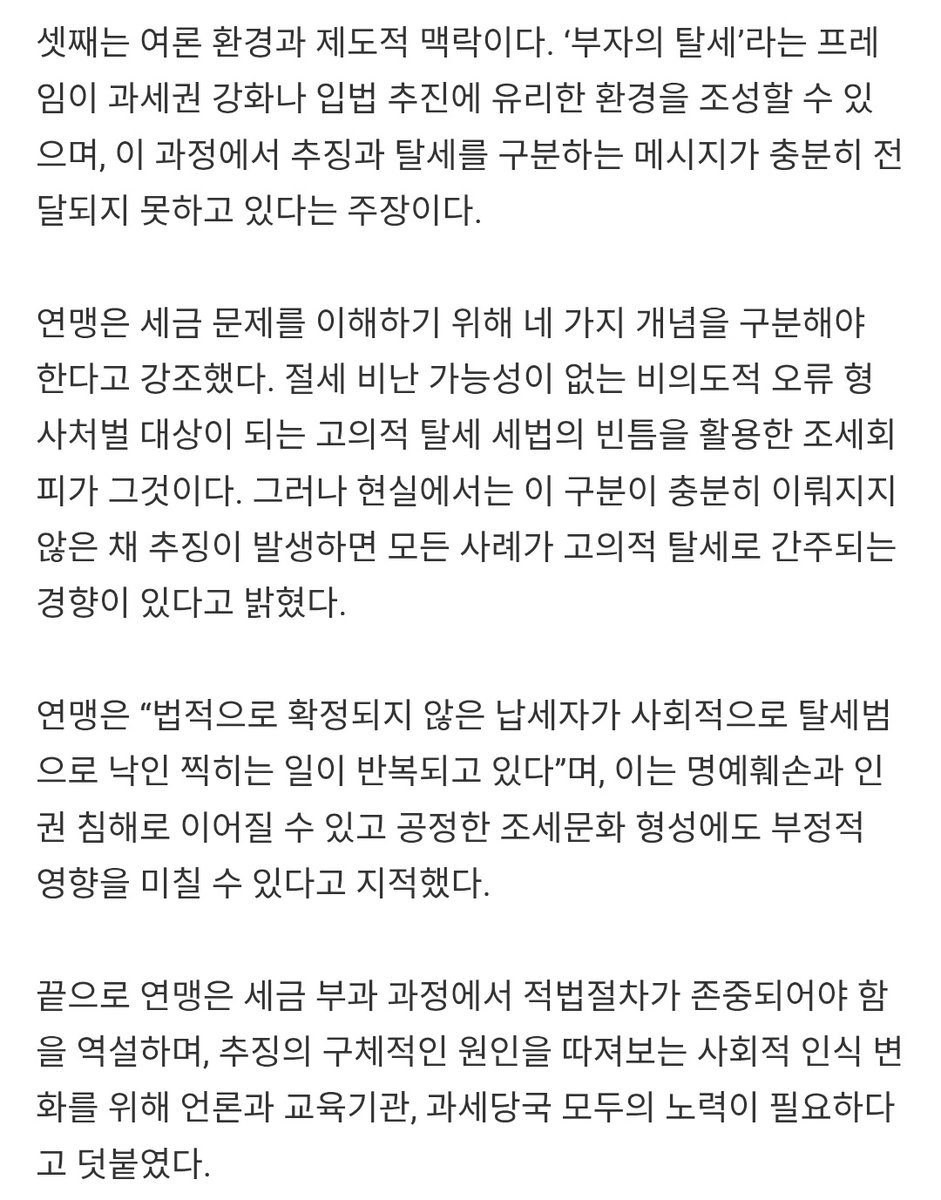
Third, the broader public opinion environment and institutional context. The framing of “tax evasion by the wealthy” may create a favorable environment for strengthening taxation authority or advancing legislation, and in this process, messages distinguishing between tax reassessments and tax evasion may not be sufficiently conveyed.
The Association stressed that four concepts must be distinguished in understanding tax issues: lawful tax saving; non-culpable, unintentional errors; intentional tax evasion subject to criminal punishment; and tax avoidance that exploits loopholes in tax law. However, it noted that in reality these distinctions are often not sufficiently made, and when a tax reassessment occurs, there is a tendency to regard all cases as intentional tax evasion.
The Association stated, “There are repeated instances in which taxpayers, whose legal responsibility has not been definitively established, are socially stigmatized as tax evaders.” It warned that this may lead to defamation and violations of human rights and may negatively affect the establishment of a fair tax culture.
Finally, the Association emphasized that due process must be respected in the tax imposition process and added that efforts from the media, educational institutions, and tax authorities are all necessary to foster a social shift toward examining the specific causes behind tax reassessments.
Article:
🔗https://t.co/TWIbHFkRSV
DC post:
🔗https://t.co/6fkOr9sNJ1
#CHAEUNWOO #차은우 #이동민
#チャウヌ #车���优 #ชาอึนอู #車銀優
[🚨] We want to inform all fans of Cha Eunwoo about a situation currently affecting him that raises concerns about press transparency in Korea.
According to a Kcharm whose information was posted on Nunu Gallery on DC Inside (a Korean forum), an unusual issue arose regarding an article about the Korea Taxpayers Association’s statement.
The post explains that although the Association’s statement had been available on its official website for about a week, no media outlet had published coverage of it during that time. Then, at approximately 8 a.m., a single article reporting on the statement appeared.
Shortly afterward, however, the article could no longer be found through searches on major portal sites. The user searched on Daum, Naver, and Google using the “latest” sorting option, as well as keywords such as “Cha Eunwoo,” “tax evader,” and “Korea Taxpayers Association,” but the article did not appear in the results.
The user then checked the media outlet’s official website, Startup & Management News, and confirmed that the article was still listed there, with a publication time of around 8 a.m. Screenshots were taken while the article was still visible in Daum’s recent search results. Later, it disappeared entirely from portal searches.
According to the post, the article had been searchable on portal sites roughly an hour earlier, but within that time frame it was no longer visible in search results. The situation was described as highly unusual, and others were asked to verify whether they were experiencing the same issue.
Additionally, we personally verified that access to the article is restricted for international fans. It cannot be accessed from outside Korea through normal browsing and was only viewable by using a VPN connected to Korea.
–---------------
📰 [ARTICLE] “Equating ‘tax reassessment’ with ‘tax evader’ is a misunderstanding… caution needed against unjust social stigma”
The Korea Taxpayers Association recently addressed media reports concerning tax evasion allegations involving entertainer Cha Eunwoo, pointing out the public’s tendency to equate a “tax reassessment” with “tax evasion,” and urging the protection of taxpayers’ rights.
In a press release issued on the 12th, the Association analyzed that a social perception is spreading in which the mere fact that additional taxes were assessed leads to the taxpayer being morally condemned as a tax evader.
It was reported that, following the related coverage, the Association received protests criticizing the nature of the organization or accusing it of defending tax evaders. The Association explained that such reactions stem from the simplistic equation being accepted as fact — that “a tax reassessment equals tax evasion and therefore warrants moral condemnation.”
The Association emphasized that “a tax reassessment does not automatically mean the crime of tax evasion.” It explained that a reassessment is an administrative outcome arising during tax audits and assessment procedures and may occur for various reasons; therefore, uniformly equating it with a crime is inaccurate.
According to the Association, tax reassessments can largely be divided into three categories. First, cases resulting from administrative issues such as errors in judgment by the tax authority or procedural violations. These include the complexity of tax laws, insufficient prior guidance, excessive or unreasonable interpretations of tax statutes, and errors in fact-finding.
Second, cases arising from mistakes without culpability on the part of the taxpayer, such as simple calculation errors, differences between corporate accounting and tax accounting, or disputes over statutory interpretation.
Third, cases involving intentional and blameworthy acts of tax evasion, such as omitting sales through borrowed-name accounts or receiving false tax invoices (+)
#CHAEUNWOO #차은우 #이동민
#チャウヌ #车银优 #ชาอึนอู #車銀優
¡COLOMBIA ES TERRITORIO #CHAEUNWOO 🇨🇴💜 #1 en iTunes con "Love So Fine"
¡Ahora vamos por el Top 10 en Netflix! 📺 No olviden este fin de semana es la Maratón de True Beauty. Dale play, deja que corran los capítulos y apoyemos a nuestro príncipe. 👑🤴🏻
¡AROHA DE LATAM UNIDA! 💜💪



![ChaEunwooINTL's tweet photo. [🚨] We want to inform all fans of Cha Eunwoo about a situation currently affecting him that raises concerns about press transparency in Korea.
According to a Kcharm whose information was posted on Nunu Gallery on DC Inside (a Korean forum), an unusual issue arose regarding an article about the Korea Taxpayers Association’s statement.
The post explains that although the Association’s statement had been available on its official website for about a week, no media outlet had published coverage of it during that time. Then, at approximately 8 a.m., a single article reporting on the statement appeared.
Shortly afterward, however, the article could no longer be found through searches on major portal sites. The user searched on Daum, Naver, and Google using the “latest” sorting option, as well as keywords such as “Cha Eunwoo,” “tax evader,” and “Korea Taxpayers Association,” but the article did not appear in the results.
The user then checked the media outlet’s official website, Startup & Management News, and confirmed that the article was still listed there, with a publication time of around 8 a.m. Screenshots were taken while the article was still visible in Daum’s recent search results. Later, it disappeared entirely from portal searches.
According to the post, the article had been searchable on portal sites roughly an hour earlier, but within that time frame it was no longer visible in search results. The situation was described as highly unusual, and others were asked to verify whether they were experiencing the same issue.
Additionally, we personally verified that access to the article is restricted for international fans. It cannot be accessed from outside Korea through normal browsing and was only viewable by using a VPN connected to Korea.
–---------------
📰 [ARTICLE] “Equating ‘tax reassessment’ with ‘tax evader’ is a misunderstanding… caution needed against unjust social stigma”
The Korea Taxpayers Association recently addressed media reports concerning tax evasion allegations involving entertainer Cha Eunwoo, pointing out the public’s tendency to equate a “tax reassessment” with “tax evasion,” and urging the protection of taxpayers’ rights.
In a press release issued on the 12th, the Association analyzed that a social perception is spreading in which the mere fact that additional taxes were assessed leads to the taxpayer being morally condemned as a tax evader.
It was reported that, following the related coverage, the Association received protests criticizing the nature of the organization or accusing it of defending tax evaders. The Association explained that such reactions stem from the simplistic equation being accepted as fact — that “a tax reassessment equals tax evasion and therefore warrants moral condemnation.”
The Association emphasized that “a tax reassessment does not automatically mean the crime of tax evasion.” It explained that a reassessment is an administrative outcome arising during tax audits and assessment procedures and may occur for various reasons; therefore, uniformly equating it with a crime is inaccurate.
According to the Association, tax reassessments can largely be divided into three categories. First, cases resulting from administrative issues such as errors in judgment by the tax authority or procedural violations. These include the complexity of tax laws, insufficient prior guidance, excessive or unreasonable interpretations of tax statutes, and errors in fact-finding.
Second, cases arising from mistakes without culpability on the part of the taxpayer, such as simple calculation errors, differences between corporate accounting and tax accounting, or disputes over statutory interpretation.
Third, cases involving intentional and blameworthy acts of tax evasion, such as omitting sales through borrowed-name accounts or receiving false tax invoices (+)
#CHAEUNWOO #차은우 #이동민
#チャウヌ #车银优 #ชาอึนอู #車銀優](https://pbs.twimg.com/media/HBeydIlXkAAC9d-.jpg)









![ChaEunwooINTL's tweet photo. [🚨] We want to inform all fans of Cha Eunwoo about a situation currently affecting him that raises concerns about press transparency in Korea.
According to a Kcharm whose information was posted on Nunu Gallery on DC Inside (a Korean forum), an unusual issue arose regarding an article about the Korea Taxpayers Association’s statement.
The post explains that although the Association’s statement had been available on its official website for about a week, no media outlet had published coverage of it during that time. Then, at approximately 8 a.m., a single article reporting on the statement appeared.
Shortly afterward, however, the article could no longer be found through searches on major portal sites. The user searched on Daum, Naver, and Google using the “latest” sorting option, as well as keywords such as “Cha Eunwoo,” “tax evader,” and “Korea Taxpayers Association,” but the article did not appear in the results.
The user then checked the media outlet’s official website, Startup & Management News, and confirmed that the article was still listed there, with a publication time of around 8 a.m. Screenshots were taken while the article was still visible in Daum’s recent search results. Later, it disappeared entirely from portal searches.
According to the post, the article had been searchable on portal sites roughly an hour earlier, but within that time frame it was no longer visible in search results. The situation was described as highly unusual, and others were asked to verify whether they were experiencing the same issue.
Additionally, we personally verified that access to the article is restricted for international fans. It cannot be accessed from outside Korea through normal browsing and was only viewable by using a VPN connected to Korea.
–---------------
📰 [ARTICLE] “Equating ‘tax reassessment’ with ‘tax evader’ is a misunderstanding… caution needed against unjust social stigma”
The Korea Taxpayers Association recently addressed media reports concerning tax evasion allegations involving entertainer Cha Eunwoo, pointing out the public’s tendency to equate a “tax reassessment” with “tax evasion,” and urging the protection of taxpayers’ rights.
In a press release issued on the 12th, the Association analyzed that a social perception is spreading in which the mere fact that additional taxes were assessed leads to the taxpayer being morally condemned as a tax evader.
It was reported that, following the related coverage, the Association received protests criticizing the nature of the organization or accusing it of defending tax evaders. The Association explained that such reactions stem from the simplistic equation being accepted as fact — that “a tax reassessment equals tax evasion and therefore warrants moral condemnation.”
The Association emphasized that “a tax reassessment does not automatically mean the crime of tax evasion.” It explained that a reassessment is an administrative outcome arising during tax audits and assessment procedures and may occur for various reasons; therefore, uniformly equating it with a crime is inaccurate.
According to the Association, tax reassessments can largely be divided into three categories. First, cases resulting from administrative issues such as errors in judgment by the tax authority or procedural violations. These include the complexity of tax laws, insufficient prior guidance, excessive or unreasonable interpretations of tax statutes, and errors in fact-finding.
Second, cases arising from mistakes without culpability on the part of the taxpayer, such as simple calculation errors, differences between corporate accounting and tax accounting, or disputes over statutory interpretation.
Third, cases involving intentional and blameworthy acts of tax evasion, such as omitting sales through borrowed-name accounts or receiving false tax invoices (+)
#CHAEUNWOO #차은우 #이동민
#チャウヌ #车银优 #ชาอึนอู #車銀優](https://pbs.twimg.com/media/HBeydnaXMAAqQXO.jpg)