Rather than functioning as another conversational assistant, ARQEN understands objectives, coordinates the necessary tools and workflows, executes tasks, and va
We're still at the beginning of understanding what autonomous execution can become.
At ARQEN, we'll continue exploring the systems, workflows, and design principles that could make intelligent action more reliable.
More to come.
AI agents are evolving quickly, but the fundamentals still matter.
Clear goals. Good system design. Reliable tools. Measurable outcomes.
New capabilities are exciting. Dependable execution is what makes them useful.
A question we're thinking about:
How much autonomy should an AI system have before it needs human confirmation?
The answer probably depends on the task, the risk, and how easily an action can be reversed.
An agent completing 95% of a workflow sounds impressive.
Until the remaining 5% is the part that actually matters.
End-to-end reliability is a very different challenge from producing a convincing intermediate result.
The future of AI infrastructure isn't only about faster models.
It's also about how models interact with software, coordinate operations, handle uncertainty, and deliver useful results in real environments.
Not every task needs an autonomous agent.
Sometimes a simple script is better. Sometimes a traditional workflow is enough.
The challenge is knowing when reasoning and adaptive execution actually add value.
There's a difference between an AI system that tells you how to do something and one that helps you get it done.
The gap between those two experiences is where a lot of interesting engineering work is happening.
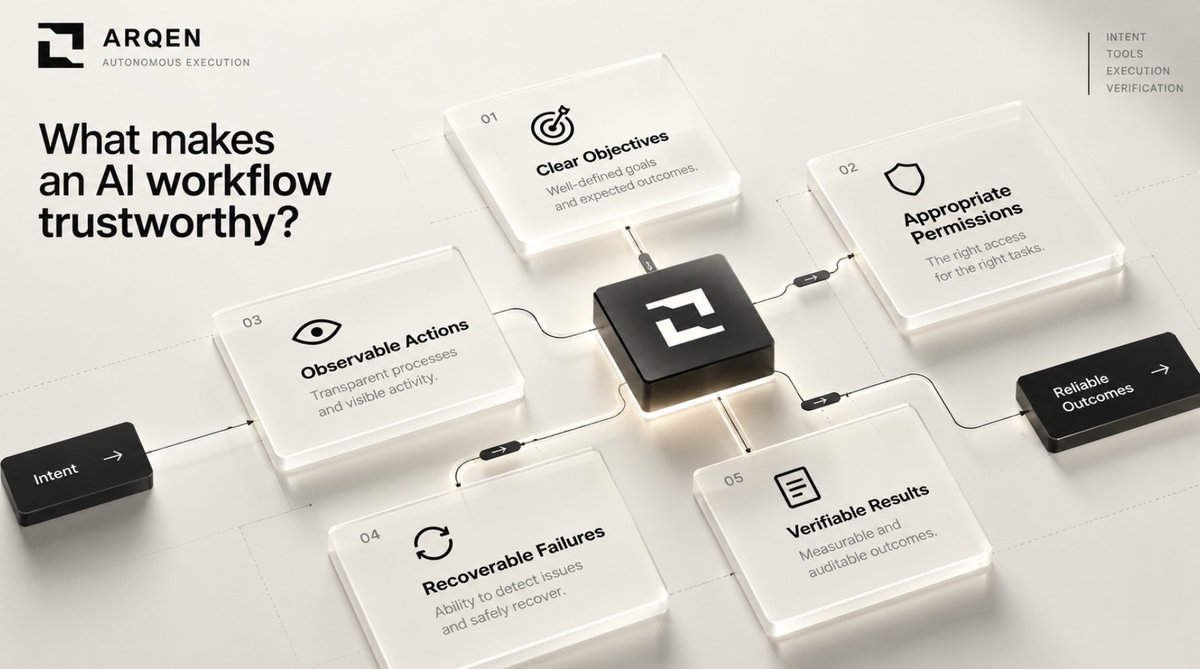
What makes an AI workflow trustworthy?
A few things come to mind:
• Clear objectives
• Appropriate permissions
• Observable actions
• Recoverable failures
• Verifiable results
What would you add?
More autonomy doesn't have to mean less human control.
Clear permissions, defined boundaries, and meaningful checkpoints can make intelligent systems more useful—not less capable.
Good execution requires good constraints.
A simple way to think about intelligent execution:
Understand the goal.
Plan the workflow.
Coordinate the tools.
Execute with controls.
Verify the outcome.
Each step matters.
One of the hardest problems in agentic AI is coordination.
Models, tools, APIs, data sources, and human decisions all need to work together.
Making those interactions predictable is an important part of building useful execution systems.
The most useful AI systems may not be the ones with the most features.
They may be the ones that can reliably complete a small number of important tasks.
Reliability is a feature.
Execution without verification creates uncertainty.
An AI system completing a task should be able to establish what happened, what succeeded, and what still needs attention.
Reliable outcomes matter more than confident responses.
Automation and autonomy aren't quite the same thing.
Automation follows predefined steps.
Autonomy introduces the ability to reason about which steps are needed.
Both matter. The real opportunity is bringing them together.
A good AI agent shouldn't need constant instructions for every small step.
It should understand the objective, identify what needs to happen, and coordinate the process within clear boundaries.
That's one of the most interesting challenges in autonomous systems.
A home for our ideas, research, and long-term vision.
Explore ARQEN: arqen work
We'll be sharing more about autonomous execution, agent workflows, and the technologies shaping this space.
Intelligence is useful.
Intelligence that can act responsibly is even more powerful.
We believe the future of AI will be shaped not only by what systems know, but by what they can reliably accomplish.
What does autonomous execution actually mean?
It's the idea that intelligent systems should be able to understand objectives, coordinate the right tools, carry out workflows, and verify results.
Not just suggest the next step.
AI has become remarkably good at understanding what we ask.
The next challenge is turning that understanding into meaningful action.
That's the direction we're exploring at ARQEN.
Introducing ARQEN.
We're exploring a future where AI does more than generate answers.
ARQEN is focused on autonomous execution—connecting intent, tools, workflows, and verifiable outcomes.
From understanding what needs to be done to helping make it happen.
This is where our journey begins.