Big news! Today we're launching the competition for Physical-Engineering's Last Exam on @Kaggle, with $400,000 in prizes! 🛠️⚡
LLMs have conquered coding benchmarks—but can your agent engineer the physical world?
Today, the best agent scores under 50%. The headroom is massive. 🚀
Today we're opening Physical-Engineering's Last Exam (PLE) as a $400K open challenge.
No AI agent completes half of real engineering tasks.
Can you build one that does?
🥇 $250K 🥈 $100K 🥉 $50K
🧵👇
Can AI agents do real engineering work?
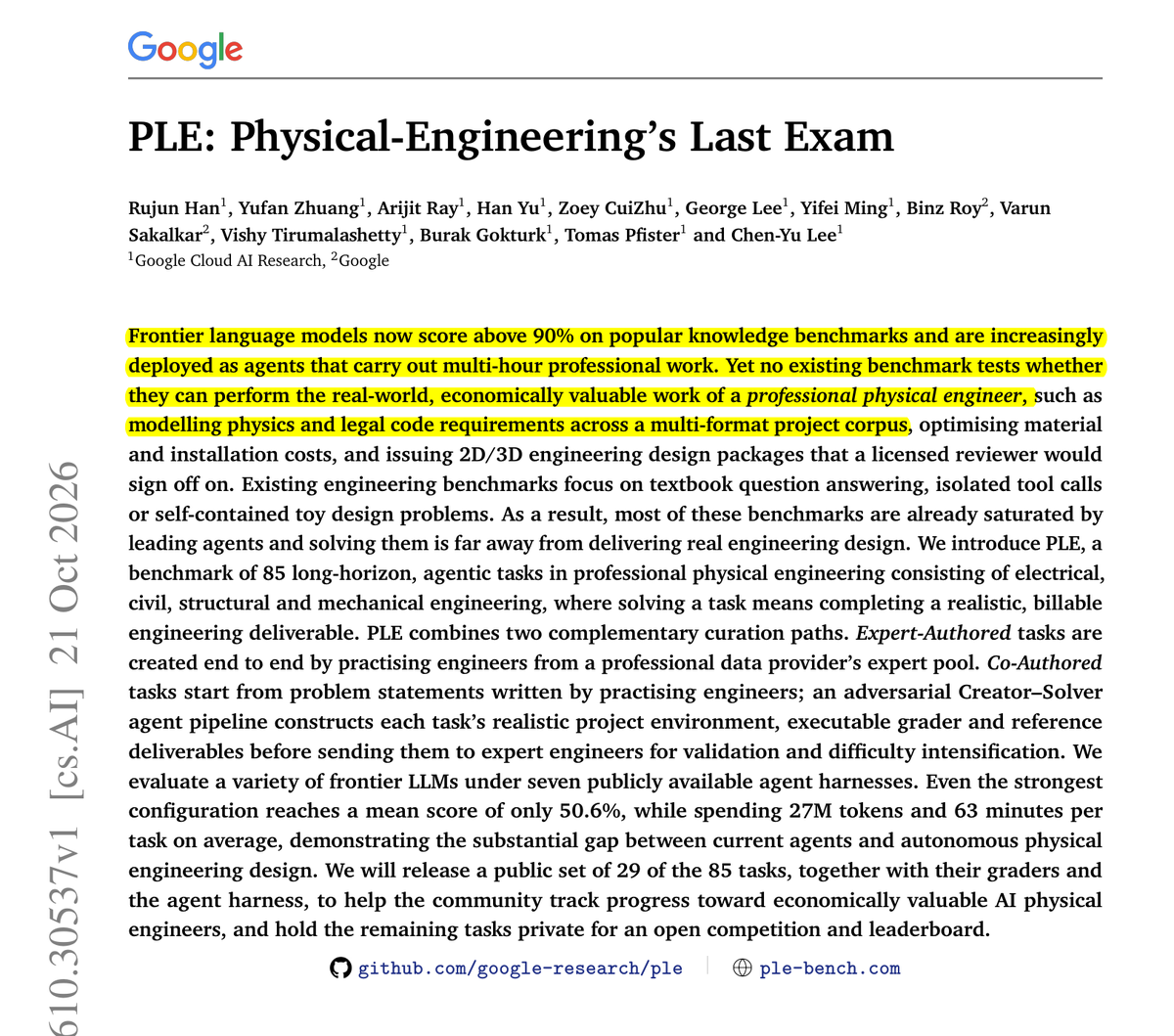
Physical-Engineering's Last Exam (PLE), from @GoogleResearch & @GoogleCloud: 85 long-horizon tasks built by licensed engineers across mechanical, electrical, civil and structural engineering.
Even the best model + harness scores ~50%. 🧵
New Google paper finds that the best AI agent scores only 50.6% on physical engineering jobs, often by missing a hard safety or feasibility rule.
Engineering benchmarks for LLMs mostly test textbook questions or toy problems that top agents already handle well. Real engineers work from piles of PDFs, spreadsheets, and CAD files and must issue designs that meet code and stay cheap.
They built PLE, 85 electrical, civil, structural, and mechanical jobs written or checked by practising engineers. Agents must read about 61 project files per task and deliver schedules, reports, or 2D and 3D drawings.
Claude Opus 5.5 in Claude Code topped 14 models at 50.6%, using 27M tokens and 63 minutes per task. On design tasks its outputs met 91% of constraints, but only 41.3% met every hard constraint.
If you build engineering agents, gate every design on hard safety and code limits, and spend effort on model choice before tuning the agent scaffold.
Lots of headroom on our benchmark - try your agent and harness designs, let us know what you build!! 🚀
📄 https://t.co/v79zmR68HJ
🌐 https://t.co/RuqgYWB8iJ
AI can write code, build websites, even do research. But can it help build the physical world?
Super excited to share what we have been working on: PLE, Physical-Engineering's Last Exam.
Visual, spatial, physics, language & code reasoning all in one task. Truly AI-complete. 💫 🧵
HLE tested knowledge. ALE tested digital work. PLE tests the work that builds the physical world.
Today we’re releasing Physical-Engineering’s Last Exam (PLE) from Google Cloud AI Research.
All frontier models scored under 50% 🧵
This isn't just an academic hurdle.
ASCE estimates a $3.7T U.S. infrastructure funding gap in the next ~7 years. Roads, bridges, grids, water: all need engineers.
Moving agents from code to physical-world design to help engineers is where AI's compounding economic and societal value lies.
HLE tested knowledge. ALE tested digital work. PLE tests the work that builds the physical world.
Today we’re releasing Physical-Engineering’s Last Exam (PLE) from Google Cloud AI Research.
All frontier models scored under 50% 🧵
HLE tested knowledge. ALE tested digital work. PLE tests the work that builds the physical world.
Today we’re releasing Physical-Engineering’s Last Exam (PLE) from Google Cloud AI Research.
All frontier models scored under 50% 🧵
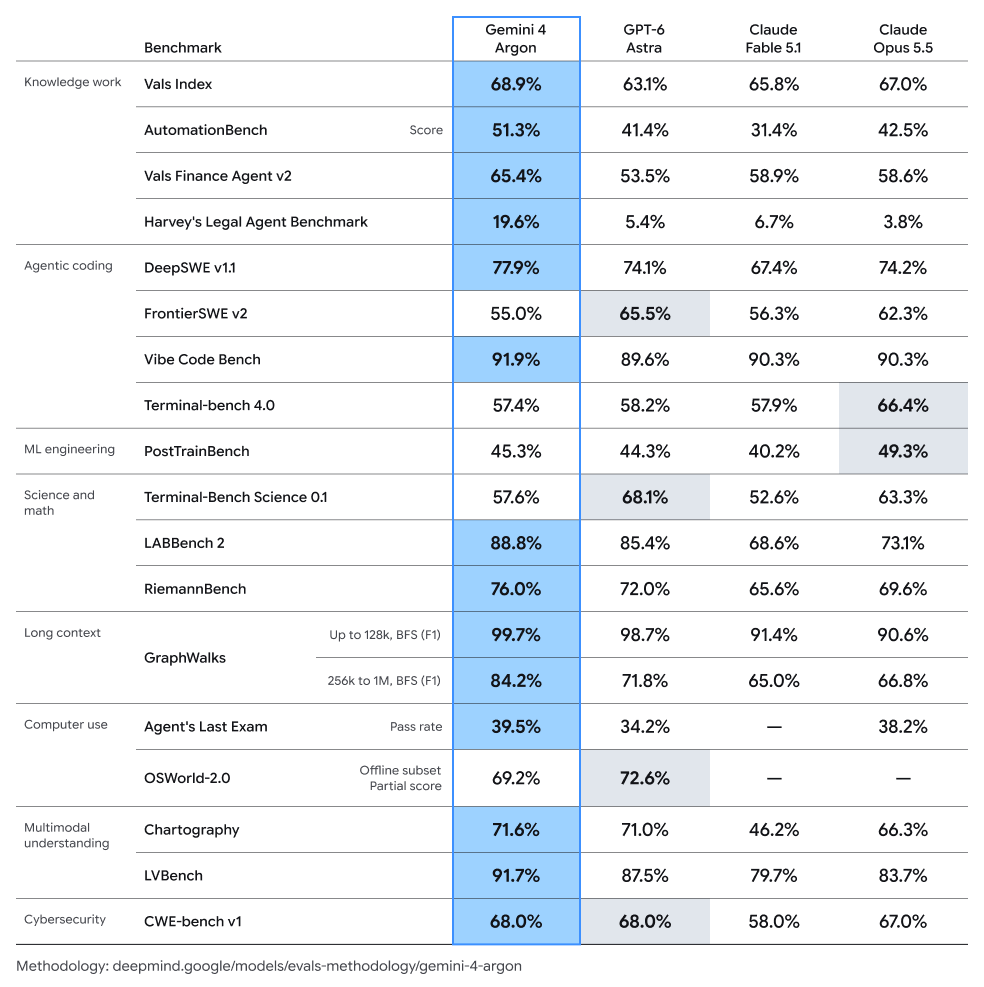
Very excited to announce Gemini 4 Argon, our new Frontier AI model, and a huge step forward across key capabilities. We’re focused on rolling it out responsibly starting with government and trusted cyber defenders through our Fairwind Program today, before wider availability soon
Launching my research group, MAGIC (Manipulation and General Intelligence Control) Lab @NUSComputing, Singapore!
We focus on building the next generation of human-centric models for robotic manipulation — deployable safely, reliably, and easily in the real world. Our research spans MLLM reasoning, 3D vision, robot learning, simulation, dexterous manipulation, and cross-embodiment learning.
Interested in joining? Sign up here and I'll send a reminder email: https://t.co/9lEQnFERuh
Today we're releasing MolmoWeb, an open source agent that can navigate + complete tasks in a browser on your behalf.
Built on Molmo 2 in 4B & 8B sizes, it sets a new open-weight SOTA across four major web-agent benchmarks & even surpasses agents built on proprietary models. 🧵
This work would not be possible without all my amazing collaborators: Ahmed Abdelkader, Chengzhi Mao, Bryan Plummer, @kate_saenko_ , @RanjayKrishna , Leonidas Guibas, and Vincent Chu!
"It is by logic that we prove, but by [abstract] intuition that we discover." - Henri Poincaré.
When faced with a complex problem, we pause, we think.
Not exactly in words, not exactly in images —
in something more abstract,
something harder to name.
So, for truly intelligent agents, should we not ask that they do the same?
Introducing Mull-Tokens — a modality-agnostic latent thinking paradigm.
Now, the model can think in space, in time,
in words, in affordances —
in all the things that language alone
cannot easily convey.
https://t.co/4A4l7vED9d
As conversations continue around grounding visual & textual reasoning, we believe latent, modality-agnostic thinking could be a promising direction.
The latents can be extended to anything - trajectories, 3D point-cloud features, audio!
Paper, code, and models posted. Dive in and let us know what you build! 🚀