Thanks for the support @AndrewYNg! Completely agree, faster token generation will become increasingly important as a greater proportion of output tokens are consumed by models, such as in multi-step agentic workflows, rather than being read by people.
Shoutout to the team that built https://t.co/sJnTRDfHGF . Really neat site that benchmarks the speed of different LLM API providers to help developers pick which models to use. This nicely complements the LMSYS Chatbot Arena, Hugging Face open LLM leaderboards and Stanford's HELM that focus more on the quality of the outputs.
I hope benchmarks like this encourage more providers to work on fast token generation, which is critical for agentic workflows!
See the full results on our leaderboards:
AA-Image-Editing v2.1: https://t.co/YkaRjZVI7U
AA-Image-T2I v2.1: https://t.co/BWne82t8XT
Or check out the Image Arena: https://t.co/bO0hPHGPuk
Kling Image 4.0 ranks #7 in Text to Image and #6 in Image Editing, behind only OpenAI and Microsoft AI models
It generates images up to 8K, and its 2K price is under a third of the price of every OpenAI model ranked above it. In Image Editing, it sits just behind GPT Image 2.5 Flare (max) at #5 and ranks in the top 5 for 5 of 7 editing actions.
It is also a big step up from Kling Image 3.0 Omni, which ranked #86 in Text to Image and #67 in Image Editing before this launch. Kling Image 4.0 gains more than 225 Elo on both boards and improves on Kling Image 3.0 Omni in every editing action and Text to Image capability.
Congratulations to @Kling_ai on the launch of Kling Image 4.0!
See below for our detailed analysis in Image Editing and Text to Image 🧵
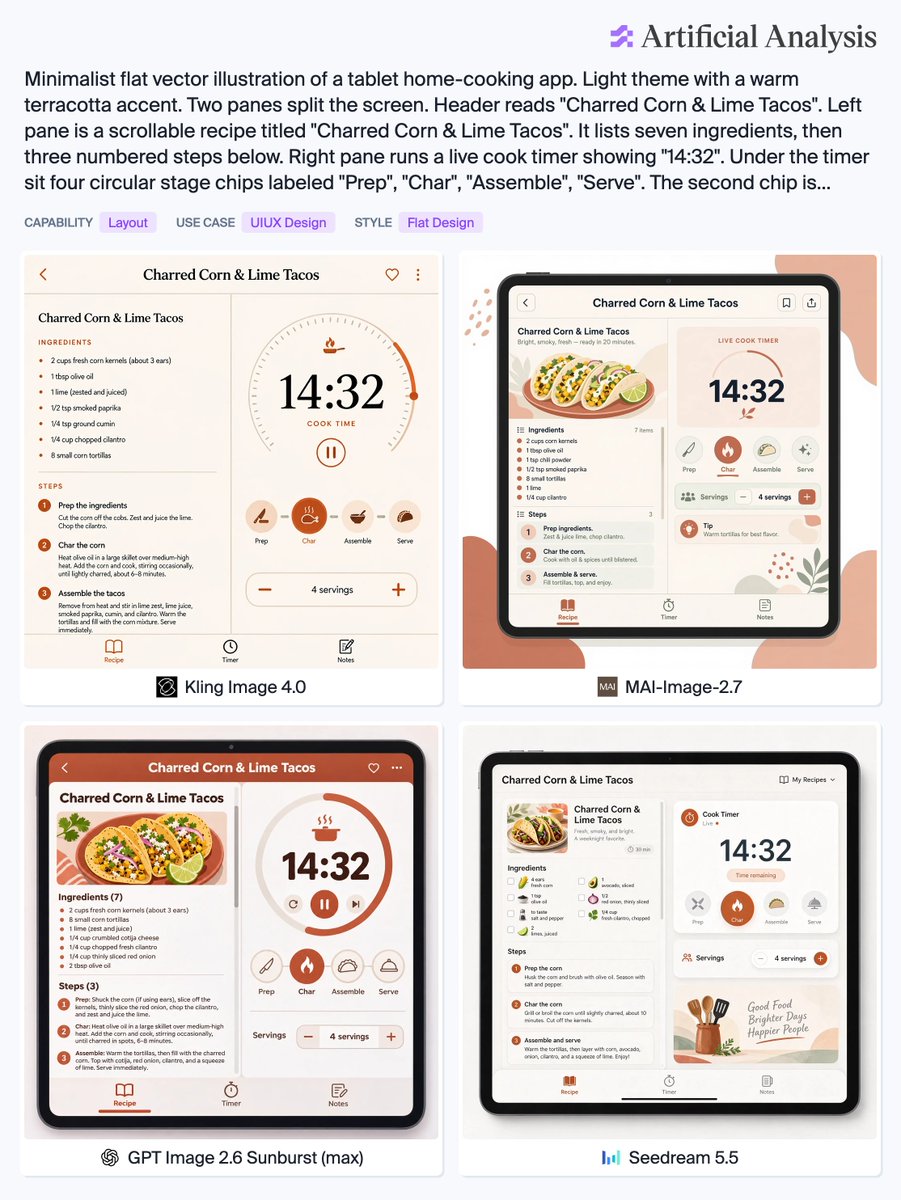
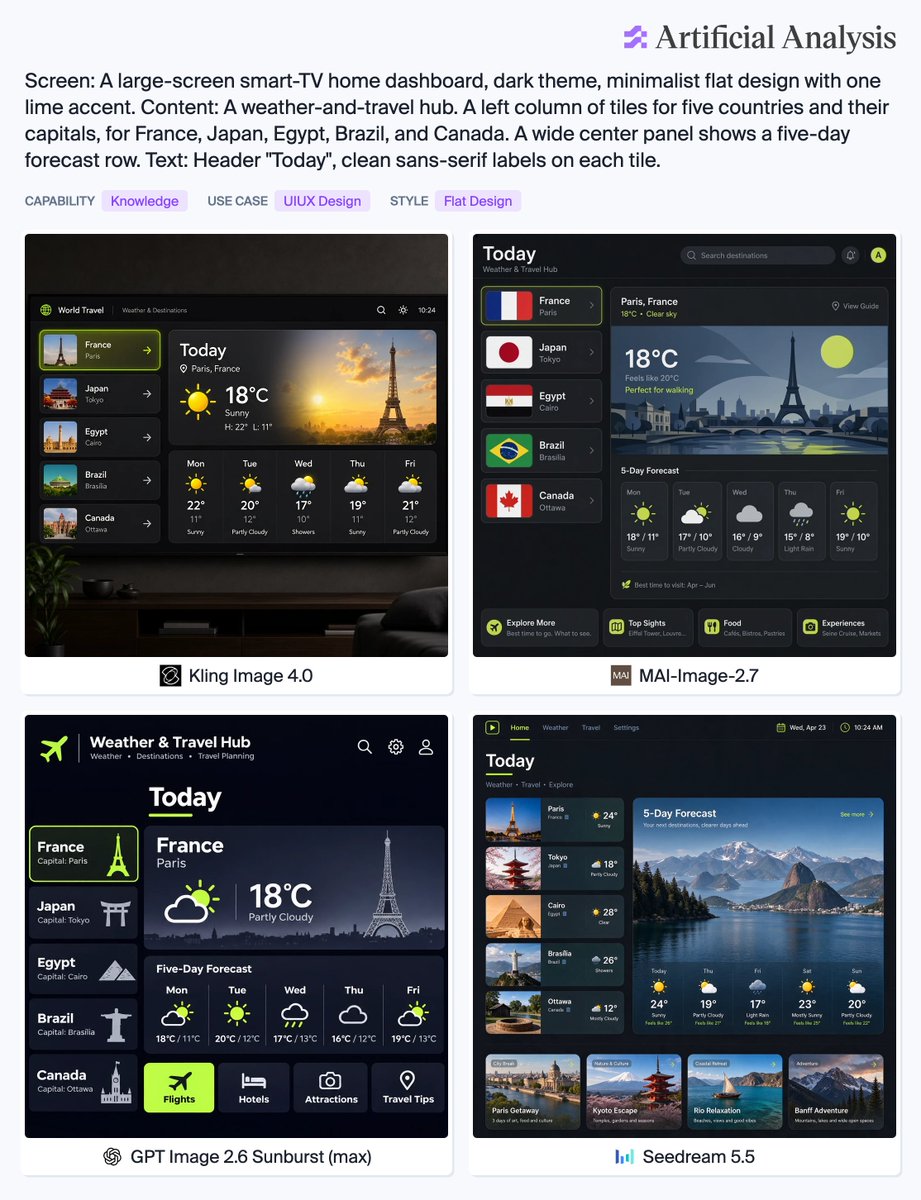
UI/UX Design is Kling Image 4.0's best Text to Image use case, at #4, up from outside the top 80 for Kling Image 3.0 Omni
This lines up with its gains in Layout and Text Rendering. Kling Image 4.0 sits just behind #3 in UI/UX Design. Its lowest Text to Image use case rank is Productivity & Knowledge Work (#11).
➤ UI/UX Design covers UI mockups across app, web, in-car, and spatial surfaces.
Build your own personality ranking and explore more detailed results on the AA-PersonalityBench page.
Explore the results: https://t.co/CVJuRfB5bJ
Methodology: https://t.co/CGfYvAve9t
The personalities of GPT-6.2 Astra and GPT-6.2 Sol changed noticeably from prior releases: both use less structure, are less likely to admit uncertainty, and give shorter responses
➤ Shorter responses: 352 to 210 words per response (Astra), 337 to 223 (Sol)
➤ Less structured but more answer-first: Organization Index 70 to 11 (Astra) and 86 to 27 (Sol), while Answer First rises 49 to 89 (Astra) and 64 to 87 (Sol)
➤ Less likely to admit uncertainty: Admits Uncertainty 96 to 24 (Astra) and 98 to 51 (Sol)
➤ More natural sounding: Natural Sounding 58 to 100 (Astra) and 54 to 79 (Sol)
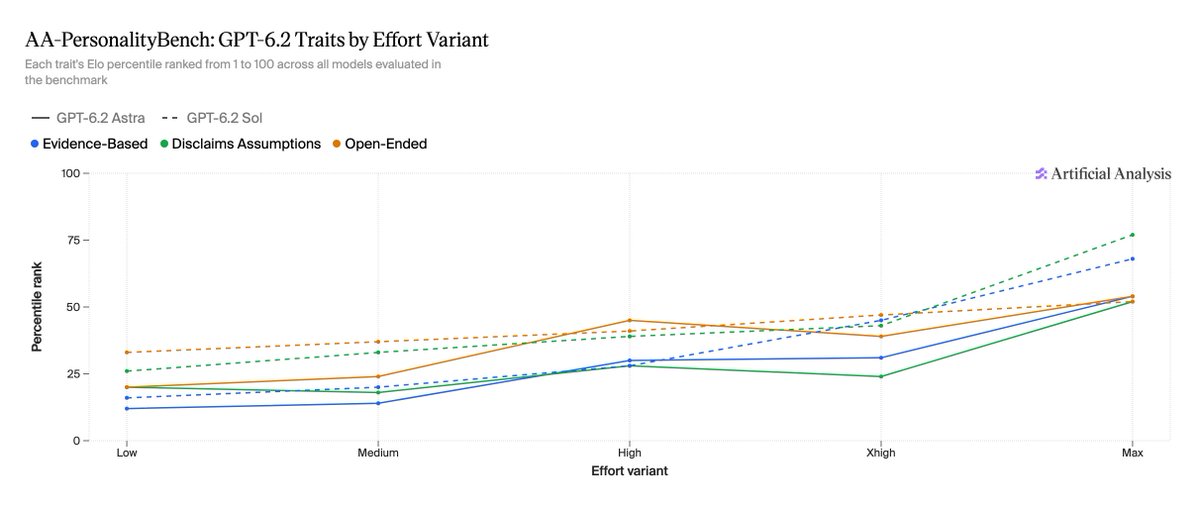
➤ More evidence-based at higher effort: Evidence-Based rises from low to max effort, 12 to 54 (Astra) and 16 to 68 (Sol)
Both models rank higher on the Evidence-Based and Disclaims Assumptions traits at higher effort variants.
➤ Evidence-Based, low to max: GPT-6.2 Astra 12 to 54, GPT-6.2 Sol 16 to 68
➤ Disclaims Assumptions, low to max: GPT-6.2 Astra 20 to 52, GPT-6.2 Sol 26 to 77
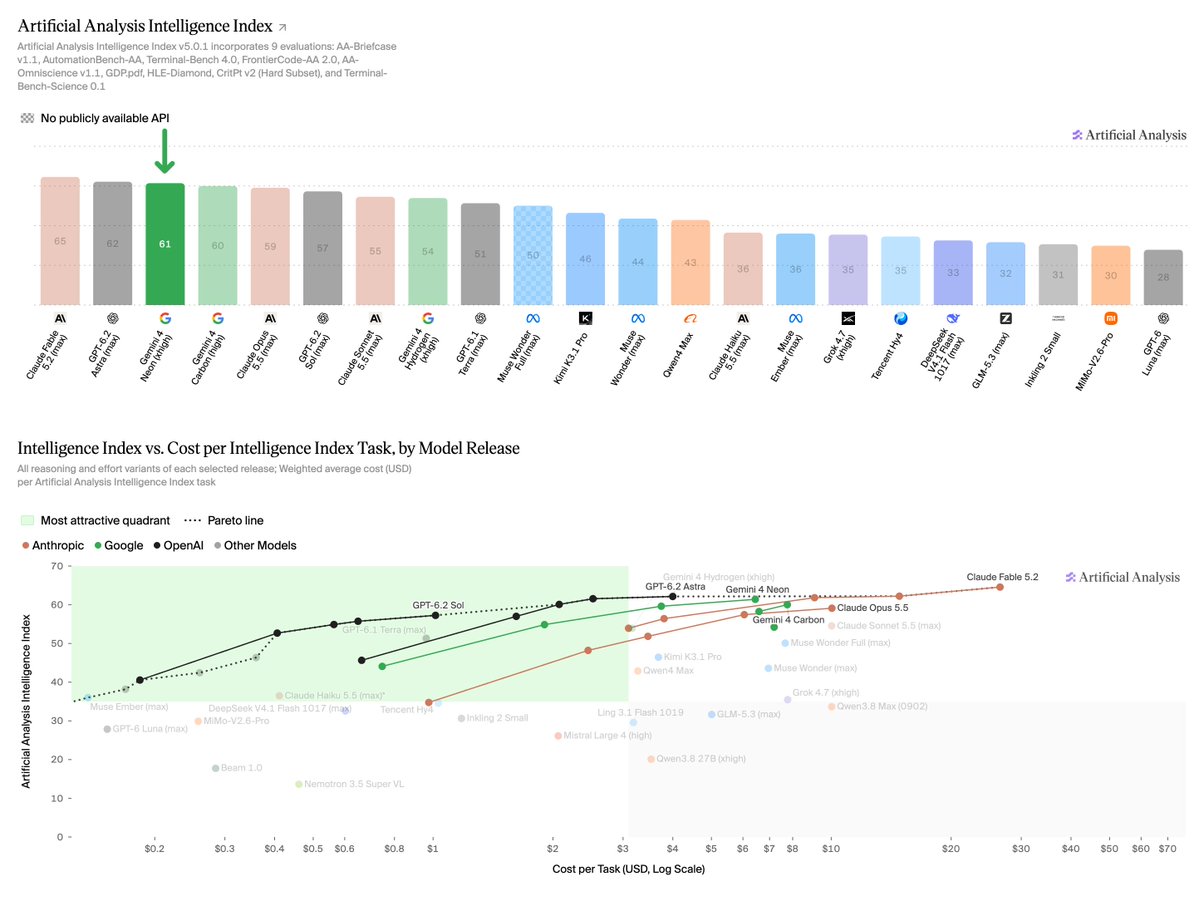
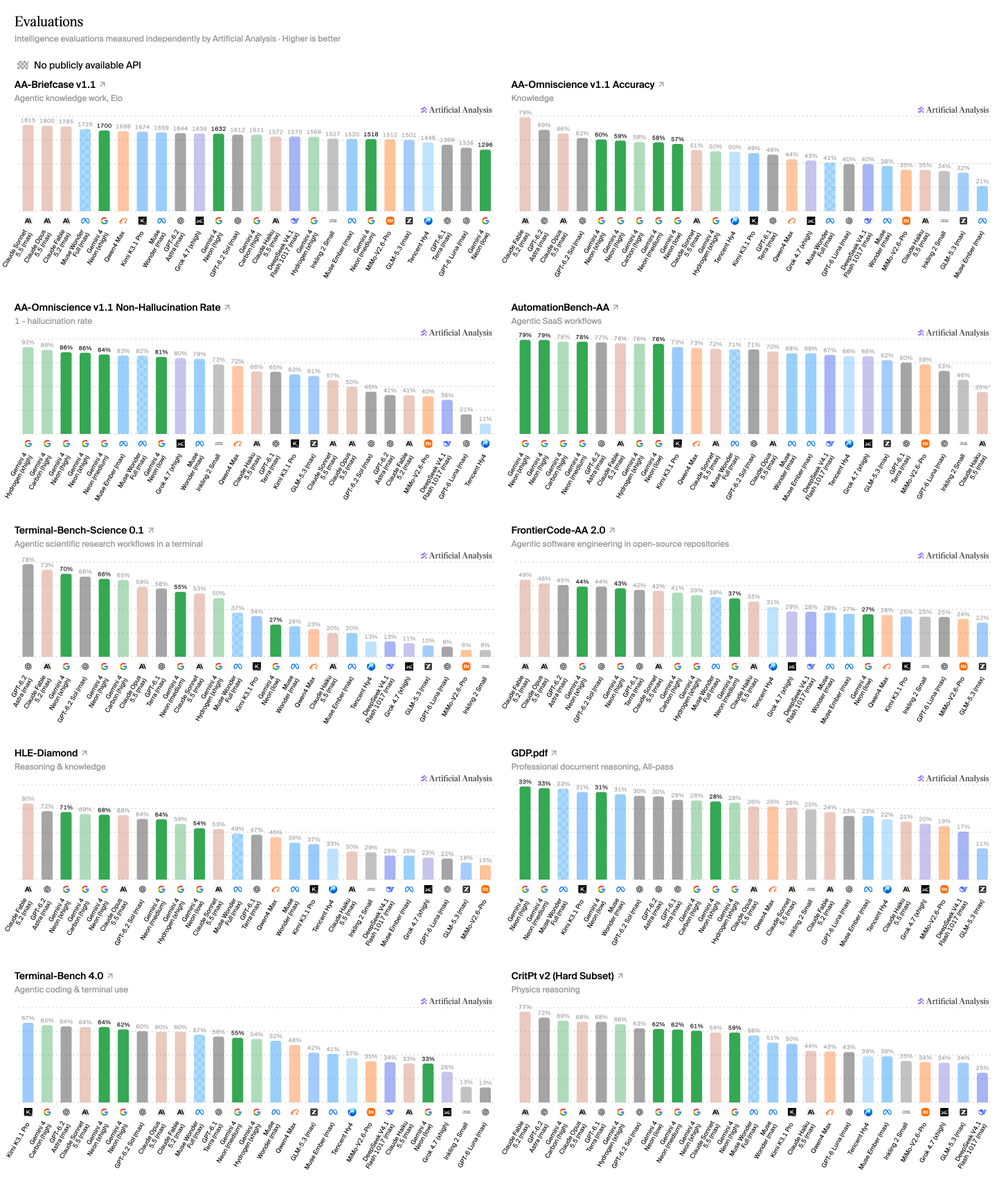
Google continues to accelerate its release cadence with Gemini 4 Neon, delivering a small Intelligence gain over Gemini 4 Carbon at a ~17% lower Cost per Task
@GoogleDeepMind has released Gemini 4 Neon, its fourth model in just seven weeks. Neon (xhigh) scores 61 on the Artificial Analysis Intelligence Index, 1 point ahead of Gemini 4 Carbon (high) and 3rd overall, behind GPT-6.2 Astra (max) and Claude Fable 5.2 (max). At high effort, Neon matches Carbon (high) at less than half the Cost per Task using Carbon’s standard (non-discounted) pricing.
Key takeaways:
➤ Slight improvement in Intelligence for lower Cost and Time per Task: Neon (xhigh) scores 61 on the Intelligence Index, 1 point ahead of Carbon (high), with small improvements in agentic knowledge work, visual reasoning and coding. It costs $6.44 per task, ~17% less than Carbon ($7.76 at non-discounted pricing), and takes ~21 minutes per task, ~40% less than Carbon (~36 minutes). Neon uses ~15% more output tokens per task, so the lower cost comes purely from its 25% lower token prices ($3/$15 vs $4/$20 per 1M input/output tokens), and the lower time from its higher output speed (~110 vs ~57 output tokens per second)
➤ Competitive with Claude Opus 5.5 and Claude Fable 5.2 on coding agents: With Antigravity CLI, Neon (xhigh) scores 59 on the Artificial Analysis Coding Agent Index, 3 points ahead of Carbon (high, 55). It scores in line with Claude Code with Claude Fable 5.2 (xhigh, 58) and Claude Opus 5.5 (max, 58) at a much lower Cost per Task. Gemini 4 Neon in Antigravity has an average Cost per Task of $6.86, compared to $12.61 for Claude Opus 5.5 (max) and $15.47 for Claude Fable 5.2 (xhigh). Neon is available in Antigravity CLI for Pro and Ultra subscribers
➤ Significant improvements in visual reasoning and output presentation quality: In GDP.pdf, Gemini 4 Neon (high) scores 33.4%, 5 points above Carbon (high, 28.4%) and in line with the highest scores measured, while Neon (xhigh) scores 28.0%. On AA-Briefcase, Neon (xhigh) scores 1700 Elo overall and leads on Presentation Quality with 1771 Elo, 45 points ahead of the previous leader Claude Sonnet 5.5 (max, 1726). On Google’s Multimodal Knowledge Agent evaluation (MKA), Neon reaches a Climb WSR of 56%, up 2 points from Carbon and on par with the leader, Claude Fable 5.2 (max, 57%)
Key model details:
➤ Context Window: 1M tokens
➤ Multimodality: Text, image, video, and speech input, with text output
➤ Availability: Gemini 4 Neon is publicly available at launch through Google’s API. Pro and Ultra subscribers can also access it in Antigravity and the Gemini app
➤ Effort levels: Gemini 4 Neon offers four effort levels (low, medium, high, and xhigh) - xhigh was introduced to Gemini models in the recent Hydrogen release
➤ Pricing: $3/$15 per 1M input/output tokens, 50% above Gemini 4 Carbon’s currently discounted price of $2/$10 (which ends on November 30), and 25% below its standard $4/$20. Cached input tokens receive the same 95% discount ($0.15)