This is an unbelievable piece of work by Sarthak and something that requires amplification.
Let me explain what he found, in simple terms.
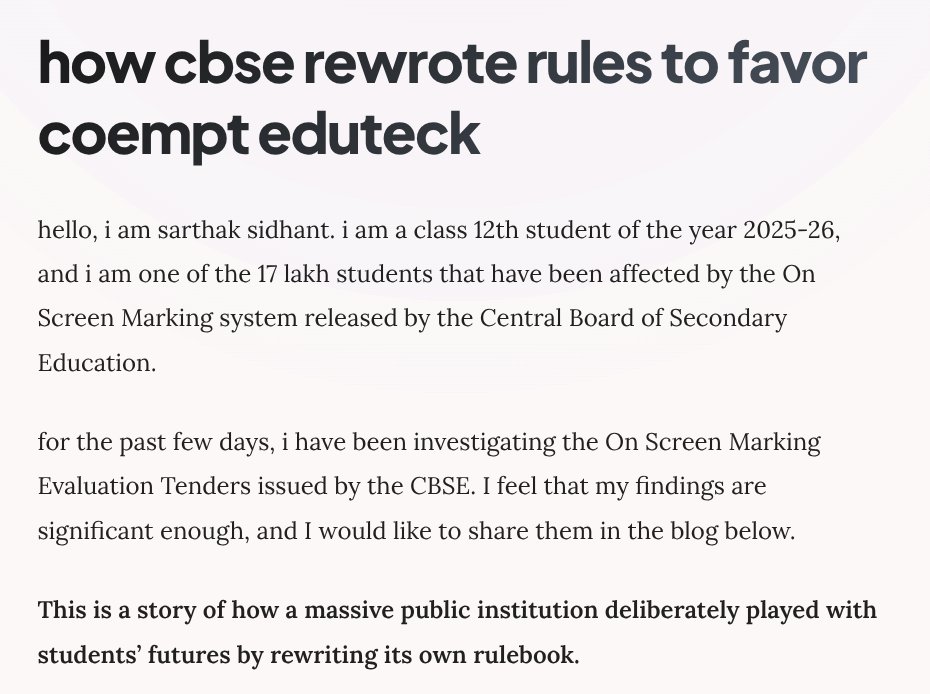
Sarthak is a Class 12 student from the 2025-26 batch, one of the 17 lakh students whose answer sheets went through CBSE's new On-Screen Marking system.
He spent days reading through CBSE's evaluation tenders, scraped all 576 tenders CBSE has issued, and tracked how the rules changed across three versions of the same tender.
The core finding is that the company that won the contract to scan and grade 17 lakh students' answer sheets is Coempt Eduteck.
Coempt used to be called Globarena Technologies. Globarena was the company behind the 2019 Telangana intermediate exam disaster, where software failures led to 3.8 lakh students getting wrong or missing marks, and 23 students died by suicide.
A government committee found systemic failure and negligence. Six months later, Globarena rebranded to Coempt Eduteck.
So a company with that track record won a contract to handle 17 lakh CBSE students. Sarthak's investigation is about how the rules were rewritten to let that happen.
The tender was issued three times.
> First tender, February 2025. It existed, then disappeared from the public GeM portal. Sarthak scraped all 576 CBSE tenders and this one was missing from the archive entirely.
> Second tender, May 2025. Four companies applied including TCS and Coempt. All four failed the technical evaluation. Cancelled.
> Third tender, August 2025. Coempt won. Between the second and third tender, a series of rule changes happened, and every single one made it easier for Coempt to qualify.
Here is what changed, one by one.
01. The old rules disqualified any company with a history of abandoning work, failing to complete contracts, or financial weakness. The new rules deleted this clause entirely. Coempt's Telangana history stopped being a barrier.
02. The old rules disqualified any company that was "blacklisted earlier." The new rules changed this to "currently blacklisted." Because Globarena rebranded after Telangana, removing the word "earlier" effectively erased their past.
03. The rules required Rs 50 crore average turnover over three years. Coempt's exact average came to Rs 50.86 crore. They cleared the bar by less than 1%. Earlier, a smaller company had asked CBSE to lower the bar to Rs 30 crore for fairer competition. CBSE refused. So the bar was kept high enough to block small players, but sat exactly low enough for Coempt to scrape through.
04. Software maturity is measured on the CMMI scale, 1 to 5. The old rules required Level 5. The new rules dropped it to Level 3. Coempt is a Level 3 company.
05. The cooling-off period for engaging retired CBSE officials was cut from two years to one. This makes it easier to use recently retired insiders to influence the process.
06. The old rules required experience with large projects of at least 5 lakh students each. The new rules removed the student count and counted cumulative answer-book volume across small projects instead. Coempt has many small fragmented university contracts. This helped Coempt and hurt TCS.
07. The old rules required bidders to own their own data centre and disaster recovery centre on Indian soil. The new rules allowed third-party MeitY-empanelled cloud hosting. Coempt runs on AWS and Azure. This helped Coempt and hurt TCS, which owns its own data centres. It also means student data is no longer on sovereign, Indian infrastructure.
08. The old rules required the bidder to own or control the complete source code of its software. The new rules deleted this. Coempt's platform runs on Microsoft's proprietary IIS, which they don't own.
09. A last-minute corrigendum, issued right before bid submission, removed CBSE's own power to blacklist the firm if its software failed catastrophically. So even a Telangana-scale failure couldn't get Coempt banned from future government tenders.
10. The penalty structure shifted from punishing mistakes to punishing delays. The old rules fined the vendor for wrong scanning, merged pages, and unscanned books. The new rules dropped those and instead levied Rs 50,000 per day for delays. This incentivises rushed scanning over accurate scanning.
11. The old rules had a hard accuracy threshold, error rate not to exceed 0.5%. The new rules removed this number entirely.
12. The old rules specified proper book and robotics scanners. The new rules just say "sufficient scanners." The definition was vague enough that, as Sarthak notes, the scanning could be done with a phone on a stand.
13. On the security side, the contract required a VAPT (vulnerability and penetration test) certified by CERT-In before go-live, and a restricted beta phase before launch. The system clearly wasn't restricted, because the other researcher, Nisarga, was able to access it and find vulnerabilities four days before go-live. So the mandatory security audit appears to have been bypassed.
These are more than a dozen rule changes, all between the failed tender and the winning tender, all pushing in the same direction, all benefiting the one company with the worst track record in the field.
The security holes Nisarga found last week now have an explanation. The system was built by a vendor that was specifically allowed to skip the security certification, the source code ownership, the data sovereignty, and the quality thresholds the original rules demanded.
Following things need to happen immediately;
1. An immediate CAG audit of the tender process.
2. A parliamentary debate on the topic.
3. An independent investigation into
> Why the first tender vanished?
> Why the disqualification clauses were deleted?
> Why the turnover bar was held exactly where it was?
> Why the security level was dropped?
> Why the blacklisting power was removed at the last moment?
Sarthak, this is genuinely exceptional investigative work. Far better than most journalists with full resources ever manage. Take a bow. :)
Japonya 1992'de İngiltere'nin yaşadığı şeyi yaşıyor. Çok daha büyük ölçekte.
Geçen hafta uluslararası para piyasasında sessiz bir savaş yaşandı.
Japonya yen'i savunmak için tek başına 72 milyar dolar harcadı.
Tarihte böyle olaylar her zaman aynı şekilde sonuçlandı.
Anlatıyorum.
Tarih 16 Eylül 1992.
İngiltere bir savaşın içindeydi.
Pound düşüyordu. Avrupa Döviz Mekanizması'nın kuralları belliydi. Pound, Alman markına karşı belirli bir aralıkta tutulacaktı.
İngiltere Merkez Bankası savunmaya geçti.
Sabah saat 10:30'da faizi yüzde 10'dan 12'ye çıkardı. Piyasa pound satışına devam etti.
Saat 14:15'te ikinci hamle geldi. Faiz 12'den 15'e yükseldi. Tarihin en agresif tek günlük faiz artışıydı.
Aynı gün İngiltere Merkez Bankası rezervlerini tüketti. 27 milyar pound piyasaya akıttı.
Karşısında bir adam vardı.
Adı George Soros'tu.
Macar asıllı, Londra'da ekonomi okumuş, sonra New York'a göç etmiş bir hedge fon yöneticisi.
Soros aylardır bu krize hazırlanıyordu. Pound'un tutulamayacağına ikna olmuştu. Pound'a 10 milyar dolarlık short açmıştı.
Pozisyon basit. İngiltere kaybedecekti.
Soros'un yanında genç bir ekonomist vardı. Adı Scott Bessent'ti.
Bessent o gün 30 yaşındaydı. Soros'un Londra ekibinde genç bir fon yöneticisiydi. Bir merkez bankasının yenilişine canlı tanık oldu.
O günü hiç unutmadı.
Akşam saat 19:00'da İngiltere Merkez Bankası pes etti. İngiltere Avrupa Döviz Mekanizmasından çekildiğini açıkladı.
Pound bir günde yüzde 15 düştü.
Soros tek günde 1 milyar dolardan fazla kazandı.
Tarihe "Bankayı Kıran Adam" olarak geçti.
Şimdi 2026 Mayıs'ına gelin.
Japonya aynı pozisyonda.
Yen düşüyor. USD/JPY 160 seviyesini aştı. Bu seviye Japon hükümeti için kırmızı çizgi.
Maliye Bakanlığı ve Merkez Bankası eyleme geçti.
Bank of America stratejisti Yamada en az dört müdahale tespit etti.
30 Nisan, 1 Mayıs, 4 Mayıs, 6 Mayıs.
Hepsi Japonya'nın bahar tatili döneminde. Tokyo piyasası kapalıydı. Likidite düşüktü. Müdahale daha etkili oluyordu.
Tahmini rakam 72 milyar dolar.
Burada inanılmaz bir detay var.
Japonya'nın bugünkü hareketini masanın diğer tarafından izleyen kişi 1992'deki o genç ekonomist.
Scott Bessent.
Bugün Donald Trump'ın Hazine Bakanı.
ABD'nin borç piyasasını yöneten adam.
Soros'un öğrencisi.
1992'de bir merkez bankasının nasıl yenildiğini canlı gören adam, bugün başka bir merkez bankasının aynı senaryoyu yaşamasını izliyor.
Şimdi karşılaştırın.
İngiltere bir günde 27 milyar pound harcadı.
Japonya bir haftada 72 milyar dolar harcadı.
Peki Japonya bu parayı nereden buluyor?
Bloomberg verilerine göre yabancı ülkelerin Fed'deki ABD tahvili stoğu 6 Mayıs'ta 8.7 milyar dolar düştü. Bank of America bu hareketi Japonya'nın ABD tahvil satışı olarak yorumluyor.
Mantık zinciri şu.
Japonya yen almak için doları piyasada satıyor. Bu doları kasasındaki ABD tahvillerinden çıkarıyor. Tahvilleri elden çıkarınca tahvil arzı artıyor. Fiyatlar düşüyor. Getiriler yükseliyor.
Sonuç ABD'nin yeni borçlanma maliyetinin artması.
Burada işin can alıcı noktası başlıyor.
Japonya, dünyanın en büyük yabancı ABD tahvili sahibi.
ABD'nin zaten ciddi bir borç sorunu var. Yıllık bir trilyon doları aşan faiz ödemesi. Toplanan her dört vergi dolarından biri sadece eski borcun faizine gidiyor.
Bu tabloda Japonya'nın tahvil satışları küçük bir ek baskı değil. Sistemi gerçek bir teste sokuyor.
Burada bir not düşmem gerekir.
Hiçbiri kesin değil.
Japonya Maliye Bakanlığı müdahaleleri resmi olarak doğrulamadı. Tahvil satışları piyasa veri analizine dayanıyor. Bloomberg'in Fed verilerinden çıkardığı yorumlar ve Bank of America stratejistlerinin tahminleri bu tabloyu çiziyor.
Ama veriler bir araya getirildiğinde tablo çok netleşiyor.
Şimdi en kritik soru.
Japonya kazanabilir mi?
Bessent'in masasındaki bilgilere bakılırsa cevap zor.
Çünkü Bessent 1992'de aynı senaryoyu yaşadı. Bir merkez bankasının nasıl yenildiğini gördü.
İngiltere kaybetti. Çünkü piyasa İngiltere'den büyüktü.
Japonya 72 milyar dolar harcadı. Yen üzerinde baskı hâlâ devam ediyor.
Üç senaryo var.
1. Japonya direnir. ABD tahvil satışları sürer. ABD borç piyasası daha çok sallanır.
2. Japonya pes eder. Yen 170-180 görür. Carry trade çöker. Küresel kriz tetiklenir.
3. Bessent koordineli bir anlaşmaya gider. ABD ve Japonya birlikte yen'i destekler.
Bessent'in para savaşları geçmişi üçüncü senaryoyu mümkün kılıyor. Sonuçta kendisi 1992'de saldıran taraftaydı. Şimdi savunma tarafında.
Bu benim kişisel analizim.
Gelişmeleri takip ediyorum, sizi bilgilendireceğim.
@UPPCLLKO@CMOfficeUP@EMofficeUP@aksharmaBharat@mduppcl Every time the SDO asks what is the issue when it’s been clearly highlighted that even though the meter reading is 0 (since we don’t live in that house as much), the bill is Rs9000/- due to some commercial aspect erroneously attached. Sharing copy of our application.
@UPPCLLKO very bad experience with complaint resolution. My mother is tired of running to your offices to get our inflated bill corrected. We are being erroneously charged for commercial connection for our residence. Raised the issue at all portals. Kindly support. @EMofficeUP
@UPPCLLKO
Extremely disappointed with the recent experience in resolution of my complaint pertaining to a highly inflated bill. I have put a complaint on the website, WhatsApp, Jan Sunwai app & called up customer care numerous times but no help/support. Tracking id 2798831874
Deeply shocked by the news of terrorist attacks in Israel. Our thoughts and prayers are with the innocent victims and their families. We stand in solidarity with Israel at this difficult hour.
@MumbaiPolice Hi, thanks for your response. We have already done it at the Rafi Ahmed Kidwai marg police station, but no resolution has been provided yet.
@LoveStanleyblr we have been defrauded by your Bhiwandi store in Mumbai for a significant amount. We had ordered a sofa in July which we haven’t still received. Even after registering multiple complaints with you and @MumbaiPolice we haven’t received any resolution. #fraud
State Bank of India’s digital platform has witnessed declines in new account openings and loan disbursals, a Moneycontrol analysis of the lender’s data showed.
Read more about it 👇
https://t.co/NyXQMOpbOV
by @jinitparmar10 | #SBI#YONO
Unfortunate to see a behemoth like @TheOfficialSBI, running it’s retail asset business solely based on a private company - #CIBIL (TU). Why bother having an underwriting team when they don’t even look at a profile let alone evaluating it? Sad you are losing out on cream customers