"Scale: Why India is likely to continue growing faster than expected - Part 4 of 4"
https://t.co/KwQf48awYe
'In this last part, we discuss increasing returns - the great unsayable of economics for half a century. India is most poised to benefit from this.'
Part 1: https://t.co/DdDIiHQyEd
Part 2/3: https://t.co/1FmgInF9Ue
My latest piece.
Mutual trust is the most important strategic asset today.
But, sadly, today, the world does not suffer from a shortage of resources…it suffers from a shortage of trust.
And the future of our partnerships depends on re-building this trust.
Yes, comparing Modi era with Nehru’s is right. Not to do so would be injustice to millions who suffered because of Nehru.
For example, Hindu Bengali refugees. Their children, grandchildren must never forget that their people were abandoned and thrown to the wolves by Jawaharlal Nehru before, during and after Partition.
Nehru despised dark-skinned Hindu Bengali refugees, among them my father, his siblings, their widowed mother and grandmother, fleeing rapacious and murderous Muslim League mobs in East Bengal; he did not want them to seek shelter in India.
Nehru wrote to CM BC Roy, instructing him not to let Hindu Bengali refugees enter West Bengal. Push them back from the border, Nehru said, don’t let them in.
Nehru insisted Hindu Bengalis of East Bengal / East Pakistan were coming to India for free-loading at the expense of Indians. He cut back Central funds for West Bengal to stop the meagre refugee assistance by way of a couple of kilos of inedible worm-infested rotten rice for Hindu Bengalis.
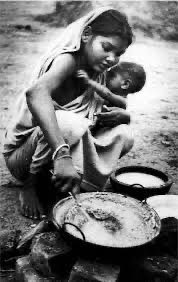
Hindu Bengali refugee women and children separated from their families, or widowed and orphaned in the Noakhali genocide and subsequent Partition Massacre of Hindus, rummaged in garbage bins and pitifully begged for morsels of food.
Hindu Bengali refugee children in rags with dark large sad eyes greedily licked on used banana leaves dumped on the streets by eateries, also known as ‘pice hotels’ in Kolkata parlance, of which there was a profusion in the post-War years. Emaciated babies and rickety children of Hindu Bengali refugees huddled with stray dogs on pavements.
Many Hindu Bengali refugees lived on ‘rice water’ or ‘fan’ (the starchy water that is thrown away after boiling rice) collected from homes of compassionate Bengalis who had little food to share.
In the morning and evening there were pheriwallahs hawking their wares; in the afternoon there were Hindu Bengali refugee women in tattered sarees that barely covered their bodies and naked children with battered and bruised aluminium pots going from house to house, begging for ‘rice water’: “Ma, fan daao Ma…”
Those voices of has hunger were to haunt Hindu Bengali refugees like my parents for long, often till death.
Driven by hate for Hindu Bengali refugees, Nehru ordered horrifyingly, nauseatingly squalid and disease-ridden refugee camps to be named ‘Permanent Liability Camps’ or PLCs — PLC 1, PLC 2… — reminiscent of the ‘Permanent Solution Camps’ of the Nazis.
When despite his best efforts Nehru failed to push back the Hindu Bengali refugees to be slaughtered in East Bengal/East Pakistan, Nehru brought his devastating Freight Equalisation Policy which collapsed industry in West Bengal. Tens of thousands of jobs were destroyed and the Hindu Bengali was rendered jobless: Those who lost their jobs and businesses began turning on Hindu Bengali refugees just as Nehru had hoped.
Yet Nehru could not break the spirit of the Hindu Bengali refugees who were grateful to Bharat and determined to help rebuild this great nation savaged by invaders and colonisers especially John Company.
Through generations we Hindu Bengali refugees toiled, we built, we paid taxes, we sacrificed for the Nation, our Nation, we succeeded in establishing ourselves as dutiful, law-abiding, loyal citizens of India. Having lost our home and hearth, we had no other home but India.
We Hindu Bengali refugees were hived off to malaria-infested inhospitable Dandakaranya and we cleared forests and made the soil fertile. We were packed off to Andaman and we rebuilt our lives there. When we tried to set up home at Marichjhapi we were slaughtered: the estuaries turned red with our blood.
We grieved, we got up, we overcame that setback.
We lived with dignity and honour, we earned our food, we were not freeloaders. We were poor but we were honest: we had integrity.
Cut to 2026.
So who have proved to be India’s ‘Permanent Liability’ cadging off the state and living on unearned money? Nehru Dynasty.
Shortly after their achievements, we received an unexpected letter. We publish this letter in this article for our readers.
Photo: Lennart Ootes
https://t.co/kmKMkZAGfz
What is Hinduism?
More than a religion, it is a way of understanding life, the self, and the universe.
A tradition that welcomes questions, embraces diverse paths, and seeks one truth through many perspectives.
Ancient in origin. Timeless in wisdom.
Rooted — by HHN.
#hindu
Not slavery, Shiv. These are market solutions for new-age problems. Rapid nuclearization of families, growing number of elderly, working women etc. There is dignity to such work. It’s also a pathway to more organized, skilled work.
Dear @RBI: Do not let the psychology of Rs 100 per dollar determine your policy response. 100 is just a number, like 99 and 101. Whether the oil shortage is short-lived or long-lived, the right response at this moment is to let the rupee depreciate. 1/6
Did you know that the U.S. defaulted on its sovereign obligations in 1971 when it unilaterally reneged on dollar-gold convertibility.
Russia defaulted in 1998 and 2022.
Argentina: 9 times since independence.
Pakistan: required IMF bailouts 23 times.
Greece defaulted in 2012.
And India? Zero defaults. Not even in 1991!
Yet Western investors classify India as "emerging risk" and call U.S. Treasuries the "risk-free rate."
This isn't risk analysis. This is cognitive bias a la Daniel Kahneman's book "Thinking, Fast and Slow". Humans systematically overweight culturally proximate information while underweighting statistical patterns that don't fit our mental models.
Western strategic planners trust Western partners not because the data supports it, but because the cultural markers feel familiar.
Three facts that challenge everything about how we assess partnership risk:
FACT 1: Across 5,000 years of recorded history, India has rarely waged wars of territorial conquest. Not in 3000 BCE when the Indus Valley Civilization had technological superiority. Not in 1000 CE when Indian mathematics and metallurgy exceeded Europe by centuries. Not in 2026 when it possesses nuclear weapons and the world's 4th-largest military. Not in 2047 when it projects to be a top-two economy.
Compare: China (annexed Tibet 1950, 14 territorial disputes, South China Sea expansion). Russia (Georgia 2008, Crimea 2014, Ukraine 2022). Europe (500 years of colonial conquest across three continents). U.S. (military interventions in 20+ countries since 1945).
This pattern is observable strategic behavior anchored in the Arthashastra, Kautilya's 2,300-year-old treatise arguing that short-term territorial expansion undermines the systemic conditions for sustained prosperity. The concept of "mandala" (circle of states) recognizes that each power's long-term interest depends on system equilibrium.
FACT 2: India has never defaulted on debt, treaties, or security guarantees since independence in 1947. The most revealing test: 1991 balance of payments crisis. Reserves fell to $1.2 billion = just three weeks of imports. Default appeared certain. Instead, India implemented painful reforms, honored every obligation. India didn't use political costs as an excuse to default. Commitments were kept.
This behavior isn't accidental. It's anchored in the Sanskrit concept of ṛṇānubandhaḥ, that obligations are metaphysically binding across time. The Mahabharata established 2,000 years ago that rulers who break commitments violate cosmic order and create systemic instability.
Philosophy became institutional architecture: investment-grade credit through multiple crises, $600B forex reserves (6th globally), zero defaults on government securities across 77 years.
FACT 3: During COVID-19, India exported 300 million vaccine doses to 110 countries while its own vaccination was incomplete. 96 countries received doses free through "Vaccine Maitri."
Meanwhile: U.S. ordered 1.2 billion doses for 330 million people (4x population). EU ordered 4.6 billion for 450 million (10x population). Canada ordered 400 million for 38 million people (10x population).
Western nations didn't begin international distribution until domestic targets were substantially met.
The distinction? India's Economic Survey 2020-21 quoted Sanskrit: "āpadā hi prāṇa rakṣā hi dharmasya prathama aṅkuraḥ" (in calamity, protecting life is the first duty). Not Indian life. Life in general.
This aligns with Vasudhaiva Kutumbakam (the world as one family), not as rhetoric but as policy. India supplies 60% of global vaccines and 20% of generic medicines normally, maintained production during its own constraints, built digital public infrastructure (UPI processes more transactions than all nations combined) and offers it open-source to developing countries.
WHY THIS MATTERS NOW:
Every CFO, sovereign wealth fund, and policymaker is asking: "Who can we depend on for the next 50 years?"
Ukraine shattered the illusion that economic integration prevents aggression. COVID exposed single-source dependencies. Taiwan reveals semiconductor concentration risk.
The global economy is re-optimizing from efficiency to trust.
But here's where Kahneman's research becomes critical: most strategic planners are making decisions using "System 1" thinking (fast, intuitive, pattern-matching based on cultural familiarity) rather than "System 2" thinking (slow, analytical, data-driven assessment of long-horizon behavioral patterns).
The result? Systematic mispricing of partnership risk.
Strategic planners face a choice:
- China: manufacturing efficiency + demonstrated willingness to weaponize interdependence (sanctions on South Korea over THAAD, Australia over COVID inquiry, Lithuania over Taiwan, Belt & Road debt traps in 60+ countries)
- Russia: resource access + repeated weaponization (invaded Ukraine despite economic integration, cut gas to freeze European cities)
- U.S.: innovation + extraterritorial enforcement (billions in fines on European banks for transactions legal in Europe, CLOUD Act overrides local privacy laws, "America First" tariffs hit Canada, Mexico, EU alongside rivals)
- India: 5,000-year track record of territorial restraint + zero defaults + systemic thinking during crises +
challenges (infrastructure gaps, bureaucratic complexity, uneven state capacity).
The question isn't perfection. It is: which risk profile aligns with 50-year partnership objectives when analyzed through System 2 rather than System 1 thinking?
THE UNCOMFORTABLE TRUTH:
If India's pattern suggests lower long-duration risk, why is trust in India still "emerging"?
Kahneman would predict exactly this outcome. Three cognitive biases at work:
1. **Availability bias:** We assess risk based on vivid, recent, culturally proximate information. NATO expansion incorporated Poland, Czech Republic, Hungary rapidly because they registered as "European." India's democracy, rule of law, English-language business environment gets discounted because cultural markers differ.
2. **Confirmation bias:** Western institutions have decades of frameworks built around current partnerships. New data contradicting established models gets filtered out rather than integrated.
3. **Status quo bias:** Existing relationships are comfortable. The U.S.-Europe alliance, U.S.-Japan partnership, Five Eyes intelligence sharing operate with established protocols. Structural change requires crisis-level disruption to overcome inertia.
The crisis arrived.
For boards evaluating long-term partnerships—semiconductors, pharmaceuticals, digital infrastructure, maritime security, critical minerals—India presents a risk profile worth systematic, System 2 analysis.
Because of demonstrated behavior across sufficient time horizons to be statistically meaningful.
In an era of fragmentation, weaponized interdependence, and trust deficits, historical patterns become predictive indicators.
Kahneman spent decades showing that intuitive judgments systematically diverge from statistical reality. Strategic partnership assessment is no exception.
The question is: Are we assessing risk based on data, or based on what feels familiar?
In the 21st century, power matters. But trust may matter more.
And trust should be measured by track record, not by cultural proximity.
As a Muslim, I don’t buy this leadership gap line anymore. For decades, we were spoken for by leaders who delivered nothing.Sachar pointed the gaps in 2006, but the same politics kept us there. Look at Assam m, my state where decades of Congress politics turned illegal immigration into a vote bank tool, hurting locals (including Indian Muslims) the most.
Meanwhile, change is coming from ground level governance: toilets, houses, bank accounts, scholarships without asking your religion first.
Maybe the real problem isn’t lack of leaders. It’s an ecosystem that wants Muslims dependent, not empowered.